RN VATI LEADERSHIP ASSESSMENT REMEDIATION
❖ Management of Care – (11)
➢ Assignment, Delegation and Supervision – (1)
▪ Managing Client Care: Time Management Strategies (Active Learning Template –
Basic Concept, RM Le
...
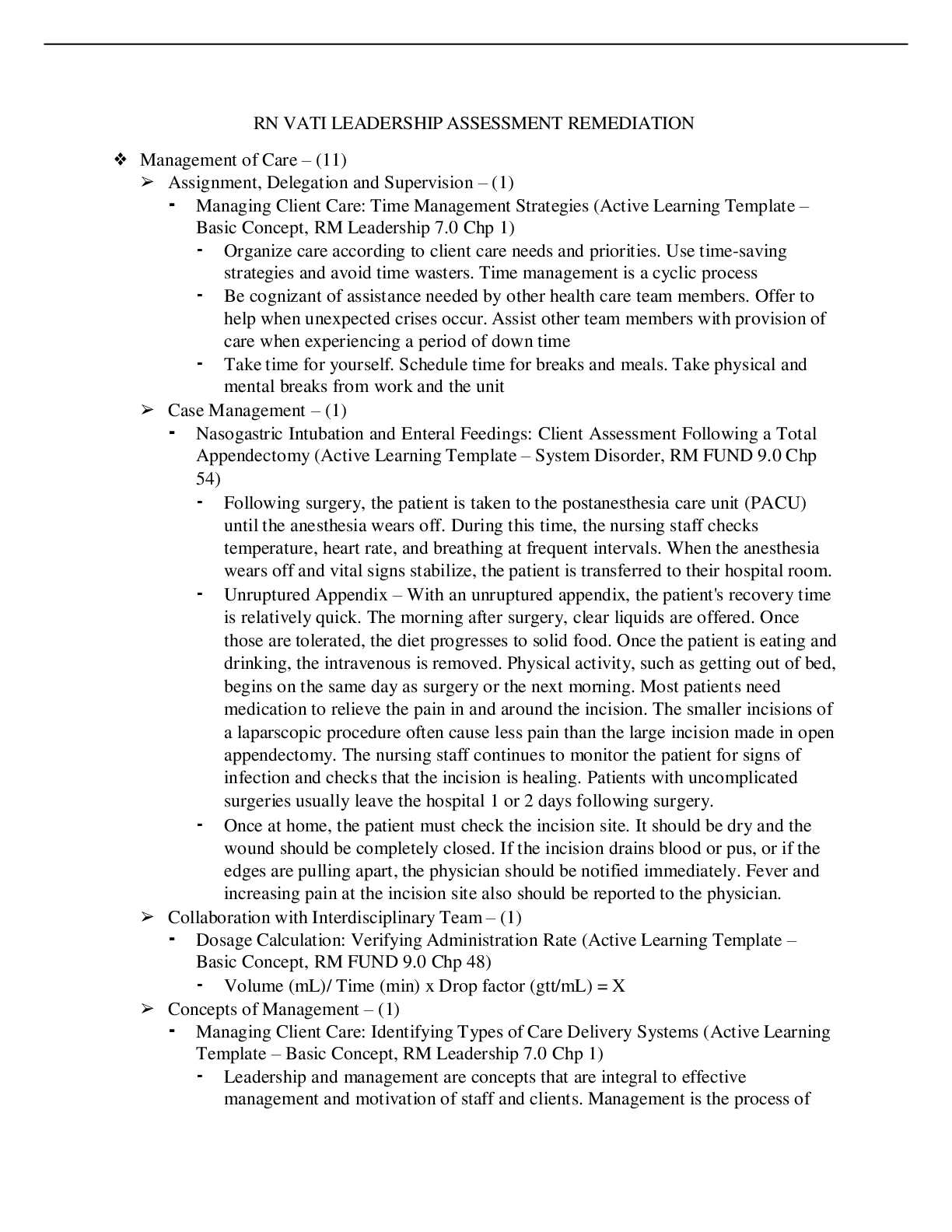
RN VATI LEADERSHIP ASSESSMENT REMEDIATION
❖ Management of Care – (11)
➢ Assignment, Delegation and Supervision – (1)
▪ Managing Client Care: Time Management Strategies (Active Learning Template –
Basic Concept, RM Leadership 7.0 Chp 1)
• Organize care according to client care needs and priorities. Use time-saving
strategies and avoid time wasters. Time management is a cyclic process
• Be cognizant of assistance needed by other health care team members. Offer to
help when unexpected crises occur. Assist other team members with provision of
care when experiencing a period of down time
• Take time for yourself. Schedule time for breaks and meals. Take physical and
mental breaks from work and the unit
➢ Case Management – (1)
▪ Nasogastric Intubation and Enteral Feedings: Client Assessment Following a Total
Appendectomy (Active Learning Template – System Disorder, RM FUND 9.0 Chp
54)
• Following surgery, the patient is taken to the postanesthesia care unit (PACU)
until the anesthesia wears off. During this time, the nursing staff checks
temperature, heart rate, and breathing at frequent intervals. When the anesthesia
wears off and vital signs stabilize, the patient is transferred to their hospital room.
• Unruptured Appendix – With an unruptured appendix, the patient's recovery time
is relatively quick. The morning after surgery, clear liquids are offered. Once
those are tolerated, the diet progresses to solid food. Once the patient is eating and
drinking, the intravenous is removed. Physical activity, such as getting out of bed,
begins on the same day as surgery or the next morning. Most patients need
medication to relieve the pain in and around the incision. The smaller incisions of
a laparscopic procedure often cause less pain than the large incision made in open
appendectomy. The nursing staff continues to monitor the patient for signs of
infection and checks that the incision is healing. Patients with uncomplicated
surgeries usually leave the hospital 1 or 2 days following surgery.
• Once at home, the patient must check the incision site. It should be dry and the
wound should be completely closed. If the incision drains blood or pus, or if the
edges are pulling apart, the physician should be notified immediately. Fever and
increasing pain at the incision site also should be reported to the physician.
➢ Collaboration with Interdisciplinary Team – (1)
▪ Dosage Calculation: Verifying Administration Rate (Active Learning Template –
Basic Concept, RM FUND 9.0 Chp 48)
• Volume (mL)/ Time (min) x Drop factor (gtt/mL) = X
➢ Concepts of Management – (1)
▪ Managing Client Care: Identifying Types of Care Delivery Systems (Active Learning
Template – Basic Concept, RM Leadership 7.0 Chp 1)
• Leadership and management are concepts that are integral to effective
management and motivation of staff and clients. Management is the process of
planning, organizing, directing, and coordinating the work within an organization.
Leadership is the ability to inspire others to achieve a desired outcome. Effective
managers usually possess good leadership skills. However, effective leaders are
not always in a management position. Managers have formal positions of power
and authority. Leaders might have only the informal power afforded them by their
peers. One cannot be a leader without followers. A number of theories describe
the characteristics of a leader. Behavioral theories describe leadership theories
contrast two types of leaders. The emotionally intelligent leader displays
sensitivity when interacting with others.
[Show More]