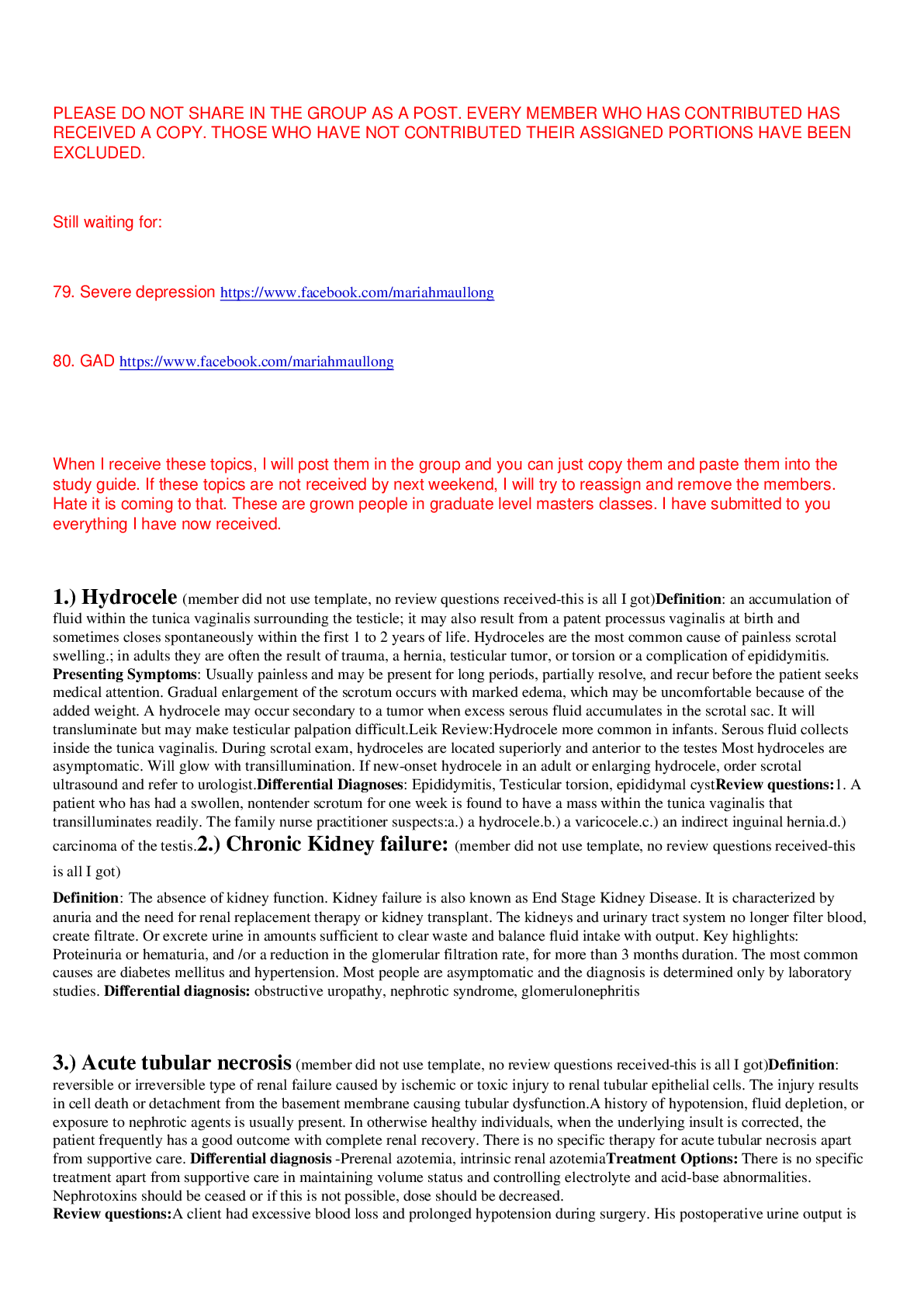
Hydrocele (member did not use template, no review questions received-this is all I got)
Definition: an accumulation of fluid within the tunica vaginalis surrounding the testicle; it may also
result from a patent proces
...
Hydrocele (member did not use template, no review questions received-this is all I got)
Definition: an accumulation of fluid within the tunica vaginalis surrounding the testicle; it may also
result from a patent processus vaginalis at birth and sometimes closes spontaneously within the first 1 to
2 years of life. Hydroceles are the most common cause of painless scrotal swelling.; in adults they are
often the result of trauma, a hernia, testicular tumor, or torsion or a complication of epididymitis.
Presenting Symptoms: Usually painless and may be present for long periods, partially resolve, and recur
before the patient seeks medical attention. Gradual enlargement of the scrotum occurs with marked
edema, which may be uncomfortable because of the added weight. A hydrocele may occur secondary to
a tumor when excess serous fluid accumulates in the scrotal sac. It will transluminate but may make
testicular palpation difficult.
Leik Review:
Hydrocele more common in infants. Serous fluid collects inside the tunica vaginalis. During scrotal exam,
hydroceles are located superiorly and anterior to the testes Most hydroceles are asymptomatic.
Will glow with transillumination. If new-onset hydrocele in an adult or enlarging hydrocele, order scrotal
ultrasound and refer to urologist.
Differential Diagnoses: Epididymitis, Testicular torsion, epididymal cyst
Review questions:
1. A patient who has had a swollen, nontender scrotum for one week is found to have a mass within the
tunica vaginalis that transilluminates readily. The family nurse practitioner suspects:
a.) a hydrocele.
b.) a varicocele.
c.) an indirect inguinal hernia.
d.) carcinoma of the testis.
2.) Chronic Kidney failure: (member did not use template, no review questions received-this is all
I got)
Definition: The absence of kidney function. Kidney failure is also known as End Stage Kidney Disease. It
is characterized by anuria and the need for renal replacement therapy or kidney transplant. The kidneys
and urinary tract system no longer filter blood, create filtrate. Or excrete urine in amounts sufficient to
clear waste and balance fluid intake with output. Key highlights: Proteinuria or hematuria, and /or a
reduction in the glomerular filtration rate, for more than 3 months duration. The most common causes
[Show More]















![Preview of HESI A2 CHEMISTRY [Q&A_Solved]](https://scholarfriends.com/storage/gch9gmkM2025-07-23-04-176880381f57615.png)