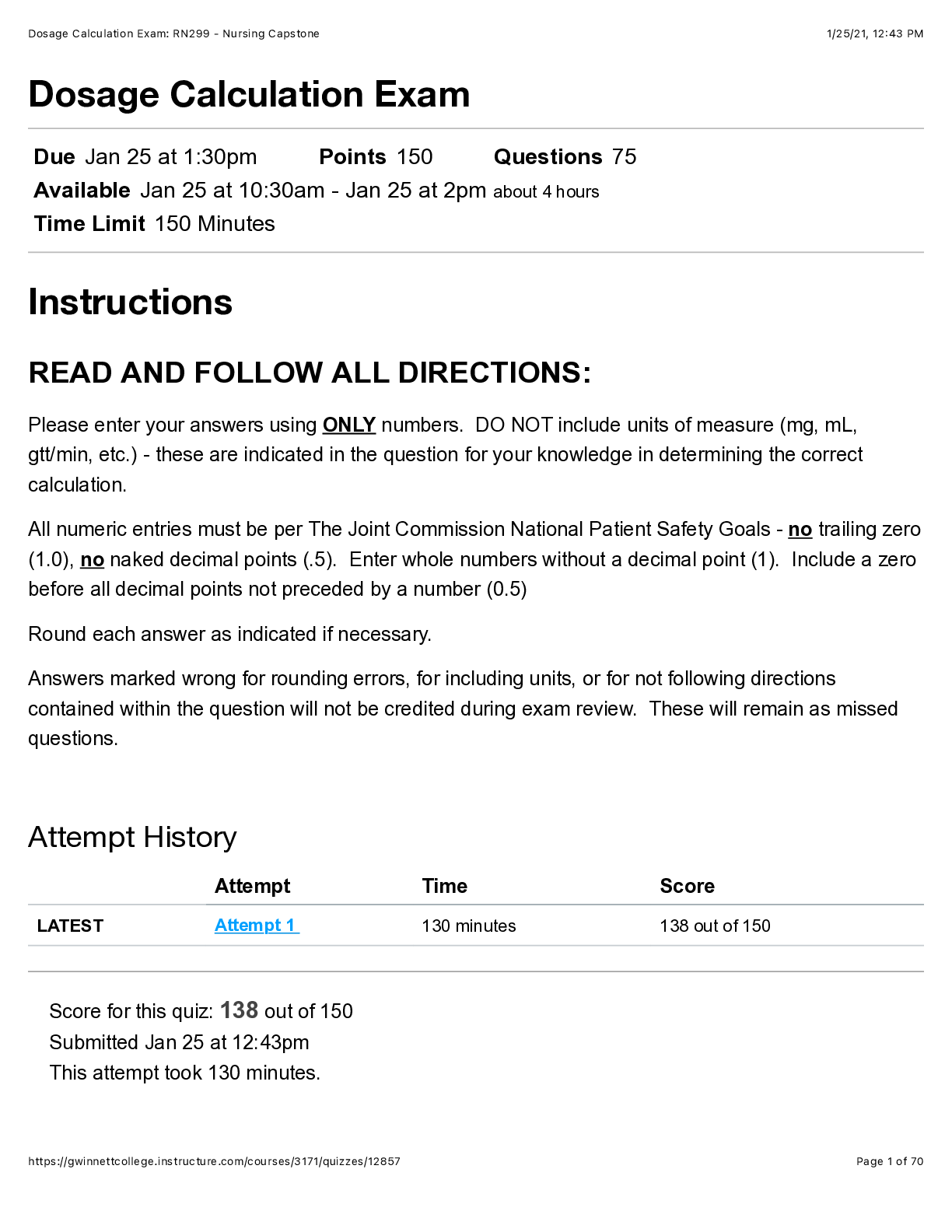
WPC 480 Exam 1:
Chapter 1: Strategic Management and Strategic Competitiveness
Core Concepts:
● A Strategy is an integrated and coordinated set of commitments and actions desigined to exploit
core competencies and gai
...
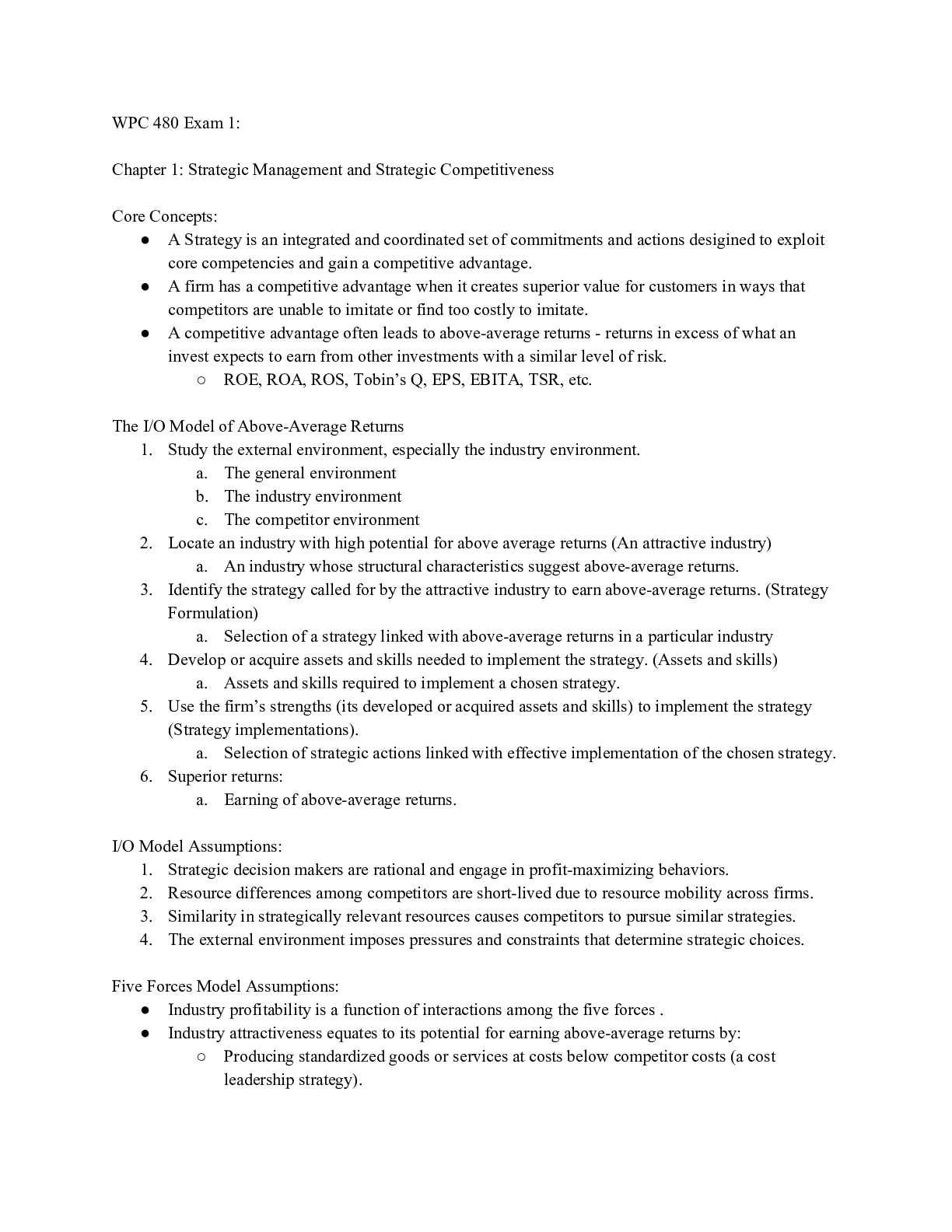
WPC 480 Exam 1:
Chapter 1: Strategic Management and Strategic Competitiveness
Core Concepts:
● A Strategy is an integrated and coordinated set of commitments and actions desigined to exploit
core competencies and gain a competitive advantage.
● A firm has a competitive advantage when it creates superior value for customers in ways that
competitors are unable to imitate or find too costly to imitate.
● A competitive advantage often leads to above-average returns - returns in excess of what an
invest expects to earn from other investments with a similar level of risk.
○ ROE, ROA, ROS, Tobin’s Q, EPS, EBITA, TSR, etc.
The I/O Model of Above-Average Returns
1. Study the external environment, especially the industry environment.
a. The general environment
b. The industry environment
c. The competitor environment
2. Locate an industry with high potential for above average returns (An attractive industry)
a. An industry whose structural characteristics suggest above-average returns.
3. Identify the strategy called for by the attractive industry to earn above-average returns. (Strategy
Formulation)
a. Selection of a strategy linked with above-average returns in a particular industry
4. Develop or acquire assets and skills needed to implement the strategy. (Assets and skills)
a. Assets and skills required to implement a chosen strategy.
5. Use the firm’s strengths (its developed or acquired assets and skills) to implement the strategy
(Strategy implementations).
a. Selection of strategic actions linked with effective implementation of the chosen strategy.
6. Superior returns:
a. Earning of above-average returns.
I/O Model Assumptions:
1. Strategic decision makers are rational and engage in profit-maximizing behaviors.
2. Resource differences among competitors are short-lived due to resource mobility across firms.
3. Similarity in strategically relevant resources causes competitors to pursue similar strategies.
4. The external environment imposes pressures and constraints that determine strategic choices.
Five Forces Model Assumptions:
● Industry profitability is a function of interactions among the five forces .
● Industry attractiveness equates to its potential for earning above-average returns by:
○ Producing standardized goods or services at costs below competitor costs (a cost
leadership strategy).
○ Producing differentiated goods or services for which customers are willing to pay a price
premium (a differentiation strategy).
The Resource-Based Model of Above-Average Returns
● Building competitive advantage through
○ Resources
■ Physical, human, and organizational capital (tangible and intangible)
○ Capability
■ An integrated set of resources
○ Core competence
■ A source of competitive advantage.
Resource-Based Model Assumptions:
1. Resources and certain capabilities are not highly mobile across firms.
2. Firms acquire different resources.
3. Firms develop unique capabilities based on how they combine and use resources.
4. Differences in resources and capabilities are the bases of competitive advantage and a firm’s
performance rather than its industry’s structural characteristics.
Resource-Based Model of Above-average Returns
1. Identify the firm’s resources. Study its strengths and weaknesses compared with those of
competitors (Resources).
a. Inputs into a firm’s production process.
2. Determine the firm’s capabilities. What do the capabilities allow the firm to do better than its
competitors? (Capability)
a. Capacity of an integrated set of resources to integratively perform a task or activity.
3. Determine the potential of the firm’s resources and capabilities in terms of a competitive
advantage. (Competitive advantage)
a. Ability of a firm to outperform its rivals.
4. Locate an attractive industry (an attractive industry)
a. An industry with opportunities that can be exploited by the firm’s resources and
capabilities.
5. Select a strategy that best allows the firm to utilize its resources and capabilities relative to
opportunities in the external environment. (Strategy Formulation and Implementation)
a. Strategic actions taken to earn above-average returns
6. Super returns: earning of above-average returns.
Strategic Decision Making:
● With Industry Organization (I/O) Model and Resource-Based Model, a company can achieve
Competitive Strategy Decision
Vision Statement:
● A successful vision:
○ Is an enduring word picture of what the firm wants to be and expects to achieve in the
future.
○ Stretches and challenges its people.
○ Reflects the firm’s values and aspirations.
○ Is most effective when its development includes all stakeholders.
○ Recognize the firm’s internal and external competitive environments.
○ Is supported by upper management decisions and actions.
Mission Statement:
● An effective Mission
○ Specifies the present business or businesses in which the firm intends to compete and
customers it intends to serve.
○ Has a more concrete, near-term focus on current product markets and customers than the
firm’s vision.
○ Should be inspiring and relevant to all stakeholders.
Classification of Stakeholders:
● Categories of stakeholders:
○ Capital market stakeholders:
■ Shareholders
■ Major suppliers of capital
○ Product market stakeholders:
■ Primary customers
■ Suppliers
■ Host communities
■ Unions
○ Organizational stakeholders:
■ Employees
■ Managers
■ Nonmanagers
● Stakeholders: people who are affected by a firm’s performance and who have claim on its
performance.
Chapter 2: The External Environment, Opportunities, Threats, Industry Competition, and Competitor
Analysis
External Environmental Analysis:
● General Environment
○ Focused on the future
● Industry environment
○ Focused on factors and conditions influencing a firm’s profitability within an industry
● Competitor environment:
○ Focused on predicting the dynamics of competitors’ actions, responses and intentions
[Show More]

.png)
.png)


.png)


![Preview of ASVAB Official Practice Questions [Fall 2022/2023] with Complete Solutions](https://browseimages.nyc3.digitaloceanspaces.com/paper-images/2023/Aug/24/OLMf9ViE2023-08-24-05-2464e768273d5d5.png)