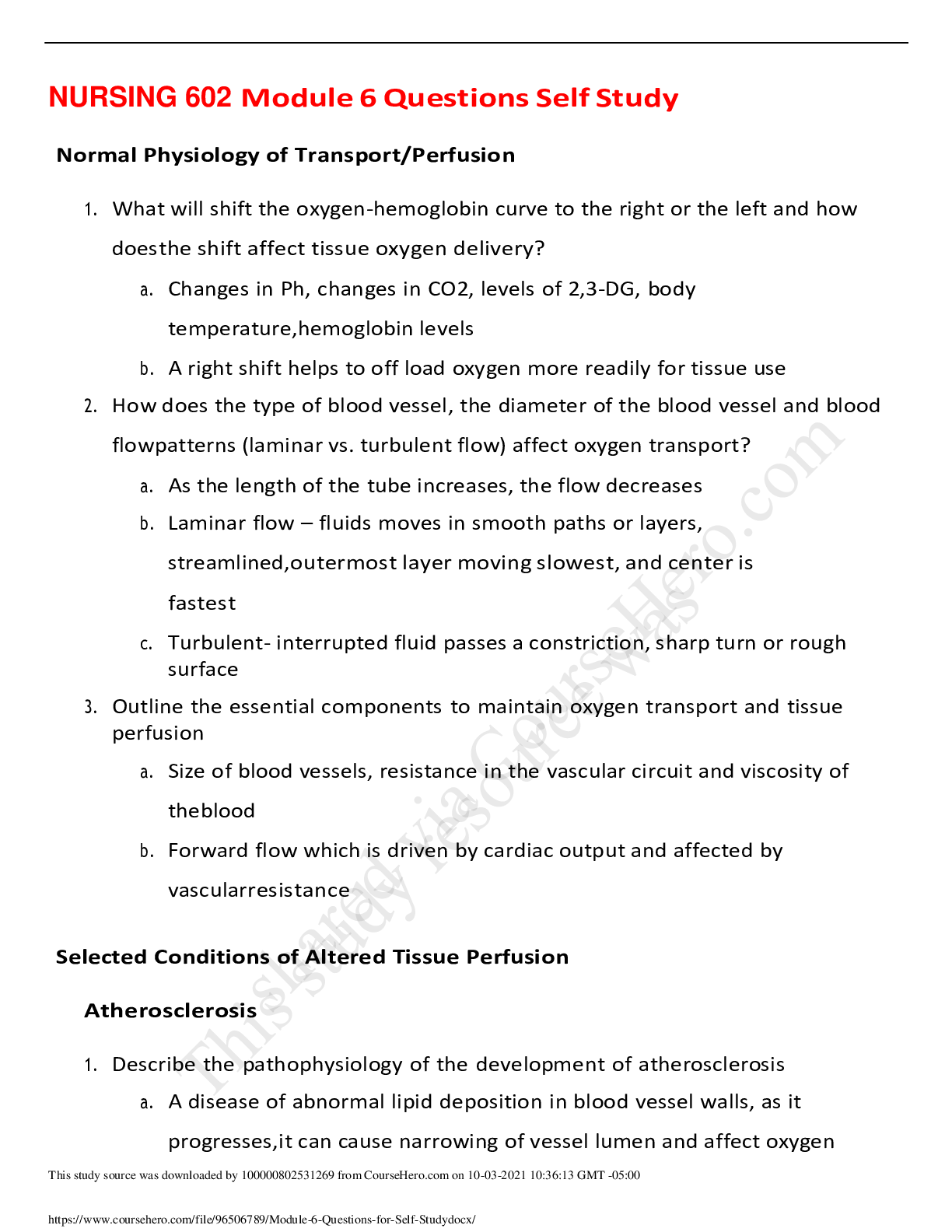
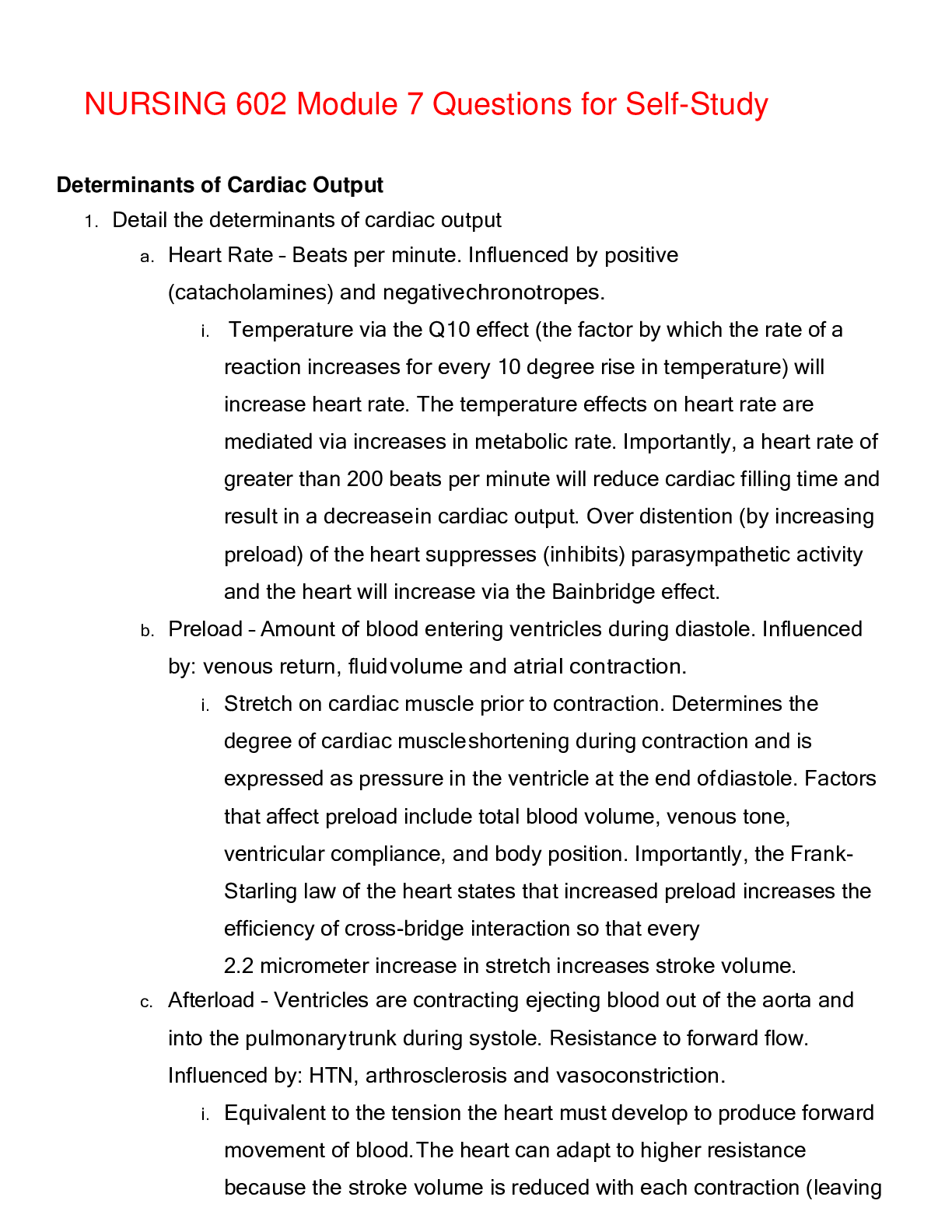
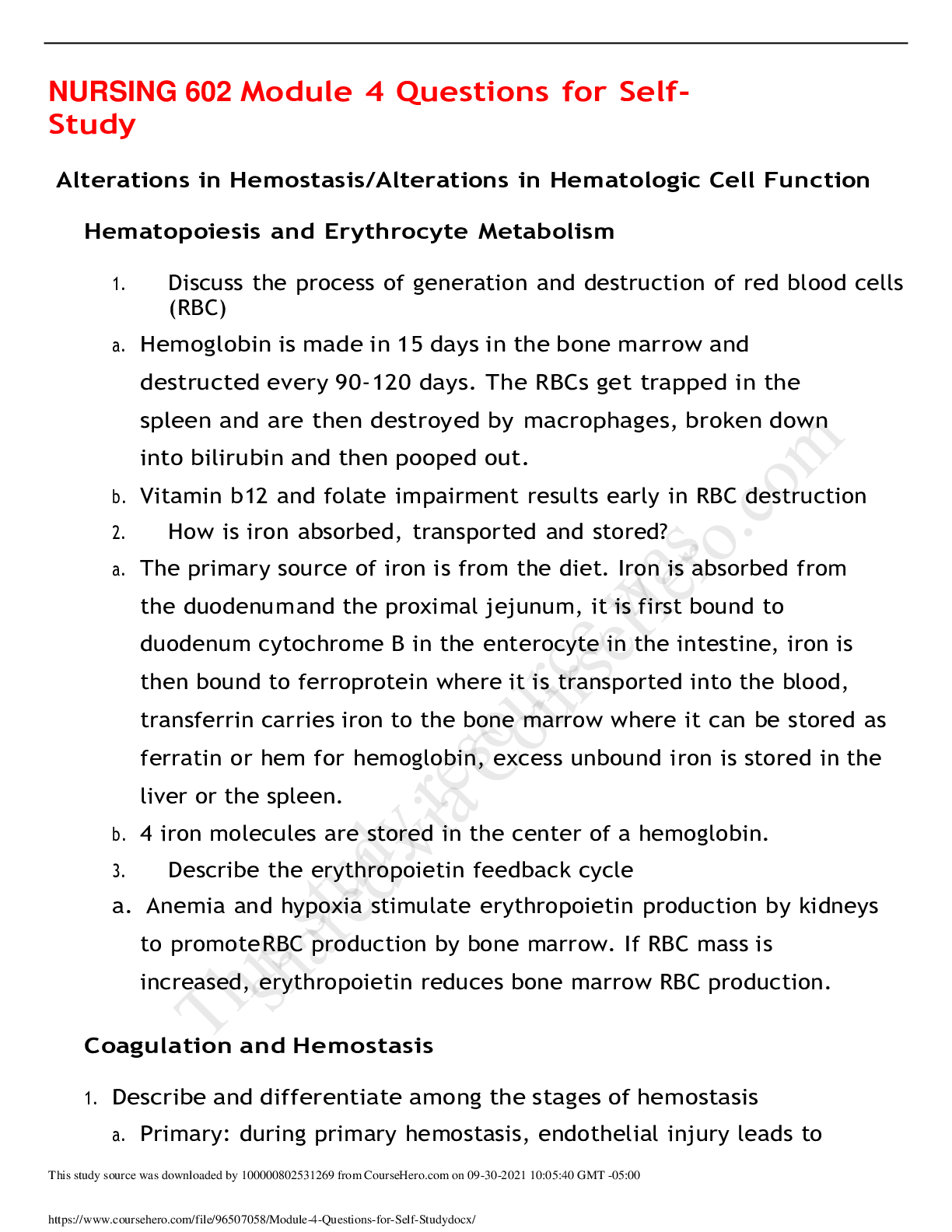
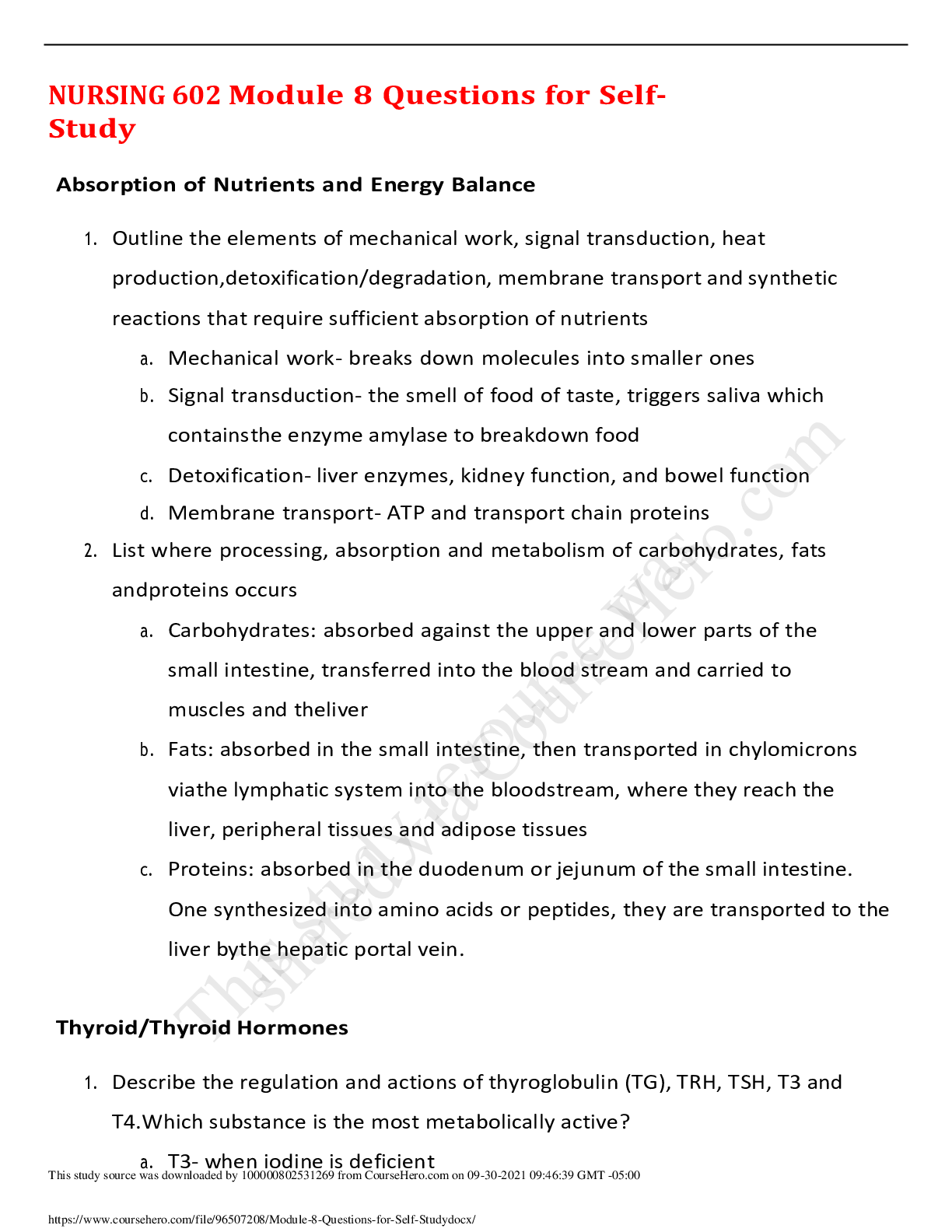
NURSING 602 Module 6 Questions Self Study Normal Physiology of Transport/Perfusion 1. What will shift the oxygen-hemoglobin curve to the right or the left and how does the shift affect tissue ox ... ygen delivery? a. Changes in Ph, changes in CO2, levels of 2,3-DG, body temperature, hemoglobin levels b. A right shift helps to off load oxygen more readily for tissue use 2. How does the type of blood vessel, the diameter of the blood vessel and blood flow patterns (laminar vs. turbulent flow) affect oxygen transport? a. As the length of the tube increases, the flow decreases b. Laminar flow – fluids moves in smooth paths or layers, streamlined, outermost layer moving slowest, and center is fastest c. Turbulent- interrupted fluid passes a constriction, sharp turn or rough surface 3. Outline the essential components to maintain oxygen transport and tissue perfusion a. Size of blood vessels, resistance in the vascular circuit and viscosity of the blood b. Forward flow which is driven by cardiac output and affected by vascular resistance Selected Conditions of Altered Tissue Perfusion Atherosclerosis 1. Describe the pathophysiology of the development of atherosclerosis a. A disease of abnormal lipid deposition in blood vessel walls, as it progresses, it can cause narrowing of vessel lumen and affect oxygen delivery to surrounding tissues (tissue perfusion) 2. Outline how macrophages play a key role in the formation of atherosclerotic plaques a. Macrophages eat lipid cells and eventually die, this process forms a cluster of dead cells and lipids which accumulate against the artery wall, forming a atherosclerotic plaque PAD 1. What is the cause of PAD and what is the effect on blood flow? a. Cause: narrowing of the vessel, increased velocity of flow and turbulence occurs across the stenotic vessel which causes a fall in flow pressure distal to the stenosis. Diabetes, smoking, older age and atherosclerosis b. Effect: produces an imbalance between oxygen supply and demand. 2. Outline the pathophysiology of PAD a. See above explanation 3. Describe how the vascular changes associated with PAD cause the clinical manifestations/features of PAD a. Hair loss due to lack of nutrients that would usually be in the blood, cyanosis due to poor oxygenation of blood cells, non-healing ulcers due to lack of clotting factors Buerger’s Disease 1. Describe the causes and the pathophysiology of Buerger’s disease a. Causes: smoking*, frostbite, trauma b. Patho: inflammation of small and medium peripheral arteries 2. Outline how the vascular changes associated with PAD cause the clinical manifestations/features of PAD a. Distal arterial occlusion, Raynauds, migrating superficial vein thrombosis, arm and foot claudication, ischemia of digits, areas of stenosis interspersed with normal appearing vessels 3. What is Reynaud’s phenomenon and how is it manifested? a. Lack of blood flow due to fibrin and scarring in the blood vessels and coagulation of blood which leads to ischemia Varicose Veins/DVT 1. Describe the causes and pathophysiology of varicose veins a. Causes: pregnancy, obesity, and prolonged standing b. Patho: incompetent closure of venous valves and are accompanied by venous congestion and dilation. Due to loss of the elastic matrix of the venous walls producing vessel dilation. Also a reduction of type III collagen 2. Outline how changes in peripheral varicose veins cause the clinical manifestations/features of varicose a. Superficial dilation of veins, dull ache or pressure after prolonged standing, venous insufficiency evidence by swellings and skin ulceration 3. Describe the contributions of 3 major factors Virchow’s triad in the formation of deep vein thrombosis a. Endothelial injury- triggering of the intrinsic coagulation cascade b. venous stasis- immobilization, cardiac failure, hyper-viscosity. Disrupts laminar flow and brings platelets into contact with the endothelium to trigger coagulation c. hypercoagulability- smoking, pregnancy, antiphospholipid antibodies, disorders of coagulation 4. Describe how the formation of DVT cause the clinical manifestations/features of DVT a. Edema- increased bone and tissue densities b. Erythema- blood clot c. Warmth- blood surfaces Selected Conditions that Disrupt the CV System Aneurysms 1. Describe the causes/pathophysiology of aneurysms in the heart, vasculature, and brain a. Heart- thinning of the myocardial muscle mass b. Vasculature- loss of vascular elasticity, high bp c. Brain- dilation of segments of the cerebral vessels and are often associated with congenital defects of the medial layer of an artery 2. Outline the classification of aneurysms a. Fusiform; i. Wall stress- chronic htn ii. Atherosclerosis – erosion of vessel wall iii. Infection iv. Collagen disorders v. Traumatic injury to chest b. False (pseudo) c. Dissection 3. What are the clinical features/manifestations of dissecting vascular aneurysms? a. Severe chest or upper back pain, LOC< SOB, sweating, weak pulse, loss of vision, speaking, weakness or paralysis 4. What are the clinical features of cerebral aneurysms and the clinical signs of a leaking cerebral aneurysm? a. Leaking: Bloody spinal tap, sudden headaches, photophobia, N/V, stiff neck b. Sudden increase in ICP, vasospasms, altered loc, pupillary dilation, Aortic Transection/Rupture 1. Where are the common locations of tears in a partial or total traumatic aortic transection? a. The proximal descending aorta (distal to branching of the left subclavian artery. b. The location where the aorta is secured near the liagmentum arteriosum c. Aortic valve d. Thoracic aorta above the diaphragm 2. Describe the clinical manifestations/features of a partially transected aorta Selected Conditions that Affect Pressure in the CV System Hypertension 1. Outline the causes of hypertension and the clinical clues associated with each a. Essential – age 20-50, family history, normal serum potassium b. Chronic renal disease- increased creatinine, abn urinalysis c. Renovascular- adb bruit, sudden onset, decrease serum pot d. Pheochromocytoma- palpitations, anxiety, e. Coarctation of the aorta- decreased serum pot f. Cushings syndrome- cushing 2. Describe the pathophysiology of primary (essential) hypertension a. Defects in blood pressure regulation, genetically influenced b. Renal sodium excretion, abn renal sodium transport across cell membranes, high ANS response to exogenous stress 3. Describe the consequences of chronic hypertension a. Weakened vessels, cerebral hemorrhage (stroke), retinopathy, decrease in perfusion, thrombosis, aortic aneurysm and dissection, renal failure Hypotension 1. Detail the common causes of hypotension a. Inadequate volume of blood to fill cardiovascular system (hypovolemic shock) b. Increased size of the vascular system produced by vasodilation in the presence of normal blood volume c. Inadequate cardiac output d. Inadequate cardiac output as a result of obstruction of blood flow in the lungs or heart 2. Outline the compensatory mechanisms associated with hypotension a. Rapid thready pulse b. Very low bp c. Pale, cold, clammy d. Rapid resp e. Decreased urine output 3. Outline the downstream effects of progressive, decompensated shock [Show More]
Last updated: 3 years ago
Preview 1 out of 9 pages
Buy this document to get the full access instantly
Instant Download Access after purchase
Buy NowInstant download
We Accept:
Can't find what you want? Try our AI powered Search
Connected school, study & course
About the document
Uploaded On
Oct 03, 2021
Number of pages
9
Written in
All
This document has been written for:
Uploaded
Oct 03, 2021
Downloads
0
Views
56
Scholarfriends.com Online Platform by Browsegrades Inc. 651N South Broad St, Middletown DE. United States.
We're available through e-mail, Twitter, and live chat.
FAQ
Questions? Leave a message!
Copyright © Scholarfriends · High quality services·