Midterm 6635 PMHNP Walden University January 2021
Document Content and Description Below
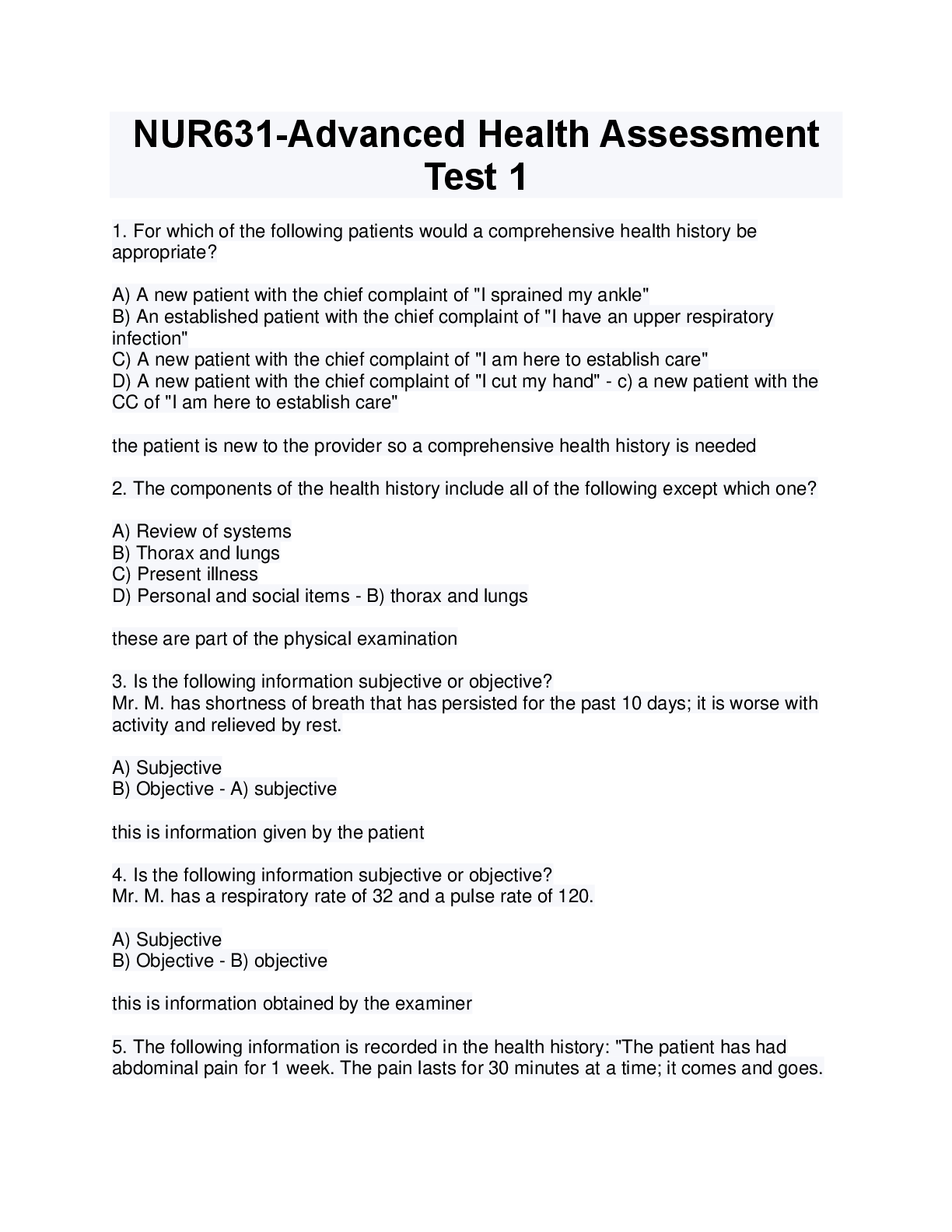
QUESTION 1
1. Select the neurotransmitter involved in obsessive-compulsive disorder (OCD) in
children and adolescents based on the common comorbidity of tic disorders.
A.
Norepinephr
ine
B.
GABA
C.
Dopamine
D.
...
[Show More]
Last updated: 3 years ago
Preview 1 out of 31 pages
Instant download

Buy this Document to get the Full Access Instantly
Provided by Students Who Aced it
We Verify Document Content to Gurantee Accuracy
Reviews( 0 )
Document information
Connected school, study & course
About the document
Uploaded On
Oct 04, 2021
Number of pages
31
Written in
All

Additional information
This document has been written for:
Uploaded
Oct 04, 2021
Downloads
0
Views
122
Topic Tags
Recommended For You
Get more on EXAM »
$9
32 Pages
Pearson Edexcel International GCSEWednesday 13 January 2021
$13
11 Pages
ORIGINAL ARTICLEISSN(Print) 2287-9110ISSN(Online) 2287-9129Chi...

$6
28 Pages
Pearson Edexcel International GCSE Mathematics A Paper 1HR Hig...

$7
24 Pages
Pearson Edexcel International GCSE Mathematics A Paper 2HR Hig...

$6
28 Pages
Pearson Edexcel International GCSE Mathematics A Paper 2H High...

$3
24 Pages