• Question 1
4 out of 4 points
An investor who
writes standard call
options against
stock held in his or
her portfolio is said
to be selling what
type of options?
Answer
Selected Answer:
Covered
Correct Answe
...
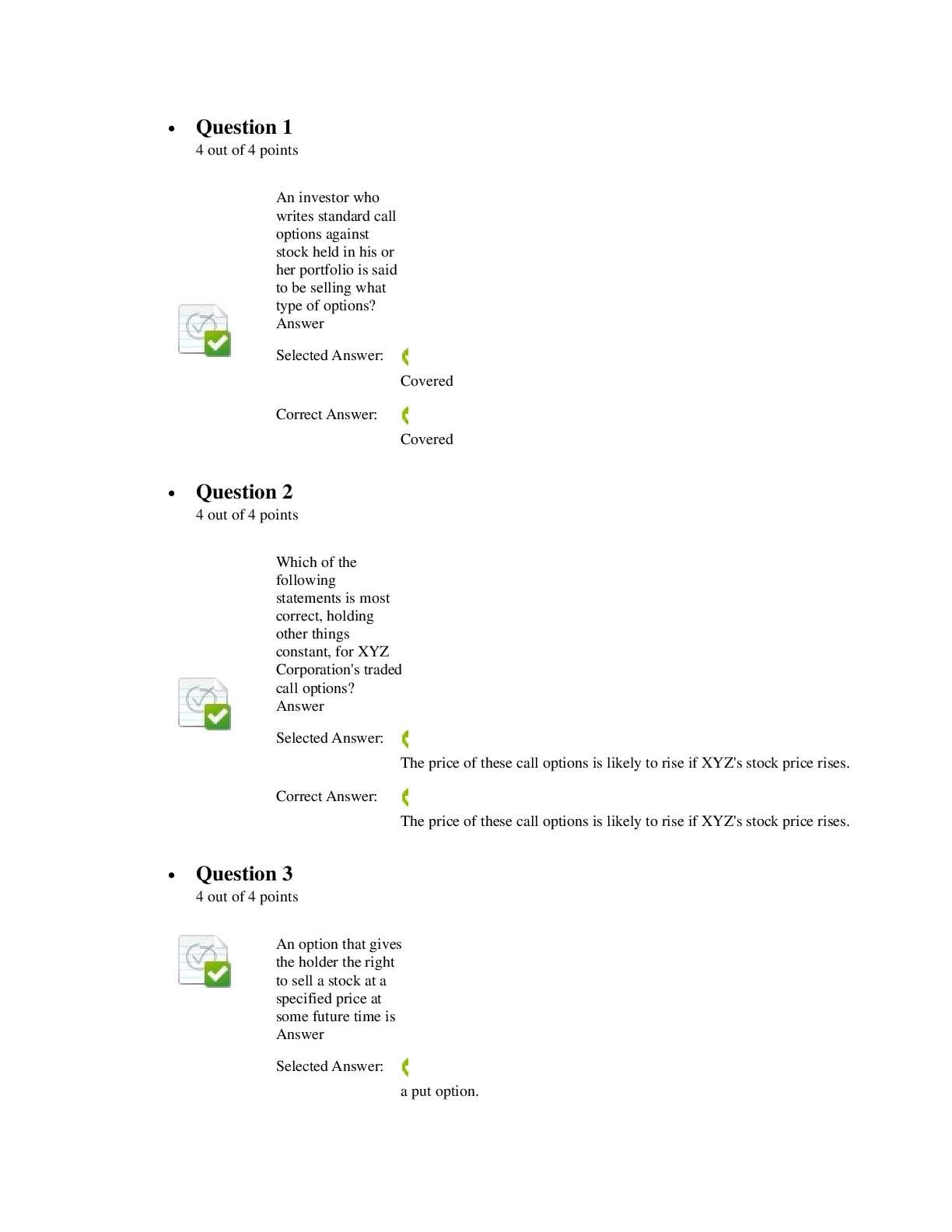
• Question 1
4 out of 4 points
An investor who
writes standard call
options against
stock held in his or
her portfolio is said
to be selling what
type of options?
Answer
Selected Answer:
Covered
Correct Answer:
Covered
• Question 2
4 out of 4 points
Which of the
following
statements is most
correct, holding
other things
constant, for XYZ
Corporation's traded
call options?
Answer
Selected Answer:
The price of these call options is likely to rise if XYZ's stock price rises.
Correct Answer:
The price of these call options is likely to rise if XYZ's stock price rises.
• Question 3
4 out of 4 points
An option that gives
the holder the right
to sell a stock at a
specified price at
some future time is
Answer
Selected Answer:
a put option.
Correct Answer:
a put option.
• Question 4
4 out of 4 points
Cazden Motors'
stock is trading at
$30 a share. Call
options on the
company's stock are
also available, some
with a strike price of
$25 and some with a
strike price of $35.
Both options expire
in three months.
Which of the
following best
describes the value
of these options?
Answer
Selected
Answer: If Cazden's stock price rose by $5, the exercise value of the options with the
$25 strike price would also increase by $5.
Correct
Answer: If Cazden's stock price rose by $5, the exercise value of the options with the
$25 strike price would also increase by $5.
• Question 5
4 out of 4 points
The current price of
a stock is $50, the
annual risk-free rate
is 6%, and a 1-year
call option with a
strike price of $55
sells for $7.20.
What is the value of
a put option,
assuming the same
strike price and
expiration date as
for the call option?
Answer
Selected Answer:
$9.00
Correct Answer:
$9.00
• Question 6
4 out of 4 points
Braddock
Construction Co.'s
stock is trading at
$20 a share. Call
options that expire
in three months with
a strike price of $20
sell for $1.50.
Which of the
following will occur
if the stock price
increases 10%, to
$22 a share?
Answer
Selected
Answer: The price of the call option will increase by less than $2, but the percentage
increase in price will be more than 10%.
Correct
Answer: The price of the call option will increase by less than $2, but the percentage
increase in price will be more than 10%.
• Question 7
4 out of 4 points
Other things held
constant, the value
of an option
depends on the
stock's price, the
risk-free rate, and
the
Answer
Selected Answer:
All of the above.
Correct Answer:
All of the above.
• Question 8
4 out of 4 points
Which of the
following
statements is
CORRECT?
Answer
Selected
Answer: If the underlying stock does not pay a dividend, it does not make good
economic sense to exercise a call option prior to its expiration date, even if
this would yield an immediate profit.
Correct
Answer: If the underlying stock does not pay a dividend, it does not make good
economic sense to exercise a call option prior to its expiration date, even if
this would yield an immediate profit.
• Question 9
4 out of 4 points
Which of the
following
statements is
CORRECT?
Answer
Selected
Answer: Call options generally sell at prices above their exercise value, but for an inthe-money option, the greater the exercise value in relation to the strike price,
the lower the premium on the option is likely to be.
Correct
Answer: Call options generally sell at prices above their exercise value, but for an inthe-money option, the greater the exercise value in relation to the strike price,
the lower the premium on the option is likely to be.
• Question 10
4 out of 4 points
Which of the
following
statements is
CORRECT?
Answer
Selected
Answer: The market value of an option depends in part on the option's time to
maturity and also on the variability of the underlying stock's price.
Correct
Answer: The market value of an option depends in part on the option's time to
maturity and also on the variability of the underlying stock's price.
• Question 11
4 out of 4 points
Suppose you believe
that Florio
Company's stock
price is going to
decline from its
current level of
$82.50 sometime
during the next 5
months. For $5.10
you could buy a 5-
month put option
giving you the right
to sell 1 share at a
price of $85 per
share. If you bought
this option for $5.10
and Florio's stock
price actually
dropped to $60,
what would your
pre-tax net profit
be?
Answer
Selected Answer:
$19.90
Correct Answer:
$19.90
• Question 12
4 out of 4 points
Which of the
following
statements is
CORRECT?
Answer
Selected
Answer: If the underlying stock does not pay a dividend, it does not make good
economic sense to exercise a call option prior to its expiration date, even if
this would yield an immediate profit.
Correct
Answer: If the underlying stock does not pay a dividend, it does not make good
economic sense to exercise a call option prior to its expiration date, even if
this would yield an immediate profit.
• Question 13
4 out of 4 points
Which of the
following
statements is
CORRECT?
Answer
Selected
Answer: An option holder is not entitled to receive dividends unless he or she
exercises their option before the stock goes ex dividend.
Correct
Answer: An option holder is not entitled to receive dividends unless he or she
exercises their option before the stock goes ex dividend.
• Question 14
4 out of 4 points
Suppose you believe
that Basso Inc.'s
stock price is going
to increase from its
current level of
$22.50 sometime
during the next 5
months. For $3.10
you can buy a 5-
month call option
giving you the right
to buy 1 share at a
price of $25 per
share. If you buy
this option for $3.10
and Basso's stock
price actually rises
to $45, what would
your pre-tax net
profit be?
Answer
Selected Answer:
$16.90
Correct Answer:
$16.90
• Question 15
4 out of 4 points
The current price of
a stock is $22, and
at the end of one
year its price will be
either $27 or $17.
The annual risk-free
rate is 6.0%, based
on daily
compounding. A 1-
year call option on
the stock, with an
exercise price of
$22, is available.
Based on the
binomial model,
what is the option's
value? (Hint: Use
daily
compounding.)
Answer
Selected Answer:
$2.99
Correct Answer:
$2.99
• Question 16
4 out of 4 points
Which of the
following
statements is
CORRECT?
Answer
Selected
Answer: If a company's tax rate increases but the YTM on its noncallable bonds
remains the same, the after-tax cost of its debt will fall.
Correct
Answer: If a company's tax rate increases but the YTM on its noncallable bonds
remains the same, the after-tax cost of its debt will fall.
• Question 17
4 out of 4 points
With its current
financial policies,
Flagstaff Inc. will
have to issue new
common stock to
fund its capital
budget. Since new
stock has a higher
cost than reinvested
earnings, Flagstaff
would like to avoid
issuing new stock.
Which of the
following actions
would REDUCE its
need to issue new
common stock?
Answer
Selected Answer:
Increase the percentage of debt in the target capital structure.
Correct Answer:
Increase the percentage of debt in the target capital structure.
• Question 18
4 out of 4 points
Which of the
following
statements is
CORRECT?
Answer
Selected
Answer: There is an "opportunity cost" associated with using reinvested earnings,
hence they are not "free."
Correct
Answer: There is an "opportunity cost" associated with using reinvested earnings,
hence they are not "free."
• Question 19
4 out of 4 points
You have been hired
as a consultant by
Feludi Inc.'s CFO,
who wants you to
help her estimate the
cost of capital. You
have been provided
with the following
data: rRF = 4.10%;
RPM = 5.25%; and
b = 1.30. Based on
the CAPM
approach, what is
the cost of common
from reinvested
earnings?
Answer
Selected Answer:
10.93%
Correct Answer:
10.93%
• Question 20
4 out of 4 points
To help them
estimate the
company's cost of
capital, Smithco has
hired you as a
consultant. You
have been provided
with the following
data: D1 = $1.45; P0
= $22.50; and g =
6.50% (constant).
Based on the DCF
approach, what is
the cost of common
from reinvested
earnings?
Answer
Selected Answer:
12.94%
Correct Answer:
12.94%
• Question 21
4 out of 4 points
Which of the
following
statements is
CORRECT?
Assume a
company's target
capital structure is
50% debt and 50%
common equity.
Answer
Selected Answer:
The cost of equity is always equal to or greater than the cost of
debt.
Correct Answer:
The cost of equity is always equal to or greater than the cost of
debt.
• Question 22
4 out of 4 points
Which of the
following
statements is
CORRECT?
Answer
Selected
Answer: If a company assigns the same cost of capital to all of its projects regardless of
each project's risk, then the company is likely to reject some safe projects that
it actually should accept and to accept some risky projects that it should reject.
Correct
Answer: If a company assigns the same cost of capital to all of its projects regardless of
each project's risk, then the company is likely to reject some safe projects that
it actually should accept and to accept some risky projects that it should reject.
• Question 23
4 out of 4 points
Which of the
following is NOT a
capital component
when calculating the
weighted average
cost of capital
(WACC) for use in
capital budgeting?
Answer
Selected Answer:
Accounts payable.
Correct Answer:
Accounts payable.
• Question 24
4 out of 4 points
Which of the
following
statements is
CORRECT?
Answer
Selected
Answer: When calculating the cost of debt, a company needs to adjust for taxes,
because interest payments are deductible by the paying corporation.
Correct
Answer: When calculating the cost of debt, a company needs to adjust for taxes,
because interest payments are deductible by the paying corporation.
• Question 25
4 out of 4 points
A company's
perpetual preferred
stock currently sells
for $92.50 per share,
and it pays an $8.00
annual dividend. If
the company were
to sell a new
preferred issue, it
would incur a
flotation cost of
5.00% of the issue
price. What is the
firm's cost of
preferred stock?
Answer
Selected Answer:
9.10%
Correct Answer:
9.10%
• Question 26
4 out of 4 points
Burnham Brothers
Inc. has no retained
earnings since it has
always paid out all
of its earnings as
dividends. This
same situation is
expected to persist
in the future. The
company uses the
CAPM to calculate
its cost of equity,
and its target capital
structure consists of
common stock,
preferred stock, and
debt. Which of the
following events
would REDUCE its
WACC?
Answer
Selected Answer:
The market risk premium declines.
Correct Answer:
The market risk premium declines.
• Question 27
4 out of 4 points
Suppose Acme
Industries correctly
estimates its WACC
at a given point in
time and then uses
that same cost of
capital to evaluate
all projects for the
next 10 years, then
the firm will most
likely
Answer
Selected
Answer: become more risky and also have an increasing WACC. Its intrinsic value
will not be maximized.
Correct
Answer: become more risky and also have an increasing WACC. Its intrinsic value
will not be maximized.
• Question 28
4 out of 4 points
Which of the
following
statements is
CORRECT?
Answer
Selected
Answer: A firm's cost of reinvesting earnings is the rate of return stockholders
require on a firm's common stock.
Correct
Answer: A firm's cost of reinvesting earnings is the rate of return stockholders
require on a firm's common stock.
• Question 29
4 out of 4 points
Which of the
following
statements is
CORRECT?
Answer
Selected
Answer: If a company's tax rate increases, then, all else equal, its weighted average
cost of capital will decline.
Correct
Answer: If a company's tax rate increases, then, all else equal, its weighted average
cost of capital will decline.
• Question 30
4 out of 4 points
Adams Inc. has the
following data: rRF
= 5.00%; RPM =
6.00%; and b =
1.05. What is the
firm's cost of
common from
reinvested earnings
based on the
CAPM?
Answer
Selected Answer:
11.30%
Correct Answer:
11.30%
[Show More]