Chapter 1:
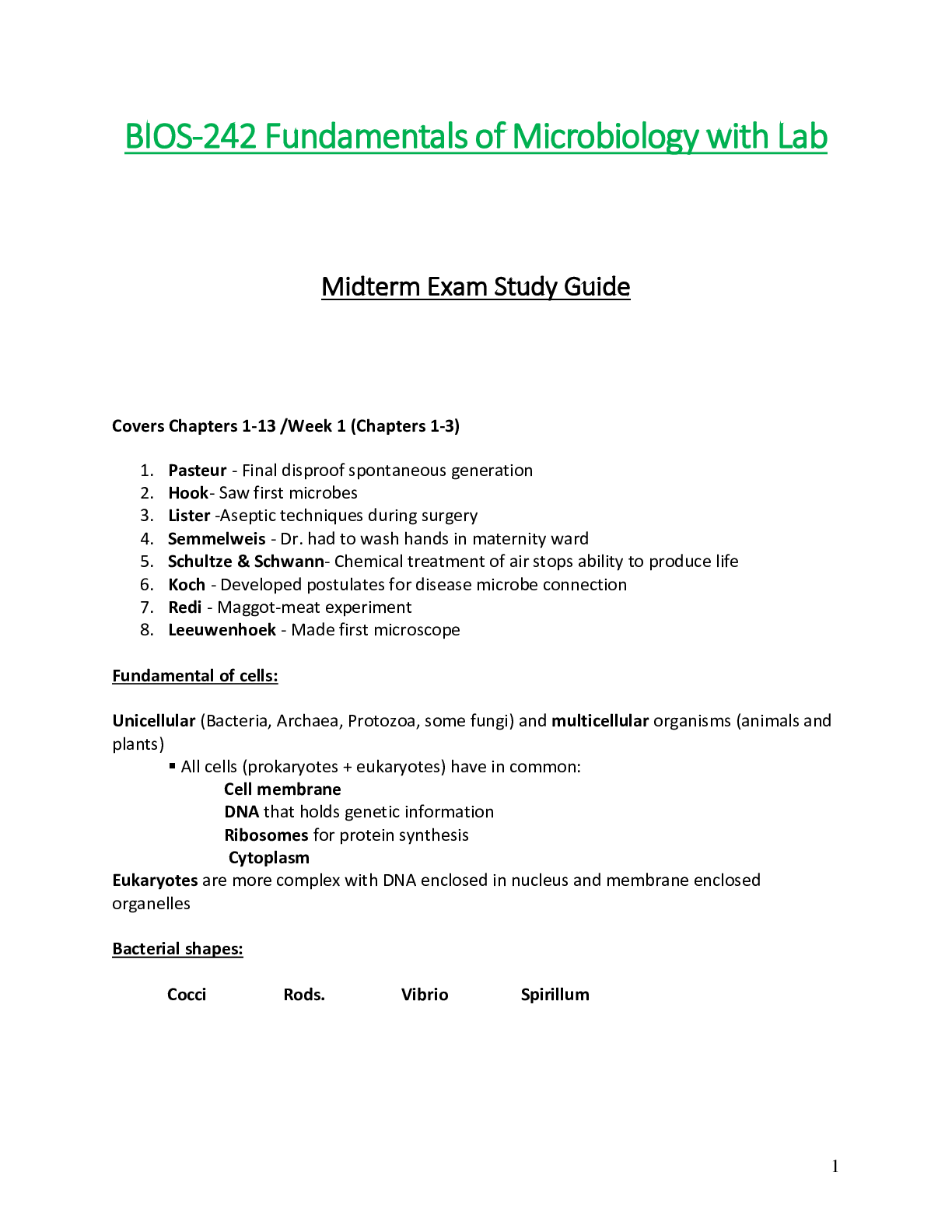
1. Compare the scientists’ beliefs and experiments for spontaneous generation.
Aristotle:
- proposed spontaneous generation: living things can arise from nonliving matter.
Redi:
- When decaying meat was k
...
Chapter 1:
1. Compare the scientists’ beliefs and experiments for spontaneous generation.
Aristotle:
- proposed spontaneous generation: living things can arise from nonliving matter.
Redi:
- When decaying meat was kept isolate from flies, maggots never developed. Meat
exposed to flies was soon infested. Scientist’s began to doubt Aristotle’s theory.
Needham:
- Scientists didn’t believe that animals could arise spontaneously, but that
microbes could. Neeham’s experiments with beef gravy and infusions of plant
material reinforced this idea.
Spallanzi:
- Results contracted Needham’s findings. Concluded that: Needham failed to heat
vials sufficiently to kill all microbes or had not sealed vials tightly enough.
Microorganisms exist in air and can contaminate experiments. Spontaneous
generation of microorganisms does not occur. The debate continued until the
experiments conducted by Louis Pasteur.
Pasteur:
- Performed investigations of spontaneous generation. When the “swan-necked”
flasks remained upright, no microbial growth appeared. When the flask was tilted,
dust from the bend in the neck seeped back into the flask and made the infusion
cloudy with microbes within a day.
2. What were the scientists/physicians Leeuwenhoek, Snow, and Lister known for?
Leeuwenhoek:
- bacteria, protozoa, mycology (fungi), parasitology (protozoa and animals),
phycology (algae).
Snow: epidemiology
Lister: antiseptic medical techniques
3. What are the major groups of microorganisms, and are they prokaryotic, eukaryotic,
or acellular?
Bacteria and Archaea: prokaryotic (lack nuclei)
Fungi: eukaryotic (have membrane-bound nucleus)
Protozoa: single-celled eukaryotes
Algae: unicellular or multicellular
4. Describe the steps in the scientific method.
Scientific method:
- Observation leads to question
- Question generates hypothesis
- Hypothesis is tested through experiments
- Results prove or disprove hypothesis
5. Which scientist had steps to identify the etiological agent, and what are those steps?
Robert Koch: studied disease causation (etiology)
Koch’s postulates:
- Suspected causative agent must be found in every case of the disease and be
absent from healthy hosts.
- Agent must be isolated and grown outside the host.
- When agent is introduced into a healthy, susceptible host, the host must get the
disease.
- Same agent must be found in the diseased experimental host.
Chapter 11
1. What are the main shapes of prokaryotes and arrangements? Describe a
coccobacillus.
Main shapes:
- Bacillus: rod shaped
- Coccus: spherical/round
- Coccobacillus: intermediate between cocci and bacilli. Very short rods that can
be mistaken for cocci
- Vibrio: curved rod shape
- Spirillum: curved/spiral
- Spirochete: corkscrew
- Pleomorphic: alter shape to environment
- Star
Arrangements: results from two aspects of division during binary fission.
- Planes in which cells divide.
- Separation of daughter cells.
2. What are the differences between bacteria and archaea? Where may archaea live?
Bacteria: cells walls contain peptidoglycan; some lack cell walls.
Archaea: cell walls are composed of polymers other than peptidoglycan.
- Found everywhere there is sufficient moisture; some have been isolated from
extreme environments.
3. Why do bacteria form endospores, and which ones are medically relevant?
- Produced by Gram-positive bacteria Bacillus and Clostridium
- Primary function is to ensure the survival of the bacteria through periods of
environmental stress.
- Can create toxins that cause tetanus, anthrax, and gangrene.
- E. Coli cannot produce toxins.
4. What are some medically relevant bacteria and the disease they cause?
Clostridia: produce toxins that cause diseases in humans.
Bacillus thuringiensis: toxin is used by farmers and gardeners as an insecticide.
Bacillus anthracis: causes anthrax.
Listeria: contaminates milk and meat products.
Streptococcus and Enterococcus: cause numerous diseases, produces toxins and
enzymes that contribute to disease.
Chlamydia: STD – most common in the US
[Show More]