GI – Patient THAO
postoperative patient experiencing hypotension due to fluid volume deficit.
Overview
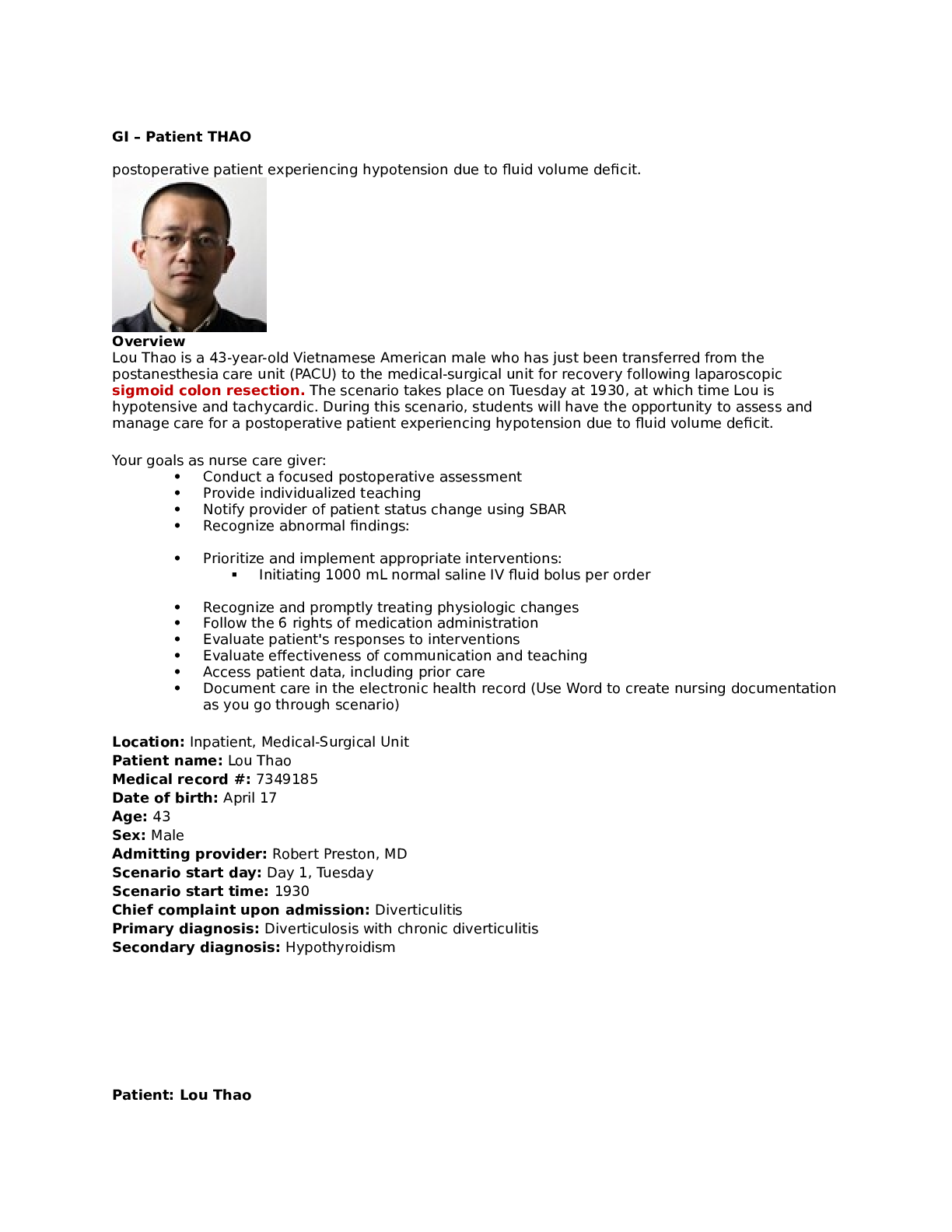
Lou Thao is a 43-year-old Vietnamese American male who has just been transferred from the
postanesthesia care uni
...
GI – Patient THAO
postoperative patient experiencing hypotension due to fluid volume deficit.
Overview
Lou Thao is a 43-year-old Vietnamese American male who has just been transferred from the
postanesthesia care unit (PACU) to the medical-surgical unit for recovery following laparoscopic
sigmoid colon resection. The scenario takes place on Tuesday at 1930, at which time Lou is
hypotensive and tachycardic. During this scenario, students will have the opportunity to assess and
manage care for a postoperative patient experiencing hypotension due to fluid volume deficit.
Pre sim Quiz Questions
1. 1.ID: 332018166
Which factors are thought to be possible causes of colorectal cancer? Select all that apply.
A. Familial adenomatous polyposis
B. High fat intake
C. Low vegetable intake
D. High fiber intake
2. 2.ID: 332018174
Following abdominal surgery, a patient will likely have a nasogastric (NG) tube placed in order to
_____. Select all that apply.
A. provide fluids
B. drain secretions from stomach
C. remove gas from stomach
D. draw lab samples
3. 3.ID: 332018168
A nurse is reviewing a patient's intake and output measurements over the past 24 hours. Which results
would the nurse expect to find in a generally healthy adult?
A. Intake 2570 mL, output 2525 mL
B. Intake 5800 mL, output 3500 mL
C. Intake 1200 mL, output 950 mL
D. Intake 3000 mL, output 2000 mL
4. 4.ID: 332018172
Medical treatment of colorectal cancer can include ____. Select all that apply.
A. surgery
B. chemotherapy
C. sigmoidoscopy
D. colonoscopy
E. radiation
5. 5.ID: 332018162
Which assessment findings suggest that a patient is experiencing fluid volume deficit due to
dehydration? Select all that apply.
A. Blood pressure 101/60
B. Specific gravity 1.000; decreased hemoglobin, hematocrit, and red blood cell count
C. Blood pressure 160/80
D. Specific gravity 1.040; increased hemoglobin, hematocrit, and red blood cell count
6. 6.ID: 332018164
You are caring for a postoperative patient following abdominal surgery. The patient has an IV line,
PCA pump, antiembolism stockings/sequential compression devices (SCDs), and Jackson-Pratt drain
to the abdominal wound as well as an NG tube to low wall suction. The patient has incisional pain
with movement and prefers to remain immobile and take shallow breaths. Which nursing diagnosis
would be most pertinent for this patient?
A. Impaired peripheral circulation related to immobility
B. Ineffective breathing pattern related to immobility
C. Imbalanced fluid volume intake
D. Risk for infection related to surgical incision
7. 7.ID: 332018170
Which conditions can lead to hypovolemia? Select all that apply.
A. Diarrhea
B. Vomiting
C. Blood loss from surgery
D. Concentrated tube feedings
Post sim exercises
Which of Lou Thao's assessment findings indicate that she is experiencing a
postoperative fluid volume deficit?
1. Pulse is high, BP low, RR high, O2 kind of low, bowl sounds absent, 1+ bilaterally
pulses, pain 6, pt states being dizzy, and thirsty.
2. Pt started to feel better after fluids were administered
Post sim quiz Questions
1. 1.ID: 332015359
As the nurse spikes and hangs the bag of normal saline, Lou Thao's wife
asks the nurse whether Lou needs any medication in his IV line. Which is
the best response from the nurse?
A. "There is medicine in the bag to help his blood pressure."
B. "The fluids will help your husband to feel better after surgery."
C. "Your husband isn't drinking enough fluids and this will help him
to feel better."
D. "The IV fluid we are giving your husband will help replenish any
fluids he lost during surgery."
2. 2.ID: 332015349
The nurse is assessing Lou Thao as he arrives at the medical unit. The
nurse notes a decreasing blood pressure and an increasing pulse. During
the assessment, Mr. Thao complains of being thirsty and dizzy and asks
the nurse, "Why don't I feel right?" Which is the best response from the
nurse?
A. "Your blood pressure is low."
B. "I will go and call your doctor to see what we can do to make
you feel better."
C. "Your dizziness is a normal reaction after surgery."
D. "I am going to give you some pain medicine to help you sleep
off the dizziness."
3. 3.ID: 332015354
Lou Thao was transferred to the medical unit from the post-anesthesia
care unit (PACU). Which assessment findings should the nurse report to
the physician immediately? Select all that apply.
A. Jackson-Pratt drain with 10 mL of serosanguineous drainage
B. Dry abdominal dressing
C. Blood pressure 88/42
D. Urinary output 60 mL in 2 hours
E. Pulse 114
4. 4.ID: 332015357
Which lab results should the nurse expect to find for a patient with fluid
volume deficit? Select all that apply.
A. Increased hematocrit
B. Increased urine specific gravity
C. Decreased hematocrit
D. Decreased urine specific gravity
5. 5.ID: 332015361
Based on Lou Thao's assessment findings, which serious complication is
he at risk for developing?
A. Hypovolemic shock
B. Pulmonary embolism
C. Fluid volume excess
D. Cardiogenic shock
6. 6.ID: 332015363
Which nursing assessment is the least reliable when assessing an older
patient experiencing fluid volume deficit?
A. Intake and output
B. Blood pressure
C. Heart rate
D. Skin turgor
E. Daily weight
7. 7.ID: 332015351
Lou Thao complains of abdominal pain rated 4 out of 10. He has a
morphine PCA pump. His vital signs are temperature 97.4 F (36.3 C), blood
pressure 78/42, pulse 132, respiratory rate 22, and oxygen saturation 95%
(2 L/min via nasal cannula). Which is the appropriate action?
A. Administering the morphine PCA as ordered
B. Holding the morphine PCA
C. Administering the morphine PCA in 1 hour
D. Requesting an increase in Mr. Thao's morphine dosage
[Show More]