NURS 360 Practice questions – Niagara University
After noting a pulse deficit when assessing a patient who has just arrived in the emergency department, the nurse will anticipate that the patient may require
a.
a 2-
...
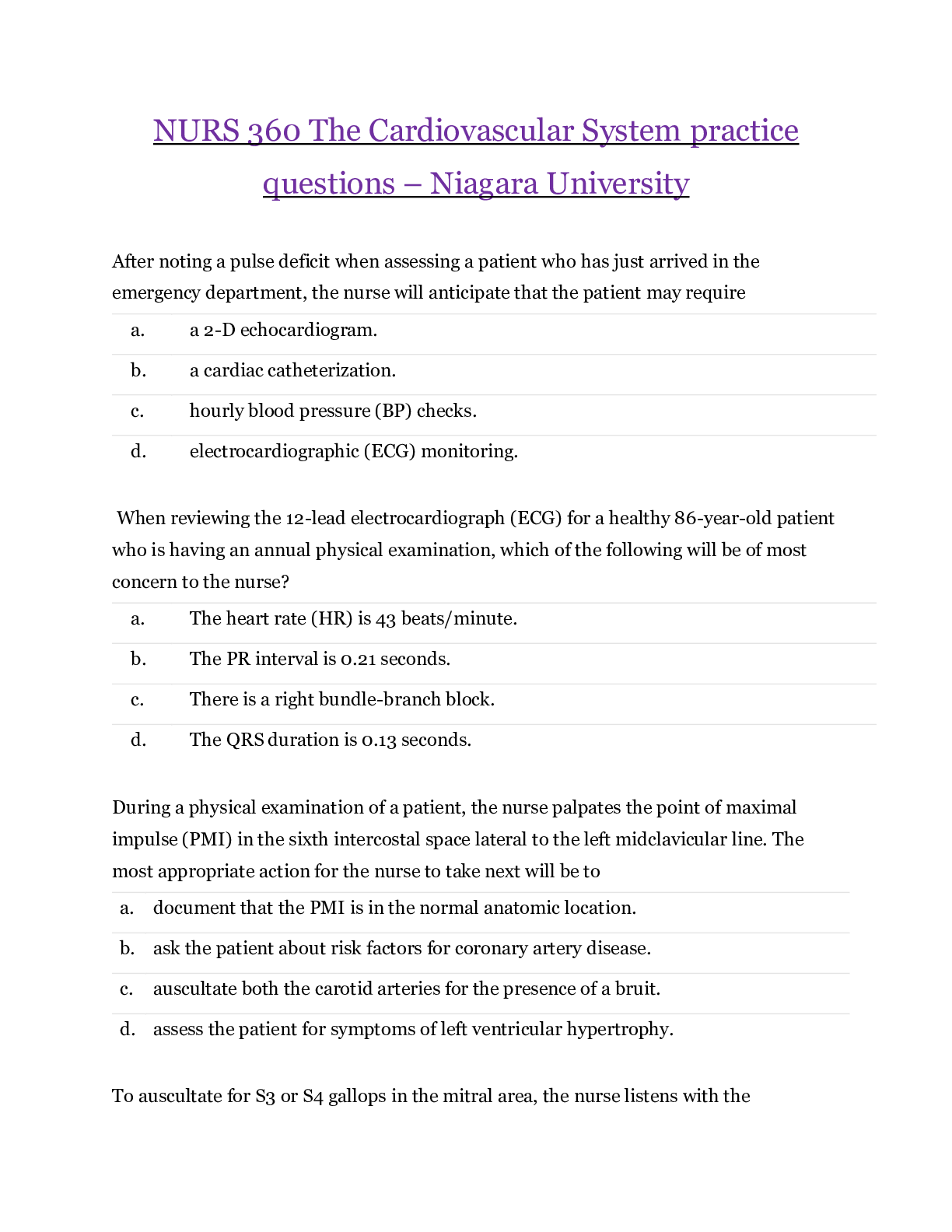
NURS 360 Practice questions – Niagara University
After noting a pulse deficit when assessing a patient who has just arrived in the emergency department, the nurse will anticipate that the patient may require
a.
a 2-D echocardiogram.
b.
a cardiac catheterization.
c.
hourly blood pressure (BP) checks.
d.
electrocardiographic (ECG) monitoring.
When reviewing the 12-lead electrocardiograph (ECG) for a healthy 86-year-old patient who is having an annual physical examination, which of the following will be of most concern to the nurse?
a.
The heart rate (HR) is 43 beats/minute.
b.
The PR interval is 0.21 seconds.
c.
There is a right bundle-branch block.
d.
The QRS duration is 0.13 seconds.
During a physical examination of a patient, the nurse palpates the point of maximal impulse (PMI) in the sixth intercostal space lateral to the left midclavicular line. The most appropriate action for the nurse to take next will be to
a.
document that the PMI is in the normal anatomic location.
b.
ask the patient about risk factors for coronary artery disease.
c.
auscultate both the carotid arteries for the presence of a bruit.
d.
assess the patient for symptoms of left ventricular hypertrophy.
To auscultate for S3 or S4 gallops in the mitral area, the nurse listens with the
a.
bell of the stethoscope with the patient in the left lateral position.
b.
bell of the stethoscope with the patient sitting and leaning forward.
c.
diaphragm of the stethoscope with the patient in a reclining position.
d.
diaphragm of the stethoscope with the patient lying flat on the left side.
To determine the effects of therapy for a patient who is being treated for heart failure, which laboratory result will the nurse plan to review?
a.
Myoglobin
b.
Homocysteine (Hcy)
c.
Low-density lipoprotein (LDL)
d.
B-type natriuretic peptide (BNP)
-
-
-
-
-
-
-
-
-
-
-
-
-
-
When admitting a patient for a coronary arteriogram and angiogram, which information about the patient is most important for the nurse to communicate to the health care provider?
a.
The patients pedal pulses are +1.
b.
The patient is allergic to shellfish.
c.
The patient has not eaten anything today.
d.
The patient had an arteriogram a year ago.
A transesophageal echocardiogram (TEE) is ordered for a patient with possible endocarditis. Which of these actions included in the standard TEE orders will the nurse need to accomplish first?
a.
Administer O2 per mask.
b.
Start a large-gauge IV line.
c.
Place the patient on NPO status.
d.
Give lorazepam (Ativan) 1 mg IV.
Hypertension
Which action will the nurse in the hypertension clinic take in order to obtain an accurate baseline blood pressure (BP) for a new patient?
a.
Obtain a BP reading in each arm and average the results.
b.
Deflate the BP cuff at a rate of 5 to 10 mm Hg per second.
c.
Have the patient sit in a chair with the feet flat on the floor.
d.
Assist the patient to the supine position for BP measurements.
The nurse obtains this information from a patient with prehypertension. Which finding is most important to address with the patient?
a.
Low dietary fiber intake
b.
No regular aerobic exercise
c.
Weight 5 pounds above ideal weight
d.
Drinks wine with dinner once a week
After giving a patient the initial dose of oral labetalol (Normodyne) for treatment of hypertension, which action should the nurse take?
a.
Encourage oral fluids to prevent dry mouth or dehydration.
b.
Instruct the patient to ask for help if heart palpitations occur.
c.
Ask the patient to request assistance when getting out of bed.
d.
Teach the patient that headaches may occur with this medication.
After the nurse teaches the patient with stage 1 hypertension about diet modifications that should be implemented, which diet choice indicates that the teaching has been effective?
a.
The patient avoids eating nuts or nut butters.
b.
The patient restricts intake of dietary protein.
c.
The patient has only one cup of coffee in the morning.
d.
The patient has a glass of low-fat milk with each meal.
-
-
-
-
-
-
-
-
-
-
-
-
-
-
-
-
-
-
-
-
-
-
-
-
-
-
-
-
-
A patient has ST segment changes that indicate an acute inferior wall myocardial infarction. Which lead will be best for monitoring the patient?
a.
I
b.
II
c.
V6
d.
MCL1
17. Which laboratory result for a patient whose cardiac monitor shows multifocal premature ventricular contractions (PVCs) is most important for the nurse to communicate to the health care provider?
a.
Blood glucose 228 mg/dL
b.
Serum chloride 90 mEq/L
c.
Serum sodium 133 mEq/L
d.
Serum potassium 2.8 mEq/L
18. A patients cardiac monitor has a pattern of undulations of varying contours and amplitude with no measurable ECG pattern. The patient is unconscious and pulseless. Which action should the nurse take first?
a.
Defibrillate at 360 joules.
b.
Give O2 per bag-valve-mask.
c.
Give epinephrine (Adrenalin) IV.
d.
Prepare for endotracheal intubation.
19. A patients cardiac monitor shows sinus rhythm, rate 60 to 70. The P-R interval is 0.18 seconds at 1:00 AM, 0.20 seconds at 2:30 PM, and 0.23 seconds at 4:00 PM. Which action should the nurse take at this time?
a.
Prepare for possible temporary pacemaker insertion.
b.
Administer atropine sulfate 1 mg IV per agency protocol.
c.
Document the patients rhythm and assess the patients response to the rhythm.
d.
Call the health care provider before giving the prescribed metoprolol (Lopressor).
20. A patient develops sinus bradycardia at a rate of 32 beats/minute, has a BP of 80/36 mm Hg, and is complaining of feeling faint. Which action should the nurse take?
a.
Continue to monitor the rhythm and BP.
b.
Apply the transcutaneous pacemaker (TCP).
c.
Have the patient perform the Valsalva maneuver.
d.
Give the scheduled dose of diltiazem (Cardizem).
21. A 21-year-old student arrives at the student health center at the end of the quarter complaining that, My heart is skipping beats. An electrocardiogram (ECG) shows occasional premature ventricular contractions (PVCs). What action should the nurse take first?
a.
Have the patient transported to the hospital emergency department (ED).
b.
Administer O2 at 2 to 3 L/min using nasal prongs.
c.
Ask the patient about any history of coronary artery disease.
d.
Question the patient about current stress level and coffee use.
22. The nurse has received change-of-shift report about the following patients on the telemetry unit. Which patient should the nurse see first?
a.
A patient with atrial fibrillation, rate 88, who has a new order for warfarin (Coumadin)
[Show More]















 – Chamberlain College of Nursing.png)
 – Chamberlain College of Nursing.png)