Question 1
2 out of 2 points
Which is true?
Selected
Answer:
Question 2
2 out of 2 points
Consensusis generally preferred when the group is grappling with sensitive
issues.
The cohesiveness of a team isindicated
...
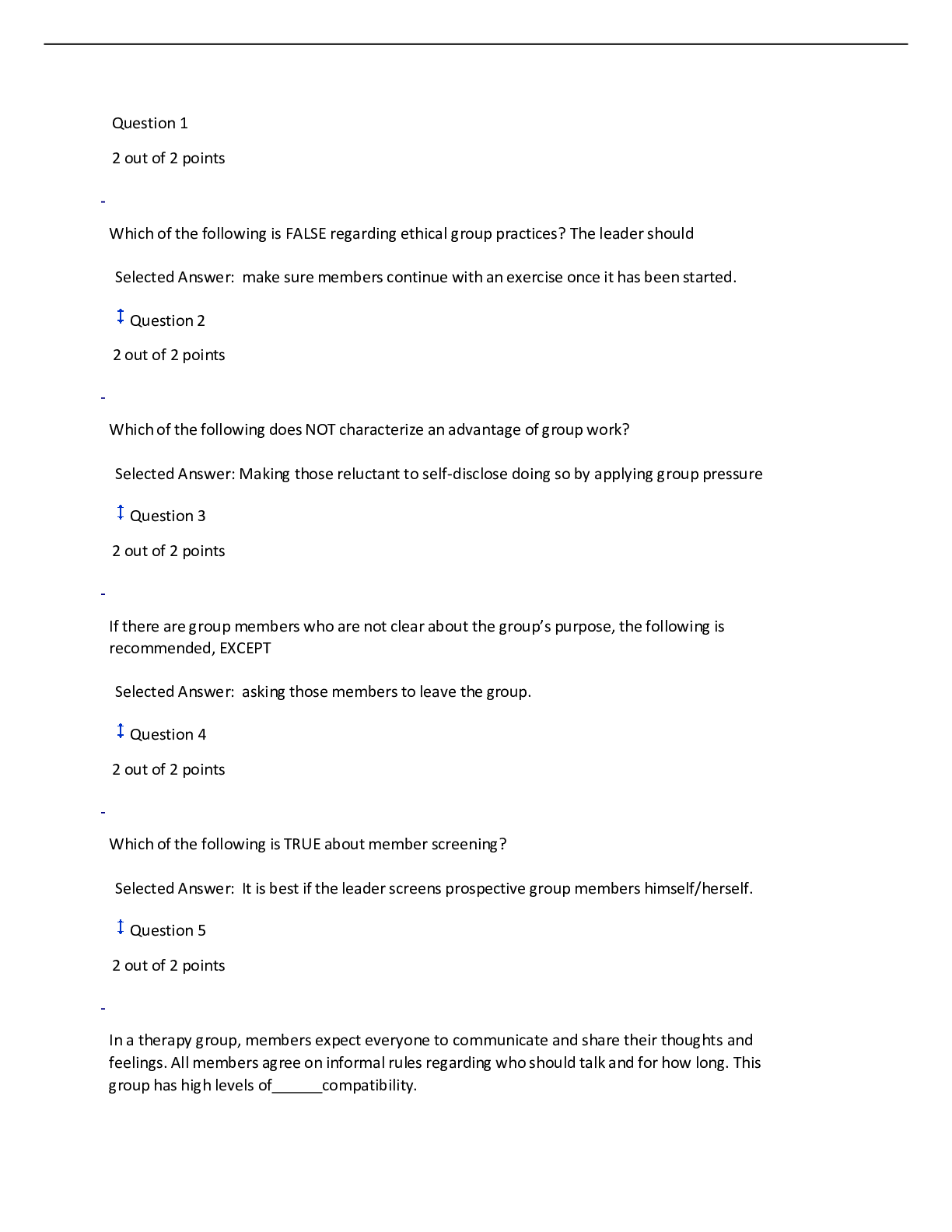
Question 1
2 out of 2 points
Which is true?
Selected
Answer:
Question 2
2 out of 2 points
Consensusis generally preferred when the group is grappling with sensitive
issues.
The cohesiveness of a team isindicated by the following, EXCEPT:
Selected Answer: Low external pressure
Question 3
2 out of 2 points
Jacobs et al. suggest using summarizing for all of the following reasons EXCEPT to
Selected Answer: encourage a review of the last session.
Question 4
2 out of 2 points
Teams with members who vary in ability and skill
Selected
Answer:
Question 5
2 out of 2 points
outperform homogeneous teams if the members of the homogenous team have
low skill levels.
Steiner found that group productivity depends mainly on
Selected Answer: the type of task to be performed.
Question 6
2 out of 2 points
Leadership is best defined as
Selected Answer: guidance of others in their pursuits.
Question 7
2 out of 2 points
If I think a good leader should be intelligent, responsible, competitive, and well-balanced, I probably
take a(n) approach to leadership.
Selected Answer: trait
Question 8
2 out of 2 points
When setting up a round, the leader needs to do each of the following EXCEPT
Selected Answer: get it started as quickly as possible.
Question 9
2 out of 2 points
A leader who says, “In a word or phrase, how are you feeling about being in this group" is initiating a
round.
Selected Answer: word or phrase
Question 10
2 out of 2 points
What is the meaning of the phrase, the “romance of teams?”
Selected
Answer:
Question 11
2 out of 2 points
Teams are thought to be effective and desirable, but their effectiveness may be
overestimated.
Studies suggest thatsocial loafing can be avoided if
Selected Answer: individuals’ contributions to the group product are identifiable.
Question 12
2 out of 2 points
A group member has been talking for some time. The leader asks members to pair up with a partner
and discuss their thoughts and feelings about what the member has shared. In this instance, the
leader
Selected Answer: shifts the focus from a person to an activity.
Question 13
2 out of 2 points
In which of the following situations would it NOT be appropriate for the leader to use the technique
of cutting off?
Selected Answer: When a member is sharing information that could benefit other members
[Show More]













.png)