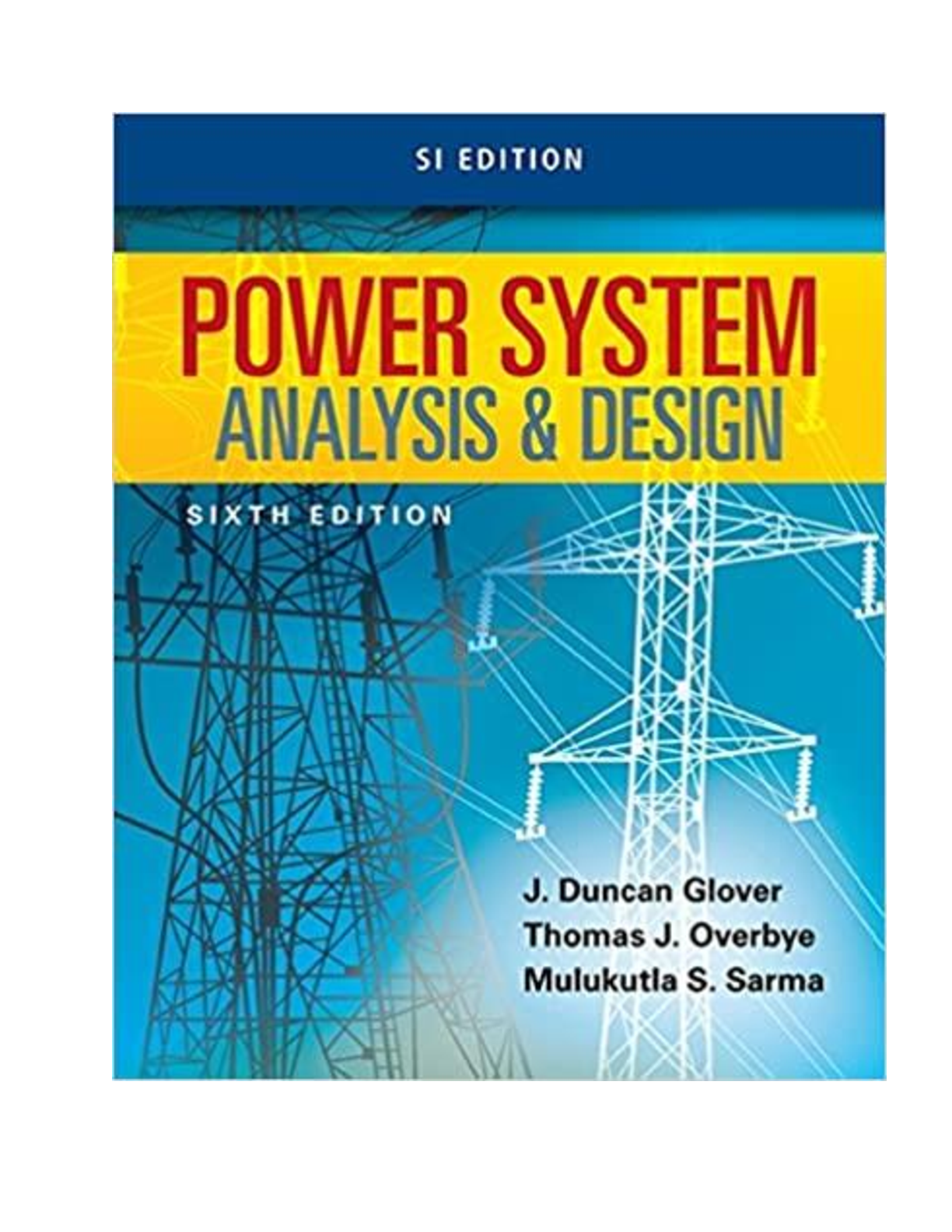
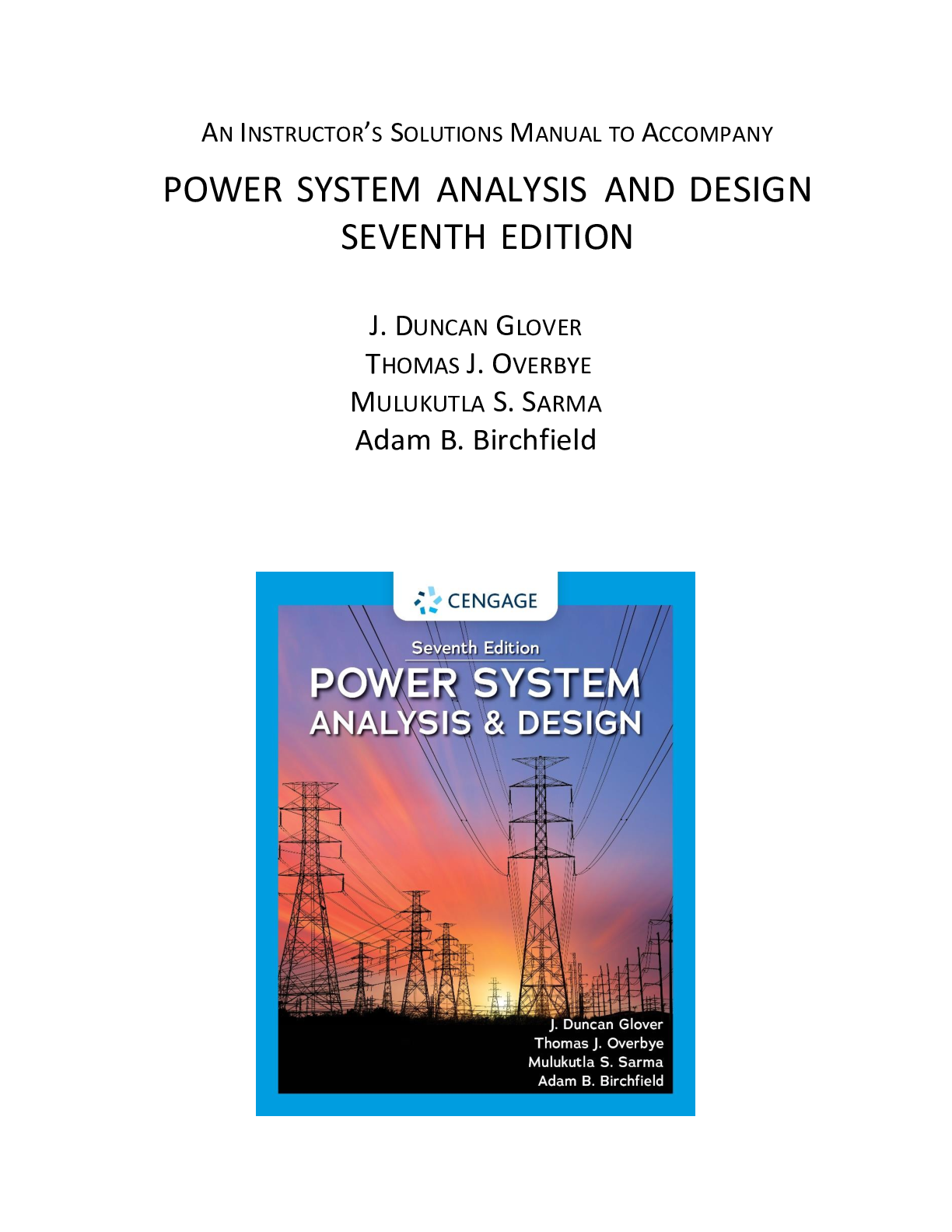
eBook for Power System Analysis and Design, 6th Edition By J. Duncan Glover, Thomas Overbye, Mulukutla S. Sarma
Get all 14 Chapters eBook PDF.
Table of contents
Preface
List of Symbols, Units, and Notation
CH
...
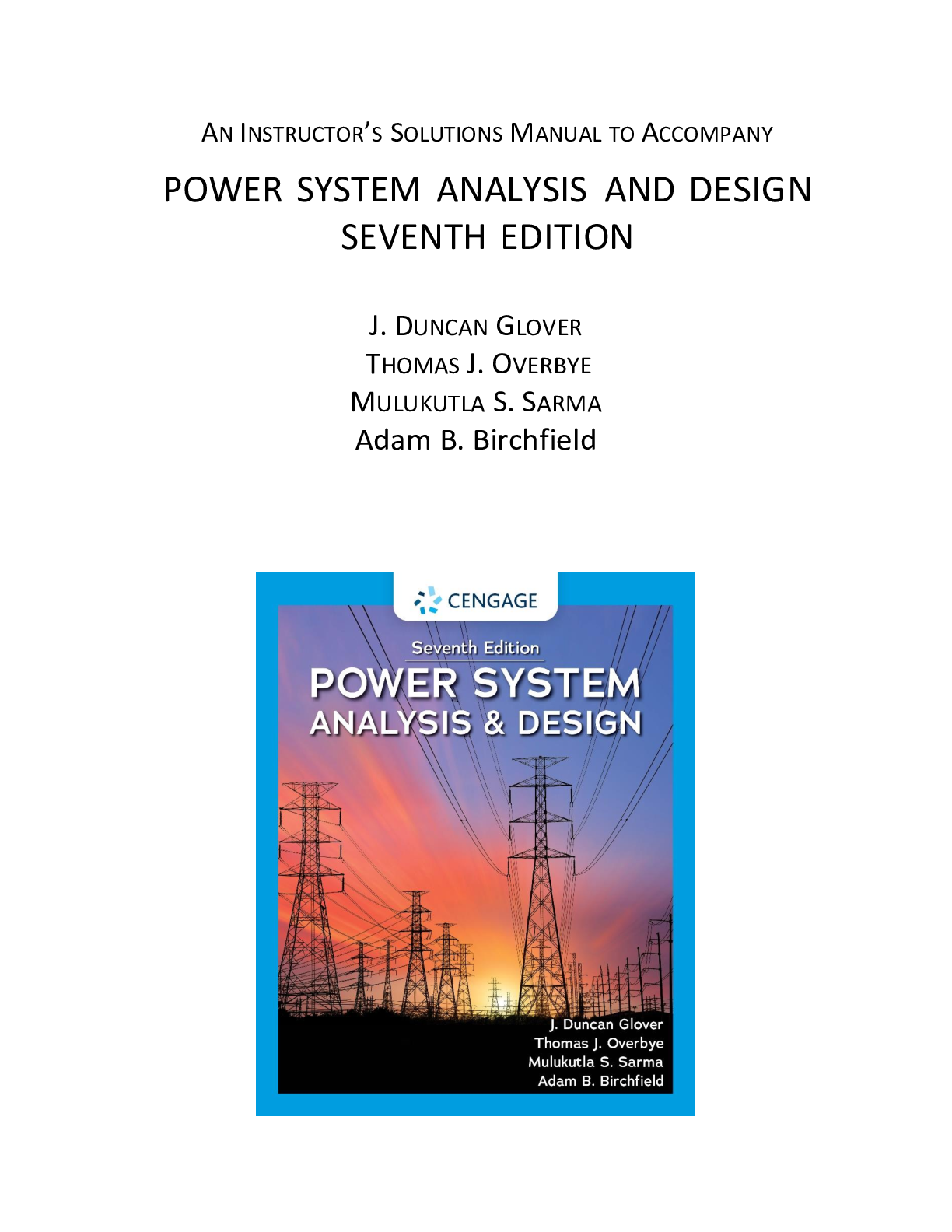
eBook for Power System Analysis and Design, 6th Edition By J. Duncan Glover, Thomas Overbye, Mulukutla S. Sarma
Get all 14 Chapters eBook PDF.
Table of contents
Preface
List of Symbols, Units, and Notation
CHAPTER 1: Introduction
Case Study: How the Free Market Rocked the Grid
1.1 History of Electric Power Systems
1.2 Present and Future Trends
1.3 Electric Utility Industry Structure
1.4 Computers in Power System Engineering
1.5 PowerWorld Simulator
CHAPTER 2: Fundamentals
Case Study: Key Connections
2.1 Phasors
2.2 Instantaneous Power in Single-Phase AC Circuits
2.3 Complex Power
2.4 Network Equations
2.5 Balanced Three-Phase Circuits
2.6 Power in Balanced Three-Phase Circuits
2.7 Advantages of Balanced Three-Phase versus Single-Phase Systems
CHAPTER 3: Power Transformers
Case Study: Power Transformers—Life Management and Extension
3.1 The Ideal Transformer
3.2 Equivalent Circuits for Practical Transformers
3.3 The Per-Unit System
3.4 Three-Phase Transformer Connections and Phase Shift
3.5 Per-Unit Equivalent Circuits of Balanced Three-Phase Two-Winding Transformers
3.6 Three-Winding Transformers
3.7 Autotransformers
3.8 Transformers with Off-Nominal Turns Ratios
CHAPTER 4: Transmission Line Parameters
Case Study: Integrating North America’s Power Grid
Case Study: Grid Congestion - Unclogging the Arteries of North America’s Power Grid
4.1 Transmission Line Design Considerations
4.2 Resistance
4.3 Conductance
4.4 Inductance: Solid Cylindrical Conductor
4.5 Inductance: Single-Phase Two-Wire Line and Three-Phase Three-Wire Line with Equal Phase Spacin
4.6 Inductance: Composite Conductors, Unequal Phase Spacing, Bundled Conductors
4.7 Series Impedances: Three-Phase Line with Neutral Conductors and Earth Return
4.8 Electric Field and Voltage: Solid Cylindrical Conductor
4.9 Capacitance: Single-Phase Two-Wire Line and Three-Phase Three-Wire Line with Equal Phase Spacin
4.10 Capacitance: Stranded Conductors, Unequal Phase Spacing, Bundled Conductors
4.11 Shunt Admittances: Lines with Neutral Conductors and Earth Return
4.12 Electric Field Strength at Conductor Surfaces and at Ground Level
4.13 Parallel Circuit Three-Phase Lines
CHAPTER 5: Transmission Lines: Steady-State Operation
Case Study: The ABCs of HVDC Transmission Technologies: An Overview of High Voltage Direct Current
5.1 Medium and Short Line Approximations
5.2 Transmission-Line Differential Equations
5.3 Equivalent Pi Circuit
5.4 Lossless Lines
5.5 Maximum Power Flow
5.6 Line Loadability
5.7 Reactive Compensation Techniques
CHAPTER 6: Power Flows
Case Study: Finding Flexibility: Cycling the Conventional Fleet
6.1 Direct Solutions to Linear Algebraic Equations: Gauss Elimination
6.2 Iterative Solutions to Linear Algebraic Equations: Jacobi and Gauss-Seidel
6.3 Iterative Solutions to Nonlinear Algebraic Equations: Newton-Raphson
6.4 The Power Flow Problem
6.5 Power Flow Solution by Gauss-Seidel
6.6 Power Flow Solution by Newton-Raphson
6.7 Control of Power Flow
6.8 Sparsity Techniques
6.9 Fast Decoupled Power Flow
6.10 The “DC” Power Flow
6.11 Power Flow Modeling of Wind Generation
6.12 Economic Dispatch
6.13 Optimal Power Flow
Design Projects 1–3
CHAPTER 7: Symmetrical Faults
Case Study: Short-Circuit Modeling of a Wind Power Plant
7.1 Series R–L Circuit Transients
7.2 Three-Phase Short Circuit—Unloaded Synchronous Machine
7.3 Power System Three-Phase Short Circuits
7.4 Bus Impedance Matrix
7.5 Circuit Breaker and Fuse Selection
Design Project 3 (continued)
CHAPTER 8: Symmetrical Components
Case Study: Technological Progress in High-Voltage Gas-Insulated Substations
8.1 Denition of Symmetrical Components
8.2 Sequence Networks of Impedance Loads
8.3 Sequence Networks of Series Impedances
8.4 Sequence Networks of Three-Phase Lines
8.5 Sequence Networks of Rotating Machines
8.6 Per-Unit Sequence Models of Three-Phase Two-Winding Transformers
8.7 Per-Unit Sequence Models of Three-Phase Three-Winding Transformers
8.8 Power in Sequence Networks
CHAPTER 9: Unsymmetrical Faults
Case Study: Innovative Medium Voltage Switchgear for Today’s Applications
9.1 System Representation
9.2 Single Line-to-Ground Fault
9.3 Line-to-Line Fault
9.4 Double Line-to-Ground Fault
9.5 Sequence Bus Impedance Matrices
Design Project 3 (continued)
Design Project 4
CHAPTER 10: System Protection
Case Study: Upgrading Relay Protection Be Prepared for the Next Replacement or Upgrade Project
10.1 System Protection Components
10.2 Instrument Transformers
10.3 Overcurrent Relays
10.4 Radial System Protection
10.5 Reclosers and Fuses
10.6 Directional Relays
10.7 Protection of a Two-Source System with Directional Relays
10.8 Zones of Protection
10.9 Line Protection with Impedance (Distance) Relays
10.10 Differential Relays
10.11 Bus Protection with Differential Relays
10.12 Transformer Protection with Differential Relays
10.13 Pilot Relaying
10.14 Numeric Relaying
CHAPTER 11: Transient Stability
Case Study: Down, but Not Out
11.1 The Swing Equation
11.2 Simplied Synchronous Machine Model and System Equivalents
11.3 The Equal-Area Criterion
11.4 Numerical Integration of the Swing Equation
11.5 Multimachine Stability
11.6 A Two-Axis Synchronous Machine Model
11.7 Wind Turbine Machine Models
11.8 Design Methods for Improving Transient Stability
CHAPTER 12: Power System Controls
Case Study: No Light in August: Power System Restoration Following the 2003 North American Blackout
12.1 Generator-Voltage Control
12.2 Turbine-Governor Control
12.3 Load-Frequency Control
CHAPTER 13: Transmission Lines: Transient Operation
Case Study: Surge Arresters
Case Study: Emergency Response
13.1 Traveling Waves on Single-Phase Lossless Lines
13.2 Boundary Conditions for Single-Phase Lossless Lines
13.3 Bewley Lattice Diagram
13.4 Discrete-Time Models of Single-Phase Lossless Lines and Lumped RLC Elements
13.5 Lossy Lines
13.6 Multiconductor Lines
13.7 Power System Overvoltages
13.8 Insulation Coordination
CHAPTER 14: Power Distribution
Case Study: It’s All in the Plans
14.1 Introduction to Distribution
14.2 Primary Distribution
14.3 Secondary Distribution
14.4 Transformers in Distribution Systems
14.5 Shunt Capacitors in Distribution Systems
14.6 Distribution Software
14.7 Distribution Reliability
14.8 Distribution Automation
14.9 Smart Grids
Appendix
Index
[Show More]


![Preview of Art History, 6th Edition, By Marilyn Stokstad, Michael Cothren [PDF] {eBook]](https://scholarfriends.com/storage/eBook for Art History, 6th Edition, By Marilyn Stokstad, Michael Cothren_compressed.png)












 Gary Donell, Clarence Byrd, Ida Chen.png)
 Gary Donell, Clarence Byrd, Ida Chen.png)