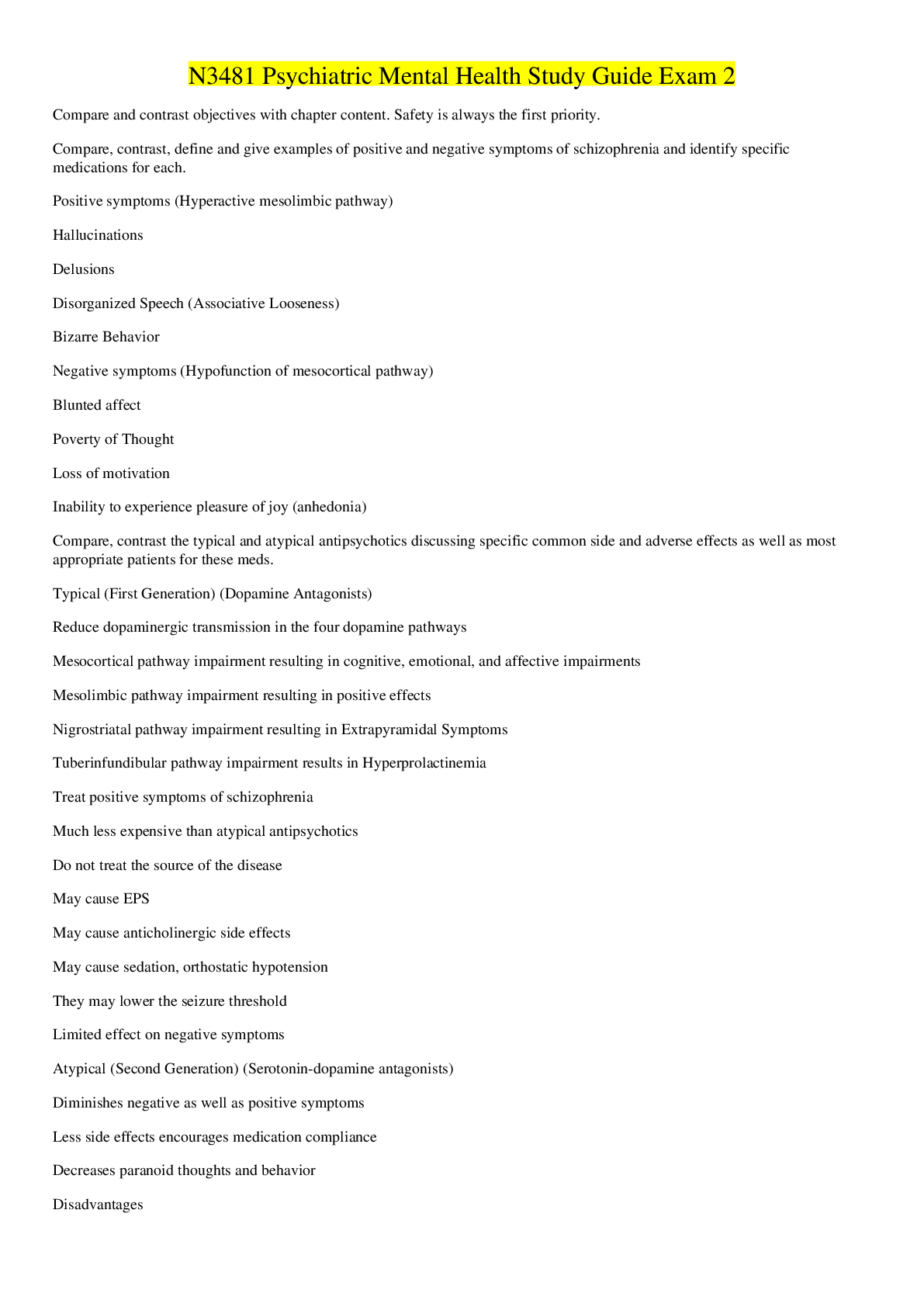
N3481 Psychiatric Mental Health Study Guide Exam 2
1. Compare and contrast objectives with chapter content. Safety is always the first priority.
2. Discuss nursing management and risk assessment of a patient experienci
...
N3481 Psychiatric Mental Health Study Guide Exam 2
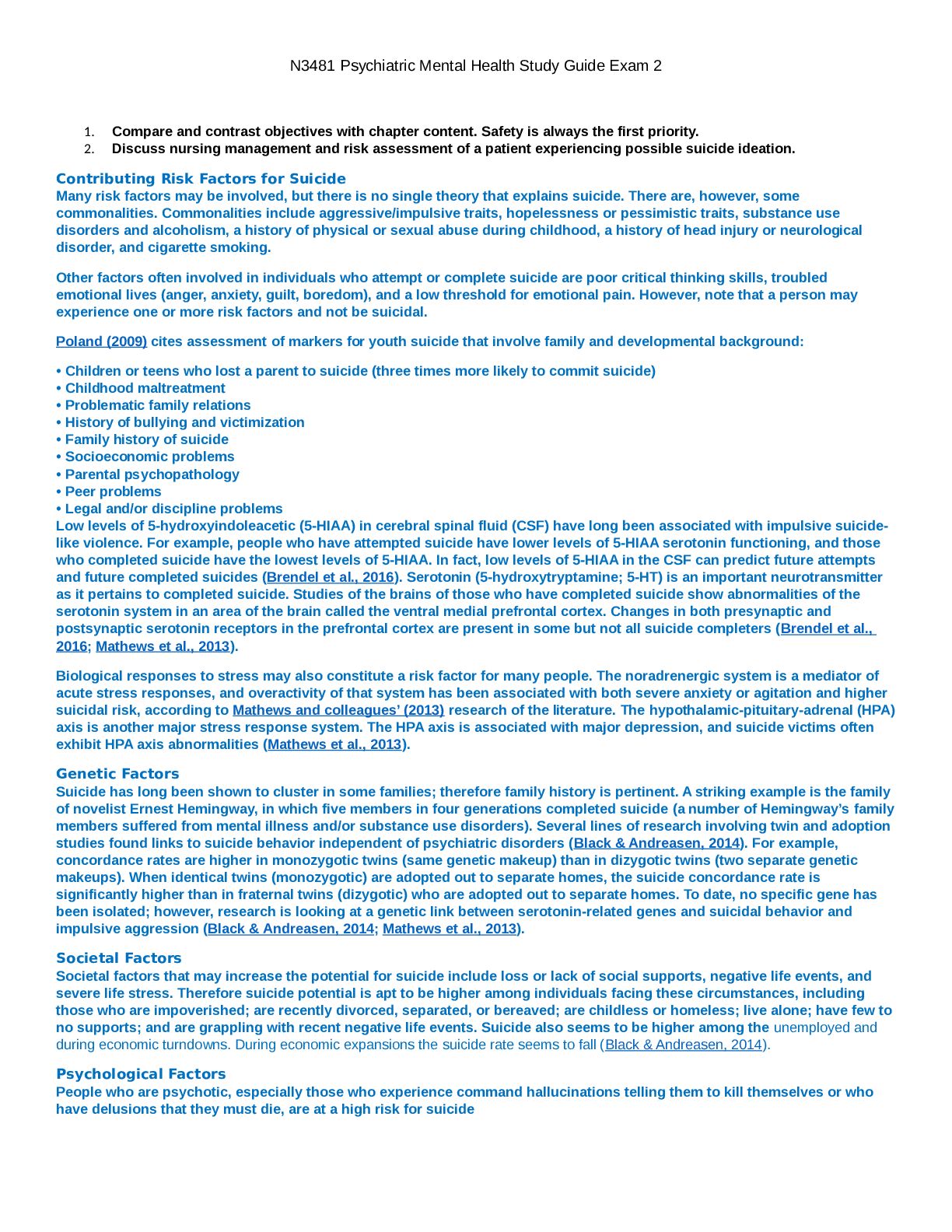
1. Compare and contrast objectives with chapter content. Safety is always the first priority.
2. Discuss nursing management and risk assessment of a patient experiencing possible suicide ideation.
Contributing Risk Factors for Suicide
Many risk factors may be involved, but there is no single theory that explains suicide. There are, however, some
commonalities. Commonalities include aggressive/impulsive traits, hopelessness or pessimistic traits, substance use
disorders and alcoholism, a history of physical or sexual abuse during childhood, a history of head injury or neurological
disorder, and cigarette smoking.
Other factors often involved in individuals who attempt or complete suicide are poor critical thinking skills, troubled
emotional lives (anger, anxiety, guilt, boredom), and a low threshold for emotional pain. However, note that a person may
experience one or more risk factors and not be suicidal.
Poland (2009) cites assessment of markers for youth suicide that involve family and developmental background:
• Children or teens who lost a parent to suicide (three times more likely to commit suicide)
• Childhood maltreatment
• Problematic family relations
• History of bullying and victimization
• Family history of suicide
• Socioeconomic problems
• Parental psychopathology
• Peer problems
• Legal and/or discipline problems
Low levels of 5-hydroxyindoleacetic (5-HIAA) in cerebral spinal fluid (CSF) have long been associated with impulsive suicidelike violence. For example, people who have attempted suicide have lower levels of 5-HIAA serotonin functioning, and those
who completed suicide have the lowest levels of 5-HIAA. In fact, low levels of 5-HIAA in the CSF can predict future attempts
and future completed suicides (Brendel et al., 2016). Serotonin (5-hydroxytryptamine; 5-HT) is an important neurotransmitter
as it pertains to completed suicide. Studies of the brains of those who have completed suicide show abnormalities of the
serotonin system in an area of the brain called the ventral medial prefrontal cortex. Changes in both presynaptic and
postsynaptic serotonin receptors in the prefrontal cortex are present in some but not all suicide completers (Brendel et al.,
2016; Mathews et al., 2013).
Biological responses to stress may also constitute a risk factor for many people. The noradrenergic system is a mediator of
acute stress responses, and overactivity of that system has been associated with both severe anxiety or agitation and higher
suicidal risk, according to Mathews and colleagues’ (2013) research of the literature. The hypothalamic-pituitary-adrenal (HPA)
axis is another major stress response system. The HPA axis is associated with major depression, and suicide victims often
exhibit HPA axis abnormalities (Mathews et al., 2013).
Genetic Factors
Suicide has long been shown to cluster in some families; therefore family history is pertinent. A striking example is the family
of novelist Ernest Hemingway, in which five members in four generations completed suicide (a number of Hemingway’s family
members suffered from mental illness and/or substance use disorders). Several lines of research involving twin and adoption
studies found links to suicide behavior independent of psychiatric disorders (Black & Andreasen, 2014). For example,
concordance rates are higher in monozygotic twins (same genetic makeup) than in dizygotic twins (two separate genetic
makeups). When identical twins (monozygotic) are adopted out to separate homes, the suicide concordance rate is
significantly higher than in fraternal twins (dizygotic) who are adopted out to separate homes. To date, no specific gene has
been isolated; however, research is looking at a genetic link between serotonin-related genes and suicidal behavior and
impulsive aggression (Black & Andreasen, 2014; Mathews et al., 2013).
[Show More]






 Quiz 2 Concept Notes MY21.png)