Question 1
0.125 out of 0.125 points
Cardiogenic shock is characterized by
Selected Answer: c. reduced cardiac output. Correct Answer: c. reduced cardiac output.
Response Feedback:
Cardiogenic shock oc
...
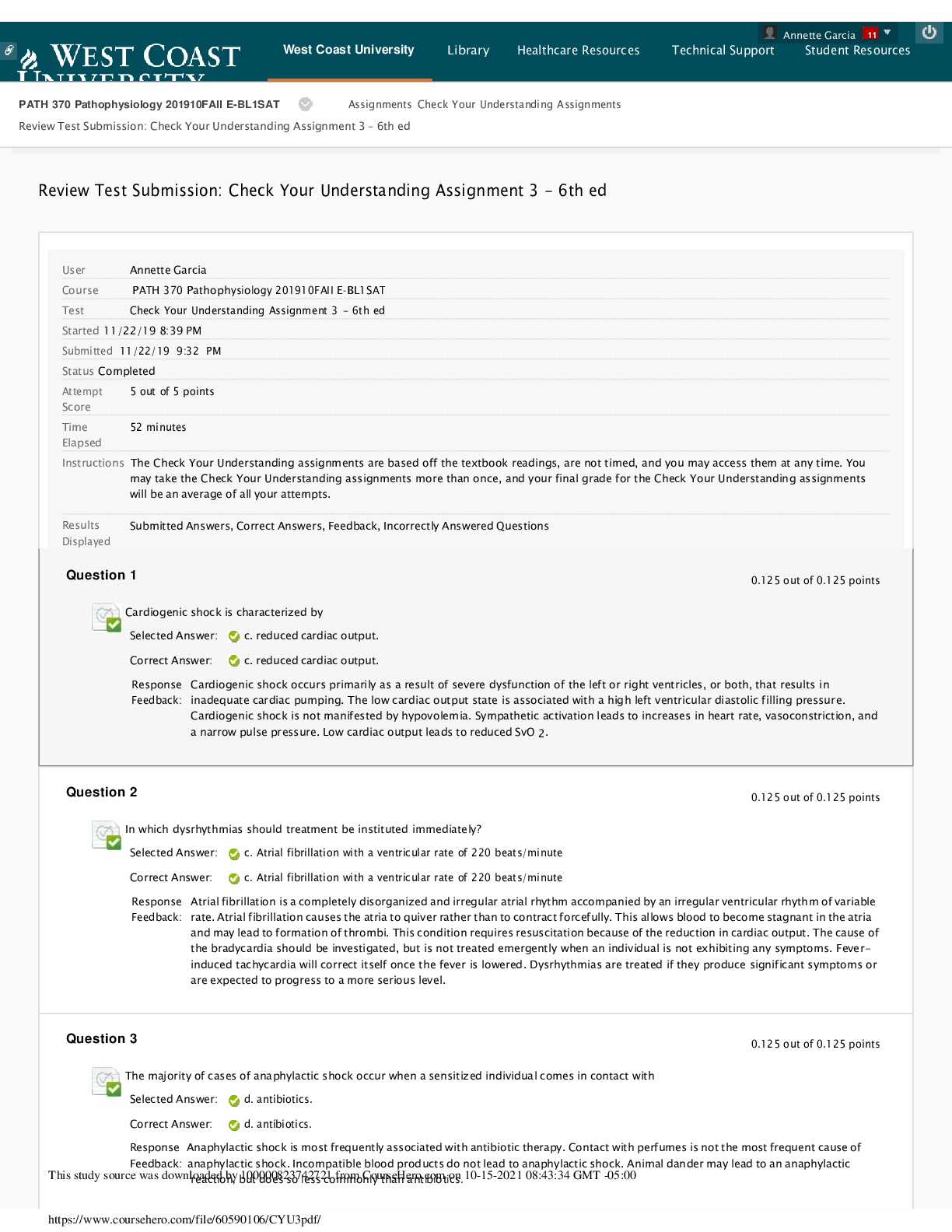
Question 1
0.125 out of 0.125 points
Cardiogenic shock is characterized by
Selected Answer: c. reduced cardiac output. Correct Answer: c. reduced cardiac output.
Response Feedback:
Cardiogenic shock occurs primarily as a result of severe dysfunction of the left or right ventricles, or both, that results in inadequate cardiac pumping. The low cardiac output state is associated with a high left ventricular diastolic filling pressure. Cardiogenic shock is not manifested by hypovolemia. Sympathetic activation leads to increases in heart rate, vasoconstriction, and a narrow pulse pressure. Low cardiac output leads to reduced SvO 2.
Question 2
0.125 out of 0.125 points
In which dysrhythmias should treatment be instituted immediately?
Selected Answer: c. Atrial fibrillation with a ventricular rate of 220 beats/minute Correct Answer: c. Atrial fibrillation with a ventricular rate of 220 beats/minute
Response Feedback:
Atrial fibrillation is a completely disorganized and irregular atrial rhythm accompanied by an irregular ventricular rhythm of variable rate. Atrial fibrillation causes the atria to quiver rather than to contract forcefully. This allows blood to become stagnant in the atria and may lead to formation of thrombi. This condition requires resuscitation because of the reduction in cardiac output. The cause of the bradycardia should be investigated, but is not treated emergently when an individual is not exhibiting any symptoms. Fever- induced tachycardia will correct itself once the fever is lowered. Dysrhythmias are treated if they produce significant symptoms or are expected to progress to a more serious level.
Question 3
0.125 out of 0.125 points
The majority of cases of anaphylactic shock occur when a sensitized individual comes in contact with
Selected Answer: d. antibiotics. Correct Answer: d. antibiotics.
Response Anaphylactic shock is most frequently associated with antibiotic therapy. Contact with perfumes is not the most frequent cause of Feedback: anaphylactic shock. Incompatible blood products do not lead to anaphylactic shock. Animal dander may lead to an anaphylactic
This study source was downlroeaadcetdiobny, b1u0t0d00o0e8s2s3o7l4e2s7s2c1ofmrommoCnloyutrhsaeHn earnot.icboimotiocsn. 10-15-2021 08:43:34 GMT -05:00
Question 4 0.125 out of 0.125 points
The majority of cardiac cells that die after myocardial infarction do so because of
Selected Answer: b. apoptosis. Correct Answer: b. apoptosis.
Response MI results when prolonged or total disruption of blood flow to the myocardium causes cellular death by necrosis or apoptosis.
Feedback: Cardiac cells do not die as a result of cellular rupture. Insufficient glucose is not associated with myocardial death. The initiating event of MI is believed to be related to thrombus, but the resulting disruption of flow to the myocardium is because of necrosis or apoptosis.
Question 5 0.125 out of 0.125 points
A patient has a history of falls, syncope, dizziness, and blurred vision. The patient’s symptomology is most likely related to
Selected Answer: b. hypotension. Correct Answer: b. hypotension.
Response Hypotension is low blood pressure characterized by dizziness, blurred vision, syncope, and injury from falls. Hypertension is high Feedback: blood pressure characterized by headache, confusion, chest pain, and difficulty breathing. Deep vein thrombosis is evidenced by calf
pain or tenderness. Angina is characterized by chest, shoulder, or jaw pain.
Question 6 0.125 out of 0.125 points
High blood pressure increases the workload of the left ventricle, because it increases
Selected Answer: d. afterload. Correct Answer: d. afterload.
Response Hypertension reflects an elevation in SVR; rising afterload increases myocardial oxygen demand and overall cardiac workload.
Feedback: The workload of the left ventricle does not increase the stroke volume, blood volume, or preload.
[Show More]