How to conduct Mini-Cog-
• The Mini-Cog has been demonstrated to have comparable psychometric properties to the MMSE
• The primary advantage of the Mini-Cog is that it is shorter than the MMSE and measures executive fu
...
How to conduct Mini-Cog-
• The Mini-Cog has been demonstrated to have comparable psychometric properties to the MMSE
• The primary advantage of the Mini-Cog is that it is shorter than the MMSE and measures executive function.
• It is composed of a three-item recall and the Clock Drawing Test (CDT) and takes about 3 minutes to administer
• The Mini-Cog is a short dementia assessment that combines three-word recall with clock-drawing capability.
• Patients are given a total score reflecting accuracy in clock drawing and recollection of the given three words.
• A score of 0 to 2 is a positive screen for dementia Causes of delirium in elderly-
• Causes of delirium are numerous and in elderly hospitalized patients there are often multiple etiologies, including
metabolic, infection, cardiac, neurological, pulmonary, sensory impairments, medications, and toxins.
• Regardless of cause, a consistent finding is significant reduction in regional cerebral perfusion during periods of delirium in comparison with blood flow patterns after recovery.
• A possible neurological common pathway may involve acetylcholine and dopamine, and the disruption in the
sleep-wake cycle in delirium indicates melatonin as a possible factor. (Kennedy-Malone 59) Agnosia
• Loss of ability to identify objects ADA criteria for diagnosing DM-
• FPG ≥126 mg/dL (7.0 mmol/L). Fasting is defined as no caloric intake for at least 8 h.*
• 2-h PG ≥200 mg/dL (11.1 mmol/L) during OGTT. The test should be performed as described by the WHO, using a glucose load containing the equivalent of 75-g anhydrous glucose dissolved in water.*
• A1C ≥6.5% (48 mmol/mol). The test should be performed in a laboratory using a method that is NGSP certified
and standardized to the DCCT assay.*
• In a patient with classic symptoms of hyperglycemia or hyperglycemic crisis, a random plasma glucose ≥200 mg/dL (11.1 mmol/L).
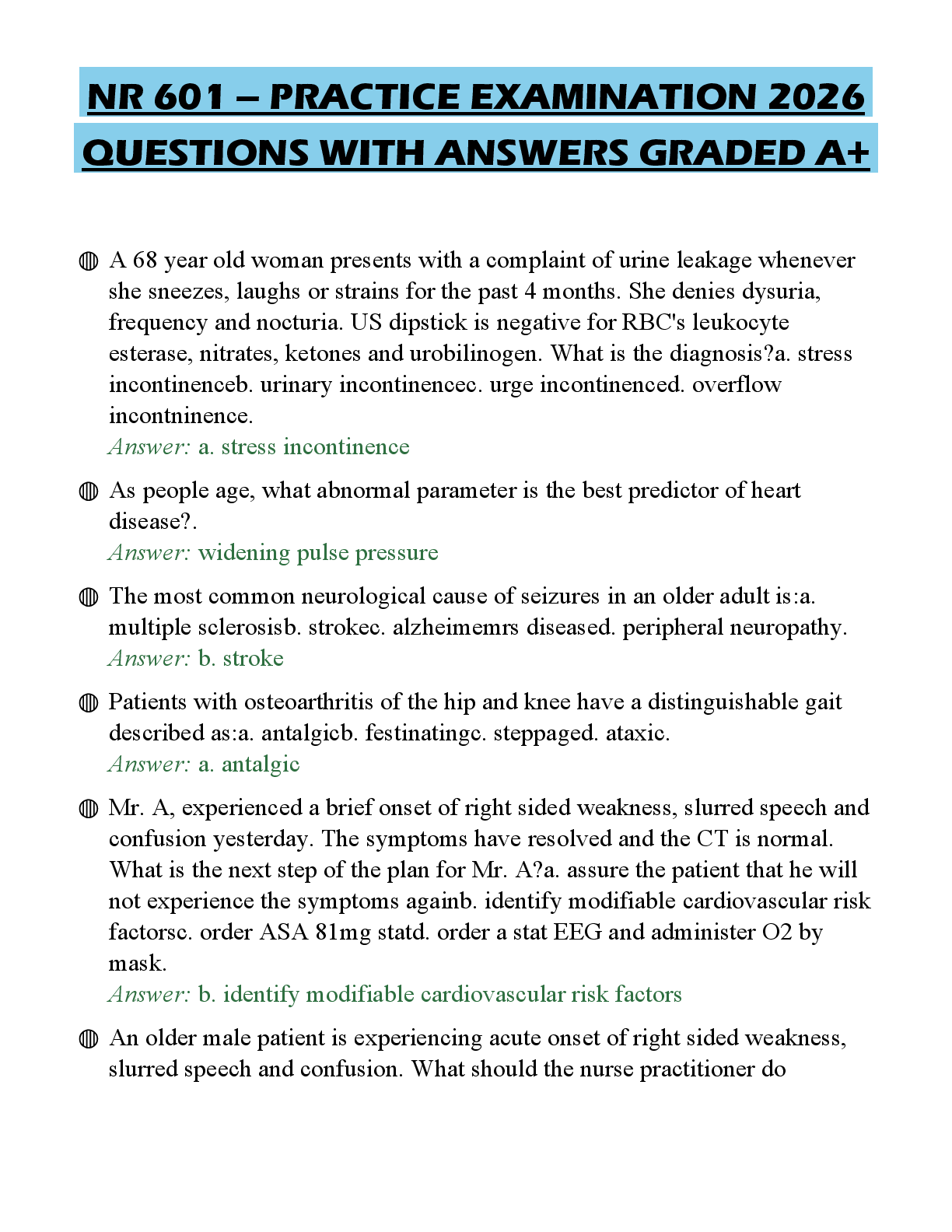
• Urinary incontinence-
• Involuntary loss of urine from the bladder
▪ So common in women many consider it normal
▪ Common in older men w/ enlarged prostate o Can affect quality of life
o Significance-One of the most common complains w/ older adults, Distress & embarrassment, Cost burden to pt & society as a whole, Not life-threatening, may effect QOL, PCP essential to educating individuals
o Epidemiology- Increased prevalence w/ age in men & women, Nursing home population – 40-70%, Often a factor in placement
▪ URGENCY UI is greater in men
▪ STRESS UI is greater in women
o Terminology
▪ UI- Unintentional voiding, loss or leakage of urine
▪ Continuous incontinence-Continuous loss or leak of urine
▪ Increased daytime frequency-More frequent during day than considered normal
▪ Nocturia-Interruption of sleep one or more times due to the need to urinate – increases in frequency after age 50
▪ Urgency-Sudden, compelling desire to pass urine that’s difficult to prevent
▪ Overactive bladder syndrome- Urgency, frequency, nocturia w/ or w/o incontinence
o Risk Factors-Aging,Obesity,Smoking, Caffeine,Uncontrolled DM, Constipation,Use of diuretics
o Risk Factors by gender-Women:Aging, obesity, smoking, caffeine intake, DM, pregnancy, multiparity, estrogen deficiency, hx of pelvic surgery, diuretics
Men:Aging, obesity, smoking, caffeine, DM, prostate dx, hx of prostate surgery, hx of UTIs, diuretics
o Physical changes w/ aging that contribute to UI
▪ Lower urinary tract-Detrusor muscle over activity,Decrease in detrusor contractility, Increase in post void residual,Decrease in urethral blood flow
▪ Women – decrease in urethral closure pressure,Low estrogen following menopause - leads to atrophy of ureteral mucosal epithelium & increase in urethral sensation
▪ Men can experience constriction of urethra due to BPH which may result in bladder outlet obstructing symptoms
- Initial clinical workup for UI in Men
o PMH, PE, UA, DRE: Eval of prostate,PSA w/ new onset in men
- UI workup in women:Exclude underlying causes,PMH, PE, UA, Pelvic exam, vaginal exam, perineal, Identify estrogen status of pt, Pelvic prolapse, fistula,
-Cough test, Integrity of pelvic musculature, leaking of urine
▪ Full bladder
▪ Standing position
▪ Asked to cough
▪ If urine leak is observed, stress incontinence is confirmed
- Red flags in males
o Higher level of suspicion for serious diseases, Refer to urology if Previous pelvic surgery, Pelvic radiation, Pelvic pain,
Severe incontinence, Severe UTI symptoms, Recurrent urologic infection,Abnl Prostate exam,Elevated PSA
o Be alert to these with NEW ONSET UI- Hematuria,Pelvic pain,Abdominal mass, Dysuria, Proteinuria, Glucosuria, CVA tenderness,Nodular prostate,Any new neuro symptoms
- Goals of treatment: Reduce symptoms, Improve QOL, Increase social activity, Reduce leakage volumes, increase dryness, use less protection; Increase independence in incontinence management; Decrease caregiver burden
- 1st line management guidelines
o AHRQ guidelines for management of UI in women
▪ Behavioral therapy
▪ Lifestyle modification
▪ Try for 3 months before pharm management
[Show More]

 GRADE A SOLUTION.png)




x.png)


.png)

.png)