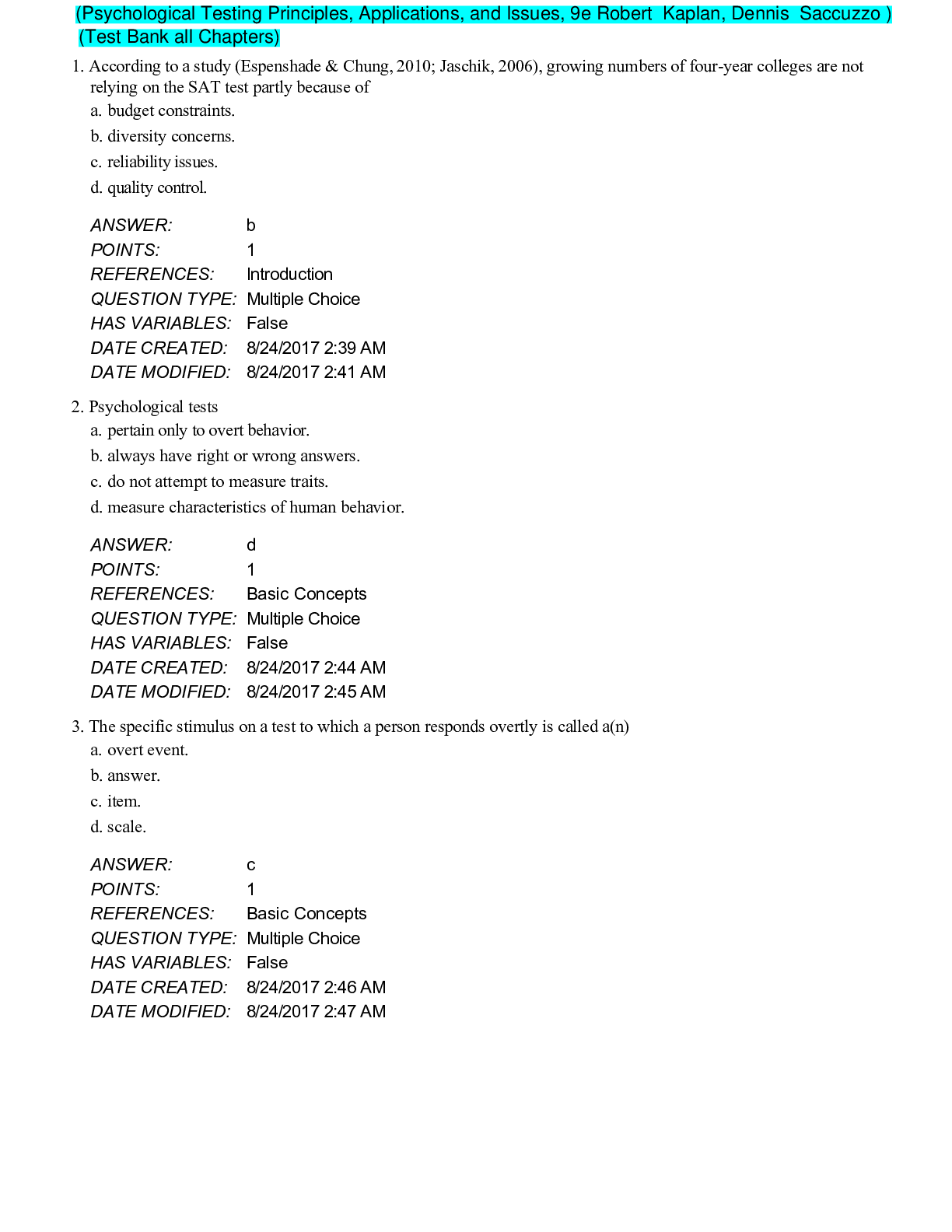
Who is thought to have spread the testing movement in the United States?
• a. Clark Wissler
• b. E.L. Thorndike
• c. James McKeen Cattell
• d. Sir Francis Galton
Who is credited with the c
...
Who is thought to have spread the testing movement in the United States?
• a. Clark Wissler
• b. E.L. Thorndike
• c. James McKeen Cattell
• d. Sir Francis Galton
Who is credited with the creation of the first formal personality test?
• a. Alfred Binet
• b. David Wechsler
• c. Hermann Rorschach
• d. Robert Woodworth
is an activity that involves judging or appraising the value or worth of something.
• a. Assessment
• b. Evaluation
• c. Measurement
• d. Testing
Which of the following would be an example of a subjective test?
• a. Exam consisting of essay questions
• c. Stanford-Binet Intelligence Scale
• d. Tests & Measurements Exam
Which of the following terms refers to the degree to which test scores are free from measurement error?
• a. Reliability
• b. Validity
• c. Accuracy
• d. Consistency
A typical response test would be used to measure which of the following constructs?
• a. Achievement
• b. Aptitude
• c. Attitudes
• d. Intelligence
A student scored better than 85% of his or her peers. This is an example of which approach to score interpretation?
• a. Construct-referenced
• b. Criterion-referenced
• c. Norm-referenced
• d. Standard-referenced
Which of the following uses a criterion-referenced approach to score interpretation?
• a. Driver’s license exam
• b. Intelligence test
• c. MMPI-2
Which of the following assumptions of psychological assessment is correct?
• a. Assessment procedures are essentially error free
• b. One source of information is enough for the assessment process
• c. Psychological constructs can be measured
• d. There is only one way to measure a construct
Which of the following involves situations where people are assigned to different tracks, ordered in some way?
• a. Categorization
• b. Classification
• c. Placement
• d. Selection
How many tests did the American Psychological Association (APA) estimate are developed every year?
• a. 20
• b. 200
• c. 2000
• d. 20000
Psychological assessment is:
• a. broader in scope than testing.
• b. one component of testing.
• c. a less detailed and technical process than testing.
• d. less precise and accurate than testing.
Testing is to assessment as is to .
• a. blood test; medical exam
• b. placement; classification
• c. Xray; MRI
• d. intern; doctor Validity refers to:
• a. the accuracy of the interpretation of test scores.
• b. the stability or consistency of test scores.
• c. the method in which norms for the tests were developed.
• d. whether the test is a good measure of a construct.
Reliability refers to:
• a. the stability or consistency of test scores.
• b. the method in which the test was developed.
• c. the specialization of the test.
Amy completes a 100 item questionnaire that asks her to respond “Yes” or “No” to statements about her typical ways of thinking and behaving. What type of test is this?
• a. Aptitude Test
• b. Objective Personality Test
• c. Power Test
• d. Speed Test
is defined as a systematic procedure for collecting information that can be used to make inferences about the characteristics of people or objects.
• a. Evaluation
• b. Measurement
• c. Assessment
• d. Testing
Which is of the following is NOT a right of a test taker according to the Joint Committee on Testing Practices?
• a. The right to review their test questions
• b. The right to receive test administration by trained individuals
• c. The right to receive information regarding their test results
• d. The right to confidentiality of their results
A psychological or educational professional who has specialized in the area of testing, measurement, and assessment is referred to as a/an
.
• a. academician
• b. diagnostician
• c. psychologist
• d. psychometrician
Since all psychological tests contain a fixed number of items, they:
........................................................................CONTINUED.................................................
[Show More]