Micro Biology  >  EXAM  >  Microbiology Test 2 Chapter 5-12, 16, 18 (All)

Microbiology Test 2 Chapter 5-12, 16, 18

Document Content and Description Below

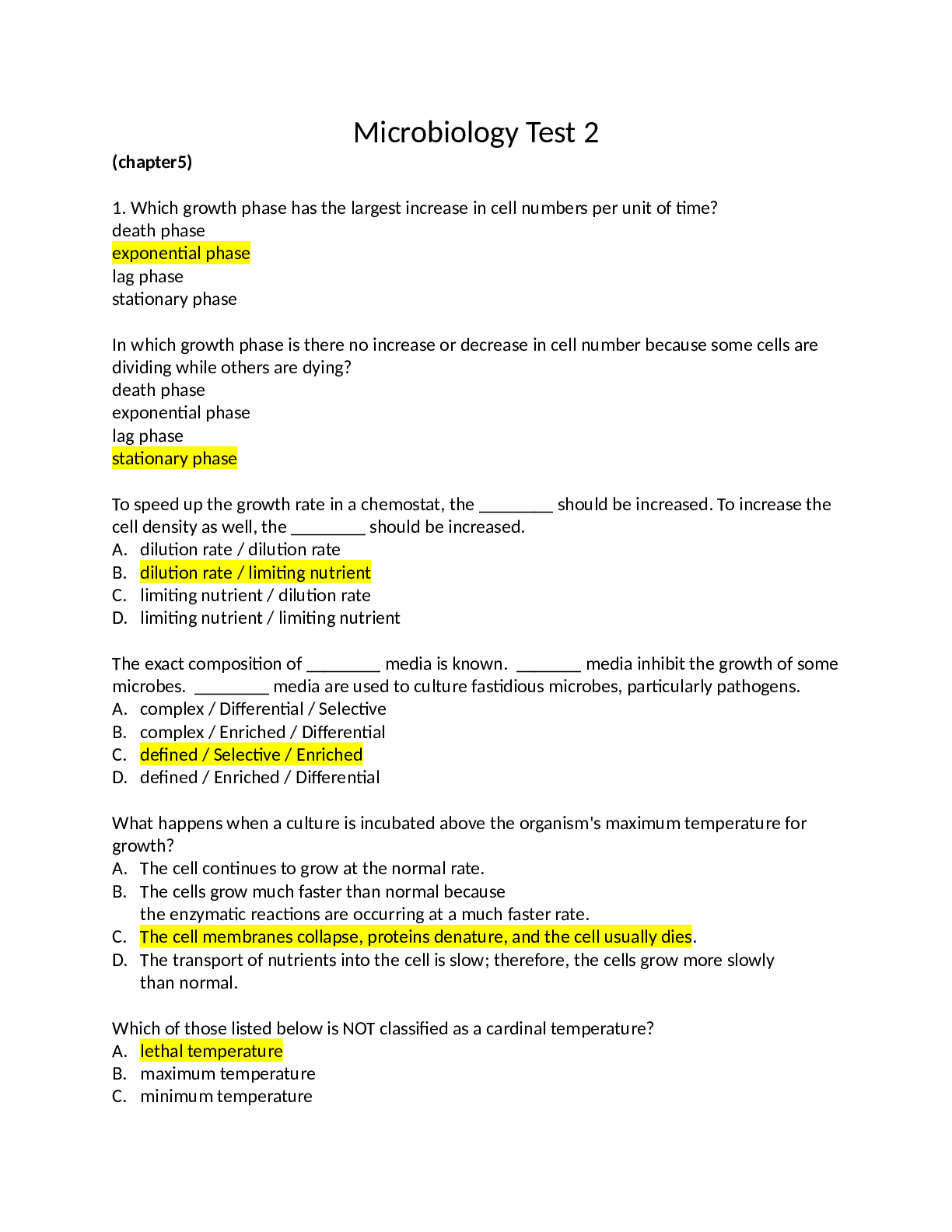
1. Which growth phase has the largest increase in cell numbers per unit of time? death phase exponential phase lag phase stationary phase In which growth phase is there no increase or decrease in cell ... number because some cells are dividing while others are dying? death phase exponential phase lag phase stationary phase To speed up the growth rate in a chemostat, the ________ should be increased. To increase the cell density as well, the ________ should be increased. A. dilution rate / dilution rate B. dilution rate / limiting nutrient C. limiting nutrient / dilution rate D. limiting nutrient / limiting nutrient The exact composition of ________ media is known. _______ media inhibit the growth of some microbes. ________ media are used to culture fastidious microbes, particularly pathogens. A. complex / Differential / Selective B. complex / Enriched / Differential C. defined / Selective / Enriched D. defined / Enriched / Differential What happens when a culture is incubated above the organism's maximum temperature for growth? A. The cell continues to grow at the normal rate. B. The cells grow much faster than normal because the enzymatic reactions are occurring at a much faster rate. C. The cell membranes collapse, proteins denature, and the cell usually dies. D. The transport of nutrients into the cell is slow; therefore, the cells grow more slowly than normal. Which of those listed below is NOT classified as a cardinal temperature? A. lethal temperature B. maximum temperature C. minimum temperature D. optimum temperature ________ is used to reduce microbes in food products to increase shelf life, and ________ is routinely used to sterilize a variety of food products, surgical supplies, and laboratory equipment. A. Ionizing radiation / pasteurization B. UV radiation / cold sterilization C. Steam heat / UV radiation D. Pasteurization / ionizing radiation (chapter6) The upstream region of an mRNA, acting as a riboswitch, binds a(n) ________ and results in translational blockage of the downstream protein-encoding sequence. a. antisense RNA b. metabolite c. peptide d. RNAi Attenuation is a transcriptional control mechanism that relies on a. attenuator molecules binding to mRNA. b. effector proteins to control the binding of RNA polymerase. c. transcriptional feedback inhibition. d. the secondary structure of the mRNA leader. Binding of an sRNA to the RBS a. inhibits translation of the mRNA. b. stimulates translation of the mRNA. c. can inhibit or stimulate translation of the mRNA. d. inhibits transcription of the mRNA. True or False: sRNAs can only regulate expression by binding mRNA. a. TRUE b. FALSE Which RNA chaperone protein binds the short trans-sRNA sequence to form a complex with its mRNA target? a. TrpC b. Hfq c. SgrS d. RpoS ________ occurs when an external signal does NOT directly enter the cell but instead is detected by a sensor that transmits it to the rest of the regulatory machinery. a. Quorum sensing b. Sensory transduction c. Signal transduction d. Two-component regulation The ________ is a bacterial regulatory mechanism used to survive nutrient-poor conditions, antibiotic exposure, and environmental stresses. a. catabolite repression b. heat shock response c. stringent response d. two-component system Whereas gram-negative bacteria such as the Proteobacteria often use ________ as autoinducers, quorum-sensing gram-positives more commonly use ________ that act as autoinducers. a. acyl homoserine lactones / short peptides b. acyl homoserine lactones / quinones c. short peptides / acyl homoserine lactones d. quinones / acyl homoserine lactones Once a signal from the environment is detected by a sensor kinase, the next step to pass on this signal involves the sensor kinase transferring a. its phosphate to ADP to form ATP. b. its phosphate onto another intracellular signaling molecule. c. phosphate from ATP onto another intracellular signaling molecule. d. phosphate from ATP onto itself. The differentiating mechanism between a flagellar response to a chemoattractant or a chemorepellent involves the ________ activity being low or high (respectively) on ________. a. autophosphorylation / CheA b. autophosphorylation / MCPs c. demethylation / CheA d. demethylation / MCPs Where do transcriptional regulators most commonly bind to? a. major grooves in dsDNA b. minor grooves in dsDNA c. primary supercoils d. promoter sequences A common motif in proteins that bind DNA in Bacteria is the a. catalytic triad. b. double helix. c. helix-turn-helix. d. turn-helix-turn. [Show More]

Last updated: 3 years ago

Preview 1 out of 37 pages

Buy Now

Instant download

We Accept:

Payment methods accepted on Scholarfriends (We Accept)
Preview image of Microbiology Test 2 Chapter 5-12, 16, 18 document

Buy this document to get the full access instantly

Instant Download Access after purchase

Buy Now

Instant download

We Accept:

Payment methods accepted on Scholarfriends (We Accept)

Reviews( 0 )

$23.00

Buy Now

We Accept:

Payment methods accepted on Scholarfriends (We Accept)

Instant download

Can't find what you want? Try our AI powered Search

95
0

Document information


Connected school, study & course


About the document


Uploaded On

Oct 22, 2021

Number of pages

37

Written in

All

Seller


Profile illustration for Ajay25
Ajay25

Member since 5 years

133 Documents Sold

Reviews Received
25
4
1
0
4
Additional information

This document has been written for:

Uploaded

Oct 22, 2021

Downloads

 0

Views

 95

Document Keyword Tags

Recommended For You

Get more on EXAM »
$23.00
What is Scholarfriends

Scholarfriends.com Online Platform by Browsegrades Inc. 651N South Broad St, Middletown DE. United States.

We are here to help

We're available through e-mail, Twitter, Facebook, and live chat.
 FAQ
 Questions? Leave a message!

Follow us on
 Twitter

Copyright © Scholarfriends · High quality services·