Alternate question types-22; Dosage Calculations-2
When studying content, focus on clinical manifestations, diagnostics, interprofessional care, and nursing interventions. Be thinking about what are the most life-thre
...
Alternate question types-22; Dosage Calculations-2
When studying content, focus on clinical manifestations, diagnostics, interprofessional care, and nursing interventions. Be thinking about what are the most life-threatening complications, ABCs of priority care.
COMPREHENSIVE REVIEW OF PREVIOUS EXAM CONTENT – 61
Week 1. Fluid, Electrolytes, and Acid/Base Imbalances and perioperative – 6 Pre and post op nursing interventions – 3
● Pre-op goal is to identify risk factors and plan care to ensure safety
○ Allergies
○ Medications
○ Health history
○ Education- what to expect, remove nail polish
○ Informed consent-witness, make sure site is marked
○ Labs-make sure available, pregnancy test
○ Meds- antibiotic (one hour cut time), atropine (secretions), morphine (pain management), benzos (anxiety), PPI/H2 blockers
○ Give valuable to family, document
● Post-op
○ Monitor VS and make sure patient does not have adverse effects following surgery (baseline) very interested in respirations, any change oxygen first
○ ABCs, LOC
○ Due to void, asses bladder, palpate, bladder scan
○ Urinary output should be at least 0.5ml/kg/hr following surgery
○ coughing , deep breathing
○ Ambulation
○
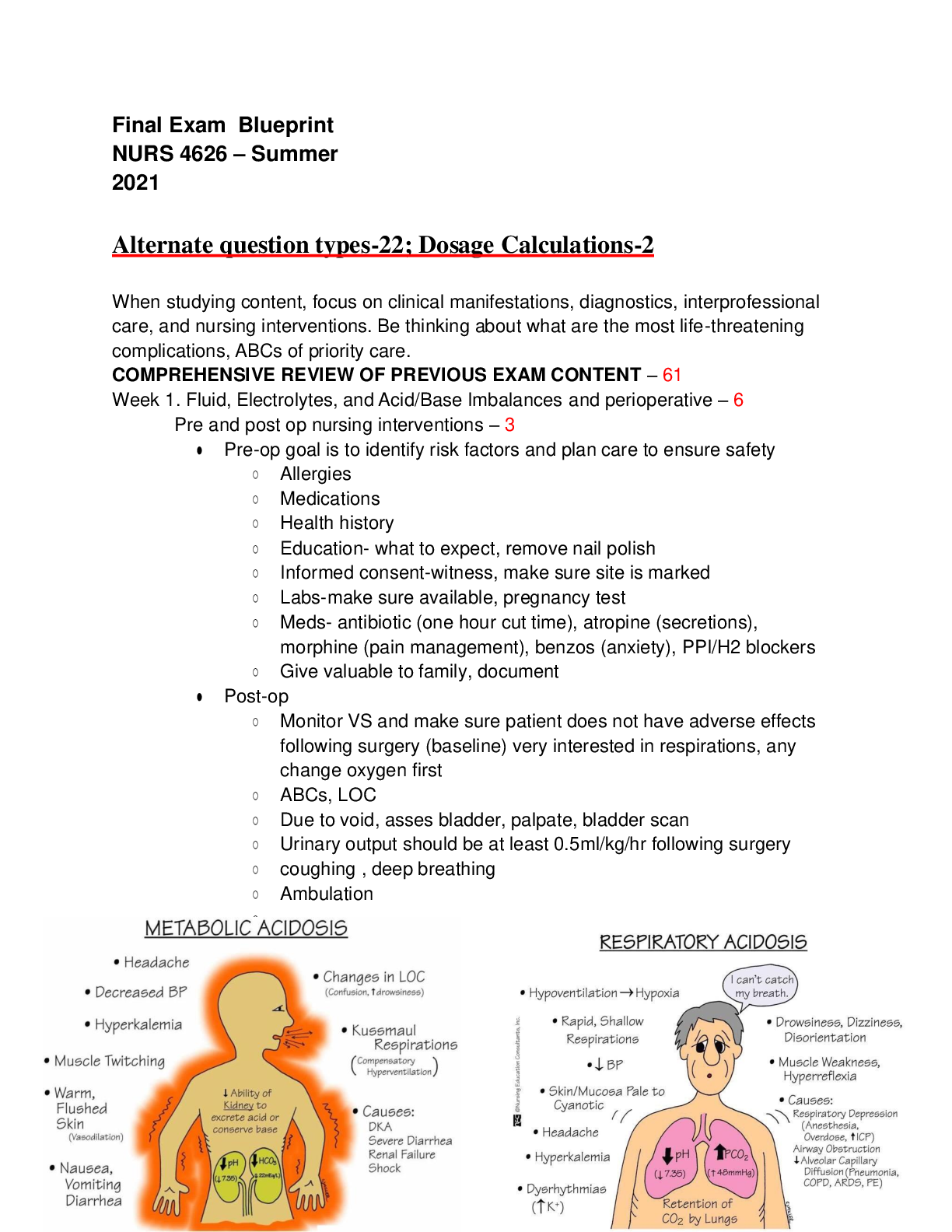
Acid/Base Imbalances – 2
Hemodynamic monitoring - 1
● Arterial line- more accurate
● CVP 0-8, with shock we want 12-15, in cardiogenic shock we want it lower than 8
● Map 70-110 must do interventions when <60
● Pulse pressure 40-60 Week 2. Dysrhythmias – 6
ECG identification and treatment – 4
● Sinus Bradycardia:
○ Fires at a rate less than 60 beats/min
○ Could be normal for athletes and when some people sleep
○ Common disease states associated with bradycardia are hypothyroidism, increased intracranial pressure and MI
○ Treatment: If due to drugs, these may have to be held, stopped or reduced, for the patient with symptoms, treatment consists of giving IV atropine. Patient may need a pacemaker
● Sinus Tachycardia:
○ The sinus rate is 101-180 beats/min
○ Associated with exercise, fever, pain, hypotension, hypovolemia, anemia, and hypoxia
○ It can be an effect of drugs such as epinephrine, norepinephrine, atropine and caffeine
○ s/s: Dizziness, dyspnea, and hypotension because of decreased cardiac output
.....................................................................CONTINUED.....................................................................
[Show More]