Congenital Heart Defect
Unfolding Reasoning
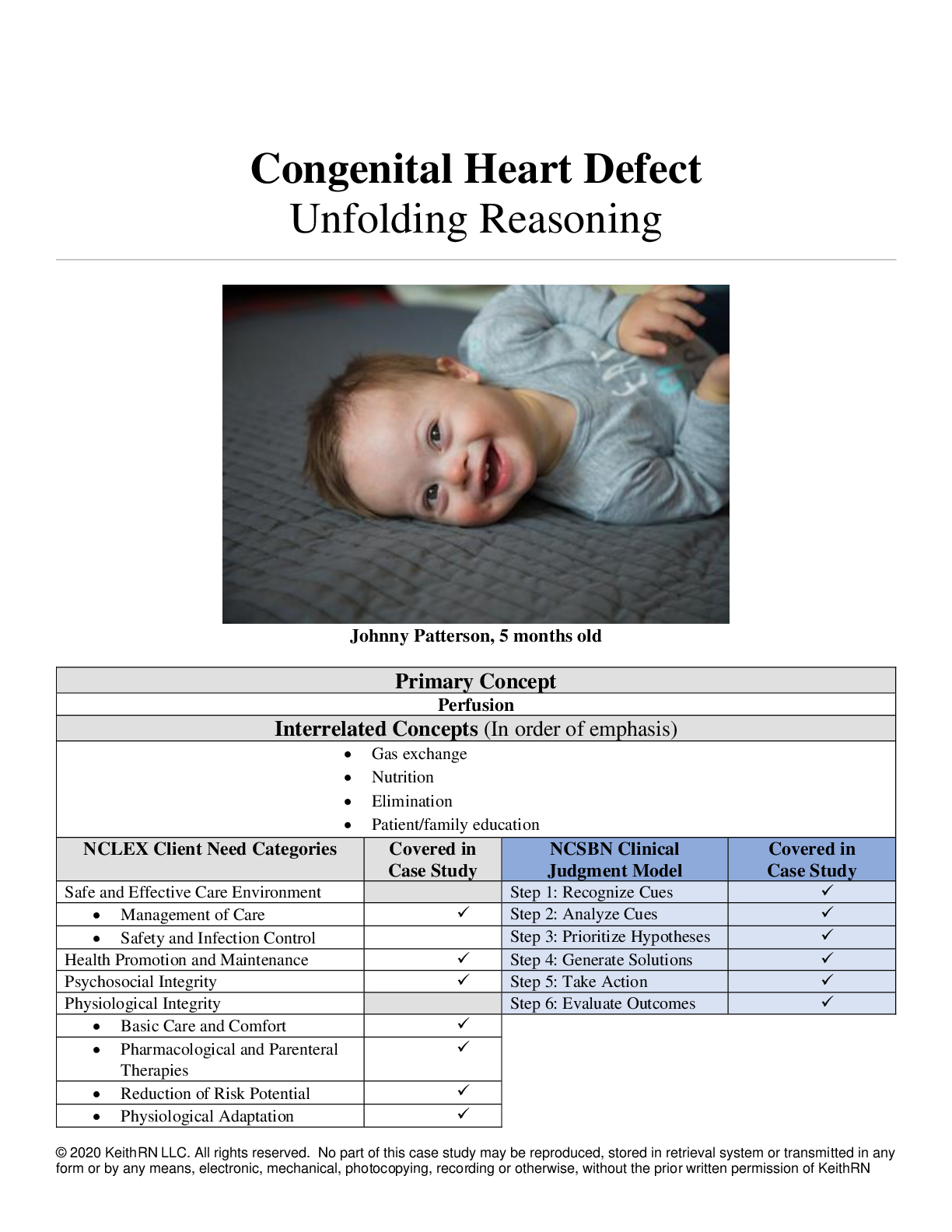
Johnny Patterson, 5 months old
Primary Concept
Perfusion
Interrelated Concepts (In order of emphasis)
• Gas exchange
• Nutrition
• Elimination
• Patient/family e
...
Congenital Heart Defect
Unfolding Reasoning
Johnny Patterson, 5 months old
Primary Concept
Perfusion
Interrelated Concepts (In order of emphasis)
• Gas exchange
• Nutrition
• Elimination
• Patient/family education
NCLEX Client Need Categories Covered in Case Study NCSBN Clinical Judgment Model Covered in Case Study
Safe and Effective Care Environment Step 1: Recognize Cues
• Management of Care Step 2: Analyze Cues
• Safety and Infection Control Step 3: Prioritize Hypotheses
Health Promotion and Maintenance Step 4: Generate Solutions
Psychosocial Integrity Step 5: Take Action
Physiological Integrity Step 6: Evaluate Outcomes
• Basic Care and Comfort
• Pharmacological and Parenteral Therapies
• Reduction of Risk Potential
• Physiological Adaptation
Part I: History of Present Illness
Johnny Patterson was born at 38 weeks gestation and diagnosed with Trisomy 21 (Down Syndrome). At his one-week well checkup at the pediatrician’s office, a prominent heart murmur was auscultated. An
echocardiogram revealed a large ventricular septal defect immediately below the aorta. A referral was made to a cardiologist who suggested no immediate interventions because Johnny did not appear to be in any distress.
Three weeks later at his second cardiologist appointment, his parents report that Johnny seems to be sleeping more. He seems to have times when he breathes faster than usual, and becomes sweaty when he breastfeeds. His weight is 4 kg. At his last visit three weeks ago he weighed 4.4 kg. The cardiologist prescribed 12 mcg digoxin every 12 hours (0.05mg/ml solution is received from the pharmacy) and 8 mg furosemide every day (10mg/ml oral solution is received from pharmacy).
Personal/Social History:
Johnny lives with his mom and dad who were married eight years ago. His mom is 37 years old and Johnny is their first child. Mom has had two miscarriages before being able to carry this baby to term. Both parents are engineers. Mom has recently begun working part-time from home so day care is not needed.
1. What data from the histories are RELEVANT and must be NOTICED as clinically significant by the nurse?
(NCSBN: Step 1 Recognize cues/NCLEX: Reduction of Risk Potential)
RELEVANT Data: Clinical Significance:
Ventricular septal defect below aorta
Lost weight in last 3 weeks Breathing difficulty, diaphoresis
Prescribed digoxin and furosemide there is a hole in the heart between the left and right ventricles creating the murmur
decreased weight, difficulty feeding
diaphoresis are signs of a ventricular septald defect
aid in help of circulation and work more efficiently (possible surgery)
RELEVANT Data Social History: Clinical Significance:
Born at 38 weeks, mother at advancedmaternal age
Mother is able to work and stay hom a term birth and advanced maternal age is a risk factor of down syndrome
The baby does not have to attend daycare/babysitter, mother will be able to care
Dosage Calculation
Current weight: 4.0 kg
Digoxin 12 mcg BID PO. 0.05mg/ml solution.
Dose in mL: 0.24
Safe dose? yes
Furosemide 8 mg PO daily. 10mg/ml oral solution.
Dose in mL:0.8
Safe dose? yes
Johnny’s 5-month visit:
What data is RELEVANT and must be NOTICED as clinically significant by the nurse?
(NCSBN: Step 1 Recognize cues/NCLEX: Reduction of Risk Potential)
RELEVANT Data: Clinical Significance:
Increase meds as baby gains weight Digoxin dose is high, therapeutic effect range is 10-15 Furosemide increase
Dosage Calculation
Current weight: 7.2 kg
Digoxin 22 mcg BID PO. 0.05mg/ml solution.
Dose in mL: 0.44
Safe dose? yes
Furosemide 14.4 mg PO daily. 10mg/ml oral solution.
Dose in mL:1.44
Safe dose? yes
Present Problem: Two Weeks Later…
His mother brings Johnny, now 5 ½ months old, to the emergency department (ED). She is extremely anxious and states, “Something is wrong with my son. I can’t get him to keep any of his feedings down. Please help him!” The triage nurse obtains a history from the mother and finds out that he has vomited repeatedly the past 24 hours and had several loose stools. She reports that Johnny has been sleepier the last couple of hours.
He was started on digoxin and furosemide four months ago to manage his heart failure secondary to a VSD that was diagnosed when he was one month old. When asked if she checks Johnny’s heart rate before giving digoxin, his mom admits that she forgot and has not checked his HR the past week. Education given about the need to check Johnny’s heart rate before each dose of digoxin and not to give the medicine if the heart rate is below 90 beats per minute.
2. What data from the histories are RELEVANT and must be NOTICED as clinically significant by the nurse?
(NCSBN: Step 1 Recognize cues/NCLEX: Reduction of Risk Potential)
RELEVANT Data Present Problem: Clinical Significance:
Keeps vomiting and not able to keep feedings down Increased sleeping
Unchecked HR prior to medication administration Possible digoxin toxicity Decreased HR= holding dose
Patient Assessment
Current VS: Normal Range: 5-month old FLACC Score:
T: 37.0 rectal (C) Faces: 0
P: 85 (regular) Awake 100-180, sleeping 90-160 BPM Legs: 0
R: 36 (regular) 30-53 BPM Activity: 0
BP: 74/50 left leg Systolic 72-104 mm/Hg
Diastolic 37-56 mm/Hg Crying: 0
O2 sat: 98% on RA Consolability: 0
What VS data are RELEVANT and must be NOTICED as clinically significant by the nurse? (NCSBN: Step 1 Recognize cues/NCLEX: Reduction of Risk Potential Reduction of Risk Potential/Health Promotion and Maintenance)
RELEVANT VS Data: Clinical Significance:
Pulse 85
Weight 6.5 kg Low heart weight
The baby has lost weight, possibly due to not able to keep feedings down?
Current Head to Toe Nursing Assessment:
GENERAL SURVEY: Arouses easily but falls back to sleep
NEUROLOGICAL: Patient opens eyes when Mom talks to him, but closes eyes quickly
HEENT: Eyes PERRLA, Head without obvious deformities, Lips dry
RESPIRATORY: Breath sounds equal and clear posteriorly and anteriorly
CARDIAC: Circulation: Pink, warm & dry, no edema, heart sounds regular, pulses strong, equal. Capillary refill on toes 3 to 4 seconds
ABDOMEN: Abdomen round, soft, and nontender. BS active in all 4 quadrants
GU: No wet diaper in 6 hours per parent
INTEGUMENTARY: Skin cool, dry, intact, normal color for ethnicity. Skin turgor decreased
GI: Vomiting, diarrhea, decreased appetite
What assessment data is RELEVANT and must be NOTICED as clinically significant by the nurse?
(NCSBN: Step 1 Recognize cues/NCLEX: Reduction of Risk Potential Reduction of Risk Potential/Health Promotion & Maintenance)
RELEVANT Assessment Data: Clinical Significance:
Lethargic
Arouses easily and falls back asleep Skin turgor decreased Medication is possibly making the baby more tired and lethargic. Could be possible toxicity/side effects and lead to fluid/electrolyte imbalnce
Baby is showing no signs of dehydration
3. Interpreting relevant clinical data, identify potential problems. What additional data is needed to identify the priority problem and nursing priorities? (NCSBN: Step 2 Analyze cues/NCLEX: Management of Care/Physiologic Adaptation)
Likely Problems: Additional Clinical Data Needed:
Drug toxicity Possible side effects Digoxin serum level test
urinalysis. serum electrolyte test, BUN, CBC, and creatinine
While awaiting lab results, the primary care provider orders the following:
Care Provider Orders: Rationale: Expected Outcome:
Establish peripheral IV
0.9% NS 10 mL/kg over 15 minutes
Place on cardiac monitor access to administer possible fluids and medications rehydrate infant and help with symptoms
monitor babys HR and rhythm (digoxin) the baby will have patent IV that is clean, dry, and intact, no edema or redness.
baby will have no signs of dehydration/diarrhea any heart abnomalities will recorded to read data and help determine possible problem
4. What are the nursing considerations with the effect on hospitalization for a child of this age?
Interpreting Diagnostic Data
Lab Results:
Complete Blood Count (CBC)
WBC HGB PLTs % Neuts Bands
Normal Range: 6.1-17.5 g/dL(1
to 23 months) 9.3-13.3 mmol/L
(3 to 11 months) 275-565 x10 to
the 3??/microL (3 to 6 months
male) 1.9-5.4 absolute
value (1 to 23 months) 0.2 to 0.5 absolute value (1 to 23
months)
Current: 8.5 12.5 290 2.5 0
2 months ago: 7.5 11.9 280 2.4 0
What lab results are RELEVANT and must be recognized as clinically significant by the nurse?
(NCSBN: Step 1 Recognize cues/NCLEX: Reduction of Risk Potential Reduction of Risk Potential/Physiologic Adaptation)
RELEVANT Lab(s): Clinical Significance: TREND:
Improve/Worsening/Stable:
Bands Little increasing counts of HGB, WBC, normal with increasing age, the bands at 0 indicates the baby has low immunity and is at increased risk of infection stable
Basic Metabolic Panel (BMP)
Na K Gluc. Creat. BUN
Normal
Range: 134-142 (2 to 5
months) 3.5-5.6 (1 to 5
months) 30-100 (2 days
to 2 years) 0.31-0.71 (infant) 4-15 mg/dL (less than
2 years)
Current: 134 mEq/L 2.9 mmol/L 90 mg/dL 0.5 mg/dl 16 mg/dL
2 Months ago: 136 mEq/L 3.7 mmol/L 88 mg/dL 0.45 mg/dl 6 mg/dL
What lab results are RELEVANT and must be NOTICED as clinically significant by the nurse?
(NCSBN: Step 1 Recognize cues/NCLEX: Reduction of Risk Potential Reduction of Risk Potential/Physiologic Adaptation)
RELEVANT Lab(s): Clinical Significance: TREND:
Improve/Worsening/Stable:
Potassium decreased Bun increased hypokalemia: diuretic & vomiting/diarrhea
Dehydration, fluid loss and kidney's do not have enough to replace what has been lost
Evidence of digoxin toxicity Worsening
Misc.
Digoxin
Normal Range: 0.5-2 ng/ml
Current: 2.5 ng/mL
2 months ago: 1.7 ng/mL
RELEVANT Lab(s): Clinical Significance: TREND:
Improve/Worsening/Stable:
Digoxin leve increased Digoxin toxicity, narrow therapeutic range and over 2 is considered toxic
Medication needs to be stoped immediatley Worsening
Put it All Together to Think Like a Nurse
1. Interpreting clinical data collected, rank the most likely problems by priority. Which problem is priority? Why?
(NCSBN: Step 2: Analyze cues/Step 3: Prioritize hypotheses/NCLEX: Management of Care)
Problems: Priority Problem: Rationale:
Dehydration
Increased level of Digoxin/fluid electrolyte imbalance Digoxin toxicity the baby is showing signs of digoxin toxicity (dehydration, hypokalemic, gi symptoms)
2. What is the pathophysiology of the priority problem? (NCLEX: Management of Care/Physiologic Adaptation)
Priority Problem: Pathophysiology of Problem in OWN Words:
Digoxin toxicity causing hypokalemia/dehydration can lead to toxicity
diuretic is causing dehydration in the baby and leading to the kidneys to be less effective at clearing the digoxin from the babys system
3. What body system(s) will you assess most thoroughly based on the primary/priority problem? Identify correlating specific nursing assessments. (NCLEX: Reduction of Risk Potential/Physiologic Adaptation)
PRIORITY Body System: PRIORITY Nursing Assessments:
Heart GI/GU
Vitals/physical assessment Labs rate/rhythm I&O's
continuing vitals, look for early signs of infection (elevated temp), breathing/respirations, reflexes, pulses and weight
blood work to assess levels
4. What nursing priority (ies) and goal will guide how the nurse RESPONDS to formulate a plan of care? (NCSBN: Step 4 Generate solutions/Step 5: Take action/NCLEX: Management of Care)
Nursing PRIORITY: Restore electrolytes and fluids, restore heart rate and rhythm
GOAL of Care: restore status, hydration, heart rhythm, no adverse effects of medication present
Nursing Interventions: Rationale: Expected Outcome:
Stop digoxin medication cardiac monitoring fluid/electrolytes
vitals, assessments, labs Toxic level found
toxicity causes arrhythmias and decreased HR
continuous monitoring will help watch for further possible complications increased HR
stable HR and rhythm
hydration/potassium levels restored
baby without further complications
5. What is the worst possible/most likely complication(s) to anticipate based on the primary problem?
(NCLEX: Reduction of Risk Potential/Physiologic Adaptation)
Worst Possible/Most Likely Complication to Anticipate:
Nursing Interventions to PREVENT this Complication: Assessments to Identify Problem EARLY: Nursing Interventions to Rescue:
cardiac monitoring electrolyte monitoring assess heart, pulses, lungs and frequent labs administer medication correct electrolyte imbalance
notify rapid response team to appropriate providers
Collaborative Care: Medical Management
6. State the rationale and expected outcomes for the medical plan of care. (NCLEX: Pharm. and Parenteral Therapies)
Care Provider Orders: Rationale: Expected Outcome:
Admit to PICU Cardiac Monitor baby will be watched closley for life thratening situations
continuous cardiac monitoring to avoid complications from arrhythmias restore levels
restore rate and rhythm
Maintenance IV fluids Strict I & O
Evaluate need for digoxin immune Fab (Digibind)
Hold digoxin
Complete metabolic panel (CMP) in AM
Digoxin level in AM fluid and electrolyte imbalance, dehydrated with low level of potassium. Intake will flush high levels of digoxin.
I&O to assess dehydration status and restore proper function
toxic level of digoxin and may need digibind if stopping medication alone does not stabalize baby
digoxin needs to be stopeed as med is not within therapeutic range
CMP to assess if treatments are working
digoxin level will provide if treatment is working and if anything further needs done and if in therapeutic range
7. Which orders do you implement first? Why? (NCLEX: Management of Care)
Care Provider Orders: Order of Priority: Rationale:
• Cardiac Monitor
• Maintenance IV fluids
• Strict I & O
• Evaluate need for digoxin immune Fab (Digibind)
• Hold digoxin
• CMP in AM (Pediatric digitalis toxicity,
n.d.) cardiac monitor hold med
evaluate for immunefab iv fluids
I&O CMP Cardiac monitoring to see where the babys rate/rhythm to establish ongoing treatment
No further doses of med and not given until baby is stable Digblind may be necessary before anything else if arrhythiias notes are life threatening
Iv fluids to restore hydration/electrolytes
Once baby is receiving treatmetn of fluids the baby can be assessed to imporovment
CMP needed but would be last as need to give treatments time
8. What psychosocial/holistic care PRIORITIES need to be addressed for this patient?
(NCLEX: Psychosocial Integrity/Basic Care and Comfort)
Psychosocial PRIORITIES:
trust vs mistrust bonding Use your lens of practice as an educator to determine how you would establish a plan of care for each of the psychosocial priorities identified above. I have some general recommendations below that can be used to
initiate dialogue and discussion.
PRIORITY Nursing Interventions: Rationale: Expected Outcome:
CARE/COMFORT: baby needs to feel safe, will be more calm and receive treatment better. Limit strangers, noises and bright lights
mom can bond and hold baby and will be more relaxed
parents have possible anxiety and worry about health in future. provide education baby will be calm with parents and calm environment
baby will not regress developmentally due to hospitalization
parents will be less anxious and confident in the care for their baby
Evaluation: Two Hours Later in PICU…
1. After implementing the plan of care, EVALUATE your patient by INTERPRETING relevant clinical data.
(NCSBN: Step 6 Evaluate outcomes/NCLEX: Management of Care)
RELEVANT Assessment Data: Clinical Significance:
1 wet diaper in last 2 hr 30ml alert and interacting
HR 130, no pvc's, no arrhythmias fluids restoring and baby rehydrating improvment of lethary/drowsiness
HR has increased and baby no longer bradycardic, no arrhythmias
status is improing
2. Has the overall status of your patient improved, declined, or remain unchanged? What is the current nursing PRIORITY? If your patient has not improved, what nursing interventions need to be implemented?
(NCSBN: Step 6 Evaluate outcomes/NCLEX: Management of Care)
Overall Status: Current Nursing Priority: Nursing Interventions:
continue to monitor and assess the baby, all relevant systmes, vitals and labs to ensure the baby continues to make improvment and is stable
3. What educational/discharge priorities are needed to develop a teaching plan for this patient and/or family?
(NCLEX: Health Promotion and Maintenance)
PRIORITY Topics to Teach: Rationale:
education of meds and dosage/precautions when to call the doctor
signs of dehydration and adverse effects
nutrition maintencance med knowledge will help prevent risk involved and adverse effects (apical pulse before administering med) knowing when to call doctor will reduce life threatning conditions
knowing early signs of dehydratin and toxicity can help the baby get treatment support family or home health care
baby lost weight during hospital stay and may be at risk for nutrien deficieny
Reflect on Your Thinking to Develop Clinical Judgment
4. To develop clinical judgment, reflect on your thinking that was used to complete this case study by answering the following questions:
What did you do well in this case study? What knowledge gaps did you identify?
evaluating the data collected to figure out the problem therapeutic range
What did you learn? How will you apply learning caring for future patients?
digoxin toxicity can reduce without administering digfab with proper fluid restoration assessmetn and critical data leading to care helps put the pieces together
[Show More]

 Correct Study Guide, Download to Score A.png)
 CASE STUDY_ CONGENITAL HEART DEFECT Trisomy 21 Unfolding Reasoning Johhny Patterson 5 months Old.png)