Keiser University :NURSING MISC VATI funds
A nurse is preparing to administer diazepam 2 mg twice daily via NG tube. Available is diazepam oral solution 5 mg/1 mL. How many mL should the nurse administer with each dos
...
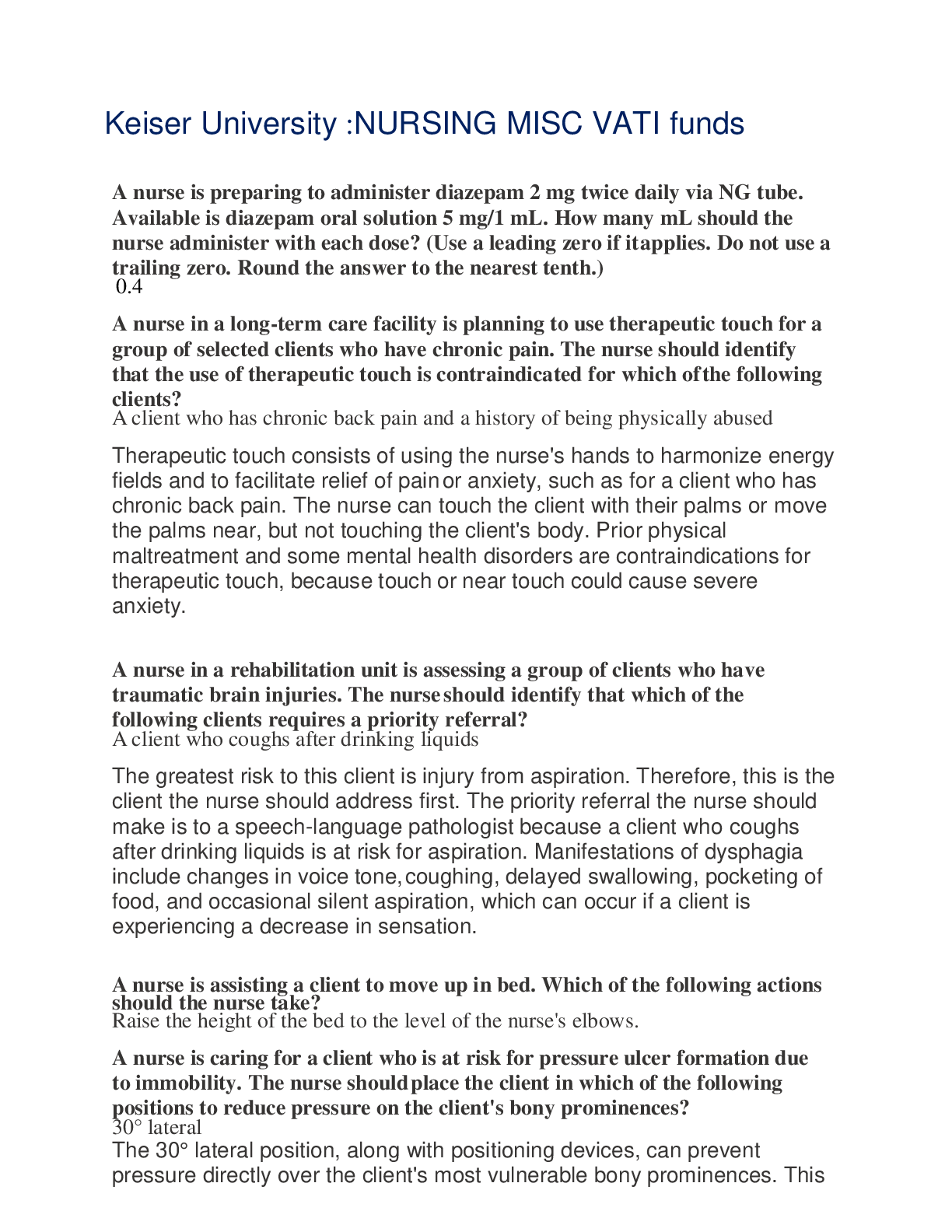
Keiser University :NURSING MISC VATI funds
A nurse is preparing to administer diazepam 2 mg twice daily via NG tube. Available is diazepam oral solution 5 mg/1 mL. How many mL should the nurse administer with each dose? (Use a leading zero if it applies. Do not use a trailing zero. Round the answer to the nearest tenth.)
0.4
A nurse in a long-term care facility is planning to use therapeutic touch for a group of selected clients who have chronic pain. The nurse should identify that the use of therapeutic touch is contraindicated for which of the following clients?
A client who has chronic back pain and a history of being physically abused
Therapeutic touch consists of using the nurse's hands to harmonize energy fields and to facilitate relief of pain or anxiety, such as for a client who has chronic back pain. The nurse can touch the client with their palms or move the palms near, but not touching the client's body. Prior physical maltreatment and some mental health disorders are contraindications for therapeutic touch, because touch or near touch could cause severe anxiety.
A nurse in a rehabilitation unit is assessing a group of clients who have traumatic brain injuries. The nurse should identify that which of the following clients requires a priority referral?
A client who coughs after drinking liquids
The greatest risk to this client is injury from aspiration. Therefore, this is the client the nurse should address first. The priority referral the nurse should make is to a speech-language pathologist because a client who coughs after drinking liquids is at risk for aspiration. Manifestations of dysphagia include changes in voice tone, coughing, delayed swallowing, pocketing of food, and occasional silent aspiration, which can occur if a client is experiencing a decrease in sensation.
A nurse is assisting a client to move up in bed. Which of the following actions should the nurse take?
Raise the height of the bed to the level of the nurse's elbows.
A nurse is caring for a client who is at risk for pressure ulcer formation due to immobility. The nurse should place the client in which of the following positions to reduce pressure on the client's bony prominences?
30° lateral
The 30° lateral position, along with positioning devices, can prevent pressure directly over the client's most vulnerable bony prominences. This position can, however, cause pressure on the shoulder, ankle, anterior iliac spine, and trochanter. Therefore, the nurse should ensure the client's head is midline and supported, rotation of the spine is avoided, and position changes are implemented every 1 to 2 hr
A nurse is preparing to administer vancomycin 500 mg by intermittent IV infusion every 6 hr. Available is vancomycin 500 mg in 0.9% sodium chloride 100 mL to infuse over 2 hr. The nurse should set the IV pump to deliver how many mL/hr? (Round the answer to the nearest whole number. Use a leading zero if applicable. Do not use a trailing zero.)
50
A nurse is admitting a client who is to undergo a surgical procedure. Under the Patient Self-Determination Act (PSDA), which of the following actions is the nurse's responsibility regarding the client's advance directives?
Ask the client whether he has created advance directives.
A nurse is assessing a client who has hypokalemia. Which of the following manifestations should the nurse expect?
Decreased bowel sounds
Decreased bowel sounds are an indication of hypokalemia because of decreased excitability of cells, resulting in less responsiveness to normal stimuli in nerves and muscles.
A nurse is planning care for a client who has an endotracheal tube and is receiving mechanical ventilation. Which of the following interventions should the nurse include to reduce the client's risk for ventilator- associated pneumonia?
Swab the client's mouth with chlorhexidine solution.
A nurse is providing teaching to a client following a thoracentesis. Which of the following actions should the nurse take?
Position the client on her unaffected side.
The nurse should position the client on the unaffected side to help facilitate expansion of the affected lung
A nurse is completing a neurological assessment of an older adult client and notes that the client has become increasingly confused and agitated in the last 48 hr. Which of the following conditions is the priority assessment by the nurse?
Infection
A nurse is assessing a client who is receiving intermittent catheter irrigation following a transurethral resection of the prostate (TURP). Which of the following manifestations is the priority for the nurse to report to the provider?
Increase in bladder spasms
A nurse is providing discharge teaching to a client who has heart failure and a new prescription for furosemide. Which of the following foods should the nurse recommend to the client as the best source of potassium?
1 cup cantaloupe
A nurse is preparing to administer an opioid medication to a client who is experiencing pain. Which of the following actions should the nurse take?
Ask a second nurse to witness the discarding of unused opioid medication.
The nurse should ask a second nurse to witness the discarding of unused opioid medication and sign the designated form.
A nurse is providing discharge teaching to a client who is prescribed home oxygen therapy using a compressed oxygen system. Which of the following statements by the client indicates to the nurse that the teaching has been effective?
"I will store oxygen tanks in an upright position."
This statement by the client indicates an understanding of the teaching. The nurse should instruct the client to store oxygen tanks in an upright position in a holder to prevent damage to the tank and injury to the client and the client's family.
A school nurse is teaching a group of parents about measures to prevent firearm injuries in the home. Which of the following instructions should the nurse include in the teaching?
"Keep ammunition and guns in separate, locked locations."
A nurse is performing postmortem care for an older adult client who has just died. Which of the following actions should the nurse take?
Identify the client using two identifiers.
The nurse should identify the deceased client using two identifiers, such as name and birth date, or name and account number, and then compare the identifiers to the information in the client's medical records.
A nurse is caring for a client who had a stroke and is immobile. Which of the following actions should the nurse take to maintain the client's skin integrity?
Use an alcohol-free barrier product
The nurse should apply an alcohol-free barrier film to keep the client's skin dry and protect it from the collection of moisture. This action will help to maintain the integrity of the client's skin.
Repostion every 2 hours
A nurse is preparing to administer an intramuscular injection to a client. At which of the following angles should the nurse insert the needle?
90°
The nurse should plan to insert the needle at a 90° angle when administering medication via the intramuscular route. The intramuscular route promotes quicker medication absorption into the muscle than the other routes of medication administration.
45 60 degree- sub q
15 degree- intradermal
A nurse is providing teaching to an older adult client who has kyphosis and osteoporosis. Which of the following statements by the client indicates to the nurse that the teaching has been effective?
"I will increase daily intake of calcium and vitamin D."
A nurse is assessing a client who has an NG tube with continuous enteral feedings. The nurse auscultates coarse crackles in the client's lungs. After discontinuing the feeding, which of the following actions should the nurse take next?
Position the client on her side.
The greatest risk to this client is aspiration from possible dislodgment of the NG tube and aspirated stomach contents into the respiratory tract. Therefore, the priority nursing action to decrease exacerbation of the condition is to position the client on their side.
A nurse is caring for a client who is receiving intermittent enteral feedings via gastrostomy tube (G-tube). Which of the following actions should the nurse take when administering the feeding?
Pour the client's formula into the syringe, raising or lowering it to control the rate of flow.
A nurse is caring for a client who is recovering from a bronchoscopy. Select the area the nurse should assess before giving the client ice chips or fluids. (You will find "hot spots" to select in the artwork below. Select only the hot spot that corresponds to your answer.)
A nurse is providing teaching about cough etiquette to a client who has influenza. Which of the following instructions should the nurse include in the teaching?
Cover your nose and mouth with a tissue when coughing."
The nurse should instruct the client to cover their nose and mouth with a tissue when coughing. The client should discard the tissue promptly in the nearest trash container.
A nurse is inserting an NG tube for a client who has a new prescription for enteral feedings. Which of the following actions should the nurse take to verify the placement of the client's tube? (Select all that apply.) Examine the color of aspirated secretions.
Measure the pH of the client's aspirate.
Obtain an x-ray of the client's chest and abdomen.
Measure the amount of aspirate in the NG tube is incorrect. The nurse should measure the amount of aspirate in the NG tube when the client is receiving tube feedings to evaluate absorption. However, measuring the aspirate in the NG tube does not confirm placement.
Placement of the NG tube must be confirmed prior to initiating feedings.
Flush the tube with 50 mL of tap water is incorrect. The nurse should not instill fluid into an enteral tube until placement is confirmed.
Examine the color of aspirated secretions is correct. Gastric secretions are typically cloudy, green, or tan in color. Intestinal secretions are bile-stained and therefore, typically appear yellow
in color.
Measure the pH of the client's aspirate is correct. Stomach contents are usually acidic, with a pH less than 5.5. A pH of 6 is an indication that the distal end of the tube is located in the intestines. A pH above 7 is an indication that the distal end of the tube is located in the respiratory tract.
Obtain an x-ray of the client's chest and abdomen is correct. Radiological examination is the most reliable method of verifying the placement of a client's NG tube.
A nurse is reviewing data in a client's medical record. Which of the following pieces of information should the nurse expect to find in the nurses' notes?
The client's ability to cope with a new illness
A nurse is caring for a client who has a stressful job and reports a decrease in quality of sleep. Which of the following actions should the nurse take to assist the client to manage her stress effectively?
Help the client identify what triggers her stress.
A nurse is caring for a client who has a terminal illness. The client requests a do-not-resuscitate (DNR) status, but her family is opposing her decision. Which of the following actions should the nurse take first?
Gather information to support the client's need for DNR status
Using the nursing process, the first action the nurse should take is to assess the situation by gathering information to support the client's request for a DNR order. This information should include the client's current clinical status, factors such as the client's spirituality, culture, and family dynamics, and evidence from literature about the client's condition.
A nurse is assessing a client's coping skills. Which of the following client stressors should the nurse identify as internal?
Nutritional status
Fear of medical test results
MY ANSWER
Fear of medical test results is an internal stressor that originates within the body and mind of a client. Internal stressors are pressures that the client places upon themselves and are often the most common causes of stress. These stressors often force clients to deal with conflicting inner values and interactions with others.
When a client manages internal stressors, it enhances their ability to deal with external stressors.
A nurse is teaching pursed-lip breathing to a client who has COPD. Which of the following instructions should the nurse include in the teaching?
"Exhale slowly through your mouth."
A nurse is caring for a client who has a new onset of type 1 diabetes mellitus. The client has expressed feelings of hopelessness about managing the disease. Which of the following interventions should the nurse use first to encourage the client's efforts to manage the disease?
Exploring the client's past coping mechanisms
The first action the nurse should take when using the nursing process is to assess the methods that the client used to successfully cope with other issues in the past and then reinforce them. This will help encourage the client to begin to learn self-care.
A nurse is preparing to transfer a client who weighs 136 kg (300 lb) from a bed to a stretcher with the aid of an assistive personnel (AP). Which of the following actions should the nurse take?
Move the client using an air-assisted transfer device.
The nurse should place an air-assisted device under the client prior to transfers to prevent injury. An air- assisted transfer device is an inflatable mattress that minimizes friction to smoothly and efficiently move the client from the bed to the stretcher. In addition, at least two caregivers should assist with the transfer of a client who weighs 136 kg (300 lb).
A home health care nurse is conducting a fall risk assessment for an older adult client who lives alone. The nurse should identify which of the following factors as creating a significant risk for falls?
The client owning a small dog
A nurse is preparing to administer an IM injection of two medications in the same syringe as a single injection. (Move the steps into the box on the right, placing them in the selected order of performance. Use all the steps.
To mix medications from two vials in the same syringe, the nurse should first draw up a volume of air equal to the volume of the medication dosage from vial A. The nurse should then inject into vial A the volume of air equal to the amount of medication to withdraw from vial A, making sure the needle does not touch the medication. Next, the nurse should withdraw the needle from vial A and draw up the amount of air equal to the volume of the dose from vial B. The nurse should inject that air into vial B, and without withdrawing the needle, draw up the medication dose from vial B. After replacing the needle with a fresh sterile needle, the nurse can withdraw the prescribed amount of medication from vial A. The medications are then ready to administer.
A nurse receives a telephone call from a client's family member who asks the nurse for an update on the client's condition. Which of the following actions should the nurse take to maintain the client's confidentiality?
Encourage the family member to contact the client directly for information.
Nurses are legally and ethically obligated to maintain the confidentiality of client information, including the client’s current health status. Therefore, the nurse should encourage the family member to contact the client directly for more information.
A nurse is providing teaching to a client who has a new colostomy. Which of the following actions should the nurse take when demonstrating how to change the ostomy appliance?
Clean the peristomal skin with warm tap water.
A nurse is assessing a client who wears partial dentures and reports mouth pain. Which of the following actions should the nurse take?
Advise the client to rinse his mouth and dentures after each meal.
A nurse is caring for a client who has an ankle sprain and a prescription for an aquathermia pad. Which of the following actions should the nurse take?
Cover the pad with a pillow case before application.
The nurse should cover the aquathermia pad with a thin towel or pillowcase before use because applying the pad directly to the skin could cause a burn injury.
A home health nurse is visiting an older adult client. Which of the following statements by the client should alert the nurse to suggest additional safety measures in the client's home?
"I use space heaters to keep warm in the winter."
A common environmental hazard in the home is the use of space heaters, which can increase the risk of fire.
A nurse manager is teaching a group of newly licensed nurses about vancomycin-resistant enterococci (VRE) infections. Which of the following information should the nurse manager include in the teaching?
"VRE is a nosocomial infection."
A nurse is teaching a client who has a latex allergy about items found in the home that can contain latex. Which of the following items place the client at risk for an allergic reaction? (Select all that apply.) Dishwashing gloves is correct. Many kinds of dishwashing gloves contain latex. Therefore, it places the client at risk for an allergic reaction.
Adhesive tape is correct. Adhesive tape contains latex. Therefore, it places the client at risk for an allergic reaction.
Macadamia nuts is incorrect. Tree nuts are a significant trigger for allergies in adults. However, macadamia nuts do not come from a source that contains latex.
Bananas is correct. Certain foods such as kiwi, avocados, and bananas can trigger latex allergies.
Rubber bands is correct. Rubber bands contain latex. Therefore, they place the client at risk for an allergic reaction.
A nurse is preparing to teach a group of clients about the effect of smoking cessation on sleep patterns. Which of the following information should the nurse include in the teaching?
"Smoking cessation makes it easier to fall asleep at night."
A nurse is discussing death and dying with a client who has terminal cancer and is at the end of life. The client asks, "Am I really dying?" Which of the following responses should the nurse make?
"I would like to hear more about what you think."
A nurse is planning teaching to a client who has a new diagnosis of type 2 diabetes mellitus. Which of the following actions should the nurse take prior to performing the teaching? (Select all that apply.)
Establish the client's learning needs is correct. Prior to planning any teaching session, the nurse should perform a comprehensive assessment of the client's learning needs. This assessment incorporates information from the client's history and physical assessment, current health problems, understanding of and compliance with the prescribed treatment plan, and support system.
Determine the client's literacy level is correct. Knowing the client's literacy level is an important factor in communicating with the client and in delivering audiovisual presentations and written materials. If the client cannot understand the information the nurse presents, he will not learn.
Evaluate the client's readiness for learning is correct. The nurse should determine the client's physical readiness (pain control), emotional readiness (acceptance of diagnosis), and cognitive readiness (appropriate level of consciousness).
Verify the client's computer access is incorrect. The nurse can use a variety of teaching methods, such as dialogue, written materials, and role playing. Computer-assisted learning is not a prerequisite.
Identify the client's learning style is correct. The best way to learn varies from client to client. Some people learn best by watching a demonstration, while others thrive in a group setting, and others prefer to read information on their own. In a group setting, the nurse should use a variety of styles to accommodate most learners.
A nurse is reviewing the medical record for a client who is postoperative and has a prescription for a clear liquid diet. Based on the information in the medical record, which of the following actions should the nurse take first? (Click on the "Exhibit" button below for additional client information. There are three tabs that contain separate categories of data.)
Obtain a prescription for IV fluids.
The greatest risk to this client is injury from dehydration. Therefore, the first action the nurse should take is to contact the provider for a prescription to initiate IV fluid infusion. The client has assessment findings that indicate fluid volume deficit and dehydration. The client has an increased urine specific gravity, a decreased blood pressure, an increased temperature, and a weak pulse. The client also has increased fluid output with decreased intake as well as concentrated urine. The fastest way to prevent worsening dehydration is to administer IV fluid.
A nurse is assessing a client for hearing acuity by performing the Rinne test. Which of the following actions should the nurse take when performing this test?
Move a vibrating tuning fork's prongs in front of the client's left or right ear canal.
A nurse is providing discharge teaching about bathtub safety to an older adult client. Which of the following statements by the client indicates an understanding of the teaching?
"I will place a bath mat in front of the tub."
The client should place a bath mat in front of the tub because it decreases the risk for falls. The client's wet feet could become slippery and slide on the floor without a bath mat
A nurse manager is teaching a group of newly licensed nurses about which procedures are within their scope of practice. Which of the following examples should the nurse include in the teaching?
Monitoring a continuous intra-arterial infusion of a thrombolytic medication
Monitoring the infusion of a clot-dissolving agent is within a nurse's scope of practice. In addition, the nurse should inspect the IV line for a disconnection, check the infusion site for bleeding, and maintain site integrity.
A nurse is administering oral care to a client who is unconscious. Which of the following actions is the nurse's priority to ensure client safety?
Place the client in a side-lying position.
The greatest risk to this client is injury from aspiration. Therefore, the first action the nurse should instruct the family to perform is to place the client in a side-lying position. If the client should not be placed in a side-lying position, then the nurse should instruct the family to turn the client's head to the side to allow fluid to run out of the client's mouth.
A nurse is preparing to notify the provider about a change in a client's status. Which of the following information should the nurse plan to include in the background portion of the Situation, Background, Assessment, Recommendation (SBAR) communication tool?
Previous treatments The nurse should include previous treatments in the "background" portion of the SBAR communication tool. Other information the nurse should include in the "background" portion is the client's admission history, diagnosis, pertinent medical history, and code status.
A nurse is caring for a client who is pulling at his abdominal wound drains. The provider prescribes wrist restraints for the client's safety. To which of the following parts of the bed should the nurse secure the restraints?
Moveable portion of the bed frame
Attaching the wrist restraints to the moveable portion of the bed frame allows the head of the bed to be raised or lowered without causing injury to the client.
A nurse in the surgical department is completing a preadmission interview with a client who is to undergo surgery the next day. The client reports a latex allergy. Which of the following interventions should the nurse include when planning care for the client's surgery? (Select all that apply.)
Schedule the client as the last case of the day is incorrect. A client who is allergic to latex should be the first case of the day in the surgical department. This allows overnight removal of latex dust from the previous day.
Notify ancillary departments of the client's allergy is correct. Notifying ancillary departments of the client's sensitivity to latex allows the staff to take appropriate measures to ensure medications and surgical items are not contaminated by latex.
Label the surgical suite as latex-free is correct. This helps keep personnel from bringing rubber products into the room.
Provide powdered gloves for the staff's use is incorrect. Powder from products containing latex can transmit allergens from the hands of health care personnel to the client.
Ensure a latex allergy cart is available is correct. A latex allergy cart should be kept in the operating room at all times. All of the contents must be latex free.
A nurse is planning care for a client who is receiving an IV fluid infusion. Which of the following interventions should the nurse implement to maintain asepsis?
Change the primary IV infusion set every 96 hr.
The nurse should change the primary IV infusion set every 96 hr to minimize the risk of contamination and infection.
Change bag every 24 hrs
A nurse receives a telephone prescription from the provider who states, "Four milligrams of morphine diluted with five milliliters of sterile water intravenous each morning at nine o'clock before a client's dressing change". Which of the following entries indicates that the nurse is transcribing the prescription correctly?
Morphine 4 mg IV bolus daily at 0900 before dressing changes, dilute medication with 5 mL of sterile water A nurse is evaluating preoperative teaching to a female client who is to undergo surgery with general anesthesia. Which of the following statements by the client should indicate to the nurse that the teaching has been effective?
"I should remove nail polish from my fingers before surgery."
The nurse should instruct the client to remove nail polish for accurate pulse oximetry monitoring and for a clear view of the nail beds when assessing capillary refill.
A nurse in an acute care setting is planning care for a client and is preparing to delegate tasks to an assistive personnel (AP). Which of the following tasks should the nurse delegate to the AP?
Assisting a client with ambulation
When delegating client care activities to an AP, the delegating nurse should follow the five rights of delegation, which include right task, right circumstance, right person, right direction, and right evaluation. Assisting a client with ambulation is within the range of function of an AP
A nurse is planning care for a client who has a history of seizures. Which of the following interventions should the nurse include in the plan of care?
Ensure oral suction equipment is at the bedside.
The nurse should ensure that oral suction equipment is available at the client's bedside to prevent aspiration of oral secretions during a seizure.
A nurse is assessing a client who is postoperative following a cholecystectomy. Which of the following techniques should the nurse use to assess for peristalsis of the abdomen?
Auscultate for as long as 5 min.
Although it usually takes only 5 to 20 seconds to hear bowel sounds, the nurse might have to listen in all four abdominal quadrants for at least 5 min before determining that bowel sounds are absent.
A nurse is preparing to administer ophthalmic drops to a client. Which of the following actions should the nurse take?
Rest a hand on the client's forehead while instilling the drops.
The nurse should rest the nondominant hand on the client's forehead while instilling the drops. This action stabilizes the nurse's hand and ensures that the hand will move with the client if they move suddenly. This simple precaution reduces the risk of striking the client's eye with the dropper and injuring it.
A nurse is planning care for a group of clients. Which of the following clients should the nurse attend to first?
A client who has dysphagia and has a scheduled feeding
A home health nurse is making an initial assessment visit to an older adult client who has type 1 diabetes mellitus. Which of the following statements should the nurse make to evaluate the client's ability to measure blood glucose accurately?
Please show me how you use your glucometer
Asking for a return demonstration is an effective way to assess a client's ability to complete a psychomotor activity. The nurse should carefully observe the client using the glucometer to validate the client's understanding of the procedure and evaluate whether or not the method is accurate.
A nurse is applying a new transdermal patch to a client. Which of the following actions should the nurse take?
Wear gloves when applying the patch.
MY ANSWERThe nurse should apply the patch while wearing clean gloves to prevent transfer of the medication through the skin.
A nurse is planning an in-service about foot care for a group of clients who have peripheral neuropathy. Which of the following information should the nurse include?
Inspect the feet daily with a mirror
The nurse should include in the program to inspect the feet daily with a mirror for dryness, redness, lesions, or lacerations, which can place the client at risk for infection.
To mix insulin from two vials in the same syringe, the nurse should first draw up a volume of air equal to the volume of insulin from the intermediate-acting insulin vial. The nurse should then inject the volume of air equal to the amount of insulin to withdraw from the intermediate-acting insulin vial, making sure the needle does not touch the insulin. Next, the nurse should inject the volume of air equal to the insulin dose from the short-acting
insulin vial. Then, the nurse should withdraw the prescribed amount of insulin from the short-acting insulin vial. Lastly, the nurse should withdraw the prescribed amount of insulin from the intermediate-acting insulin vial. The insulins are now mixed and ready to administer.
A nurse is performing a family assessment for a client who has recently developed paraplegia following a stroke. Which of the following actions should the nurse take first? Determine how the client views the concept of a family.
-According to evidence-based practice, the nurse should first determine how the client views the concept of a family. This will influence the nurse's decision on how or whether to move forward in including the family into the client's plan of care.
A nurse is planning care for a client who has dysphagia and is at risk for aspiration. Which of the following referrals should the nurse make? Speech-language pathologist
MY ANSWER
The nurse should recommend a referral for a client who has dysphagia to a speech-language pathologist. Clients who have dysphagia have difficulty swallowing and are at risk for aspiration. The speech-language pathologist can perform a swallow study to determine the extent of the client's dysphagia and work with the client to develop new swallowing techniques.
A nurse is caring for a client who has suspected clonus. Which of the following actions should the nurse take to assess for this condition? Use a reflex hammer.
The nurse should use a reflex hammer to assess the client for clonus. The reflex hammer causes the muscle to immediately contract due to a two- neuron reflex arc involving the spinal or brainstem segment that innervates the muscle.
A nurse is creating a plan care for a client who requires suture removal. Which of the following actions should the nurse plan to take?
Cut the sutures as close to the skin as possible.
The nurse should cut the sutures as close to the skin as possible. The exposed part of the suture contains bacteria, so cutting close to the skin prevents bacteria from entering the clean wound, decreasing the risk for infection.
A nurse is moving a client up in bed with the assistance of another nurse. Which of the following actions should the nurse take?
Position the client's arms across their chest.
MY ANSWER
The nurse should position the client's arms across their chest to minimize friction during movement and prevent injury.
FLAG
A nurse is assessing an older adult client who has become increasingly confused and agitated in the last 48 hr. Which of the following conditions should the nurse expect?
Urinary tract infection
MY ANSWER
According to evidence-based practice, the nurse should expect the client who has a urinary tract infection to become increasingly confused and agitated. Confusion and agitation in older adult clients often result from a systemic infection, such as a urinary tract infection or pneumonia.
FLAG
A nurse is caring for a client who has terminal cancer. The client begins to cry and says, "I am afraid of dying." Which of the following responses should the nurse make?
"It must be a very difficult time for you."
MY ANSWER
The nurse is using the therapeutic communication technique of verbalizing the implied. This technique puts into words what the client has said indirectly and creates a more positive nurse-client relationship.
FLAG
A nurse is reviewing data in a client's medical record. Which of the following information should the nurse expect to find in the discharge summary section?
List of community resources
MY ANSWER
The nurse should expect to find a list of community resources provided to the client in the discharge summary section. Other information the nurse should expect to find in the discharge summary section includes unresolved problems, a list of complications to report to the provider, the mode of transportation used, and who accompanied the client at discharge.
FLAG
A nurse has administered 5 mL of medication to a client via NG tube. They used 30 mL of water to flush the tube both before and after the instillation. The nurse should document which of the following amounts as liquid intake for the client?
65 mL
MY ANSWER
A client who has an NG tube can receive numerous liquid medications, plus water to flush the tube before and after medications. Over a 24-hr period, these liquids can amount to a significant intake. The nurse should document
them on the intake and output record. A value of 65 mL accounts for 5 mL of medication and two 30-mL flushes.
CORRECT
FLAG
• Time Remaining: 00:41:05
• Pause Remaining: 00:05:00
PAUSE
A nurse receives a telephone prescription from the provider, who states, "Four milligrams of morphine diluted with five milliliters of sterile water intravenous each morning at nine o'clock before client dressing changes." Which of the following entries by the nurse indicates correct transcription of the prescription? Morphine 4 mg IV bolus daily at 0900 before dressing changes, dilute medication with 5 mL of sterile water
MY ANSWER
This entry by the nurse indicates correct transcription of the prescription. This transcription contains acceptable abbreviations according to The Joint Commission and includes complete information from the provider.
FLAG
A nurse is receiving change-of-shift report for a group of clients. Which of the following clients should the nurse plan to see first?
A client who has dysphagia and has a scheduled feeding
Using the airway, breathing, and circulation approach to client care, the priority action the nurse should take is to monitor the feeding of the client who is at risk for choking and aspiration. Therefore, the nurse should plan to see this client first.
FLAG
A school nurse is teaching a group of parents about measures to prevent firearm injuries in the home. Which of the following instructions should the nurse include in the teaching?
"Keep ammunition and guns in separate, locked locations."
MY ANSWER
The nurse should instruct the parents to keep ammunition in a locked cabinet separate from the firearms to reduce the risk for injury. This action will prevent access to the firearm and also prevents injury from accidental discharge because the firearm does not contain ammunition. Also, the keys to the cabinet should not be accessible to children.
FLAG
A nurse is assessing a client for hearing acuity by performing the Rinne test. Which of the following actions should the nurse take?
Move a vibrating tuning fork's prongs in front of the client's left or right ear canal.
MY ANSWER
The nurse should perform the Rinne test by placing the handle of a vibrating tuning fork on the client's mastoid process and then moving the vibrating prongs 1 to 2 cm (0.4 to 0.8 in) in front of the client's left or right ear canal. The Rinne test compares bone conduction with air conduction. The client is expected to hear sound conduction by air for twice as long as bone conduction.
FLAG
A nurse is assessing a client who wears partial dentures and reports mouth pain. Which of the following actions should the nurse take?
Advise the client to rinse their mouth and dentures after each meal.
MY ANSWER
The nurse should advise the client to rinse their mouth and dentures after each meal to remove food and particles and to promote healing of gums and oral mucosa.
FLAG
A nurse is teaching a client to manage stress by using progressive relaxation techniques. Which of the following statements by the client indicates an understanding of the teaching?
"I'll compare the sensations I feel when I tense my muscles to what I feel when I relax them."
Progressive relaxation involves tensing and relaxing specific muscles, moving progressively through the body's muscle groups. The key is to distinguish sensations during tension from those during relaxation.
FLAG
A charge nurse is providing an in-service about client advocacy to a group of newly licensed nurses. Which of the following examples should the nurse include?
Providing information about advance directives to a client
Providing information about advance directives is an example of advocacy. The nurse is protecting the client's rights by ensuring that the client has received information to make an informed decision about end-of-life care.
FLAG
A nurse is caring for a client who reports having insomnia due to increased stress. Which of the following actions should the nurse take first?
Determine the source of the client's stress.
MY ANSWER
The first action the nurse should take when using the nursing process is to assess or determine what is causing the client to experience increased stress.
FLAG
A nurse is admitting a client who is to undergo a surgical procedure. Under the Patient Self-Determination Act (PSDA), which of the following actions is the nurse's responsibility regarding the client's advance directives?
Ask the client whether they have created advance directives.
MY ANSWER
The PSDA requires facilities to provide information to clients about their rights under state law to make decisions, including the right to refuse treatment and formulate advance directives. Under the act, staff should ask the client if they have advance directives, and the nurse should document the client's response in the medical record.
[Show More]






.png)