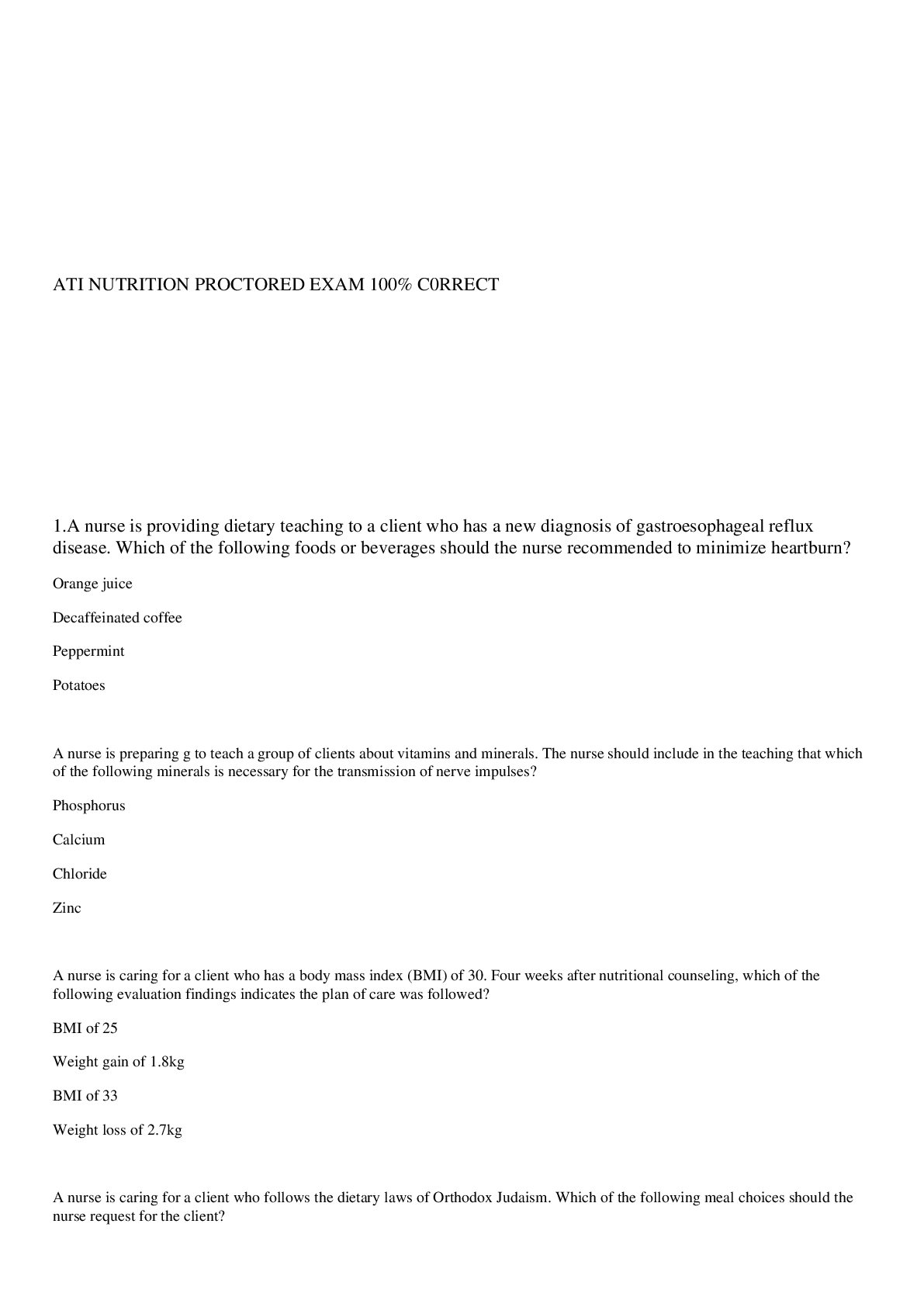
A nurse is caring for a client who is receiving TPN. Which of the following lab
findings indicates that the TPN therapy is effective?
A. Calcium 8 mg/mL
B. Hemoglobin 9 g/dL
C. Prealbumin 30 mg/dL
D. Cholesterol 140
...
A nurse is caring for a client who is receiving TPN. Which of the following lab
findings indicates that the TPN therapy is effective?
A. Calcium 8 mg/mL
B. Hemoglobin 9 g/dL
C. Prealbumin 30 mg/dL
D. Cholesterol 140 mg/dL
2. A patient who is Islam has a surgery during Ramadan. The nurse suspects
the patient may follow what rule?
Fasting during daylight hours while at the hospital
3. Basic food choices for kosher, orthodox Judaism diets:
- Prealbumin is indicative to nutritional status
- Meat
- no mixing meat and dairy (cheeseburger)
- no pork or shellfish
- fish must have scales & fins to be kosher4. A nurse is providing instructions to a client who has a new diagnosis of
celiac disease. Which of the following food choices by the client indicates a
need for further teaching?
A. Potatoes
B. Graham crackers
C. Wild rice
D. Canned pears
5. A client has anorexia nervosa. What interventions should the nurse
implement?
Observe client during meals. Reward client based on meals eaten.
Watch client after meals for potential purging.
6. A nurse is caring for a client who develops diarrhea while receiving a
continuous enteral tube feeding. Which of the following actions should the
nurse take?
A. Provide a low-protein formula
B. Elevate the HOB to 30 deg.
C. Switch to intermittent feedings
D. Warm the formula to room temp
7. A client has a headache. What deficiency may they have?
Vitamin A
- Graham crackers are made from wheat flour
All others are gluten-free
- A client can develop diarrhea if the formula is too cold.8. A nurse is caring for a client who has age-related macular degeneration
(AMD) & asks the nurse if there are any nutritional changes to consider.
Which of the following responses should the nurse make?
A. Use soy products as much as possible
B. Add niacin-rich foods to the diet
C. Increase dietary intake of lutein
D. Consume foods w/a high glycemic index
9. A mom tells the nurse their child has GERD. what might the nurse tell the
mom to do to prevent aspiration?
Place in side lying position if the baby is vomiting
10. A nurse is caring for a client who is on a full liquid diet due to dysphagia.
Which of the following nursing actions is the highest priority?
A. Add thickener to liquids.
B. Educate the client about acceptable liquids.
C. Perform a calorie count of consumed liquids.
D. Offer high-protein liquid supplements.
- (Found in vitamin A)
- this is highest priority to reduce the risk of aspiration11. A nurse is caring for a client who is at 8 weeks of gestation & has a BMI of
34. The client asks about weight goals during her pregnancy. The nurse
should advise the client to do which of the following?
A. Maintain her current BMI.
B. Gain approximately 6.8 kg (15 lb).
C. Lower her BMI to 30.
D. Gain 12.7 to 15.8 kg (28-35 lb).
12. A nurse is providing discharge teaching to a client who has a new
ileostomy. Which of the following dietary guidelines should the nurse
include in the teaching?
A. Plan to reduce dietary salt intake.
B. Cook foods w/limited amounts of pasta products.
C. Prepare meals on a schedule.
D. Reduce dietary B12.
13. A nurse is providing to a client who has dumping syndrome & is
experiencing weight loss. Which of the following instructions should the
nurse include in the teaching?
A. Consume liquids between meals
B. Increase intake of simple carbohydrates
C. Decrease foods high in fat content
D. Eat meals low in protein
14. A nurse is gathering assessment date from a client. what is an accurate
way to do this?
24 HR RECALL.
Food diary15. A nurse is providing teaching to a client who has DM & an HbA1c of 8.7%.
Which of the following statements by the client indicates understanding of
this lab value?
A. "I should have gone to my exercise class yesterday."
B. "This shows that my result is finally within normal range."
C. "This shows that I have not been following my diet."
D. "I should have my blood work done 1st thing in the morning."
16. A client who eats 75% of their meal daily asks when they can be weaned off
of TPN. How might the nurse respond?
You can be weaned off TPN when 60% of calories are coming from
the diet. As of right now, I see you are eating majority fo meals. I
will let the provider know about your decision to want to be weaned
off of TPN
17. A client has iodine deficiency. what should the nurse recommend?
Iodized salt
18. A new mom is beginning breast feeding/ bottle feeding. What should the
nurse suggest?
Feeding baby based on cues, every 3 to 4 hrs. Switch breasts after 5-
10 mins. Use 1-way valves.
19. A client has been in a traumatic accident. What might the nurse suspect
with his BMR?
It may be increased20. A client has COPD. What are some important considerations regarding
their diet?
Need high protein high carb diet. More fluids to help thin secretions
21. A client presents to the nurse with ascites. What might the nurse do to his
diet to reduce the ascites present?
Limit sodium to 2000mg or less daily
22. A client wants to lose weight. What might the nurse recommend to not lose
weight too quickly?
Loose a lb a week.
23. A client who is pregnant asks about what folic acid pills will help with. the
nurse’s appropriate response is:
folic acid should be increased during pregnancy to reduce fetal rural
tube defects
24. A client on tube feeds is experiencing diarrhea. What can the nurse to to
prevent this?
Slow the feed rate
25. A patient has stomatitis of the mouth and has been told by the provider to
rinse their mouth out every 2 hours. What types of mouthwashes should the
nurse recommend?
Normal saline, Lidocaine
No alcohol based, hydrogen peroxide and CHG because they can be
irritating26. A patient with stomatitis reports having a metallic taste from chemo drugs.
What should the nurse recommend?
Eat with plastic utensils
27. A patient with stomatitis reports they have lost weight due to the chemo
drugs. What interventions should the nurse recommend?
Eat cool or room temperature foods
Use a straw
May use sauces or gravies to help add flavor to food
Chew slowly
Have a high protein, low carb diet
Avoid citrus, salty foods and spicy food
Rinse mouth out with gentle mouthwash
Eat foods that are not filling
4-6 smaller meals a day
28. A patient receives TPN. What are important interventions the nurse should
take?
Obtain daily weights
Check blood glucose levels every 4 hrs.
Have 10% dextrose solution ready if the bag runs out
Check patient for egg allergy
Change tubing every 24 hrs.
Give via port or Central Line
If fat floating, return bag to pharmacy
29. A patient has dumping syndrome as a result of gastric bypass surgery.
What nutritional teaching should the nurse do with the patient?
Limit liquids with meals
Avoid exercise after meals
Eat slowly and chew thoroughly
Avoid sugars
Begin the meal with a protein
Lie down after meals30. Dumping syndrome S/S
Fullness, faintness, diaphoresis, tachycardia, palpitations,
hypotension, nausea, abdominal distinction, cramping, diarrhea,
weakness, and syncope.
31. If a client has a BMI between 25-29, they should be referred to a what?
Weight loss group
32. If a patient has a BMI less than 18.5, what are they at risk for?
Malnutrition
33. s/s of malnutrition
dry, thin hair, dry mucous membranes, cool extremities, low BP,
high HR with weak and thready pulse
muscle wasting present
confusion
34. Patients with a BMI of greater than 30 are at risk for:
diabetes, CVD, stroke
35. A patient reports following Kosher laws. What dietary practices might they
follow?
No pork. They will eat meat with dairy only. Must have separate
prep boards for meats.
36. Order of how the body gets energy from macronutrients in the body:
carbs, fats, proteins37. A patient asks the nurse what is the meaning of his HbA1C. How might the
nurse respond?
The HbA1C is a measurement of how well you have been
maintaining your sugars within 3 months. A reading of 4-6% is
considered normal. For diabetics, they should aim to have readings
between 6.5% and 7% to be considered healthy.
38. A patient has burns amongst 15% of his body. What are likely some
nutrition interventions the nurse will perform?
Give patient high calorie, high protein diet, use enteral feedings to
increase food consumption
39. Amounts of nutrients providing energy to the body:
Carbs and Protein: 4 g
Fats: 9g
40. A patient has coronary artery disease. What is a food the nurse might
recommend?
Baked salmon
41. Triglycerides range
<150 mg/dL
42. LDL range
less than 13043. HDL range
[Show More]






.png)



 (2100+ Q & A).png)









 2019 AG21.png)

