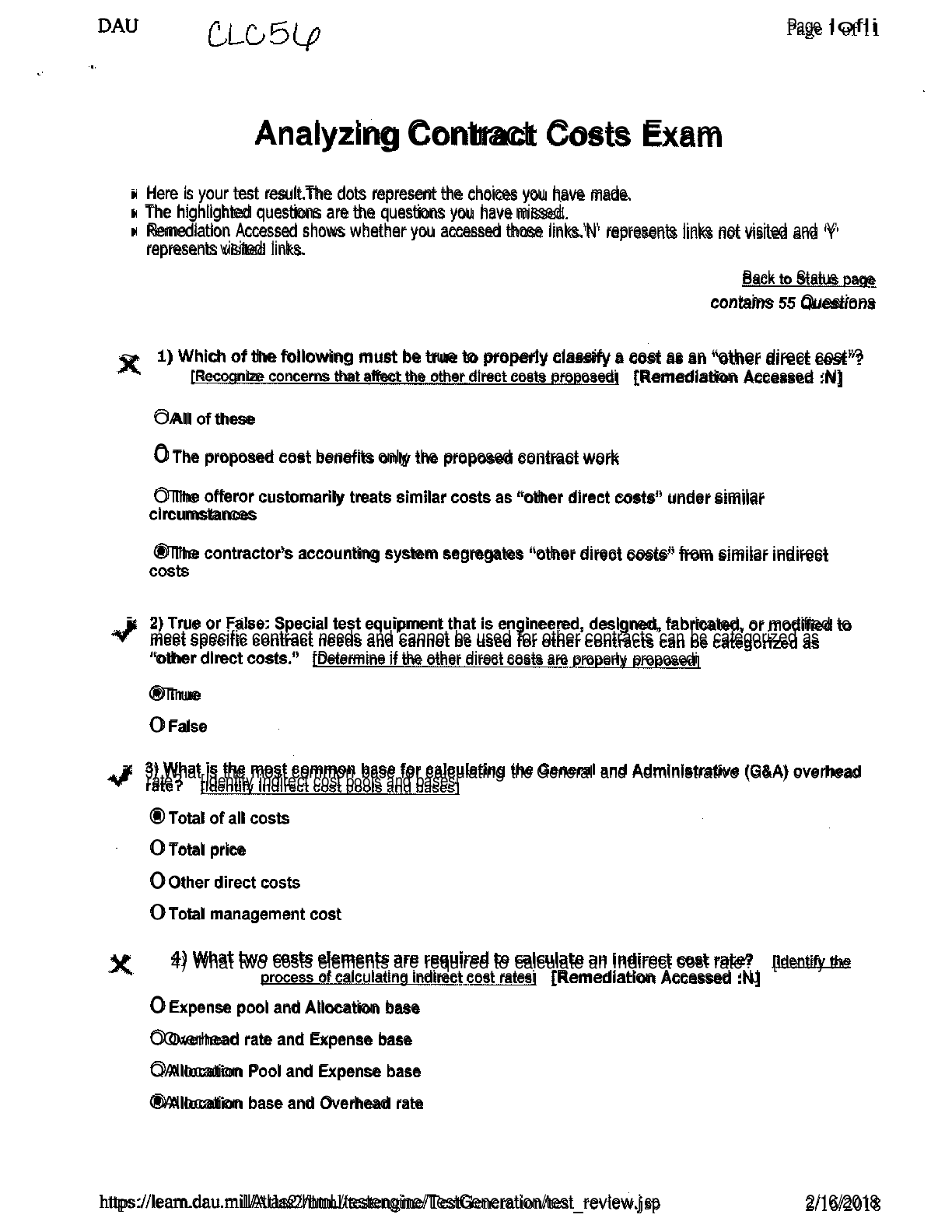
1) Which of the following must be true to properly classify a cost as an “other direct cost”?
[Recognize concerns that affect the other direct costs proposed]
All of these
The proposed cost benefits only the proposed
...
1) Which of the following must be true to properly classify a cost as an “other direct cost”?
[Recognize concerns that affect the other direct costs proposed]
All of these
The proposed cost benefits only the proposed contract work
The offeror customarily treats similar costs as “other direct costs” under similar
circumstances
The contractor’s accounting system segregates “other direct costs” from similar indirect
costs
2) Which of these statements below is correct regarding the criteria for classifying a special test
equipment cost as an "other direct cost”? [Determine if the other direct costs are properly
proposed]
Engineered, designed, fabricated, or modified to meet specific contract needs and cannot be
used for other contracts
An item (e.g., fixture, pattern, or gauge) that is necessary in aiding the development of a unique
product
Engineered, designed, fabricated, or modified to meet not only the requirements of the current
contract but also the requirements of all other contracts
Developed and engineered by a subcontractor who is not currently working on another contract
3) Which of the following is an indirect cost pool? [Identify indirect cost pools and bases]
General and Administrative Expenses
Direct material
Assembly labor
Manufacturing labor
4) What two costs elements are required to calculate an indirect cost rate? [Identify the process of
calculating indirect cost rates]
Expense pool and Allocation base
DAU Page 1 of 12
Overhead rate and Expense base
Allocation Pool and Expense base
Allocation base and Overhead rate
5) In which of the following phases does the contractor determine actual indirect cost rates?
[Identify the cost allocation cycle]
Final Allocation Phase
Beginning Payment Phase
Forward Pricing Phase
Billing Phase
6) How is simple linear regression used? [Identify what regression analysis is]
To make predictions about one dependent variable based on one independent variable
To make predictions about one dependent variable based on more than one independent
variable
To calculate an estimate that demonstrates the most likely average value based on the data
supplied
To ensure contractor’s estimates properly capture the reduction of labor costs associated with
repetitive production tasks
7) Which regression method would be used when there is more than one independent variable?
[Identify the different regression analysis methods]
Multivariate regression
Simple linear regression
Curvilinear regression
Segmented regression
8) Identify the situation where you would use simple linear regression. [Identify contract pricing
situations where simple regression analysis should be considered]
Indirect cost rate analysis
Labor classification analysis
Facilities Capital Cost of Money calculation
Profit objective calculation
9) Which variable is also considered the independent variable? [Identify the steps for using simple
regression analysis]
X
Z
R
DAU Page 2 of 12
Y
10) Which of the following situations would the use of improvement curve analysis likely be useful
in evaluating proposed costs? [Identify situations where improvement curve analysis would be
appropriate]
Assembly line repair of a turret assembly for an M1/A2 Abrams tank
Assembly of two prototype aerial refueling airplanes
Fabrication of a single jet engine frame assembly
Fabrication of a new aircraft carrier
11) What is the best method for determining an improvement curve slope? [Identify the steps for
using improvement curve analysis]
Using actual historical data
Using the median percentage from similar products
Using established slopes from the Cost Estimator’s Reference Manual
Using established slopes derived on recent procurements
12) Given the improvement curve data, calculate the cost objective for unit #8.
Labor hours for unit #4: 120 hours
Labor hours for unit #1: 160 hoursa
Rate of improvement: 10%
Improvement curve slope: 90%
[Calculate an objective using improvement curve analysis]
108
12
16
144
13) Which of the following are factors used in calculating the Facilities Capital Cost of Money
(FCCOM) amount? [Recognize elements affecting facilities capital cost of money]
Proposal allocation base amounts
Percentage of land, building, and profit distributions
Company-wide allocation base amounts
Division-wide allocation base amounts
14) Which of the following is a factor that affects profit/fee calculations? [Identify the factors
affecting profit/fee analysis]
Contract type
Distribution of equipment percentage
Magnitude of the contract in dollars
DAU Page 3 of 12
Profit/fee percentage historically paid to contractor
15) When is the working capital adjustment used while calculating profit/fee? [Calculate a profit/fee
using the appropriate structured approach]
On all fixed price contracts with progress payments
On all fixed price contracts
On all fixed price contracts with financing
On all fixed price contracts with performance based payments
16) What is the “base” that used in the calculation of the performance risk, contract type risk, and
cost efficiency factor when using the weighted guidelines to determine a profit/fee objective? [–
Develop a pre-negotiation position for profit or fee that is fair and reasonable.]
Total costs
Subtotal of costs
Total price
Direct and Indirect costs
17) What is the government’s primary objective in negotiations? [Identify factors that contribute to
success in any negotiation]
To agree on a price that is fair and reasonable to the government and the contractor
To establish a profit/fee percentage that is in line with previous contracts with the particular
contractor
To agree on each element of cost with the contractor
To ensure the agreed to price is the same, or lower, than the government’s objective
18) What is the n
[Show More]