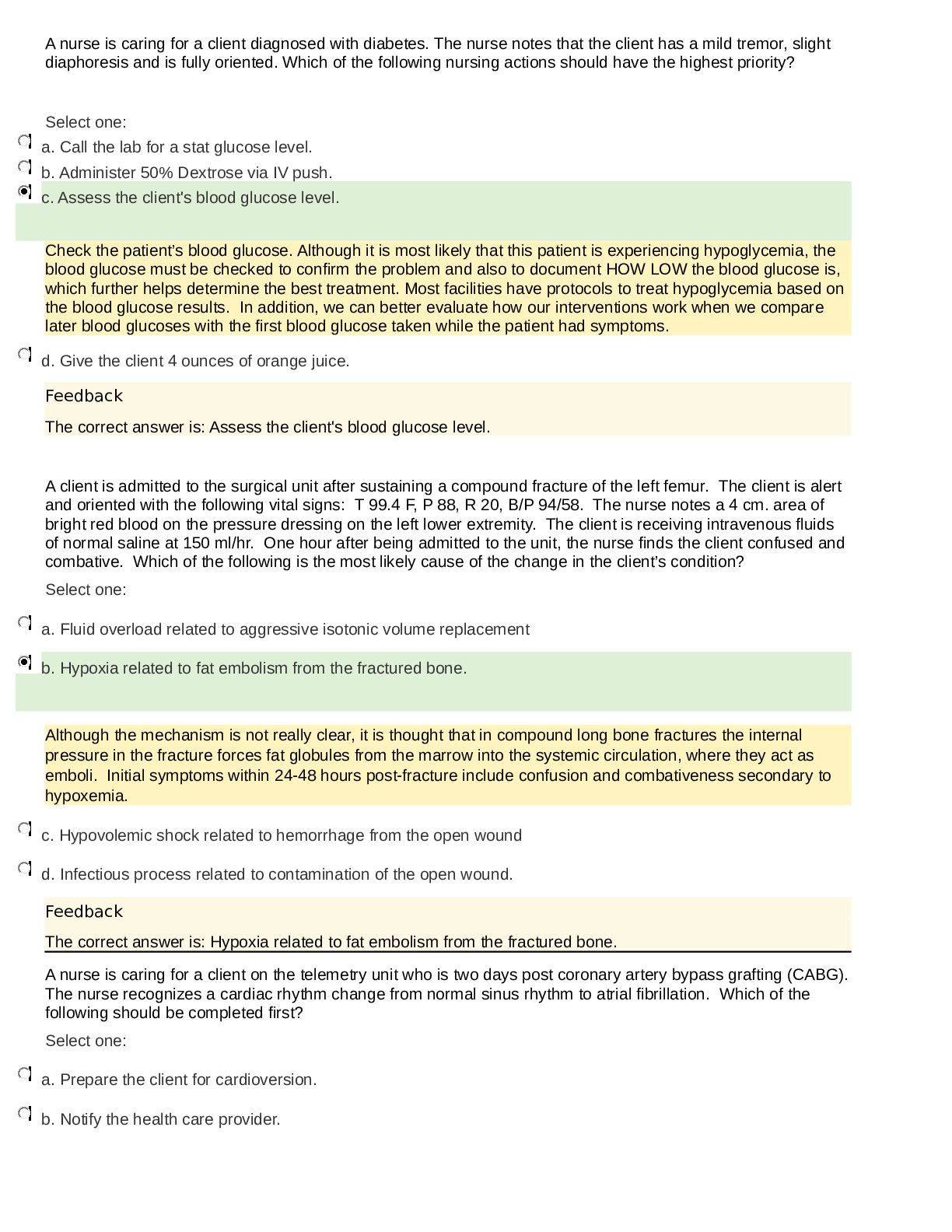
A nurse is caring for a client diagnosed with diabetes. The nurse notes that the client has a mild tremor, slight
diaphoresis and is fully oriented. Which of the following nursing actions should have the highest priorit
...
A nurse is caring for a client diagnosed with diabetes. The nurse notes that the client has a mild tremor, slight
diaphoresis and is fully oriented. Which of the following nursing actions should have the highest priority?
Select one:
a. Call the lab for a stat glucose level.
b. Administer 50% Dextrose via IV push.
c. Assess the client's blood glucose level.
Check the patient’s blood glucose. Although it is most likely that this patient is experiencing hypoglycemia, the
blood glucose must be checked to confirm the problem and also to document HOW LOW the blood glucose is,
which further helps determine the best treatment. Most facilities have protocols to treat hypoglycemia based on
the blood glucose results. In addition, we can better evaluate how our interventions work when we compare
later blood glucoses with the first blood glucose taken while the patient had symptoms.
d. Give the client 4 ounces of orange juice.
Feedback
The correct answer is: Assess the client's blood glucose level.
A client is admitted to the surgical unit after sustaining a compound fracture of the left femur. The client is alert
and oriented with the following vital signs: T 99.4 F, P 88, R 20, B/P 94/58. The nurse notes a 4 cm. area of
bright red blood on the pressure dressing on the left lower extremity. The client is receiving intravenous fluids
of normal saline at 150 ml/hr. One hour after being admitted to the unit, the nurse finds the client confused and
combative. Which of the following is the most likely cause of the change in the client’s condition?
Select one:
a. Fluid overload related to aggressive isotonic volume replacement
b. Hypoxia related to fat embolism from the fractured bone.
Although the mechanism is not really clear, it is thought that in compound long bone fractures the internal
pressure in the fracture forces fat globules from the marrow into the systemic circulation, where they act as
emboli. Initial symptoms within 24-48 hours post-fracture include confusion and combativeness secondary to
hypoxemia.
c. Hypovolemic shock related to hemorrhage from the open wound
d. Infectious process related to contamination of the open wound.
Feedback
The correct answer is: Hypoxia related to fat embolism from the fractured bone.
A nurse is caring for a client on the telemetry unit who is two days post coronary artery bypass grafting (CABG).
The nurse recognizes a cardiac rhythm change from normal sinus rhythm to atrial fibrillation. Which of the
following should be completed first?
Select one:
a. Prepare the client for cardioversion.
b. Notify
[Show More]