MED SURG PRACTICE A
A nurse is reinforcing teaching with a client who has mitral valve disease. Which of following statements
by the client indicates an understanding of the disease process?
A. "I should call my docto
...
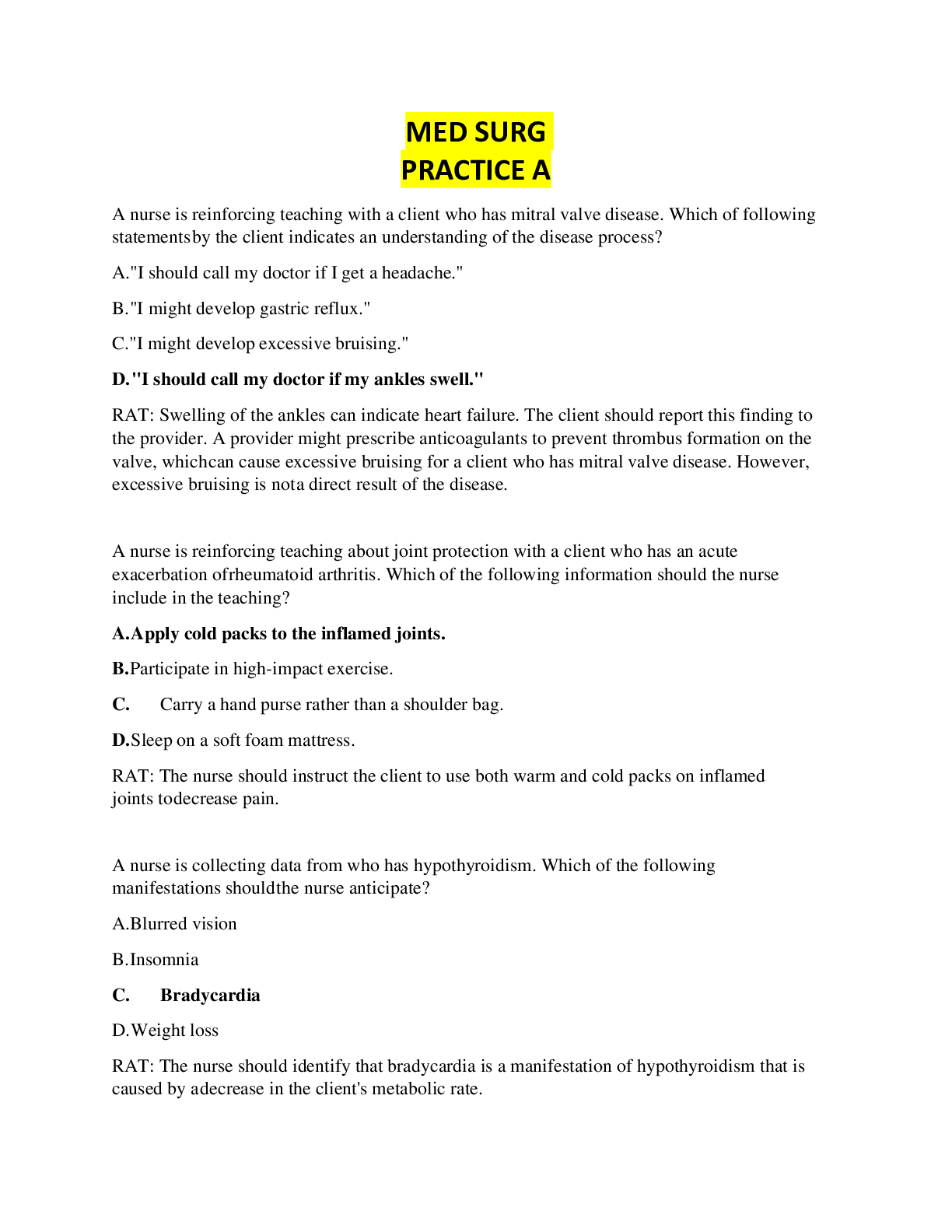
MED SURG PRACTICE A
A nurse is reinforcing teaching with a client who has mitral valve disease. Which of following statements
by the client indicates an understanding of the disease process?
A. "I should call my doctor if I get a headache."
B. "I might develop gastric reflux."
C. "I might develop excessive bruising."
D. "I should call my doctor if my ankles swell."
RAT: Swelling of the ankles can indicate heart failure. The client should report this finding to the
provider. A provider might prescribe anticoagulants to prevent thrombus formation on the valve, which
can cause excessive bruising for a client who has mitral valve disease. However, excessive bruising is not
a direct result of the disease.
A nurse is reinforcing teaching about joint protection with a client who has an acute exacerbation of
rheumatoid arthritis. Which of the following information should the nurse include in the teaching?
A. Apply cold packs to the inflamed joints.
B. Participate in high-impact exercise.
C. Carry a hand purse rather than a shoulder bag.
D. Sleep on a soft foam mattress.
RAT: The nurse should instruct the client to use both warm and cold packs on inflamed joints to
decrease pain.
A nurse is collecting data from who has hypothyroidism. Which of the following manifestations should
the nurse anticipate?
A. Blurred vision
B. Insomnia
C. Bradycardia
D. Weight loss
RAT: The nurse should identify that bradycardia is a manifestation of hypothyroidism that is caused by a
decrease in the client's metabolic rate.
A nurse is reinforcing teaching with an adolescent child regarding testicular self-examination. Which of
the following statements by the client indicates an understanding of the teaching?
A. "I will perform the exam before I shower."
B. "I will check my testicles every 6 months."
C. "I understand that testicular cancer is typically painless."
D. "I understand that pea-sized lumps are normal."
RAT: Clients should report a lump that is not painful because testicular cancer is typically painless.
Clients should perform a testicular self-examination after a warm shower. Clients should perform a
testicular self-examination monthly.
A nurse is contributing to the plan of care of a client who is at risk for osteoporosis. Which of the
following interventions should the nurse include to prevent bone loss?
A. Increase fluid intake.
B. Encourage range-of-motion exercises.
C. Massage bony prominences.
D. Encourage weight-bearing exercises.
Weight-bearing exercises, such as walking, can maintain bone mass by reducing bone demineralization,
thus helping to prevent osteoporosis.
A nurse is reinforcing teaching about management of constipation with a client who has
hypothyroidism. Which of the following instructions should the nurse include in the teaching?
A. Increase intake of fiber-rich foods.
B. Take a laxative every morning.
C. Maintain a fluid intake of 1,200 mL/day.
D. Limit activity to preserve energy.
RAT: The nurse should instruct the client to increase the amount of fiber-rich foods in their diet. Dried
beans and brown rice are examples of fiber-rich foods. The nurse should instruct the client to increase
activity to stimulate the evacuation of stool.
A home health nurse is reinforcing teaching with a client about preventing complications of peripheral
vascular disease. Which of the following statements indicates that the client is adhering to the nurse's
instructions?
A. "I apply rubbing alcohol to my feet every day to prevent infection."
B. "I will wear clean, knee-high wool socks every day to help improve my circulation."
C. "I use hot water bottles to keep my feet warm at night."
D. "I don't cross my legs anymore."
RAT: Clients who have peripheral vascular disease should not cross their legs because it can impede
circulation.
A nurse observes a client who is lying in bed and experiencing a tonic-clonic seizure. Which of the
following actions should the nurse take?
A. Lower the side rails of the client's bed.
B. Apply wrist restraints to the client.
C. Position the client in the semi-Fowler's position.
[Show More]