Jack is a 3-year-old boy who is being evaluated for developmental delay. The mental status
examination is significant for an inability to stack two blocks or draw a circle. The PMHNP
also appreciates the inability to a
...
Jack is a 3-year-old boy who is being evaluated for developmental delay. The mental status
examination is significant for an inability to stack two blocks or draw a circle. The PMHNP
also appreciates the inability to attend to any task for more than a few seconds. These
findings indicate an abnormality in:
A
.
Social relatedness
B
.
Thought process and
content
C
.
Motor behavior
D
.
Judgment and insight
C
During the mental status exam of Oliver, a 4-year-old child, the PMHNP appreciates that he
appears to be having transient visual and auditory hallucinations. The PMHNP knows that the
best approach to this finding is to consider that:
A
.
This is most consistent with early-onset
schizophrenia
B
.
An organic brain disorder should be ruled out
C
.
These are normal findings in very young
children
D
.
Comprehensive psychiatric assessment is
indicated
B
Jason is a 17-month-old male who is referred for evaluation of an unusually high level of
irritability. His mother says he cries “all the time,” and sometimes he just cannot be
comforted; Jason’s pediatrician felt that the complaint warranted an evaluation by child
psychiatry. Comprehensive assessment of Jason’s irritability should include all the following
except:
A
.
A comprehensive medical
assessment
B
.
Standardized developmental
measures
C
.
Assessment without the parents
present
D
.
Observation of Jason during play
D
Which of the following is the most common anxiety disorder of childhood?
A
.
Generalized anxiety
disorder
B
.
Separation anxiety
disorder
C
.
Social anxiety disorder
D
.
Obsessive-compulsive
disorder
A
When evaluating treatment strategies for a 14-year-old patient with obsessive-compulsive
disorder (OCD), the PMHNP considers that evidence-based data from the Pediatric OCD
Treatment Study (POTS) suggests that best outcomes are achieved with cognitive behavioral
therapy (CBT) and:
A
.
Clomipramine
(Anafranil)
B
.
Sertraline (Zoloft)
C
.
Aripiprazole (Abilify)
D
.
Lithium (Eskalith)
B
Which of the following behaviors is least suspicious for an adolescent who is being bullied at
school?
A
.
A significant change in study habits in which the patient is demonstrating higher
academic achievement to the exclusion of a social life
B
.
A persistent, sustained increase in the number and variety of physical complaints that
have no obvious organic cause
C
.
Evidence that the patient has started smoking cigarettes and seems to spend more time
alone than usual
D
.
Migration to a completely different peer group and a change in appearance and behavior
to aggressively mimic the new group
A
Michael is a 13-year-old boy who was involved in a traumatic automobile accident in which
his mother, the driver, was killed. After suffering multiple injuries and weeks in the hospital,
Michael was discharged to home with physical therapy. He ultimately made a complete
physical recovery but is unable to get into a car. Just the thought of riding in a car produces
profound physiologic symptoms. He has been diagnosed with post-traumatic stress disorder
(PTSD). His avoidance of riding in a car is conceptualized as:
A
.
Panic attacks
B
.
Operant
conditioning
C
.
Hyper arousal
D
.
Flashbacks
C
Which of the following is a true statement with respect to developmental testing in infants?
A
.
None of the available validated developmental tools are reliable in infants under 6
months of age.
B
.
An infant’s score on developmental assessment is a reliable predictor of future
intelligence quotient.
C
.
Infant assessments are helpful in detecting mental retardation and developmental
disorders.
D
.
Assessment in older infants focuses on sensorimotor and social responses.
C
Wendy is a 6-year-old female being evaluated by the PMHNP following a suicide attempt. The
police were called when a neighbor saw Wendy jump out of the open window of her firstfloor apartment. She was unhurt, but when the neighbor asked why she jumped out she said
she wanted to kill herself. Which coincident finding would warrant an inpatient psychiatric
admission for Wendy?
A
.
This was not the first episode.
B
.
The caretaker is incapable of arranging follow-up.
C
.
One or both of the biological parents has a history of
suicide attempts.
D
.
Wendy was left with a babysitter when the incident
occurred.
B
Caleb is a 10-year-old boy who is referred for assessment because he is not following any of
the rules of discipline at home. His parents report that they have had three separate nannies
resign in the last 4 months because Caleb is unmanageable. This is a long-standing problem,
going back to daycare even before kindergarten. The PMHNP knows that when conducting
her initial interview of Caleb she should:
A
.
Anticipate that he can tolerate up to a 45-
minute session
B
.
Consider that symbolic play with dolls will be
informative
C
.
Interview him alone before involving the parents
D
.
Be clear that he is there because of problem
behavior
D
Treatment of abused children is multimodal and long term. The single most important aspect
of treatment is:
A
.
Establishing a safe place for the
child
B
.
Exposure related to the feared
experience
C
.
Psychoeducation
D
.
Cognitive-behavioral interventions
A
Psychiatric assessment of the adolescent patient is different in several ways from
assessment of younger children. While trying to establish a therapeutic environment with an
adolescent who is openly hostile, one of the most important things the PMHNP can do is to:
A
.
Be more liberal in terms of limit setting and tolerating hostility in order to facilitate honest
communication
B
.
Ensure the patient that under no circumstances will anything said be repeated to the
parents
C
.
Allow silences to last as long as necessary until the patient is inclined to offer any verbal
input
D
.
Communicate to the patient that his or her perspective is valued and will not be judged
or critiqued
A
A variety of questionnaires, scales, guided-interview tools, and other standardized
instruments are available to aid with various aspects of assessment. The majority are
intended only to be used as an aid to information gathering and not to make a diagnosis.
Which of the following tools requires training to administer and can be used to determine
diagnoses?
A
.
Child and Adolescent Psychiatric Assessment (CAPA)
B
.
Brief Impairment Scale
C
.
Pictorial Instrument for Children and Adolescents
(PICA-III-R)
D
.
Achenbach Child Behavior Checklist
C
The PMHNP is drafting a proposal for research funding for a project to offer primary
prevention strategies designed to reduce the incidence of bullying. In support of this project,
the PMHNP provides data supporting the fact that both perpetrators and victims of bullying
suffer all of the following except:
A
.
Higher incidence of emotional
problems
B
.
Greater difficulty making friends
C
.
Poorer academic achievement
D
.
Increased percentage of smoking
D
Which of the following manifestations of childhood anxiety disorders is considered a
psychiatric emergency?
A
.
School
refusal
B
.
Bedtime
refusal
C
.
Eating
refusal
D
.
Speech
refusal
A
The PMHNP is performing an assessment on Julie, a 4-year-old girl who has been brought to
care by her mother. The mother was referred by the pediatrician because Julie has been
demonstrating an appreciable change in her behavior. She is developmentally on target and
has always been a happy and curious child, but for the last few months she seems to be
much more fearful and anxious. Which of the following recently acquired behaviors
described by the mother is most suspicious for sexual abuse?
A
.
Prolonged periods of daydreaming
B
.
Masturbating with a toy
C
.
Touching the genitals of her 3-year-old
cousin
D
.
Showing her genitals to other children at
daycare
B
What is the primary diagnostic difference between obsessive-compulsive disorders in
children as compared to adults?
A
.
Age of onset
B
.
Response to treatment
C
.
Recognition that the thoughts or behaviors are
irrational
D
.
The thoughts or behaviors occupy > 1 hour
daily
A
With respect to treatment of conduct disorder, the PMHNP knows that:
A
.
The reduction of violence and aggression in school is critical
B
.
Parental psychiatric intervention has not demonstrated
improved outcomes
C
.
Atypical antipsychotics are avoided due to the adverse effect
profile
D
.
Treatment with psychostimulants exacerbates aggressive
behaviors
A
Kelly is a 13-year-old girl who is being evaluated because her parents are very concerned
about her sudden disinterest in school. She does not want to go to any social activities and
her grades have dropped markedly in the last several months. When considering bullying as
a cause of her behavior change, the PMHP considers that which type of bullying is more
common among girls?
A
.
Verbal
B
.
Physical
C
.
Relation
al
D
.
Cyber
A
Karen is a 7-year-old girl who has been started on atomoxetine 18 mg once daily for ADHD,
which is just under the recommended starting dose of 0.5 mg/kg/day. After just 1 week, her
parents report that she is not eating, complains of stomach pain almost every day, is having
trouble sleeping, and is “really cranky.” Her teacher says she never seen anything like it;
that Karen is actually worse on her ADHD medication. A careful review reveals that Karen is
taking her medication just as prescribed. She is not on any other prescribed, over-thecounter, or herbal medications. The PMHNP considers that:
A
.
These are common in the first weeks of therapy and the dose should be increased to a
therapeutic regimen
B
.
Karen may be a poor metabolizer of CYP2D6 medications and will need a change of
therapy
C
.
Behavioral modalities should be started as optimal management of ADHD is multimodal
D
.
Fluoxetine should be added to the regimen as it has demonstrated efficacy with
coincident anxiety
A
Carolyn is a 14-year-old female who is in care because she has developed increasingly
difficult behavior at home and school. She is inappropriately dressed for the interview,
wearing heavy makeup and conducting herself in a suggestive manner. Her medical history
is significant only for childhood asthma and four urinary tract infections in the last year.
Carolyn’s mother reveals that Carolyn’s stepfather has a history of sexually abusing his
biological daughter, and the mother is beginning to wonder if something isn’t “going on” in
her own home. Carolyn vigorously denies this, and indicates that her stepfather is very good
to her, takes care of her, and is her “best friend.” The PMHNP recognizes that Carolyn may
be in which phase of intrafamilial sexual abuse?
A
.
Engagem
ent
B
.
Secrecy
C
.
Disclosure
D
.
Suppressi
on
B
Phillip is a 5-year-old boy who is in care after being referred for failure to speak at school. He
has been in kindergarten for 5 months, and initially his teacher thought he was just shy, so
she did not focus on him. However, it has become increasingly apparent that he flat out will
not speak at school. Phillip’s parents are adamant that there is not any problem at home and
that Phillip talks with them and his older sister routinely. Further assessment reveals that he
has always been extremely shy and that he doesn’t like it when people make a fuss over
him. The PMHNP suspects that Phillip has selective mutism, which is closely related to:
A
.
A history of sexual
abuse
B
.
Fetal alcohol
syndrome
C
.
Early onset
schizophrenia
D
.
Social anxiety
disorder
D
With respect to psychiatric assessment, the PMNHP knows that in terms of confidentiality:
A
.
All information related to a minor may be shared with the parents without the
child’s consent.
B
.
Whenever there is a suspicion of neglect or abuse, the appropriate state agency
must be notified.
C
.
Every state has laws that emancipate children for issues of mental health.
D
.
All children are entitled to confidentiality unless they are a danger to themselves
or others.
B
The PMHNP is performing a series of court-ordered home visits to evaluate concerns about a
4-month-old infant who presented for a well checkup with clear failure to thrive. While
observing the mother’s interaction with the infant, the PMHNP notes a negative pattern of
interaction. This is characterized by:
A
.
The child refusing to feed and the mother feeling rejected and withdrawing
B
.
The mother not holding the child during feeding and the child withdrawing
C
.
The mother not responding to hunger cues, e.g., crying, and the child stopping
demonstrating them
D
.
The mother being overly protective and trying to feed excessively, and the infant
stopping eating
B
The PMHNP observes separation from and reunion with the parent as part the mental status
exam of a 25-month-old toddler. Extremes of emotion during separation or reunion are most
consistent with:
A
.
Normal developmental progression at
that age
B
.
Cognitive dysfunction
C
.
Neurologic dysfunction
D
.
Problems with the parent-child
relationship
D
The PMHNP is reviewing assessment data on Richard, a 14-year-old boy who was brought in
for evaluation by his parents. He has a longstanding history of being difficult, defiant, and
argumentative with adults. While considering differential diagnosis of oppositional defiant
disorder and conduct disorder, which of the following findings meet criteria for conduct
disorder?
A
.
Openly defies rules, argues with adults, is truant from school
B
.
Shoplifts valuable jewelry, is persistently angry and resentful, runs away from home
C
.
Often loses temper in the classroom, upturned a desk at school in anger, is verbally cruel
to classmates
D
.
Has a history of physical cruelty to the family cat, broke into the neighbors’ house while
they were on vacation, starting fist fights at school
D
Melanie is a 13-month-old female who has been referred by her primary care pediatrician.
She has not had consistent well-child checks, and at her first visit with this pediatrician at
age 1 year, there was a notable absence of verbal babbling, interactive play, or smiling.
Comprehensive assessment of Melanie must include all the following except:
A
.
The Children’s Apperception Test
(CAT)
B
.
A comprehensive history
C
.
A mental status examination
D
.
Neuropsychiatric assessment
C
Despite a wealth of data-based information on bullying, including information about its
forms, presenting symptoms, and consequences, current research suggests that accurate
information about bullying is not influencing preventive and awareness strategies in most
school systems. When advising school personnel, parents, and primary care providers about
bullying, the PMHNP should emphasize that:
A
.
Physical bullying has the most dangerous
outcomes
B
.
Bullying is more common in boys than girls
C
.
Victims often develop alcohol abuse
problems
D
.
Verbal bullying is the most common form
D
Minor physical anomalies, such as high-arched palate, low-set ears, and transverse palmar
creases, occur in a higher than average distribution in children with all of the following
except:
A
.
Learning disabilities
B
.
Speech and language
disorders
C
.
Hyperactivity
D
.
Delayed puberty
D
Comprehensive psychiatric assessment of young school-aged children requires a variety of
information sources. Input is necessary from parents, caregivers, and teachers because
children of this age group cannot reliably provide information about:
A
.
Their own fears and anxieties
B
.
Psychotic episodes they have
experienced
C
.
The chronology of symptom
presentation
D
.
Episodes of mood extremes
C
Mark is a 5-year-old boy brought in for evaluation because his behavior at school has
become so disruptive. According to the parents, Mark’s teacher says he just refuses to follow
the rules of the classroom, openly defies her, and actually seems to try and upset his
classmates. The teacher says Mark gets frustrated very easily when he cannot complete a
task and is resistant to any effort to help him. This happens almost every day, and the
teacher has indicated that she will not be able to keep him in the classroom if things do not
change. Mark’s parents admit that he has always been “willful” and difficult to manage, but
as he is an only child with a stay-at-home mom, the family overlooked his disruptive
tendencies and accommodated Mark. The parents report that they often skip social events
and family outings because they don’t know how Mark will behave. While counseling Mark’s
parents about the theories of causation of oppositional defiant disorder (ODD), the PMHNP
tells the parents that psychiatric theories include all of the following except:
A
.
Unresolved conflict as a fuel for aggressive behavior targeting authority figures
B
.
The concept that oppositionality is a reinforced, learned behavior in which the child exerts
control over authority figures
C
.
A maladaptive response to parents’ modeling of conflict avoidance as manifested by
even-tempered responses to parent-toddler struggles
D
.
That the behavior is reinforced by increased parental attention in response to the
undesirable behavior
C
Having child and adolescent patients rate their feelings and moods on a scale of 1–10 is
most effective in which age group?
A
.
18-months to 3
years
B
.
3 to 5 years
C 5 to 11 years
.
D
.
12 to 17 years
C
Which of the following is a true statement with respect to conduct disorder?
A
.
The diagnosis is distributed equally between boys and girls.
B
.
Boys with conduct disorder are more likely to develop somatic symptoms later in life.
C
.
About 80% of children with conduct disorder were previously diagnosed with oppositional
defiant disorder (ODD).
D
.
The later the age of onset of conduct disorder, the greater the risk of antisocial
personality disorder (ASPD) in adulthood.
C
Being Brave: A Program for Coping With Anxiety for Young Children and Their Parents is a
manualized intervention for anxiety disorders in young children between the ages of 4 and 7
years old. It uses a combination of parent-only and parent-child sessions and demonstrates
significant improvement in children with all forms of anxiety disorders except:
A
.
Separation
anxiety
B
.
Social anxiety
C
.
Generalized
anxiety
D
.
Specific phobia
C
Eric is an 11-year-old male for whom an emergency assessment was requested due to firesetting. This is not Eric’s first fire, and his parents admit that he has had a bit of a fixation
with the fireplace and matches for a few years. During the evaluation, the PMHNP should be
particularly alert to other findings consistent with:
A
.
Childhood
schizophrenia
B
.
Bipolar disorder
C
.
Sexual abuse
D Conduct disorder
.
D
Which of the following is a true statement with respect to crisis intervention and
psychological debriefing as a preventive strategy for post-traumatic stress disorder (PTSD)?
A
.
Crisis intervention and psychologic debriefing is most effective if it occurs within 24
hours of the event
B
.
The focus of crisis intervention and psychologic debriefing is management of
emotional reactions
C
.
Psychoeducation is not typically a component of crisis intervention and psychologic
debriefing
D
.
No controlled studies support that crisis intervention and psychologic debriefing
improves outcomes
D
Which of the following is not a true statement with respect to theorized etiologies of ADHD?
A
.
Psychosocial factors do not appear to contribute to the development of ADHD.
B
.
Some literature suggests that prenatal exposure to winter infection during the first
trimester of pregnancy leads to ADHD
C
.
Biological parents of children with ADHD have a higher incidence of the disorder than
adoptive parents
D
.
Overall, no clear-cut evidence supports a single neurotransmitter in the development of
ADHD
A
The clinical interview is an important part of psychiatric assessment and should be
conducted early in the diagnostic process. However, a comprehensive assessment should
include other information-gathering modalities because the clinical interview:
A
.
Does not offer flexibility in understanding the evolution of
the problem
B
.
Frequently deemphasizes the influence of environmental
factors
C
.
May not systematically cover all psychiatric diagnostic
categories
D
.
Creates a dialogue in which patients cannot give subjective
responses
C
e PMHNP is evaluating a 15-year-old male patient who has been referred by his courtappointed guardian. He has been in foster care for the last 6 years and maintained a steady
pattern of low-level behavior problems such as skipping school and ignoring curfew. He is
not openly defiant and has always been described as a “loner.” He just does not follow most
rules. During the mental status examination, the PMHNP notes that his expressions are
sometimes inconsistent with the topic of conversation, and he does not seem to be able to
transition effectively among levels of emotion. This represents an abnormality in:
A
.
Mood
B
.
Affect
C
.
Thought process and
content
D
.
Judgment and insight
B
Kevin is a 15-year-old male who presents for court-ordered psychiatric assessment. Kevin
comes to his first appointment with both of his parents. He is sitting in the chair with his
arms crossed and responds with “yes” and “no” answers to direct questions; otherwise, he
volunteers no information. The parents are clearly upset and indicate they just “don’t know
what to do with him anymore.” The most appropriate action for the PMHNP would be to:
A
.
Ask the parents to step out and interview Kevin privately
B
.
Have Kevin complete a standardized-testing assessment
C
.
Schedule session two after reviewing court documentation
D
.
Arrange for three sessions with a family therapist then
reevaluate Kevin
A
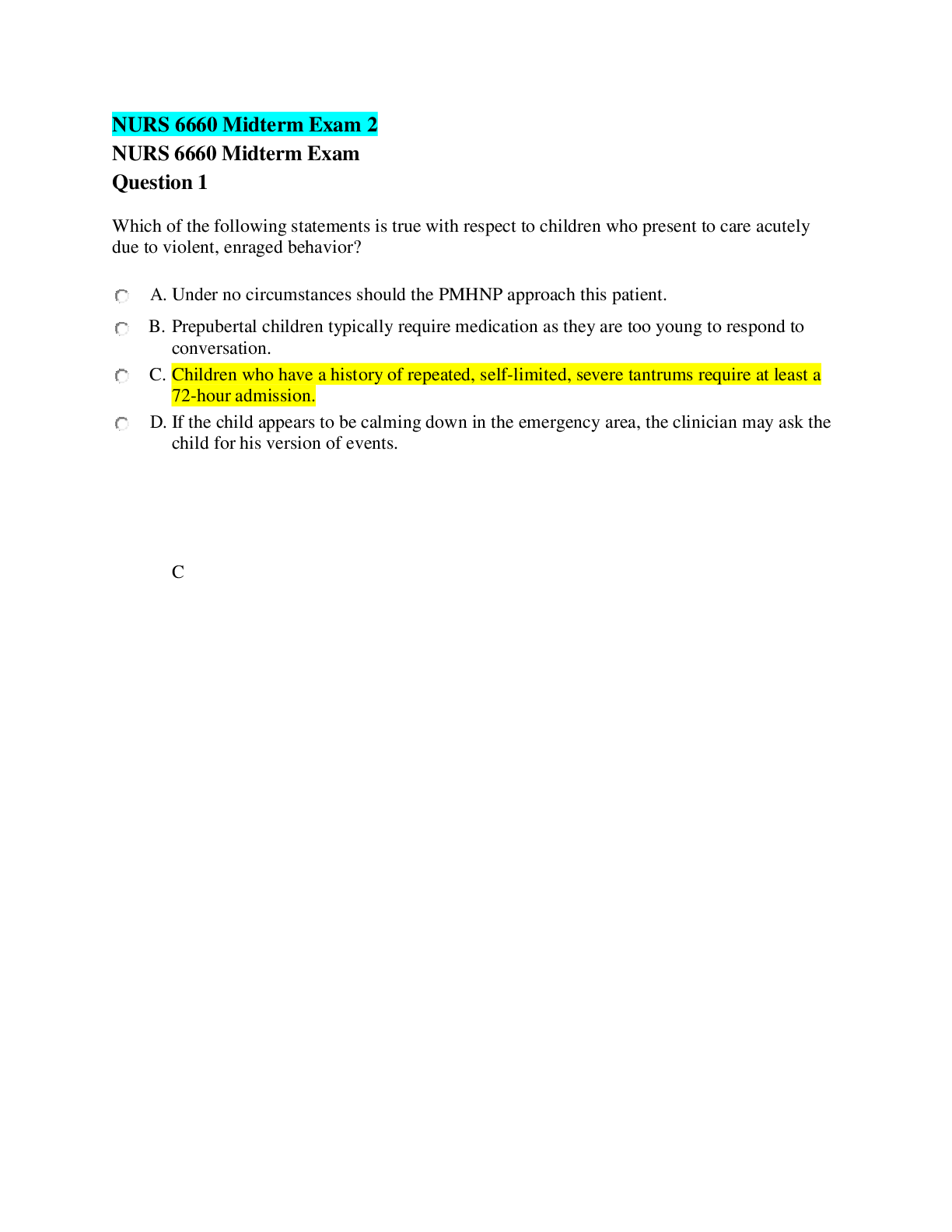
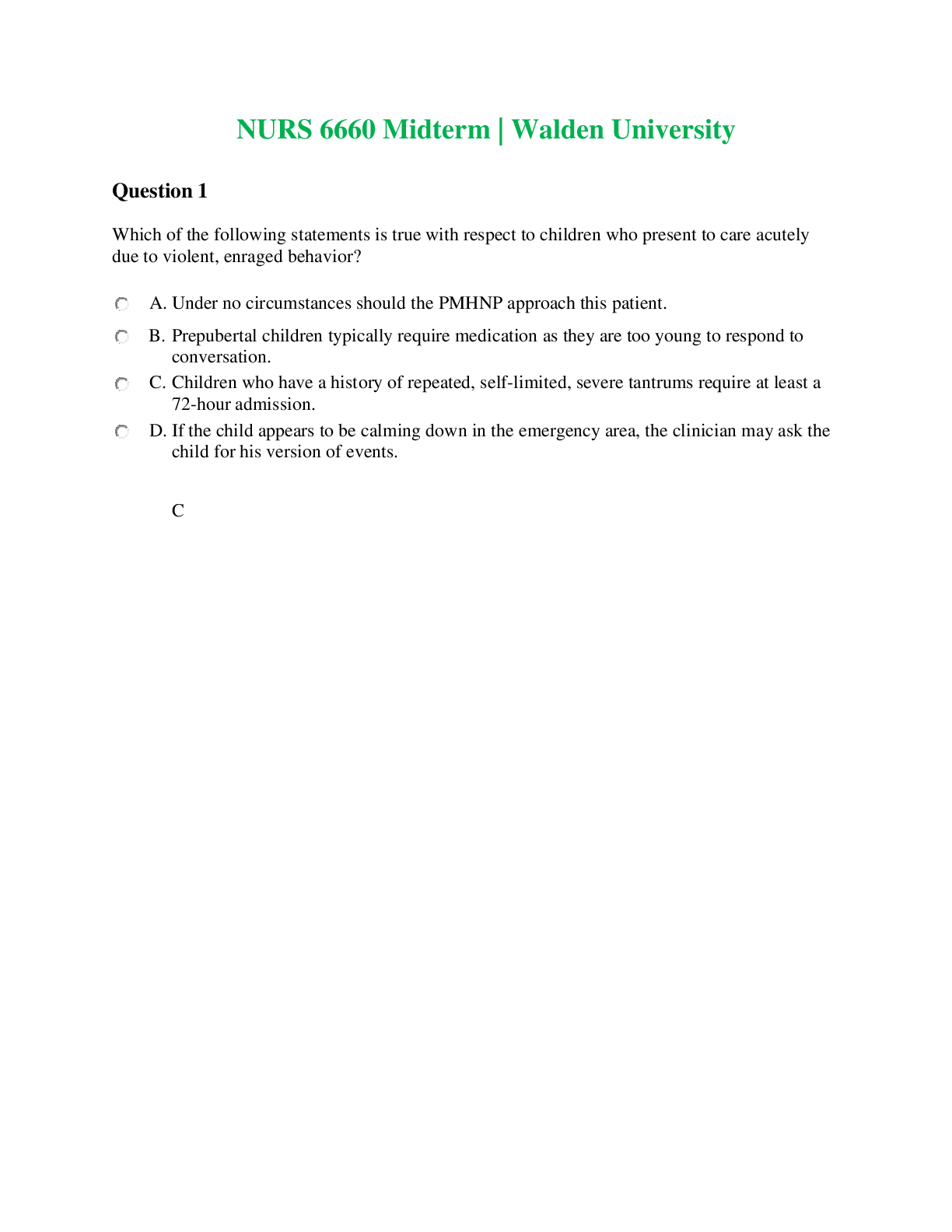
Which of the following statements is true with respect to children who present to care
acutely due to violent, enraged behavior?
A
.
Under no circumstances should the PMHNP approach this patient.
B
.
Prepubertal children typically require medication as they are too young to respond to
conversation.
C Children who have a history of repeated, self-limited, severe tantrums require at least a
. 72-hour admission.
D
.
If the child appears to be calming down in the emergency area, the clinician may ask the
child for his version of events.
D
Comprehensive psychiatric/mental health assessment of children includes an interview with
the parents or caregivers. Which of the following is not a true statement with respect to the
parental interview?
A
.
The parents’ own emotional adjustments should be
determined.
B
.
The parents are usually more aware of symptoms
than the child.
C
.
The parents may prefer to speak with the PMHNP
separately.
D
.
The parents’ upbringings are relevant to the child’s
diagnosis.
D
The PMHNP is evaluating his data for the assessment of Eric, a 23-month-old male who was
referred because he is having nightmares to the extent that most nights he is waking up
family members with his crying and screaming. In addition to the clinical interview with the
parents and patient, developmental assessment, and standardized tools, the assessment
should include:
A
.
Review of a video recording of a nightmare event and Eric’s immediate
response
B
.
Age-appropriate interview, e.g., “If you had three wishes, what would
they be?”
C
.
Observation of Eric in a playroom where he is unaware that he is being
watched
D
.
Partially open-ended questions that provide some focus but allow
expression of feeling
A
Sarah is a 10-year-old patient who has been diagnosed with oppositional defiant disorder.
While discussing the diagnosis, course and prognosis, and treatment strategies with Sarah’s
mother, the PMHNP emphasizes that successful management of oppositional defiant
disorder (ODD) must include:
A
.
Parent training
B
.
Pharmacothera
py
C
.
Time out
D
.
Conflict
avoidance
A
Management of a child who has a pattern of fire-setting behavior must include:
A
.
Combination therapies that include medication with an
SSRI
B
.
Parental counseling that the child should never be allowed
home alone
C
.
Inpatient admission for intensive individual and group
therapy
D
.
Behavioral interventions characterized by negative
reinforcement
B
The PMHNP is discussing autism spectrum disorder (ASD) treatment strategies with the
parents of 4-year-old Jeffrey. He is nonverbal and has been completely unable to adapt to
any changes of environment; an effort to put him in a preschool class was what precipitated
his evaluation and eventual diagnosis. At this point, Jeffrey’s parents are very committed to
doing anything necessary to support Jeffrey’s growth and development and promotion of
prosocial behavior. While developing his plan of care, the PMHNP suggests:
A
.
Structured classroom training with consistent behavioral
programs
B
.
Facilitated communication with a computer or letter/picture
board
C
.
A trial of escitalopram daily to promote decreased
irritability
D
.
An atypical antipsychotic as needed to decrease selfinjurious behavior
A
Justin is a 3½ -year-old boy who comes in with his mother. She is concerned that he has
obsessive-compulsive disorder (OCD). Justin’s mother says that her husband has struggled
with OCD all his life; he was first diagnosed when he was 11 years old thanks to an alert
teacher who suggested mental health care. Justin’s mother has been very proactive in
studying genetic risk, and she knows that Justin is at significantly increased risk due to the
early-onset in his father. Which of the following behaviors by Justin would be most consistent
with OCD?
A
.
Clear social difficulties in addition to an apparently unusual need for cleanliness and order
in his bedroom
B
.
Refusal to go to bed without his blue stuffed elephant; this began over a year ago and is
getting progressively worse
C
.
Insistence upon precise placement of plate, cup, utensils and food on plate when eating;
when he cannot achieve this, he will not eat
D
.
A concomitant diagnosis of ADHD for which the family is currently in behavioral therapy
C
The PMHNP is evaluating 12-year-old Dale after the police were called to the home. Dale is
assessed as having a psychotic episode; he tells the NP that voices are telling him that he is
bad and that he should hurt himself. According to the mother, he has no history of
psychiatric disease, medications, or really any concerns at all. Mom says he goes to school,
has friends, and has always seemed “normal.” An interview with his 13-year-old sister
reveals that while there is no long-term history of abnormal behavior, for the last couple of
weeks things have been very strange at home. His father has been arrested for “something
to do with a teenage girl,” and their parents have been fighting. His father lost his job, and
there is a lot of talk about money and lawyers and jail. Dale has been very emotional as he
has always been close to his Dad; he seems to go from crying to laughing in a blink, and is
getting in fights at school. Even now, after he has calmed a bit, Dale’s reality testing is
altered. The PMHNP considers that Dale is demonstrating:
A
.
Symptoms of childhood
schizophrenia
B
.
A manic episode
C
.
Brief psychotic disorder
D
.
Intermittent explosive disorder
C
Trauma-focused cognitive behavior therapy is a CBT approach characterized by 10–16
sessions comprised of four components: (1) psychoeducation, (2) stress inoculation, (3)
gradual exposure, and (4) cognitive reprocessing. This is a management strategy for posttraumatic stress disorder (PTSD) that is:
A
.
Most effective when paired with eye movement desensitization and reprocessing (EMDR)
B
.
Considered by experts to be the first-line management approach for treatment of PTSD
symptoms
C Very effective in individuals but generally not recommended for group treatment, e.g.,
. school-based traumas
D
.
Gaining widespread acceptance as a first-line management strategy for other forms of
anxiety disorders
B
The PMHNP is providing counseling for the family of a 6-year-old girl who was recently
adopted. This girl reportedly was removed from a home in which she was subjected to
severe, long-term abuse in all forms: neglect, physical abuse, sexual abuse, malnutrition,
and neglect of all medical care. Upon her rescue, which was incidental during a drug raid on
the home, she was hospitalized for over 1 month for physical maintenance, nutrition,
hydration, and treatment for a variety of infections, including sexually transmitted diseases.
The adoptive family is very committed to providing a healthy environment and is very
receptive to long-term individual and family therapy. The PMHNP discusses with the new
parents and siblings that which of the following is most often linked to this type of history:
A
.
Dissociative disorders
B
.
Negative attachment
C
.
Aggression toward
siblings
D
.
School refusal
A
Children who have been subjected to maltreatment will frequently demonstrate a variety of
behavioral and psychologic symptoms, including increased aggressiveness, heightened
autonomic arousal, and memory problems. Neurobiologic explanations suggest that this may
be due to:
A
.
Scarring of the hippocampus
B
.
Hypertrophy of the corpus callosum
C
.
Limbic suppression
D
.
Decreased integration of left and right
hemispheres
D
Evaluation of psychiatric emergencies in children must include:
A
.
A complete physical examination
B Psychiatric disorders in family members
.
C
.
A comprehensive toxicology screen
D
.
Interviews with teachers and noncustodial
caretakers
B
Susan is a 10-year-old girl who has been referred by her pediatrician for mental health
evaluation due to a persistent collection of somatic symptoms for which there is no apparent
organic cause. For the last 2 months Susan has been increasingly distraught at the prospect
of leaving home. This has become very apparent since the start of the school year. She often
develops stomachaches and headaches when it is time to go to school. Lately she does not
want to go to bed unless her mother remains upstairs. The PMHNP considers a diagnosis of:
A
.
Separation anxiety
disorder
B
.
Social anxiety disorder
C
.
Generalized anxiety
disorder
D
.
Social phobia disorder
C
While evaluating Jennifer, a 32-month-old female, for autism spectrum disorder (ASD), the
PMHNP conducts a detailed assessment, including a medical history of both the patient and
all first-degree family members. This is critically important as the most common known
cause of ASD is:
A
.
Fragile X syndrome
B
.
Advanced maternal age
C
.
Autoimmune disease in > 2 first-degree family
members
D
.
Being raised in a single-parent home during the first
year of life
A
The PMHNP has been retained by the local school board to provide comprehensive
counseling and guidance following an episode of tragic school violence. A 9th grader, acting
alone, brought a gun into the school, fatally shooting a teacher and injuring four other
teachers and students before he was subdued. In an effort to promote best healthy practices
after this traumatic event, the school board is asking for advice on how to best manage the
students. The PMHNP knows that the immediate priority must be:
A
.
Returning to normal routine
immediately
B
.
Development of peer counseling
groups
C
.
Establishing the perception of
safety
D
.
A memorial service to process the
loss
B
Comprehensive psychiatric assessment ultimately requires the integration of biological
predisposition, psychodynamic factors, environmental factors, and life events. These factors,
along with a mental status exam, developmental assessment, and any appropriate
standardized testing is collectively referred to as:
A
.
Neuropsychiatric assessment
B
.
Biopsychosocial formulation
C
.
The Physical and Neurological Examination of Soft Signs
(PANESS)
D
.
Kaufman Assessment Battery for Children
B
The PMHNP is performing an emergency assessment on Renee, a 9-year-old girl who was
initially brought to the attention of social services by her maternal grandmother. Renee is
reluctant to talk about herself or her home life. The physical examination that accompanied
this emergency assessment revealed a variety of ecchymoses in various stages of healing,
and the examiner was suspicious that there was a history of sexual abuse. Renee is quiet
and passive during the interview, but is rather aggressive when playing with dolls. While
considering the need for removal from the home, the PMHNP knows that all the following
are risk factors for predictors of further abuse and maltreatment except:
A
.
Neglect as the form of
maltreatment
B
.
Parental conflict
C
.
Number of previous episodes
D
.
Gender of the victim
D
Harmony is a 4-year-old female who has been through several evaluations for behavioral
abnormalities that have become increasingly disruptive, and the family is concerned for the
safety of both Harmony and her 2-year-old brother. Comprehensive assessment of Harmony
includes neuropsychiatric testing. The PMHNP documents the presence of neurological hard
signs. These suggest:
A
.
Brain lesions
B
.
Early-onset
schizophrenia
C
.
Low intelligence
D
.
Learning disability
A
The PMHNP is preparing an educational program for primary care providers about child
abuse awareness. The goal of the program is to increase the understanding of primary care
providers regarding risk factors for child abuse so that at-risk families may be identified and
primary preventive strategies implemented before any harm occurs to children. The
program emphasizes risk factors for child maltreatment to include all of the following except:
A
.
Single-parent families
B
.
Low parental education
C
.
Parental substance
abuse
D
.
Firstborn child in the
family
D
Kristina is a 17-year-old female who was encouraged to care by her parents because they
have been worried about her. She has always been very healthy, happy, and active in school
and sports. Her boyfriend of three years broke up with her last fall, right before he left for
college. Since then she has lost all interest in her friends and school. Her parents say that
she doesn’t do anything after school except go to her room. She has lost 16 pounds in the
last 9 months. During the second session with the PMHNP, Kristina insists that her parents
are overreacting, that she is doing OK in school and is eating just fine. She says of course
she was sad that her boyfriend broke up with her, but she has gotten over it and moved on.
During this session, the PMNHP appreciates that Kristina’s clothes are clearly too big for her,
her eyes fill up with tears whenever her boyfriend is mentioned, and she does not seem
engaged in the interview. While considering her assessment, the PMHNP recognizes that:
A
.
The absence of a remote history of psychiatric disease makes a true psychiatric diagnosis
unlikely
B The PMHNP must prioritize Kristina’s subjective report versus her parents’ report
.
C
.
A standardized assessment tool such as the Patient Health Questionnaire (PHQ)-9 will be
required for diagnosis
D
.
The objective signs evident in Kristina’s examination are more compelling than her
perspective on symptoms
D
Mrs. Jacobs has accompanied her son to today’s session. Her son is in psychiatric care
because he has developed disciplinary issues and for the last several months has been
challenging authority, truant from school, and openly defiant of the household rules. Mrs.
Jacobs is understandably distraught and is adamant that her son must be the victim of
bullying because yesterday he came home from school with a black eye and a swollen lip.
While this has never happened before, she believes that bullying is the only explanation for
his behavior at home. While counseling Mrs. Jacobs about bullying, the PMHNP emphasizes
that, by definition, bullying:
A
.
At some point will always involve physical
aggression
B
.
Does not occur unless more than one aggressor
participates
C
.
Is always unprovoked and intentionally cruel
D
.
Rarely results in permanent, irreversible physical
harm
C
Jenny is a 5-year-old female who has been referred for consultation because the emergency
room physician suspects that she might be subject to physical abuse in the home. On
evaluation, the PMHNP finds Jenny to be fearful, docile, and guarded. Although clearly in
pain, Jenny seems surprised when the PMHNP attempts to provide some comfort. The
PMHNP notes that:
A
.
If Jenny demonstrates abnormal attachment with her mother, this will complete textbook
criteria for symptoms of physical abuse
B
.
There must be a consistent pattern of atypical physical injury to support the diagnosis of
physical abuse
C
.
Jenny’s behaviors are more consistent with sexual abuse than physical abuse
D
.
These same symptoms may occur in the absence of any abuse and are neither specific or
pathognomic for abuse
B
John is an 11-year-old male being evaluated for conduct disorder. His history is significant for
setting fires in his neighbor’s garage, repeated episodes of truancy for the last 2 years, and
three separate episodes of running away from home beginning when he was 8 years old. His
teacher has reported that he is quite adept at manipulating his peers to get what he wants,
and he has tried to do the same thing to her. His parents deny any concerns about anger.
They are having a hard time believing that there is a problem because while John has a
tendency to pursue dangerous activities, it seems more like it is just because he is bored.
During interview, John does not seem at all hostile or angry. Like his parents, he does not
really seem to think anything is wrong. Which of John’s findings implies the greatest risk
factor for severe, persistent conduct problems?
A
.
The fire setting
B
.
Running away beginning at
age 8
C
.
His lack of guilt
D
.
Truancy prior to age 10
A
The PMHNP is evaluating the data he has collected in the assessment of Anna, a 9-year-old
girl who presented for evaluation because her teacher strongly encouraged Anna’s mother
to seek care. According to the teacher, Anna has been consistently disruptive in the
classroom since the beginning of the school year, 2 months ago. The assessment includes
unstructured interviews with Anna, her mother, and grandmother, and Connors Parent or
Teacher Rating Scale for ADHD completed by her primary school teacher and mother. The
PMNHP notes a marked disparity among reports—they all seem to contradict each other. The
PMHNP considers that this apparent contradiction:
A
.
Likely indicates a subjective bias from the mother or
teacher
B
.
May accurately reflect Anna’s behavior in different
settings
C
.
Requires that other adults exposed to Anna’s behavior
provide input
D
.
Indicates that a different approach to Anna’s assessment
is necessary
B
Brian is a 13-year-old boy who presents for care. He was initially brought in by his mother
after a family friend suggested mental health evaluation. Brian has been suffering with a
variety physical symptoms for the past 8 months, ever since school started. He has missed
so much school that he is in danger of not advancing to the eighth grade. He persistently
complains of headache, stomachache, nausea, and dizziness. He has even vomited on more
than one occasion, so his mother knows something is “really wrong.” The pediatrician has
been unable to identify a cause of symptoms or offer any relief. During his interview, the
PMHNP learns that this is Brian’s first year in middle school. There are hundreds of students,
and it is much larger than the intimate elementary school Brian attended from kindergarten
through sixth grade. Brian is certain that all the students are making fun of him; he does not
even go to the lunchroom to eat. He has stopped socializing with his small group of friends
from elementary school because they have made friends among the other seventh graders.
Brian says he wants to have friends, but he just gets nervous and he is sure they will all
make fun of him. Brian enjoys “hanging out” with his cousins, and they spent the week of
spring break playing at his house. But, when it was time to go back to school, Brian was so
nauseous he could not attend. Initial treatment for Brian should include:
A
.
Psychiatric hospitalization
B
.
Cognitive behavioral
therapy
C
.
Fluvoxamine (Luvox) 50 mg
daily
D
.
Family interventions
C
During the initial interview with Lorraine, a 13-year-old girl being evaluated for oppositional
defiant disorder (ODD), the PMHNP does not appreciate any of the behavior that has been
reported by Lorraine’s mother and teachers. Lorraine is found to be well groomed,
appropriate in her interaction, and says she is not sure why she is there. Lorraine says that
her parents and teachers say that she is always arguing and breaking the rules, but she
does not really understand what the problem is. The PMHNP notes that:
A
.
He will need to have more information from adults who are not in frequent contact with
Lorraine
B
.
This is common, as the symptoms are often only expressed to adults who know the child
well.
C
.
ODD is episodic, and it is not unusual to have long symptom-free periods; a normal
interview does not preclude diagnosis
D
.
The diagnosis should be reconsidered as it is almost impossible to have a diagnosis of
ODD without the patient’s awareness of symptoms
B
When treating anxiety disorders in young children, cognitive behavioral therapy (CBT) is
preferred as initial treatment if the child is able to function sufficiently to engage in daily
activities while in treatment. Which of the following therapies is appropriate for those
children too young to engage in traditional CBT?
A
.
Selective serotonin reuptake inhibitors (SSRI)
B SSRI in combination with CBT
.
C
.
Coaching Approach behavior and Leading by
Modeling (CALM)
D
.
CALM in combination with a first-generation
antihistamine
A
Adam is a 26-month-old boy referred by his pediatrician for evaluation of speech delay. He
has not spoken any intelligible words. Adam is an only child, and the parents deny any
contributory medical history. Adam was delivered at 38 weeks 5 days’ gestation without
complication. At 5 weeks of age he developed respiratory failure due to respiratory syncytial
virus (RSV) and was hospitalized on a ventilator for several days; since then, the parents
report only the occasional upper respiratory virus. They report that Adam is a “really good”
child and will often entertain himself for periods of time with his building blocks; rarely he
will have a “temper tantrum.” The parents confirm that Adam does not speak any
recognizable words. While he does make sounds, his parents admit that he does not appear
to be trying to communicate with them. When considering a diagnosis of autism spectrum
disorder (ASD), the PMNHP would expect further history and examination to reveal:
A
.
The presence of imaginary play
B
.
A failed hearing test
C
.
Exaggerated response to minor
injury
D
.
Notable decrease in attachment
behaviors
D
Nate is a 9-year-old boy who presents for a follow-up visit. He was diagnosed with ADHD 4
months ago and started on methylphenidate 5 mg b.i.d. At a 1-month follow-up his mother
reported that he was not really demonstrating any improvement of symptoms, so he was
increased to 10 mg b.i.d. He has been on this dose for 1 month. Nate reports that sometimes
he doesn’t feel so great; he gets a stomach ache sometimes and a few weeks ago he felt
“dizzy.” His vital signs are within normal limits. Mom says that on this dose his teacher says
his behavior in school is much improved, and she notices that at home he seems more
focused and is able to do his homework and chores. The appropriate action with regard to
his medications at this point would be to:
Discuss with Mom nonstimulant options such as
atomoxetine
Reduce his dose back to 5 mg b.i.d. until adverse
effects resolve
Add 25 mg of diphenhydramine to his daily regimen
at h.s.
Continue the current plan of care and reassess in 1
month
D
Because some children exposed to significant traumatic events do not develop posttraumatic stress disorder (PTSD), there has been research interest in neurobiology and
assessment of predisposing or risk factors. Children with PTSD have been noted to have
which of the following when compared to age-matched controls?
A
.
Overactive amygdalae
B
.
Lower intelligence quotients
C
.
Preexisting personality disorders
D
.
Fourfold risk when first-degree family member
affected
D
The PMHNP is writing an article to increase awareness among pediatric primary care
providers to those factors that may suggest higher than average risk for the development of
childhood anxiety disorders. It is helpful to note that which of the following are
neurophysiologic correlates between young children and anxiety disorders?
A
.
Delayed developmental milestones
B
.
Elevated resting heart rate
C
.
Pupillary constriction during
cognitive tasks
D
.
Youngest child in birth order
B
Richard is an 11-year-old patient who has been hospitalized following a suicide attempt in
which he mixed a variety of household cleansers and poisons and swallowed them. He has
been medically cleared, and his initial psychiatric assessment reveals a preadolescent male
who made this suicide attempt because he was so unhappy at school. His family recently
moved from another part of the country and he started a new school. The other children
have been bullying him, and he just decided it would be better to die. He has no siblings and
no friends in this new town. Which additional findings during this assessment would prompt
the PMHNP to suggest a psychiatric admission?
A
.
His mother has a history of severe post-partum
depression
B A finding of mild depression during this
. examination
C
.
Appreciable ambivalence about suicide
D
.
Complete absence of any other psychiatric
diagnoses
B
Kelly is an 8-year-old girl who is being evaluated by the PMHNP because she is markedly
behind her peers in school performance. During her mental status examination, she is
unable to repeat three objects after five minutes, and is unable to repeat five digits forward
or three digits backward. Further evaluation reveals an inability to add single digits. The
PMHNP interprets this finding as:
A
.
Consistent with her developmental milestone
expectations
B
.
A manifestation of profound anxiety
C
.
Reflective of brain damage or learning disabilities
D
.
Suggestive of an abnormality of thought process
C
A variety of diagnostic instruments are available to assist the PMHNP with comprehensive
data collection. Which of the following tools is considered an “interviewer-based” tool
designed as a guide to clinicians designed to help clarify answers to questions?
A
.
The Children’s Interview for Psychiatric Symptoms
(ChIPS)
B
.
The Diagnostic Interview for Children and Adolescents
(DICA)
C
.
The Pictorial Instrument for Children and Adolescents
(PICA-III-R)
D
.
The Child and Adolescent Psychiatric Assessment
(CAPA)
C
Psychiatric assessment of children and adolescents is best achieved by a combination of
tools and techniques best suited to the child’s age and developmental stage. When
interviewing a 10-year-old, the PMHNP may have the best success by having the patient:
A
.
Talk with the examiner via
dolls
B
.
Respond to open-ended
questions
C
.
Draw family members and
peers
D
.
Complete an MMPI
B
[Show More]





![Preview of eBook [PDF] Barash, Cullen, and Stoelting's Clinical Anesthesia 9th Edition By Bruce F. Cu](https://browseimages.nyc3.digitaloceanspaces.com/paper-images/2024/Aug/29/8DF2QRTq2024-08-29-10-3966d0259b7c4b5.png)
![Preview of eBook [PDF] Burns' Pediatric Primary Care 7th Edition BY Dawn Lee Garzon Maaks,, Nancy Bar](https://browseimages.nyc3.digitaloceanspaces.com/paper-images/2024/Aug/26/WR2rowXX2024-08-26-02-0966cc625bea839.png)




![Preview of eBook [PDF] AACN Essentials of Progressive Care Nursing 5th Edition By Sarah A. Delgado](https://browseimages.nyc3.digitaloceanspaces.com/paper-images/2024/Aug/29/ipbdJSTN2024-08-29-11-1466d02df30fc96.png)




.png)