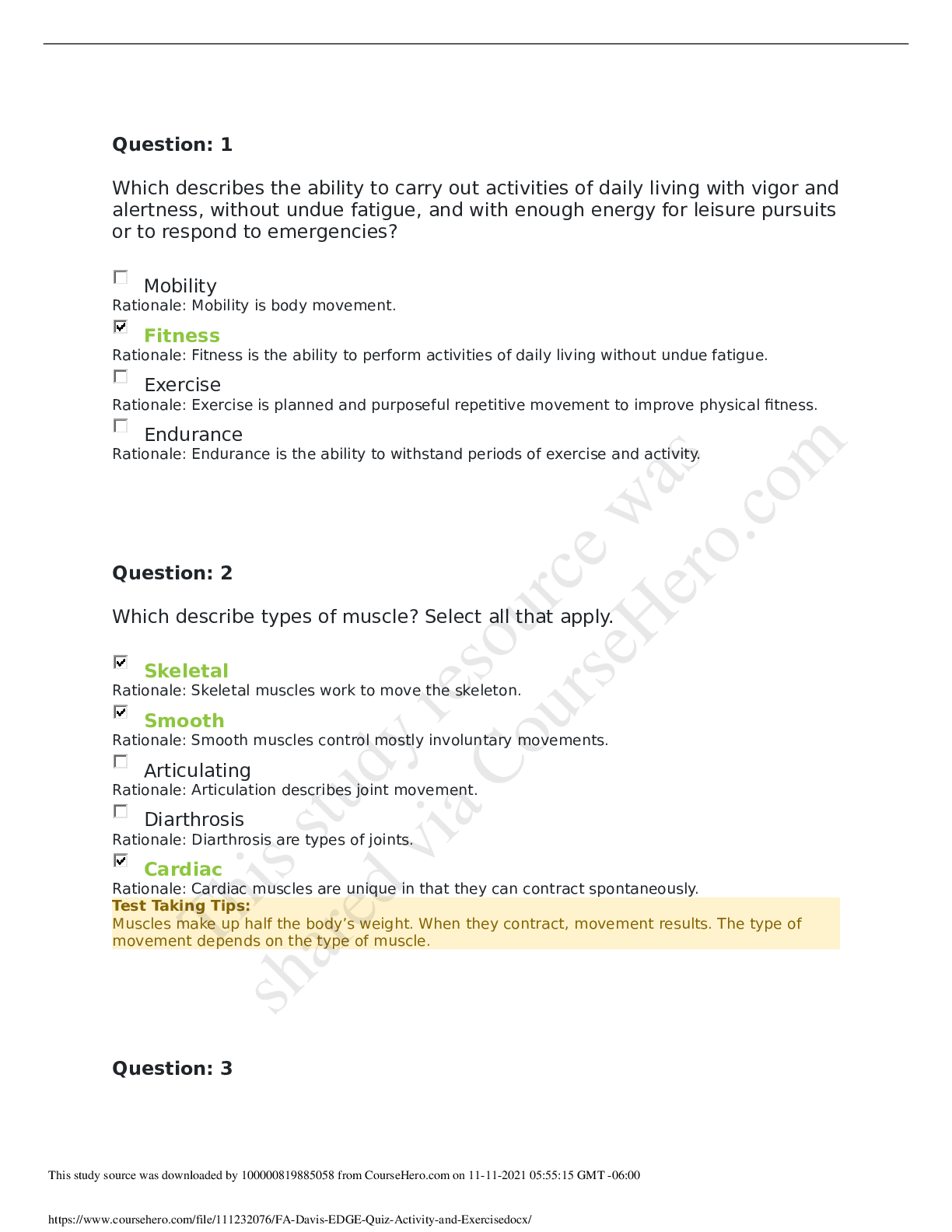
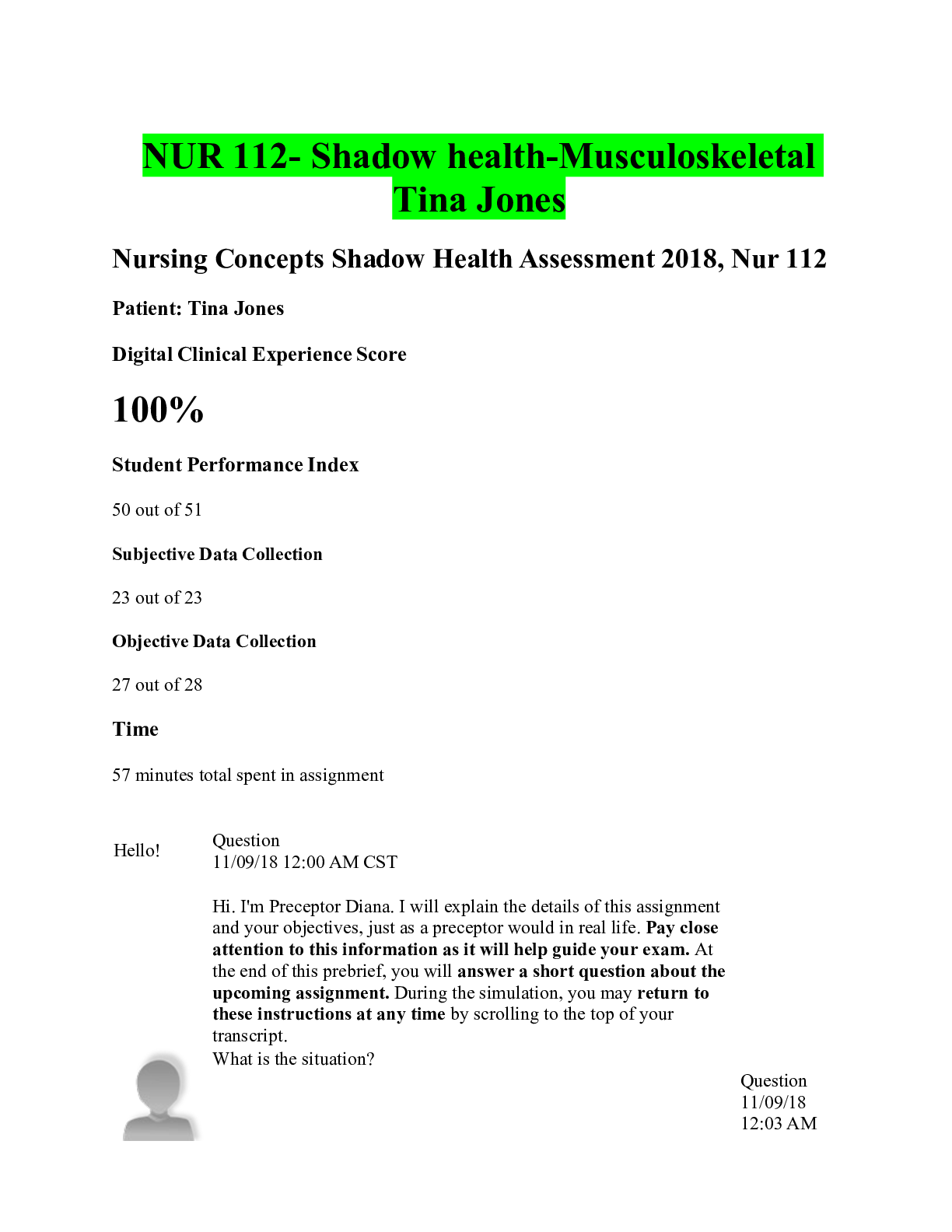
Question: 1
Which describes the ability to carry out activities of daily living with vigor and alertness, without undue fatigue, and with enough energy for leisure pursuits or to respond to emergencies?
Mobility
R
...
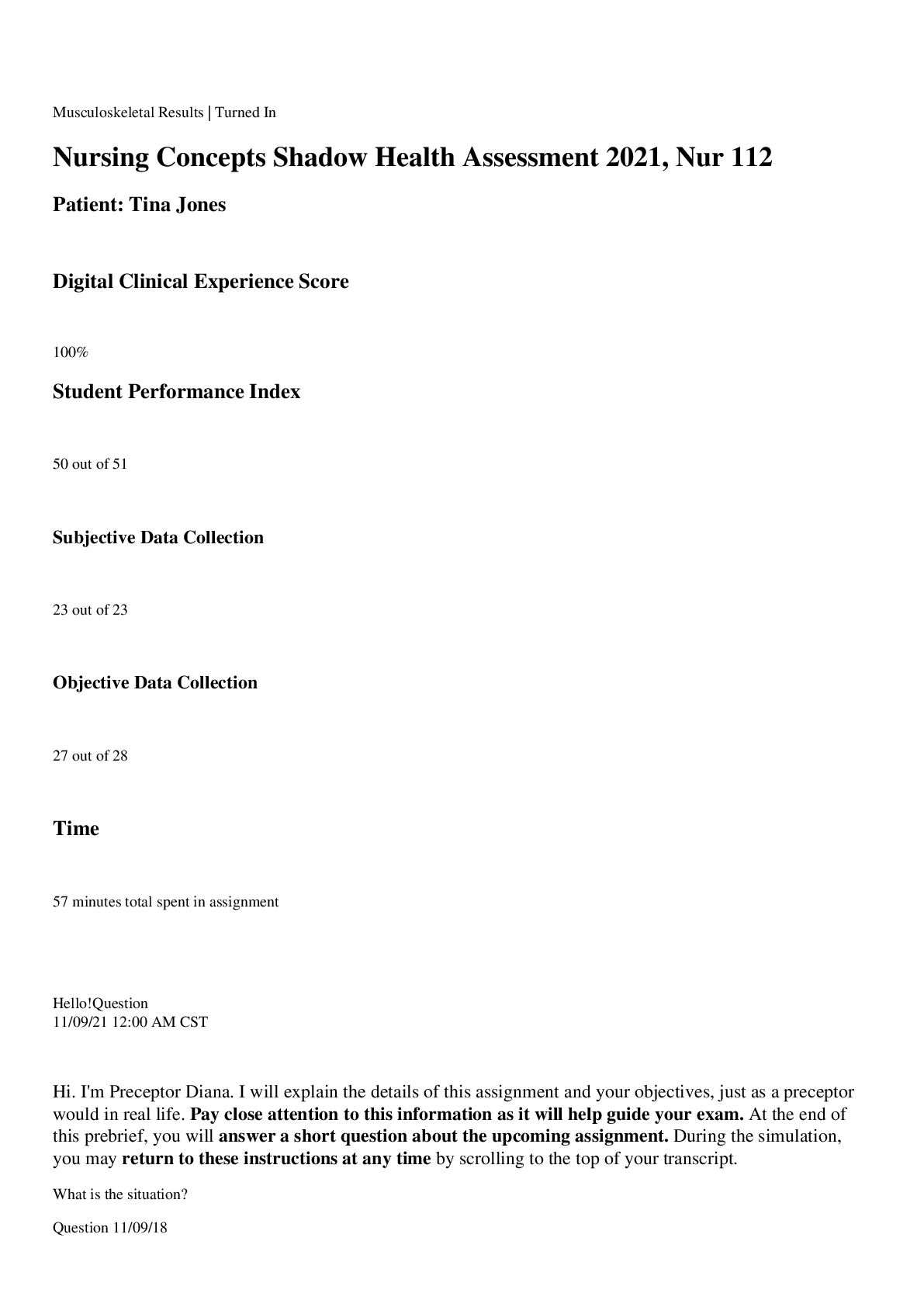
Question: 1
Which describes the ability to carry out activities of daily living with vigor and alertness, without undue fatigue, and with enough energy for leisure pursuits or to respond to emergencies?
Mobility
Rationale: Mobility is body movement.
Fitness
Rationale: Fitness is the ability to perform activities of daily living without undue fatigue.
Exercise
Rationale: Exercise is planned and purposeful repetitive movement to improve physical fitness.
Endurance
Rationale: Endurance is the ability to withstand periods of exercise and activity.
Question: 2
Which describe types of muscle? Select all that apply.
Skeletal
Rationale: Skeletal muscles work to move the skeleton.
Smooth
Rationale: Smooth muscles control mostly involuntary movements.
Articulating
Rationale: Articulation describes joint movement.
Diarthrosis
Rationale: Diarthrosis are types of joints.
Cardiac
Rationale: Cardiac muscles are unique in that they can contract spontaneously.
Question: 3
Which describes the attachment of a muscle to a more stable bone?
Point of origin
Rationale: The point of origin is where a muscle is attached to a stable bone.
Point of insertion
Rationale: The point of insertion is the attachment of a muscle to a moveable bone.
Articulation
Rationale: Articulation describes the movement of joints.
Synovial point
Rationale: Synovial joints are freely moving joints.
Question: 4
If a person makes a conscious decision to bend the elbow, which nervous system is applied?
Autonomic nervous system
Rationale: The autonomic nervous system innervates involuntary or smooth muscle.
Somatic nervous system
Rationale: Skeletal muscle is activated by the somatic nervous system.
Reflex mechanism
Rationale: A reflex mechanism is a nerve reaction to external stimulation.
Synovial movement
Rationale: Synovial movement describes the movement of joints.
Question: 5
Which structures are involved in physical coordination? Select all that apply.
Cerebral cortex
Rationale: The cerebral cortex initiates voluntary movement.
Frontal lobe
Rationale: The frontal lobe is a sensory receiver and has cognitive function.
Spinal cord
Rationale: The spinal cord is a central receiver for nervous stimulation, but it is not involved in coordination.
Cerebellum
Rationale: The cerebellum coordinates movement and is responsible for posture, movement, and position sense.
Basal ganglia
Rationale: Basal ganglia assist with coordination of movement.
Question: 6
Weight training with free weights is an example of which type of exercise?
Isometric
Rationale: Isometric exercise is muscle contraction without motion.
Isotonic
Rationale: Isotonic exercise is a movement of a joint from muscle contraction.
Isokinetic
Rationale: Isokinetic exercise is the use of specialized equipment to provide resistance to movement.
Aerobic
Rationale: Aerobic exercise is when the oxygen taken into the body meets or exceeds oxygen demand.
Question: 7
Which is an appropriate nursing diagnosis for a client who has had a stroke and has left-sided hemiparesis?
Impaired physical mobility
Rationale: This is an appropriate nursing diagnosis for a client who has had surgery to repair a fractured femur.
Sedentary lifestyle
Rationale: This is an appropriate nursing diagnosis for an obese client who does not exercise and receives assistance for activities of daily living.
Risk for disuse syndrome
Rationale: This is an appropriate nursing diagnosis for a client who has had a stroke and has left- sided hemiparesis.
Risk for injury
Rationale: This is an appropriate nursing diagnosis for a confused client who has difficulty ambulating but forgets to call for assistance.
Question: 8
Which is an inflammatory response to high levels of uric acid in the blood, resulting in severe pain and limited activity levels?
Ankylosing spondylitis
Rationale: Ankylosing spondylitis is a chronic inflammatory joint disease that results in stiffening of joints.
Rheumatoid arthritis
Rationale: Rheumatoid arthritis is a chronic autoimmune disease that results in inflammation of the joints.
Gout
Rationale: Gout produces painful joints and severely limits activity during flare-ups.
Osteoarthritis
Rationale: Osteoarthritis is the loss of articular cartilage in the joints, resulting in stiffness and immobility of joints.
Question: 9
Which describes the stretching of a ligament that causes the ligament to tear?
Sprain
Rationale: A sprain is a torn ligament from overstretching of the ligament.
Strain
Rationale: A strain is an injury to a muscle caused by overuse or overstress.
Fracture
Rationale: A fracture is a broken bone.
Degeneration
Rationale: Degeneration is a loss of bone or muscle mass.
Question: 10
A nurse is assisting a client to a standing position. The client requires frequent breaks and is unable to catch his or her breath. After standing for a few seconds, the client states he or she is exhausted and needs to lie down again. Which is an appropriate priority nursing diagnosis for this client?
Impaired physical mobility
Rationale: Impaired physical mobility is applicable to an actual inability to move, rather than exhaustion as a result of moving.
Activity intolerance
Rationale: A client who becomes fatigued easily and needs frequent breaks when moving has activity intolerance.
Risk for injury
Rationale: The client may have a risk for injury, but this is due to the fatigue from moving.
Risk for disuse syndrome
Rationale: The client may have a risk for disuse of part or all of their body, but this is not the primary problem.
Question: 11
Which are guidelines for good body mechanics? Select all that apply.
Wide base of support
Rationale: Feet placed about shoulder width apart provides a sturdy base of support.
Head facing down
Rationale: The head should be held upright and straight for optimum posture.
Abdominal muscles tight
Rationale: Abdominal muscles pulled in tight promote straight posture.
Shoulders dropped forward
Rationale: Shoulders should be held back to promote alignment of the spine.
Chest high
Rationale: Standing with the chest high promotes good body mechanics and spinal support.
Question: 12
Which is the most prevalent type of degenerative disease that can severely limit a person’s ability to perform physical activity?
Osteoarthritis
Rationale: Osteoarthritis is a deterioration of articular cartilage in the joints.
Rheumatoid arthritis
Rationale: Rheumatoid arthritis is an autoimmune disease that causes inflammation of joints.
Gout
Rationale: Gout is a buildup of uric acid in the blood, resulting in a painful, inflammatory process
Osteomyelitis
Rationale: Osteomyelitis is a bone infection that may occur after trauma or surgery.
Question: 13
Which position is described as the client lying in a semi-recumbent position, with the head of the bed elevated to 30 degrees?
Fowler’s position
Rationale: Fowler’s position is the client sitting almost upright, with the head of bed elevated to 45 to 90 degrees.
Semi-Fowler’s position
Rationale: Semi-Fowler’s position involves the client lying on his or her back with the head of the bed elevated to 30 degrees.
Prone position
Rationale: Prone position is the client lying on his or her stomach.
Lateral position
Rationale: Lateral position is a side-lying position.
Question: 14
Which would be the most appropriate way of moving a client who is very obese and immobile?
Trapeze
Rationale: A client who is very obese has a risk of injury when using the trapeze.
Transfer board
Rationale: A transfer board may not be sufficient for moving a very obese client, and it may lead to caregiver injury.
Mechanical lift
Rationale: A mechanical lift utilizes a fabric swing to lift the client and minimizes risk of injury to the client and caregiver.
Transfer belt
Rationale: A transfer belt is used only if the client is able to assist with standing.
•
•
•
•
[Show More]






 (1).png)


.png)




.png)


