Davis Edge Fluid, Electrolyte, & Acid/Base Imbalances
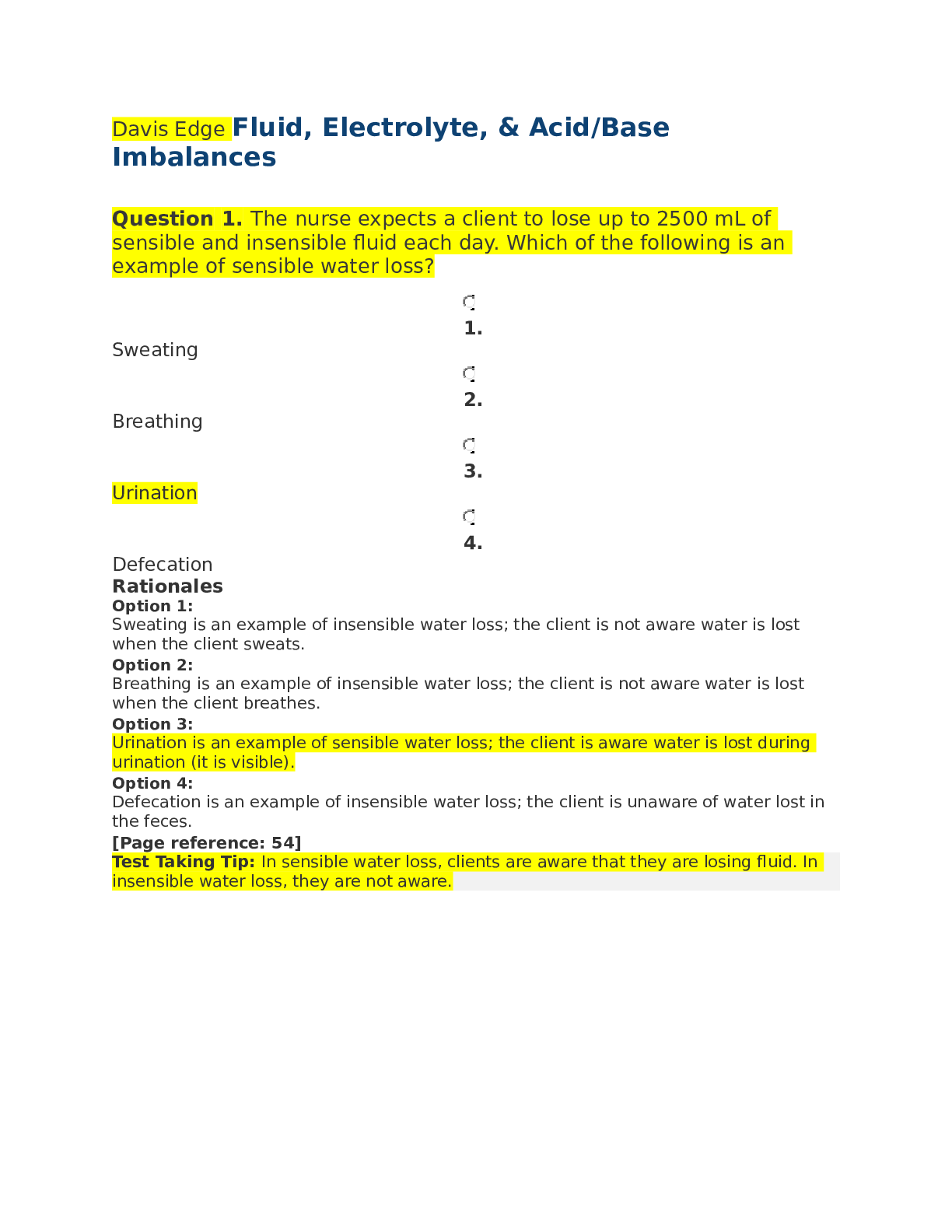
Question 1. The nurse expects a client to lose up to 2500 mL of sensible and insensible fluid each day. Which of the following is an example of sensible water loss
...
Davis Edge Fluid, Electrolyte, & Acid/Base Imbalances
Question 1. The nurse expects a client to lose up to 2500 mL of sensible and insensible fluid each day. Which of the following is an example of sensible water loss?
1.
Sweating
2.
Breathing
3.
Urination
4.
Defecation Rationales Option 1:
Sweating is an example of insensible water loss; the client is not aware water is lost when the client sweats.
Option 2:
Breathing is an example of insensible water loss; the client is not aware water is lost when the client breathes.
Option 3:
Urination is an example of sensible water loss; the client is aware water is lost during urination (it is visible).
Option 4:
Defecation is an example of insensible water loss; the client is unaware of water lost in the feces.
[Page reference: 54]
Question 2. The nurse is caring for a group of clients. Which of the following clients is at highest risk for fluid volume excess?
1.
A client who refuses to drink water.
2.
A client who has received six liters of intravenous (IV) fluid.
3.
A client who has been vomiting for 2 days.
4.
A client who currently has diarrhea
Rationales
Option 1:
Lack of water intake places a client at risk for fluid volume deficit.
Option 2:
Excessive IV fluid can place a client at risk for fluid volume excess.
Option 3:
Vomiting places, a client at risk for fluid volume deficit.
Option 4:
Diarrhea places a client at risk for fluid volume deficit.
[Page reference: 56]
Question 3. The nurse is assessing a client who is being treated for fluid volume excess. Which of the following situations warrants notifying the health-care provider (HCP)?
1.
Lung sounds clear bilaterally
2.
Neck veins nondistended
3.
Urine output 10 mL/hr
4.
Weight loss of 1 pound
Rationales
Option 1:
Clear lung sounds indicate effective treatment, and fluid retention may be subsiding.
Option 2:
Neck veins are distended when a client is exhibiting symptoms of fluid volume excess. This is an indication of effective treatment.
Option 3:
Urine output below 30 mL/hr should be reported to the RN or HCP. This indicates renal complications.
Option 4:
Weight loss indicates effective treatment for fluid volume excess.
[Page reference: 56]
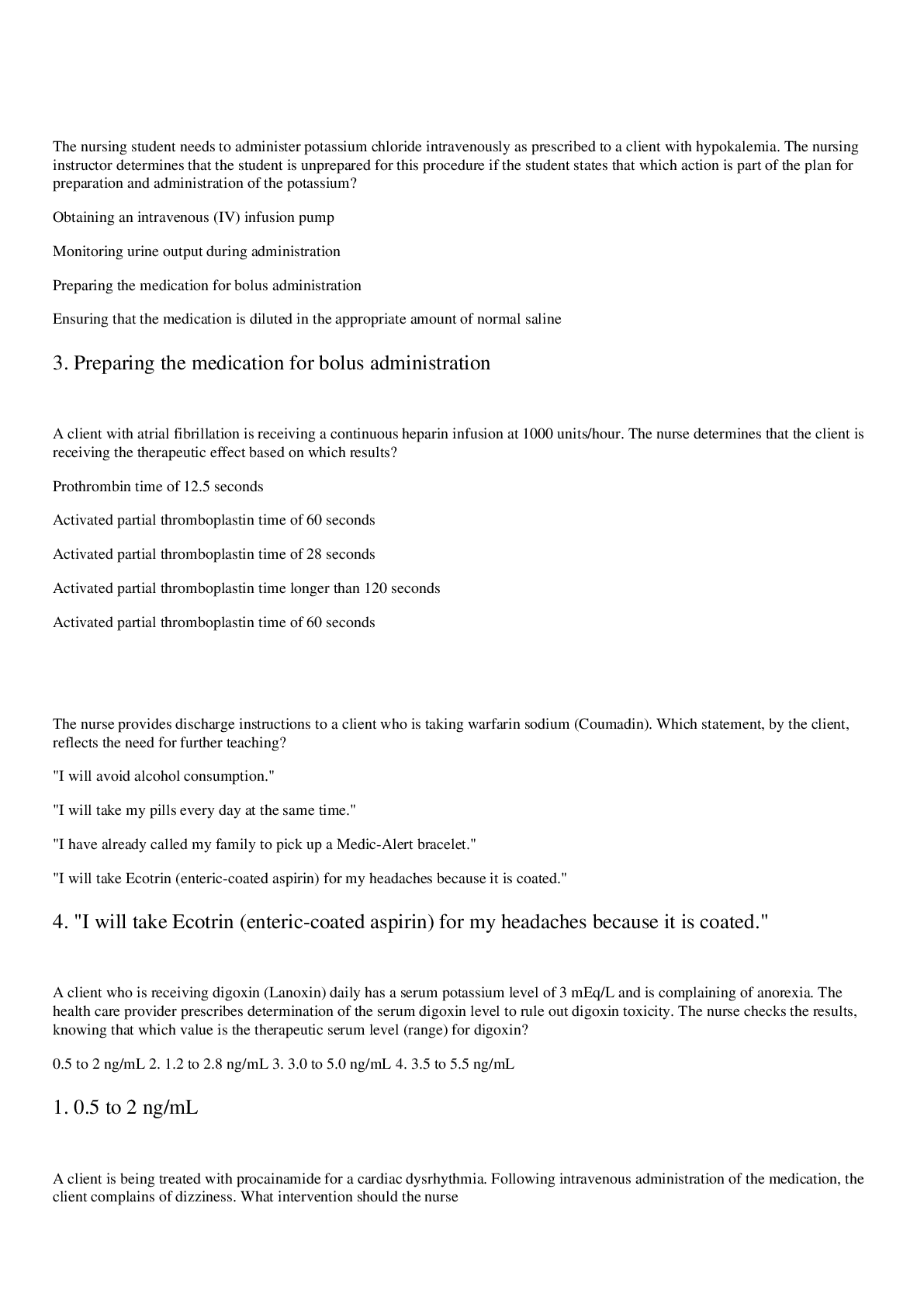
Question 4. The nurse is taking a medication history on a client admitted with hypokalemia. Which of the following medications would be of most concern to the nurse?
1.
Spironolactone
2.
Furosemide
3.
Triamterene
4.
Amiloride Rationales Option 1:
Spironolactone is a potassium-sparing diuretic.
Option 2:
Furosemide is a potassium-wasting diuretic. The client will need to take a potassium supplement.
Option 3:
Triamterene is a potassium-sparing diuretic.
Option 4:
Amiloride is a potassium-sparing diuretic.
[Page reference: 56]
Question 5. The nurse is caring for a client with a calcium level of 6 mg/dL. The nurse would expect the client to exhibit which clinical manifestation?
1.
Increased blood pressure
2.
Altered heart rhythm
3.
Constipation
4.
Increased heart rate
Rationales
Option 1:
An increase in blood pressure is seen in a client with hypercalcemia.
Option 2:
An altered heart rhythm is typically seen in clients with hypocalcemia.
Option 3:
Diarrhea is typically reported in clients with hypocalcemia.
Option 4:
An increase in heart rate is seen in a client with hypercalcemia.
[Page reference: 63]
Question 6. The nurse is reviewing lab values for a group of clients and notes a potassium level of 7 mEq/L in a client. Which of the following clients is most at risk for developing this potassium imbalance?
1.
A client taking furosemide for heart failure
2.
A client who has been vomiting for 3 days
3.
A client with chronic kidney failure
4.
A client with Cushing’s syndrome
Rationales
Option 1:
Furosemide is a potassium-wasting diuretic, so the client is at risk for hypokalemia.
Option 2:
Gastrointestinal losses place the client at risk for hypokalemia.
Option 3:
Clients with kidney failure are at risk for hyperkalemia because the kidneys cannot excrete potassium.
Option 4:
Use of corticosteroids can lead to hypokalemia. A client with Cushing’s syndrome has been or is taking corticosteroids.
[Page reference: 62-63]
Test Taking Tip: The client retaining potassium will be seen first.
Question 7. The nurse is caring for a group of clients. Which of the following clients is at high risk for developing hyponatremia? Select all that apply.
1.
A client who is nothing by mouth (NPO)
2.
A client with dry skin
3.
A client taking diuretics
4.
A client with constipation
5.
A client who experienced a near-drowning in fresh water
6.
A client with a bowel obstruction connected to high intermittent suction
Rationales
Option 1:
A client not consuming water is at risk for hyponatremia
Option 2:
A client with dry skin is not at risk for hyponatremia. A client with diaphoresis is at risk.
Option 3:
A client taking diuretics is at risk for hyponatremia.
Option 4:
A client with diarrhea, not constipation, is at risk for hyponatremia.
Option 5:
A client who experienced a freshwater near-drowning is at risk for hyponatremia.
Option 6:
A client who is connected to gastrointestinal suction is at risk for hyponatremia
[Page reference: 61]
Question 8. The nurse is caring for a client with a potassium level of 2.4 mEq/L. Which statement made by the client warrants a telephone call to the health-care provider (HCP)?
1.
“I feel like my heart is skipping a beat.”
2.
“I woke up this morning feeling nauseated.”
3.
“My leg was cramping during the night.”
4.
“I feel a little sleepy today.”
Rationales
Option 1:
This indicates the client may be experiencing a dysrhythmia, and the HCP should be notified.
Option 2:
Nausea is a common clinical manifestation of hypokalemia.
Option 3:
Leg cramps are a common clinical manifestation of hypokalemia.
Option 4:
Hypokalemia affects the nervous system, so the client may be slightly lethargic.
[Page reference: 61]
Question 9. The nurse is caring for a 75-year-old client admitted with dehydration. The nurse knows that the following statements are true regarding dehydration and older adults. Select all that apply.
1.
Older adults have an increase in thirst sensation
2.
An older adult has a decrease in total body water from 60% to 50%
3.
Older adults need to be encouraged to drink fluids often
4.
Older adults exhibit the same clinical manifestations of dehydration as a younger adult
5.
Older adults require 30 mL/kg/day of fluids to prevent dehydration
Rationales
Option 1:
Older adults have a decrease in thirst sensation.
Option 2:
This statement is true. Older adults have a decrease in total body water due to increase in body fat and decrease in thirst sensation.
Option 3:
This statement is true as result of the decrease in thirst sensation
Option 4:
This is a false statement. Older adults may experience altered mental status, lightheadedness, and syncope because they have an inadequate circulatory volume and a decrease in oxygen to the brain.
Option 5:
This is a true statement. If the client is unable to drink fluids, alternative routes may be necessary.
[Page reference: 60]
Test Taking Tip: Recall geriatric changes regarding dehydration and thirst.
Question 10. The nurse is reviewing laboratory values for a client and notes a calcium level of 13 mg/dL. The nurse can expect to see which of the following clinical manifestations? Select all that apply.
1.
Confusion
2.
Hyperactive deep tendon reflexes
3.
Increased heart rate
4.
Muscle weakness
5.
Elevated body temperature
6.
Diarrhea Rationales Option 1:
Confusion is a clinical manifestation of hypernatremia.
Option 2:
Hyperactive DTRs is indicative of hypocalcemia.
Option 3:
Clinical manifestations of hypercalcemia include increased heart rate and blood pressure, muscle weakness, and decreased GI motility.
Option 4:
Clinical manifestations of hypercalcemia include increased heart rate and blood pressure, muscle weakness, and decreased GI motility.
Option 5:
Fever is a clinical manifestation associated with hyponatremia.
Option 6:
Diarrhea is a clinical manifestation associated with hypocalcemia
[Page reference: 63]
Question 11. A client with dehydration has been prescribed 500 mL of 0.9% normal saline to run over 3 hrs using a microdrip set with a drip factor of 60 gtt/mL. Calculate the drip rate for the solution. Record your answer as a whole number. Enter the numeral only.
Incorrect
Correct Feedback
Calculating gtt/min using a microdrip of 60 gtt/mL over 3 hrs is 166.666, rounding to 167 as the nearest whole number.
[Page reference: 7]
Test Taking Tip: Round up.
Correct Answer - 167
Question 12. The nurse is performing a test on a client with suspected hypocalcemia. Which is shown in the graphic?
1.
Allen test
2.
Chvostek sign
3.
Homan’s sign
4.
Trousseau’s sign Rationales Option 1:
Allen test is used to assess blood flow to the hand.
Option 2:
To test for Chvostek sign, tap the face below the ear in front of the eye. Facial twitching on that side of the face indicates a positive test for hypocalcemia.
Option 3:
Homan’s sign involves dorsiflexion of the foot to test for deep vein thrombosis.
Option 4:
Trousseau’s sign involves inflating a blood pressure cuf f around the client’s arm. The hand and fingers become spastic and go into palmar flexion in a client with hypocalcemia.
[Page reference: 64]
Question 13. The nurse is caring for a client admitted with kidney failure waiting to receive dialysis. Which of the following electrolyte imbalances should the nurse expect to see?
1.
Hypocalcemia
2.
Hyperkalemia
3.
Hyponatremia
4.
Hypomagnesemia Rationales Option 1:
Hyperkalemia, not hypocalcemia, is seen in clients with kidney failure.
Option 2:
Hyperkalemia is seen in clients with kidney failure.
Option 3:
Hypernatremia, not hyponatremia, is seen in clients with kidney failure.
Option 4:
Hypermagnesemia, not hypomagnesia, is seen in clients with kidney failure.
[Page reference: 62]
Question 14. The nurse is caring for a group of clients. Which client is at highest risk for developing hypercalcemia?
1.
A client with Crohn’s disease
2.
A client with hyperthermia
3.
A client with dehydration
4.
A client with metastatic lung cancer
Rationales
Option 1:
Hypomagnesemia and hypocalcemia are noted in clients with Crohn’s disease.
Option 2:
Hyponatremia is seen in clients who work in the heat.
Option 3:
Hyponatremia is seen in clients with fluid deficit (dehydration).
Option 4:
Hypercalcemia can occur in clients with cancers, especially metastatic cancers.
[Page reference: 63]
Question 15. The nurse is caring for a client who has developed hyperthermia from working in extremely high temperatures. Which of the following electrolyte imbalances will the nurse expect the client to develop?
1.
Hypomagnesemia
2.
Hypocalcemia
3.
Hypokalemia
4.
Hyponatremia Rationales Option 1:
The client with diarrhea, Crohn’s disease, anorexia, or chronic alcoholism is at risk for hypomagnesemia
Option 2:
The client with Crohn’s disease, status post thyroidectomy, or those with hyperphosphatemia are at risk for hypocalcemia.
Option 3:
Major surgery, hemorrhage, potassium-wasting diuretics, severe vomiting, diarrhea, and prolonged GI suction place a client at risk for hypokalemia.
Option 4:
The client working in extreme heat is at risk for hyponatremia.
[Page reference: 60]
Question 16. Which of the following is an example of an electrolyte?
1.
Neutrophil
2.
Calcium
3.
Hemoglobin
4.
Glucose Rationales Option 1:
A neutrophil is a type of a white blood cell. It is not an electrolyte.
Option 2:
Calcium is an example of an electrolyte. Electrolytes conduct electricity when dissolved in water.
Option 3:
Hemoglobin is an iron-containing oxygen transport protein in the red blood cells. It is not an electrolyte.
Option 4:
Glucose is a simple sugar used for energy. It is not an electrolyte because it does not conduct electricity when dissolved in water.
[Page reference: 52]
Question 17. The nurse is caring for a client with severe fluid volume excess. What clinical manifestations should the nurse expect to find on assessment? Select all that apply.
1.
Decreased blood pressure
2.
Increased respirations
3.
Pitting edema in the feet
4.
Decreased urine output
5.
Weight gain
6.
Crackles in the lungs
Rationales
Option 1:
Blood pressure is increased in a client with fluid volume excess.
Option 2:
Respirations are increased and labored in a client with fluid volume excess.
Option 3:
Edema of the feet and legs can occur as a result of extra fluid.
Option 4:
The kidneys produce extra urine, so there is an increase in urine output.
Option 5:
Weight gain occurs rapidly in a client with fluid volume excess.
Option 6:
In severe fluid excess, the client may develop moist crackles in the lungs.
[Page reference: 56-57]
eliminate the distractors by identifying the options that do not show an increase brought
on by excess fluid.
Question 18. The nurse is reviewing lab results for a client with fluid volume deficit and notes a sodium level of 118 mEq/L. The nurse will expect the client to exhibit which of the following clinical manifestations? Select all that apply.
1.
Confusion
2.
Decreased body temperature
3.
Changes in mental status
4.
Increase in urine output
5.
Weight gain
6.
Excessive hunger Rationales Option 1:
Confusion is a clinical manifestation of severe hyponatremia (normal sodium level is 135 to 145 mEq/L).
Option 2:
A client will exhibit an increase in body temperature, not a decrease.
Option 3:
Changes in mental status will occur in cases of severe hyponatremia.
Option 4:
A client will experience a decrease in urine output, not an increase.
Option 5:
A client will experience weight loss, not weight gain, with fluid volume deficit and hyponatremia.
Option 6:
A client with fluid volume deficit and hyponatremia will not experience excessive hunger.
[Page reference: 58]
Question 19. The nurse is performing a test on a client with suspected hypocalcemia. Which test is shown in the graphic?
1.
Trousseau’s sign
2.
Allen test
3.
Homan’s sign
4.
Chvostek sign Rationales Option 1:
Trousseau’s sign involves inflating a blood pressure cuff around the client’s arm. The hand and fingers become spastic and go into palmar flexion in a client with hypocalcemia.
Option 2:
Allen test is used to assess blood flow to the hand.
Option 3:
Homan’s sign involves dorsiflexion of the foot to test for deep vein thrombosis.
Option 4:
To test for Chvostek sign, tap the face below the ear in front of the eye. Facial twitching on that side of the face indicates a positive test for hypocalcemia.
[Page reference: 63]
Test Taking Tip: Chvostek sign causes spasm near the Cheek. Both begin with a CH.
Question 20. The nurse is reviewing lab values for a group of clients. Which lab value would be of most concern to the nurse?
1.
Magnesium 1.6 mEq/L
2.
Sodium 120 mEq/L
3.
Potassium 4.0 mEq/L
4.
Calcium 10mg/dL Rationales Option 1:
Normal magnesium is 1.5 to 2.5mEq/L. This is a normal value.
Option 2:
Normal sodium levels are 135 to 145 mEq/L. This value is significantly low.
Option 3:
Normal potassium levels are 3.5 to 5 mEq/L. This value is normal.
Option 4:
Normal calcium levels are 9 to 11mg/dL. This value is normal.
[Page reference: 60]
Question 21. A client weighed 140 pounds yesterday. Today the client weighs 138 pounds. 1 pint of fluid (473 mL) weighs 1 pound. How many milliliters of fluid did the client lose? Enter the numeral only.
Incorrect
Correct Feedback
The client lost 2 pounds. 1 pound=473 mL; multiply 473 by 2.
[Page reference: Page 9]
Test Taking Tip: Multiply 473 by 2.
Correct Answer - 946
Question 22. The nurse is monitoring intake and output for a client with fluid volume excess. The client consumed 240 mL of orange juice, 1.5 L of water, 1 L of 0.9% normal saline, and 480 mL of chicken broth. How many milliliters will the nurse document for the client’s intake?
1.
2220mL
2.
3000mL
3.
3220mL
4.
4000mL
Rationales
Option 1:
2220 is not the correct intake; 3,220 is the correct amount.
Option 2:
3000 is not the correct intake; 3220 is the correct amount.
Option 3:
240mL + 1000 mL (in 1 L)+500 mL + 1000 mL (in 1 L)+480 mL = 3220 mL.
Option 4:
4000 is not the correct intake; 3220 is the correct amount
[Page reference: 67]
Test Taking Tip: Remember there are 1000mL in 1 L.
Question 23. The nurse is caring for a client who just underwent a parathyroidectomy. What should the nurse have readily available for emergency use?
1.
Calcium gluconate
2.
Vitamin D
3.
Loop diuretics
4.
Isotonic intravenous (IV) fluid
Rationales
Option 1:
Calcium gluconate intravenous (IV) is given for emergency use if signs of hypocalcemia occur.
Option 2:
Vitamin D is an important part of treatment for clients with hypocalcemia, but vitamin D will not work quickly.
Option 3:
Loop diuretics are given for fluid volume excess.
Option 4:
Isotonic IV fluid is used as fluid replacement, not as an emergency treatment for hypocalcemia.
[Page reference: 63]
Question 24. The nurse is reviewing lab values for a client and notes a magnesium level of 1.0 mEq/L. Which of the following interventions should the nurse expect to implement?
1.
Administer magnesium sulfate intravenously (IV) per order
2.
Insert an indwelling Foley catheter
3.
Apply oxygen at 4 L/min via nasal cannula
4.
Prepare the client for dialysis
Rationales
Option 1:
Magnesium sulfate IV is the treatment for hypomagnesemia.
Option 2:
There is nothing in the stem to indicate the client requires a catheter.
Option 3:
There is nothing in the stem to indicate the client is experiencing respiratory distress or dyspnea.
Option 4:
The stem does not imply that the client has kidney disease.
[Page reference: 66]
Question 25. The nurse is reviewing arterial blood gas (ABG) results for a client with chronic obstructive pulmonary disease (COPD) and notes a pH of 7.23. Which of the following imbalances is the client experiencing?
1.
Metabolic acidosis
2.
Metabolic alkalosis
3.
Respiratory acidosis
4.
Respiratory alkalosis
Rationales
Option 1:
The problem is in the lungs (respiratory), not elsewhere in the body, so the client is not in a metabolic imbalance.
Option 2:
The problem is in the lungs (respiratory), not elsewhere in the body, so the client is not in a metabolic imbalance.
Option 3:
The client is in respiratory acidosis. Respiratory indicates problems of the lung. In COPD, the client retains carbon dioxide as a result of hypoventilation.
Option 4:
Respiratory indicates problems of the lung. In respiratory alkalosis, the alkalosis is due to increased carbon dioxide retention as a result of hyperventilation.
[Page reference: 67]
[Show More]













.png)



.png)


