1. One of the primary focuses of improving the health of the American people in
the twenty-first century is to address:
a. Bioterrorism and global health threats
b. Delivery of individual care and hygiene
c. The need
...
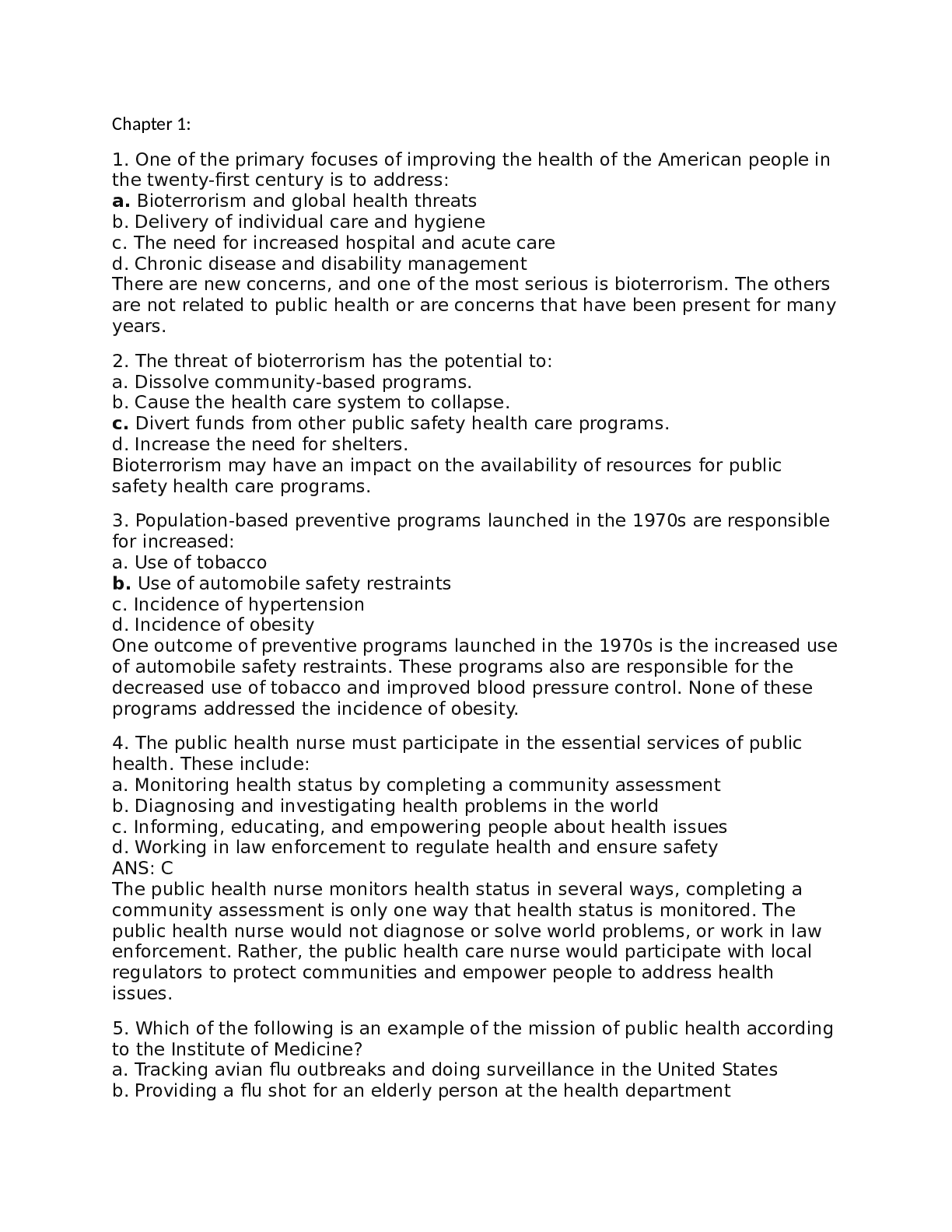
1. One of the primary focuses of improving the health of the American people in
the twenty-first century is to address:
a. Bioterrorism and global health threats
b. Delivery of individual care and hygiene
c. The need for increased hospital and acute care
d. Chronic disease and disability management
There are new concerns, and one of the most serious is bioterrorism. The others
are not related to public health or are concerns that have been present for many
years.
2. The threat of bioterrorism has the potential to:
a. Dissolve community-based programs.
b. Cause the health care system to collapse.
c. Divert funds from other public safety health care programs.
d. Increase the need for shelters.
Bioterrorism may have an impact on the availability of resources for public
safety health care programs.
3. Population-based preventive programs launched in the 1970s are responsible
for increased:
a. Use of tobacco
b. Use of automobile safety restraints
c. Incidence of hypertension
d. Incidence of obesity
One outcome of preventive programs launched in the 1970s is the increased use
of automobile safety restraints. These programs also are responsible for the
decreased use of tobacco and improved blood pressure control. None of these
programs addressed the incidence of obesity.
4. The public health nurse must participate in the essential services of public
health. These include:
a. Monitoring health status by completing a community assessment
b. Diagnosing and investigating health problems in the world
c. Informing, educating, and empowering people about health issues
d. Working in law enforcement to regulate health and ensure safety
ANS: C
The public health nurse monitors health status in several ways, completing a
community assessment is only one way that health status is monitored. The
public health nurse would not diagnose or solve world problems, or work in law
enforcement. Rather, the public health care nurse would participate with local
regulators to protect communities and empower people to address health
issues.
5. Which of the following is an example of the mission of public health according
to the Institute of Medicine?
a. Tracking avian flu outbreaks and doing surveillance in the United States
b. Providing a flu shot for an elderly person at the health department
c. Keeping track of alternative therapies in use in the United States
d. Keeping snake antivenom at the Centers for Disease Control and Prevention in
Atlanta
ANS: A
The Institute of Medicines stated mission on public health is to generate
organized community and technical knowledge to prevent disease and promote
health.
6. Making sure that essential community-oriented health services are available
defines which of the core public health functions?
a. Policy development
b. Assessment
c. Assurance
d. Scientific knowledge-based care
ANS: C
Public health is based on scientific knowledge, but is not a core function. The
definition does not fit the terms assessment or policy development.
7. The number and proportion of persons aged 25 or older with less than a high
school education is an example of:
a. Sociodemographic characteristics
b. Health status
c. Health risk factors
d. Health care resource consumption
ANS: A
The number and proportion of people is a demographical characteristic.
8. The purpose of public health core functions is to:
a. Clarify the role of the government in fulfilling the mission of public health.
b. Ensure the safety of populations in receiving quality health care.
c. Provide community-based individualized care to every person in the United
States.
d. Unite public and private providers of care in a comprehensive approach to
providing health care.
ANS: A
As defined by the Institute of Medicine in its 1988 report The Future of Public
Health, assessment, policy development, and assurance are core functions at all
levels of government for the purpose of clarifying the governments role.
9. Which of the following statements about public health is accurate?
a. Prevention of early deaths can be more effectively accomplished by medical
treatment than by public health approaches.
b. Expenditures and resources for public health have increased in recent years.
c. Historically, gains in the health of populations have been related largely to
changes in safety, sanitation, and personal behavior.
d. Reform of the medical insurance system is the single change needed to
improve the health of Americans.
ANS: C
Changes, such as immunizations, tobacco use, blood pressure control, and
automobile safety, have helped increase the health of communities.
10. Collecting data and monitoring the health status of the population defines
which of the core public health functions?
a. Assessment
b. Prevention
c. Assurance
d. Policy development
ANS: A
Prevention is not a core function, assurance is making sure essential services
are available, and policy development is needed to provide leadership in
developing policies. Assessment consists of systematic data collection and
monitoring health status.
11. The nurse who compares the rate of teenage pregnancy in various areas of
the city is practicing the public health core function of:
a. Assurance
b. Assessment
c. Prevention
d. Policy development
ANS: B
Assessment refers to systematic data collection, which this nurse is doing for
teenage pregnancy.
12. Public health nurses who develop and implement local public health policies
through partnerships with agencies, organizations, and consumers within the
community are using which core public health function?
a. Assessment
b. Prevention
c. Assurance
d. Policy development
ANS: D
Prevention is not a core function, assurance is making sure essential services
are available, and assessment refers to systematic data collection. Policy
development deals with developing and implementing health policies.
13. Providing for the availability of essential personal health services for people
who would otherwise not receive health care defines which public health core
function?
a. Assessment
b. Prevention
c. Assurance
d. Policy development
ANS: C
Assurance deals with the availability of health services. Prevention is not a core
function, assessment refers to systematic data collection, and policy
development refers to the need to provide leadership in developing health
policies.
14. The nurse manager who makes sure that the staff members who work in a
local clinic are competent is demonstrating the public health core function of:
a. Assurance
b. Assessment
c. Prevention
d. Policy development
ANS: A
Assurance refers to making sure a competent health care workforce is available.
15. The public health nurse analyzes data related to the number and type of
United States Environmental Protection agency air quality standards that a
community failed to meet. This data is an example of using which community
health profile indicator?
a. Sociodemographic characteristics
b. Health status
c. Health risk factor
d. Functional status
ANS: C
Breathing air of poor quality is a risk to health.
16. Which is an example of the primary goal of public health?
a. Ensuring that a newly diagnosed 40-year-old hypertensive man takes his
medication
b. Finding home care for a 70-year-old client recuperating from a hip
replacement
c. Conducting an infant car seat safety check
d. Contacting a local hospice to admit a terminally ill 60-year-old woman
ANS: C
The correct answer is concerned with the health of many people, while the other
answers address individual interventions.
17. The public health workforce should demonstrate competency in which of the
following competency categories?
a. Financial planning and management
b. Workforce needs assessment
c. Acute care services
d. Curriculum development
ANS: A
Workforce needs assessment, acute care services, and curriculum development
are not considered categories of core competencies of public health. Rather
there are eight categories of competency, which include: analytic/assessment,
policy development/program planning, communication, cultural competence,
community dimensions of practice, basic public health sciences, financial
planning and management, and leadership and systems thinking.
18. Public health nursing is a specialty because:
a. It has a distinct focus and scope of practice.
b. It must be done by a registered nurse with a masters degree.
c. It is focused on disadvantaged citizens.
d. It performs interventions at the acute care level.
ANS: A
Public health nursing has a distinct focus and requires a special knowledge base.
The other answers are not characteristics of a specialty.
19. The necessary basic preparation for public health nursing is a(n) _____ in
nursing.
a. Associates degree
b. Baccalaureate degree
c. Masters degree
d. PhD
ANS: B
A BSN is the necessary basic preparation to function as a beginning staff public
health nurse.
20. Public health practitioners prepared at the graduate level should be able to:
a. Teach public and community health nursing
b. Assess and intervene successfully at the aggregate level
c. Diagnose and treat disease and have prescriptive authority
d. Run for political office as experts in public health policy
ANS: B
According to the Consensus Conference, specialists should have assessment
skills that allow them to intervene at the aggregate level. Public health
practitioners have a broad range of practice areas within public health and are
not limited to only nursing and medicine.
21. A public health nurse provides a clinic for HIV-positive citizens in the
community. This is an example of:
a. Primary prevention
b. Secondary prevention
c. Tertiary prevention
d. Policy making
ANS: C
This clinic is for clients who already have a disease process; therefore, it is
tertiary prevention.
22. An example of a community health nursing practice is:
a. Administrating a flu shot to a client in a physicians office
b. Conducting a flu shot clinic at a community center
c. Performing a client assessment in a hospital
d. Providing supervision of staff in a rehabilitation center
ANS: A
Community health nursing practice focuses on providing individual interventions
in the community. Administrating a flu shot to an individual is the only example
that meets this criterion.
23. Which statement about community health nursing practice is correct?
a. It focuses on the delivery of personal health services to individuals and
families.
b. It provides care to protect the health of the community as a whole.
c. It emphasizes the setting where care is provided for clients and families.
d. It requires a baccalaureate preparation for practice.
ANS: A
By definition, the first option is correct. Public health nursing provides care to
protect the health of the community as a whole. Community-based nursing
practice emphasizes the setting where care is provided for clients and families.
It is generally assumed that a graduate of any baccalaureate program has the
necessary basic preparation to function as a beginning staff public health nurse;
however, this is not a requirement for public health nursing or community health
nursing practices.
24. The term community-based nursing care is applied when implementing
which nursing intervention?
a. Assessing the health needs of a defined community
b. Providing care to families in a community
c. Promoting the health of an entire community
d. Investigating environmental health problems in a community
ANS: B
Community-based nursing practice is a setting-specific practice whereby care is
provided for families where they live, work, and attend school. The focus is on
acute and chronic care and the provision of services. Providing care to families is
the only intervention that accurately describes this definition.
25. The nurse who conducts vision screenings on children in the school setting is
practicing _____ nursing practice.
a. Community-oriented
b. Public health
c. Community health
d. Community-based
ANS: D
This type of nursing is a setting-specific practice.
26. Which is an example of an aggregate or population?
a. Students in a county school system
b. Christians around the world
c. A patient in the intensive care unit at the local hospital
d. People who play cards together once a week at private homes
A population or aggregate is a collection of individuals who have one or more
personal or environmental characteristics in common. They can be defined in
terms of geography or a special interest. The clients in the first option share a
geographical characteristic.
27. The nurse investigating environmental health problems caused by
contaminated ground water is best described as practicing:
a. Community-oriented nursing
b. Community-based nursing
c. Policy development
d. Tertiary care
Community-oriented nursing emphasizes the prevention of disease and
disability.
28. A population is best defined as a:
a. High-risk group
b. School or institutional setting
c. Collection of individuals who share at least one common characteristic
d. Geographical location within a community
The wrong answers are types of populations; they do not define a population.
29. Population-focused practice focuses on defining the problems or needs of
and implementing solutions for:
a. Individuals
b. Aggregates
c. Communities
d. Geographical regions
ANS: B
Aggregates are a defined population made up of individuals in communities of a
specific geographical region.
30. Which of the following statements is true with regard to a population focus in
public health nursing?
a. Priority is given to the highest risk population.
b. Direct caregiving is limited to preventive measures, such as administration of
immunizations.
c. Attention is given to the population or community as a whole, regardless of
whether they do or do not access the health care system.
d. Only populations outside institutional settings are considered.
ANS: C
Public health nurses are concerned with the health of the entire population.
31. A public health staff nurse who has a clear understanding of populationfocused practice:
a. Is frustrated providing care to individuals
b. Would rather perform population-focused interventions
c. Is able to improve the effectiveness of care provided
d. Is considered a public health nurse specialist
ANS: C
Public health staff nurses who have a clear understanding of population-focused
care improve their effectiveness and efficiency of practice; have professional
satisfaction by seeing how individual care contributes to health at the population
level; and appreciate the practice of others who are population-focused
specialists. Public health nurse specialists are prepared at the masters level and
function in an administrative role.
32. A key opportunity for public health nurses to improve population-focused
care is by:
a. Assuming traditional nursing roles
b. Influencing public health policy
c. Conducting community assessments
[Show More]




.png)



![Preview of Actual_questions_from_2022_Med_surg_Hesi.pdf LATEST VERSION[DOWNLOAD]](https://scholarfriends.com/storage/Actual_questions_from_2022_Med_surg_Hesi.png)


