Test bank based on Personal Financial Planning ED.15 by Randy Billingsley, Lawrence J. Gitman & Michael D. Joehnk TRUE/FALSE
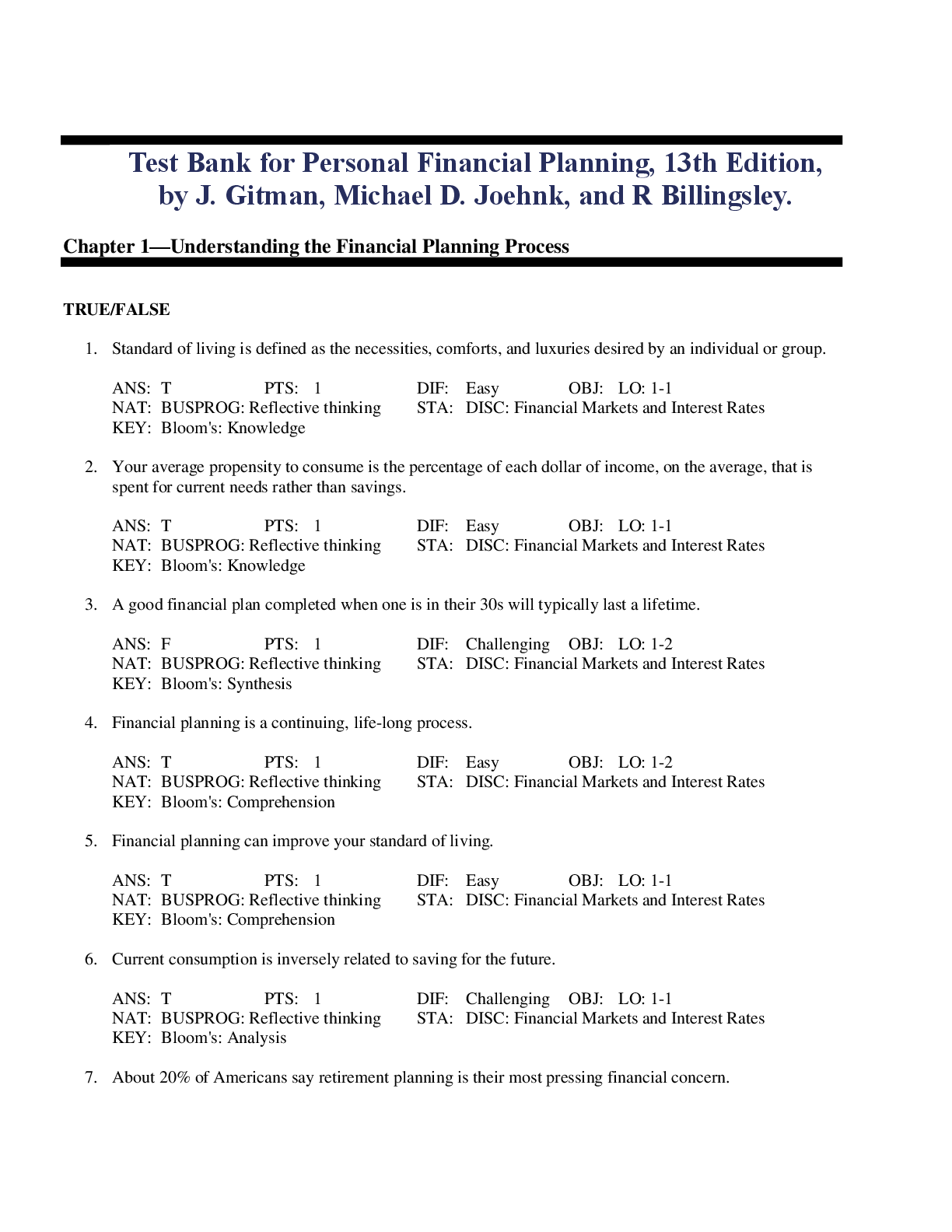
1. Standard of living is defined as the necessities, comforts, and luxuries desired by an indi
...
Test bank based on Personal Financial Planning ED.15 by Randy Billingsley, Lawrence J. Gitman & Michael D. Joehnk TRUE/FALSE
1. Standard of living is defined as the necessities, comforts, and luxuries desired by an individual or
group.
ANS: T PTS: 1 DIF: Easy OBJ: LO: 1-1
NAT: BUSPROG: Reflective thinking STA: DISC: Financial Markets and Interest Rates
KEY: Bloom's: Knowledge
2. Your average propensity to consume is the percentage of each dollar of income, on the average, that is
spent for current needs rather than savings.
ANS: T PTS: 1 DIF: Easy OBJ: LO: 1-1
NAT: BUSPROG: Reflective thinking STA: DISC: Financial Markets and Interest Rates
KEY: Bloom's: Knowledge
3. A good financial plan completed when one is in their 30s will typically last a lifetime.
ANS: F PTS: 1 DIF: Challenging OBJ: LO: 1-2
NAT: BUSPROG: Reflective thinking STA: DISC: Financial Markets and Interest Rates
KEY: Bloom's: Synthesis
4. Financial planning is a continuing, life-long process.
ANS: T PTS: 1 DIF: Easy OBJ: LO: 1-2
NAT: BUSPROG: Reflective thinking STA: DISC: Financial Markets and Interest Rates
KEY: Bloom's: Comprehension
5. Financial planning can improve your standard of living.
ANS: T PTS: 1 DIF: Easy OBJ: LO: 1-1
NAT: BUSPROG: Reflective thinking STA: DISC: Financial Markets and Interest Rates
KEY: Bloom's: Comprehension
6. Current consumption is inversely related to saving for the future.
ANS: T PTS: 1 DIF: Challenging OBJ: LO: 1-1
NAT: BUSPROG: Reflective thinking STA: DISC: Financial Markets and Interest Rates
KEY: Bloom's: Analysis
7. About 20% of Americans say retirement planning is their most pressing financial concern.
ANS: F PTS: 1 DIF: Moderate OBJ: LO: 1-1
NAT: BUSPROG: Reflective thinking STA: DISC: Financial Markets and Interest Rates
KEY: Bloom's: Knowledge
8. The most effective way to achieve financial objectives is through financial planning.
ANS: T PTS: 1 DIF: Moderate OBJ: LO: 1-1
NAT: BUSPROG: Reflective thinking STA: DISC: Financial Markets and Interest Rates
KEY: Bloom's: Comprehension
9. Defining financial goals is an important first step in personal financial planning process.
ANS: T PTS: 1 DIF: Easy OBJ: LO: 1-2
NAT: BUSPROG: Reflective thinking STA: DISC: Financial Markets and Interest Rates
KEY: Bloom's: Comprehension
10. Two persons with equal average propensities to consume will not necessarily have equal standards of
living because of differences in income.
ANS: T PTS: 1 DIF: Challenging OBJ: LO: 1-1
NAT: BUSPROG: Reflective thinking STA: DISC: Financial Markets and Interest Rates
KEY: Bloom's: Evaluation
11. The need for financial planning declines as your income increases.
ANS: F PTS: 1 DIF: Moderate OBJ: LO: 1-1
NAT: BUSPROG: Reflective thinking STA: DISC: Financial Markets and Interest Rates
KEY: Bloom's: Synthesis
12. Current consumption effects future consumption.
ANS: T PTS: 1 DIF: Challenging OBJ: LO: 1-1
NAT: BUSPROG: Reflective thinking STA: DISC: Financial Markets and Interest Rates
KEY: Bloom's: Analysis
13. A person who has $2,000 monthly income and spends $1,800 monthly has an average propensity to
consume of 90%.
ANS: T PTS: 1 DIF: Challenging OBJ: LO: 1-1
NAT: BUSPROG: Reflective thinking STA: DISC: Financial Markets and Interest Rates
KEY: Bloom's: Evaluation
14. A person making $35,000 and spending $30,800 has an average propensity to consume of 80%.
ANS: F PTS: 1 DIF: Challenging OBJ: LO: 1-1
NAT: BUSPROG: Reflective thinking STA: DISC: Financial Markets and Interest Rates
KEY: Bloom's: Evaluation
15. Most families find it difficult to discuss money matters.
ANS: T PTS: 1 DIF: Easy OBJ: LO: 1-2
NAT: BUSPROG: Reflective thinking STA: DISC: Financial Markets and Interest Rates
KEY: Bloom's: Knowledge
16. Average propensity to consume refers to how much of your money you plan to save in your financial
plan.
ANS: F PTS: 1 DIF: Challenging OBJ: LO: 1-1
NAT: BUSPROG: Reflective thinking STA: DISC: Financial Markets and Interest Rates
KEY: Bloom's: Comprehension
17. Tangible assets are earning assets that are held for the returns they promise.
ANS: F PTS: 1 DIF: Challenging OBJ: LO: 1-1
NAT: BUSPROG: Reflective thinking STA: DISC: Financial Markets and Interest Rates
KEY: Bloom's: Comprehension
18. Financial assets are paper assets, such as savings accounts and securities.
ANS: T PTS: 1 DIF: Moderate OBJ: LO: 1-1
NAT: BUSPROG: Reflective thinking STA: DISC: Financial Markets and Interest Rates
KEY: Bloom's: Comprehension
19. Mutual funds are examples of financial assets.
ANS: T PTS: 1 DIF: Easy OBJ: LO: 1-1
NAT: BUSPROG: Reflective thinking STA: DISC: Financial Markets and Interest Rates
KEY: Bloom's: Application
20. Spending for your child's private-school education is an example of deferred consumption.
ANS: F PTS: 1 DIF: Challenging OBJ: LO: 1-1
NAT: BUSPROG: Reflective thinking STA: DISC: Financial Markets and Interest Rates
KEY: Bloom's: Application
[Show More]