HESI RN Pharmacology Exam Questions with Answers, Rationales, Test�TakingStrategies and References.
1. A nurse notes that the site of a client’s peripheral intravenous (IV) catheter is reddened, warm,
painful, and slig
...
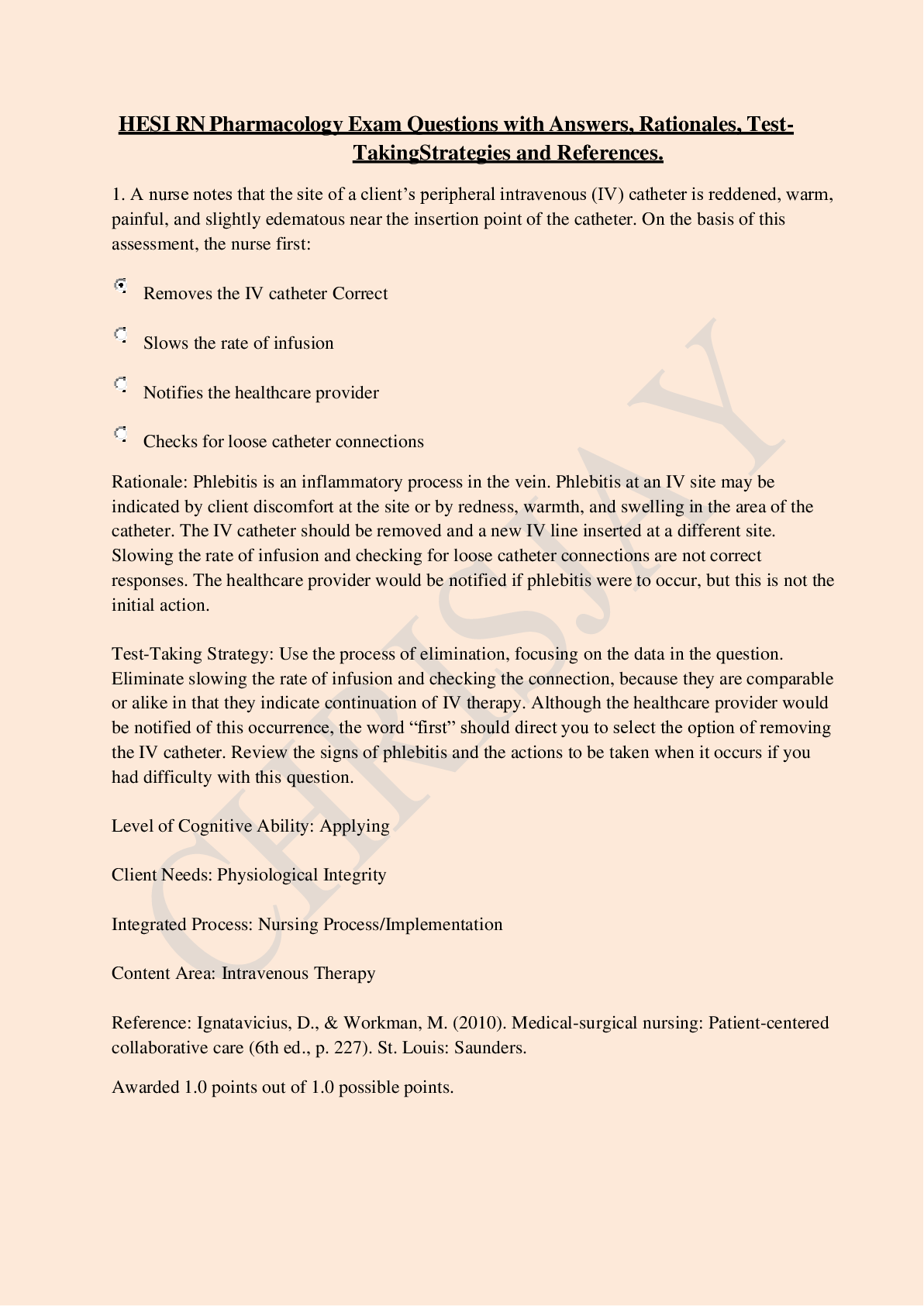
HESI RN Pharmacology Exam Questions with Answers, Rationales, Test�TakingStrategies and References.
1. A nurse notes that the site of a client’s peripheral intravenous (IV) catheter is reddened, warm,
painful, and slightly edematous near the insertion point of the catheter. On the basis of this
assessment, the nurse first:
Removes the IV catheter Correct
Slows the rate of infusion
Notifies the healthcare provider
Checks for loose catheter connections
Rationale: Phlebitis is an inflammatory process in the vein. Phlebitis at an IV site may be
indicated by client discomfort at the site or by redness, warmth, and swelling in the area of the
catheter. The IV catheter should be removed and a new IV line inserted at a different site.
Slowing the rate of infusion and checking for loose catheter connections are not correct
responses. The healthcare provider would be notified if phlebitis were to occur, but this is not the
initial action.
Test-Taking Strategy: Use the process of elimination, focusing on the data in the question.
Eliminate slowing the rate of infusion and checking the connection, because they are comparable
or alike in that they indicate continuation of IV therapy. Although the healthcare provider would
be notified of this occurrence, the word “first” should direct you to select the option of removing
the IV catheter. Review the signs of phlebitis and the actions to be taken when it occurs if you
had difficulty with this question.
Level of Cognitive Ability: Applying
Client Needs: Physiological Integrity
Integrated Process: Nursing Process/Implementation
Content Area: Intravenous Therapy
Reference: Ignatavicius, D., & Workman, M. (2010). Medical-surgical nursing: Patient-centered
collaborative care (6th ed., p. 227). St. Louis: Saunders.
Awarded 1.0 points out of 1.0 possible points.
2. A nurse hangs a 500-mL bag of intravenous (IV) fluid for an assigned client. One hour later
the client complains of chest tightness, is dyspneic and apprehensive, and has an irregular pulse.
The IV bag has 100 mL remaining. Which of the following actions should the nurse take first?
Removing the IV
Sitting the client up in bed
Shutting off the IV infusion Correct
Slowing the rate of infusion
Rationale: The client’s symptoms are indicative of speed shock, which results from the rapid
infusion of drugs or a bolus infusion. In this case, the nurse would note that 400 mL has infused
over 60 minutes. The first action on the part of the nurse is shutting off the IV infusion. Other
actions may follow in rapid sequence: The nurse may elevate the head of the bed to aid the
client’s breathing and then immediately notify the healthcare provider. Slowing the infusion rate
is inappropriate because the client will continue to receive fluid. The IV does not need to be
removed. It may be needed to manage the complication.
Test-Taking Strategy: Use the process of elimination, focusing on the data in the question. Note
the question contains the strategic word “first.” Recognizing the signs of speed shock and
recalling the appropriate interventions should also direct you to the option of shutting off the IV
infusion. Review the initial nursing actions for speed shock if you had difficulty with this
question.
Level of Cognitive Ability: Applying
Client Needs: Physiological Integrity
Integrated Process: Nursing Process/Implementation
Content Area: Intravenous Therapy
Reference: Ignatavicius, D., & Workman, M. (2010). Medical-surgical nursing: Patient-centered
collaborative care (6th ed., p. 230). St. Louis: Saunders.
Awarded 0.0 points out of 1.0 possible points.
3. A nurse discontinues infusion of a unit of packed red blood cells (RBCs) because the client is
experiencing a transfusion reaction. After discontinuing the transfusion, which of the following
actions does the nurse take next?
Removing the IV catheter
Contacting the healthcare provider Correct
Changing the solution to 5% dextrose in water
Obtaining a culture of the tip of the catheter device removed from the client
Rationale: If the nurse suspects a transfusion reaction, the transfusion is stopped and normal
saline solution infused at a keep-vein-open rate pending further physician prescriptions. The
nurse then contacts the physician. Dextrose in water is not used, because it may cause clotting or
hemolysis of blood cells. Normal saline solution is the only type of IV fluid that is compatible
with blood. The nurse would not remove the IV catheter, because then there would be no IV
access route through which to treat the reaction. There is no reason to obtain a culture of the
catheter tip; this is done when an infection is suspected.
Test-Taking Strategy: Use the process of elimination, focusing on the strategic word “next.”
Knowing that the IV should not be removed will assist you in the elimination process. Recalling
that normal saline solution is the only type of IV fluid that is compatible with blood will also
help you answer correctly. To select from the remaining options, note that infection is not the
concern; this will help you eliminate the option of obtaining a culture of the catheter tip. Review
care of the client experiencing a transfusion reaction if you had difficulty with this question.
Level of Cognitive Ability: Applying
Client Needs: Physiological Integrity
Integrated Process: Nursing Process/Implementation
Content Area: Blood administration
Reference: Ignatavicius, D., & Workman, M. (2010). Medical-surgical nursing: Critical thinking
for collaborative care (6th ed.). Philadelphia: W. B. Saunders, p. 919.
Awarded 0.0 points out of 1.0 possible points.
4. The nurse determines that the client is exhibiting signs of a hemolytic transfusion reaction
while receiving a blood transfusion. Place the actions the nurse should perform in the correct
order, with number 1 the first action and number 5 the last action:
Incorrect
Obtaining vital signs/oxygen saturation
Documenting the findings
Hanging an IV bag of normal saline solution (NS) at a keep-vein-open (KVO) rate
Notifying the healthcare provider
Stopping the infusion of blood
The correct order is:
Stopping the infusion of blood
Hanging an IV bag of normal saline solution (NS) at a keep-vein-open (KVO) rate
Notifying the healthcare provider
Obtaining vital signs/oxygen saturation
Documenting the findings
Rationale: If a transfusion reaction is suspected, the transfusion is immediately stopped and NS
infused, pending further physician prescriptions. Next, the healthcare provider should be
notified. Ensuring patent IV access also helps maintain the client’s intravascular volume. NS is
the solution of choice, rather than solutions containing dextrose, because red blood cells do not
clump with NS. Vital signs and oxygen saturation are monitored closely. Finally, the nurse
documents the findings and the client’s response to the interventions.
Test-Taking Strategy: Note that the client is experiencing a having a hemolytic transfusion
reaction. The question sets forth the problem; the nurse must determine the order in which
interventions should be performed. First, the blood transfusion is stopped and an isotonic
solution infused. Next the nurse should notify the healthcare provider, check vital signs and
oxygen saturation data, and assess the client closely. Once prescriptions from the healthcare
provider have been initiated, the nurse should document the event and client’s response. Review
the prioritization of interventions for a transfusion reaction if you had difficulty with the
question.
Level of Cognitive Ability: Applying
Client Needs: Physiological Integrity
Integrated Process: Nursing Process/Implementation
Content Area: Blood Administration
References: Black, J., & Hawks, J. (2009). Medical-surgical nursing: Clinical management for
positive outcomes (8th ed., p. 2016). St. Louis: Saunders.
Perry, A., & Potter, P. (2010). Clinical nursing skills & techniques (7th ed., p. 789). St. Louis:
Mosby.
Lewis, S., Dirksen, S., Heitkemper, M., Bucher, L., & Camera, I. (2011). Medical-surgical
nursing: Assessment and management of clinical problems (8th ed. p. 707). St. Louis: Mosby.
Awarded 0.0 points out of 1.0 possible points.
5. A client with heart failure is being given furosemide (Lasix) and digoxin (Lanoxin). The client
calls the nurse and complains of anorexia and nausea. Which action should the nurse take first?
Administering an antiemetic
Administering the daily dose of digoxin
Discontinuing the morning dose of furosemide
Checking the result of laboratory testing for potassium on the sample drawn 3 hours ago
Correct
Rationale: Anorexia and nausea are symptoms commonly associated with digoxin toxicity,
which is compounded by hypokalemia. Early clinical manifestations of digoxin toxicity include
anorexia and mild nausea, but they are frequently overlooked or not associated with digoxin
toxicity. Hallucinations and any change in pulse rhythm, color vision, or behavior should be
investigated and reported to the healthcare provider. The nurse should first check the results of
the potassium level, which will provide additional when the nurse calls the physician, an
important follow-up action. The nurse should also check the digoxin reading if one is available.
The nurse would not administer an antiemetic without further investigating the client’s problem.
Because digoxin toxicity is suspected, the nurse would withhold the digoxin until the physician
has been consulted. The nurse would not discontinue a medication without a prescription to do
so.
Test-Taking Strategy: Note the strategic word “first” and use the steps of the nursing process to
answer the question. The correct option is the only one that addresses assessment. Review
nursing interventions for suspected digoxin toxicity if you had difficulty with this question.
Level of Cognitive Ability: Applying
Client Needs: Physiological Integrity
Integrated Process: Nursing Process/Implementation
Content Area: Pharmacology
Reference: Hodgson, B., & Kizior, R. (2010). Saunders nursing drug handbook 2010 (p. 347). St.
Louis: Saunders.
Awarded 0.0 points out of 1.0 possible points.
6. A physician prescribes the administration of parenteral nutrition (PN), to be started at a rate of
50 mL/hr by way of infusion pump through an established subclavian central line. After the first
2 hours of the PN infusion, the client suddenly complains of difficulty breathing and chest pain.
The nurse immediately:
Obtains blood for culture
Clamps the PN infusion line Correct
Obtains a sample for blood glucose testing
Obtains an electrocardiogram (ECG)
Rationale: One complication of a subclavian central line is embolism, caused by air or thrombus.
Sudden onset of chest pain shortly after the initiation of PN may mean that this complication has
developed. The infusion is clamped (the line should not be discontinued, however), the client
turned on the left side with the head down, and the physician notified immediately. Depending
on agency protocol, the rapid response team would also be called. Blood cultures are not
necessary in this situation, because infection is not the concern. Likewise, there is no useful
reason for checking the blood glucose level. An ECG may be obtained, but this is not the
immediate priority. If the client shows signs of an air embolism, the nurse should examine the
catheter to determine whether an open port has allowed air into the circulatory system.
Test-Taking Strategy: Note the words “after the first 2 hours” and “immediately.” Focus on the
data provided in the question to determine that an embolus has occurred. Eliminate blood
cultures and blood glucose testing, which, respectively, relate to infection and hyperglycemia,
which is not likely to occur during the first 2 hours of PN administration. To select from the
remaining options, focus on the strategic word “immediately”; this will direct you to the correct
option. Review the complications of PN and the associated nursing interventions if you had
difficulty with this question.
Level of Cognitive Ability: Applying
Client Needs: Physiological Integrity
Integrated Process: Nursing Process/Implementation
Content Area: Parenteral Nutrition
Reference: Perry, A., & Potter, P. (2010). Clinical nursing skills & techniques (7th ed., p. 850).
St. Louis: Mosby.
Awarded 0.0 points out of 1.0 possible points.
7. A physician prescribes 2000 mL of 5% dextrose and normal saline 0.45% for infusion over 24
hours. The drop factor is 15 gtt/mL. At how many drops per minute does the nurse set the flow
rate? (Round to the nearest whole number).
Incorrect
Correct Responses: "21"
Awarded 0.0 out of 1.0 possible points.
8.ID: 383694360
A nurse is assessing a peripheral intravenous (IV) site and notes blanching, coolness, and edema
at the insertion site. What should the nurse do first?
Remove the IV Correct
Apply a warm compress
Check for blood return
Measure the area of infiltration
Peripheral pulses
Rationale: Blanching, coolness, and edema of the IV site are all signs of infiltration. Because
infiltration may result in damage to the surrounding tissue, the nurse must first remove the IV
cannula to prevent any further damage. The nurse should not depend solely on the blood return
for assurance that the cannula is in the vein, because blood return may be present even if the
cannula is only partially in the vein. Compresses may be used, but the compress (warm or cool)
depends on the type of solution infusing and physician preference. The nurse should measure the
area of infiltration after the IV has been removed so that further tissue damage is prevented.
Test-Taking Strategy: Note the strategic word “first.” Although each of these options is
appropriate, it is necessary to prioritize them. The signs presented in the question point to
infiltration. Infiltration indicates that the IV must be removed. Review the signs of infiltration
and the appropriate initial interventions if you had difficulty with this question.
Level of Cognitive Ability: Applying
Client Needs: Physiological Integrity
Integrated Process: Nursing Process/Implementation
Content Area: Intravenous Therapy
Reference: Ignatavicius, D., & Workman, M. (2010). Medical-surgical nursing: Patient-centered
collaborative care (6th ed., p. 226). St. Louis: Saunders.
Awarded 0.0 points out of 1.0 possible points.
9.ID: 383696328
A home care nurse has been assigned a client who has been discharged home with a prescription
for parenteral nutrition (PN). Which of the following parameters does the nurse plan to check at
each visit as a means of identifying complications of the PN therapy? Select all that apply.
Weight Correct
Glucose test Correct
Temperature Correct
Hemoglobin and hematocrit
52-year-old client with severe sepsis
Rationale: When a client is receiving PN therapy, the nurse monitors the client’s weight to
determine the effectiveness of the therapy. The nurse should weigh the client at each visit to
make sure that the client has not gained or lost an excessive amount of weight. Because the
formula contains a large amount of dextrose, the healthcare provider should check the client’s
glucose level frequently. The nurse caring for a client receiving PN at home should also monitor
the temperature to detect infection, which is a potential complication of this therapy. An
infection in the intravenous line could result in sepsis, because the catheter is in a blood vessel.
The peripheral pulses and hemoglobin and hematocrit readings may provide data but are
unrelated to complications associated with PN therapy.
Test-Taking Strategy: Focus on the subject, complications associated with PN therapy. Think
about the procedures involved with the administration of PN and the associated complications to
answer correctly. Review the priority assessments in the client receiving PN if you had difficulty
with this question.
Level of Cognitive Ability: Analyzing
Client Needs: Physiological Integrity
Integrated Process: Nursing Process/Planning
Content Area: Parenteral Nutrition
References: Ignatavicius, D., & Workman, M. (2010). Medical-surgical nursing: Patient-centered
collaborative care (6th ed., p. 1401). St. Louis: Saunders.
Kee, J., Hayes, E., & McCuistion, L. (2009). Pharmacology: A nursing process approach (6th
ed., p. 261). St. Louis: Saunders.
Awarded 0.0 points out of 1.0 possible points.
10.ID: 383694324
A nurse is caring for a group of adult clients on an acute care nursing unit. Which of the
following clients does the nurse recognize as the least likely candidate for parenteral nutrition
(PN)?
61-year-old client with pancreatitis
45-year-old client who has undergone repair of a hiatal hernia Correct
Hanging the IV solution but setting the infusion at just half the prescribed rate
24-year-old client with a severe exacerbation of ulcerative colitis
Rationale: PN is indicated in the client whose gastrointestinal tract is not functional or who
cannot tolerate an enteral diet for extended periods. The client with sepsis is very ill and may
require PN. Other candidates include clients who have undergone extensive surgery, sustained
multiple fractures, or have advanced cancer or AIDS. The client who has undergone hiatal hernia
repair is not a candidate, because this client would resume a normal diet within a relatively short
period after the hernia repair.
Test-Taking Strategy: Note that the question contains the strategic words “least likely,” telling
you that the correct option is the client who does not require this type of nutritional support.
Focus on the needs of the clients identified in the options and use your knowledge of the
purposes of PN to direct you to the correct option. Review the purposes and uses for PN if you
had difficulty with this question.
Level of Cognitive Ability: Analyzing
Client Needs: Physiological Integrity
Integrated Process: Nursing Process/Analysis
Content Area: Parenteral Nutrition
Reference: Ignatavicius, D., & Workman, M. (2010). Medical-surgical nursing: Patient-centered
collaborative care (6th ed., p. 1400). St. Louis: Saunders.
Awarded 0.0 points out of 1.0 possible points.
11.ID: 383697157
A client with a peripheral intravenous (IV) line in place has a new prescription for infusion of
parenteral nutrition (PN), a solution containing 25% glucose. Which of the following actions
should be taken by the nurse?
Hanging the IV solution as prescribed
Questioning the healthcare provider about the prescription Correct
Diluting the solution with sterile water to half-strength
Rationale: PN solutions containing as much as 10% glucose can be infused through peripheral
vessels. A PN solution containing 25% glucose is hypertonic. The nurse should question the
prescription in the absence of a central venous catheter or a peripherally inserted central catheter.
Diluting the solution with sterile water to half-strength and hanging the IV solution as prescribed
are both inappropriate. The nurse must not alter a prescribed solution independently.
Test-Taking Strategy: Note the words “peripheral intravenous (IV) line” and “25% glucose.”
Recalling that PN solutions containing as much as 10% glucose can be infused through
peripheral vessels will direct you to the correct option. Review base solutions of PN and their
routes of administration if you had difficulty with this question.
Level of Cognitive Ability: Applying
Client Needs: Physiological Integrity
Integrated Process: Nursing Process/Implementation
Content Area: Parenteral Nutrition
References: Ignatavicius, D., & Workman, M. (2010). Medical-surgical nursing: Patient-centered
collaborative care (6th ed., p. 1400). St. Louis: Saunders.
Kee, J., Hayes, E., & McCuistion, L. (2009). Pharmacology: A nursing process approach (6th
ed., p. 260). St. Louis: Saunders.
Awarded 0.0 points out of 1.0 possible points.
12.ID: 383696373
The first bag of parenteral nutrition (PN) solution has arrived on the clinical unit for a client
beginning this nutritional therapy. The solution is to be infused by way of a central line. Which
of the following essential pieces of equipment does the nurse obtain before hanging the solution?
Pulse oximeter
Blood glucose meter
Electronic infusion device Correct
Noninvasive blood pressure monitor
[Show More]