Using the data in case Exhibit 4 and the 2012 annual demand, calculate the EOQ and ROP quantities for the five SKUs scheduled to be produced in the last week of June. How do these amounts compare with those calculated in
...
Using the data in case Exhibit 4 and the 2012 annual demand, calculate the EOQ and ROP quantities for the five SKUs scheduled to be produced in the last week of June. How do these amounts compare with those calculated in 2011? Compare the increases in EOQs with the increases in annual demand. (2.5 points)
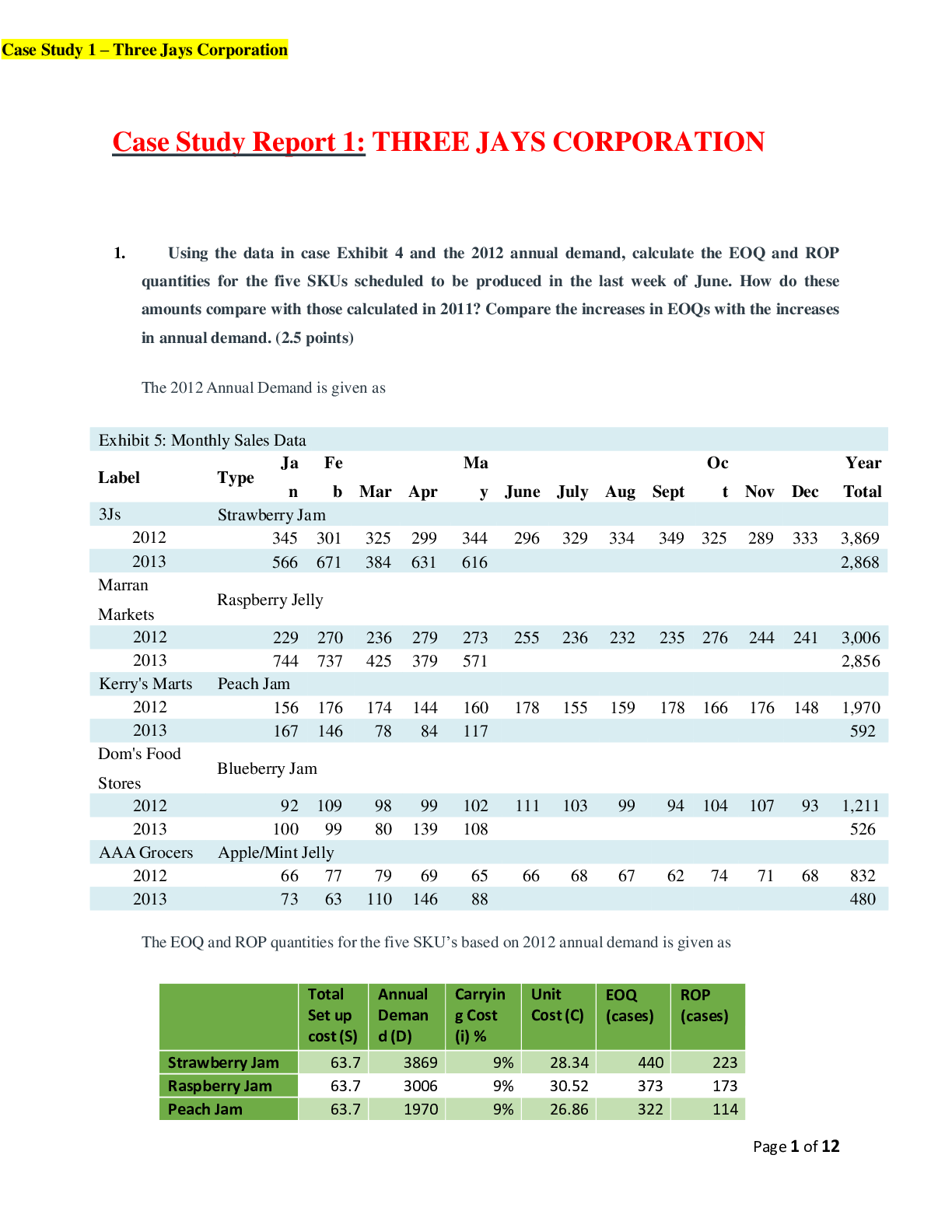
The 2012 Annual Demand is given as
Label Type
2012 345 301 325 299 344 296 329 334 349 325 289 333 3,869
Marran Markets
Raspberry Jelly
Dom's Food Stores
Blueberry Jam
The EOQ and ROP quantities for the five SKU’s based on 2012 annual demand is given as
Total Set up cost (S) Annual Deman d (D) Carryin g Cost
(i) % Unit Cost (C) EOQ
(cases) ROP
(cases)
Strawberry Jam 63.7 3869 9% 28.34 440 223
Raspberry Jam 63.7 3006 9% 30.52 373 173
Peach Jam 63.7 1970 9% 26.86 322 114
Blueberry Jam 63.7 1211 9% 29.01 243 70
Apple/Mint Jelly 63.7 832 9% 26.32 212 48
As Demand increased from 2011 to 2012, the EOQ’s also increased
Deman d (2010) Deman d (2012) Increase in Demand EOQ (2010) EOQ (2012) Increase in EOQ
2993 3869 29.27% 387 440 13.70%
2335 3006 28.74% 329 373 13.37%
1492 1970 32.04% 280 322 15.00%
886 1211 36.68% 208 243 16.83%
625 832 33.12% 183 212 15.85%
So, if Annual Demand doubles, the EOQ will increase by sqrt(2)
2. Brodie is uncertain if the costs presented in case Exhibit 2 are appropriate for determining the EOQs. What changes would you recommend, and why? Should the cost of the three idle part-time workers be included when the production line is down? Using the 2012 annual demand, and your recommendations, recalculate the EOQs for the five SKUs. (2.5 points)
In set up costs, the cost of part time workers should also be included, as they are idle at that time. Assuming the salary of each part time worker to be half that of full time worker
So, Total salary of 3 part time workers, during idle time of 1 hour = 3*0.5*23.5 = $35.25 So, new set up cost = $63.7 + $35.25 = $98.95
In carrying cost, storage cost was considered as 0%, which should be more because, there is always an opportunity cost of storing one inventory over another.
So, considering storage cost as 2%, new carrying cost = 6% + 2% + 3% = 11% Some of the basic assumptions of EOQ are debated
• The demand is not uniform throughout the year, which may lead to stock outs
• The order of new batch takes time and is not done instantly. For this case, the ROP should be adjusted to include the lead time to place order
Total Set up cost (S) Annual Demand (D) Carrying Cost (i) % Unit Cost (C) EOQ
(cases) ROP
(cases)
Strawberry Jam 98.95 3869 11% 28.34 496 223
Raspberry Jam 98.95 3006 11% 30.52 421 173
Peach Jam 98.95 1970 11% 26.86 363 114
Blueberry Jam 98.95 1211 11% 29.01 274 70
Apple/Mint Jelly 98.95 832 11% 26.32 238 48
Brodie’s first assignment in his internship is to update the EOQ and ROP quantities for all 141 SKUs, to reflect the current levels of demand (D), because the original calculations were done in 2011 with sales figure
...................................................................continued
[Show More]