University of TexasM 408M HW07-Solutions. M 408MHomework 7 Solutions. University of TexasM 408M HW07-Solutions. M 408MHomework 7 Solutions. University of TexasM 408M HW07-Solutions. M 408MHomework 7 Solutions. Univ
...
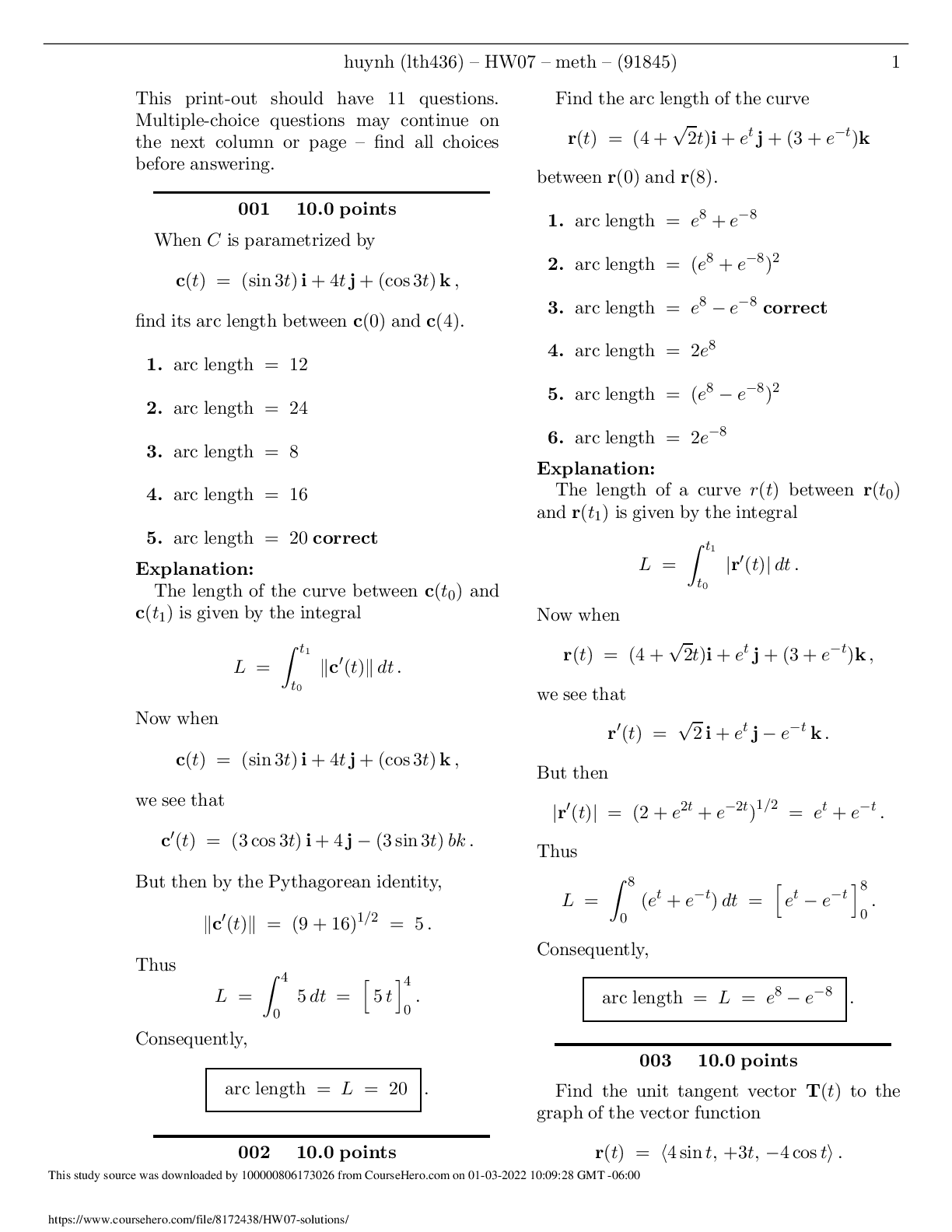
University of TexasM 408M HW07-Solutions. M 408MHomework 7 Solutions. University of TexasM 408M HW07-Solutions. M 408MHomework 7 Solutions. University of TexasM 408M HW07-Solutions. M 408MHomework 7 Solutions. University of TexasM 408M HW07-Solutions. M 408MHomework 7 Solutions. This print-out should have 11 questions.
Multiple-choice questions may continue on
the next column or page – find all choices
before answering.
001 10.0 points
When C is parametrized by
c(t) = (sin 3t) i + 4t j + (cos 3t) k ,
find its arc length between c(0) and c(4).
1. arc length = 12
2. arc length = 24
3. arc length = 8
4. arc length = 16
5. arc length = 20 correct
Explanation:
The length of the curve between c(t0) and
c(t1) is given by the integral
L = Zt0t1 kc′(t)k dt .
Now when
c(t) = (sin 3t) i + 4t j + (cos 3t) k ,
we see that
c′(t) = (3 cos 3t) i + 4 j − (3 sin 3t) bk .
But then by the Pythagorean identity,
kc′(t)k = (9 + 16)1/2 = 5 .
Thus
L = Z04 5 dt = h 5 t i4 0 .
Consequently,
arc length = L = 20 .
002 10.0 points
Find the arc length of the curve
r(t) = (4 + √2t)i + et j + (3 + e−t)k
between r(0) and r(8).
1. arc length = e8 + e−8
2. arc length = (e8 + e−8)2
3. arc length = e8 − e−8 correct
4. arc length = 2e8
5. arc length = (e8 − e−8)2
6. arc length = 2e−8
Explanation:
The length of a curve r(t) between r(t0)
and r(t1) is given by the integral
L = Zt0t1 |r′(t)| dt .
Now when
r(t) = (4 + √2t)i + et j + (3 + e−t)k ,
we see that
r′(t) = √2 i + et j − e−t k .
But then
|r′(t)| = (2 + e2t + e−2t)1/2 = et + e−t .
Thus
L = Z08 (et + e−t) dt = h et − e−t i8 0 .
Consequently,
arc length = L = e8 − e−8 .
003 10.0 points
Find the unit tangent vector T(t) to the
graph of the vector function
r(t) = h4 sin t, +3t, −4 cos ti .
This study source was downloaded by 100000806173026 from CourseHero.com on 01-03-2022 10:09:28 GMT -06:00
https://www.coursehero.com/file/8172438/HW07-solutions/huynh (lth436) – HW07 – meth – (91845) 2
1. T(t) = h4 cos t, −3, 4 sin ti
2. T(t) = h4 sin t, −3, −4 cos ti
3. T(t) = �45 cos t, 3 5, 4 5 sin t� correct
4. T(t) = �4 5 cos t, 3 5, −45 sin t�
5. T(t) = h4 sin t, −3, 4 cos ti
6. T(t) = �4 5 sin t, −35, 45 cos t�
Explanation:
The unit tangent vector T(t) to r(t) is given
by
T(t) = r′(t)
|r′(t)| .
Now when
r(t) = h4 sin t, +3t, −4 cos ti ,
we see that
r′(t) = h4 cos t, +3, 4 sin ti
while
|r(t)| = q42(cos2 t + sin2 t) + (3)2 = 5 .
Consequently,
T(t) = �45 cos t, 3 5, 45 sin t� .
keywords:
004 10.0 points
Determine the curvature, κ, of the curve
r (t) = t2 i + 7t k .
1. κ(t) = 4t2 + 49�3/2
2. κ(t) = 14
(4t2 + 49)1/2
3. κ(t) = 14t
(4t2 + 49)3/2
4. κ(t) = 14
(4t2 + 49)3/2 correct
5. κ(t) = 14t
4t2 + 49
Explanation:
The curvature κ of the curve
r (t) = t2 i + 7t k
is given by
κ(t) = kr′(t) × r′′(t)k
kr′(t)k3 .
Now in this case,
r′(t) = 2t i + 7 k, r′′(t) = 2 i.
Thus
r′(t) × r′′(t) = 14j
and
kr′(t) × r′′(t)k = p142 = 14 .
Since
kr′(t)k = (4t2 + 49)1/2 ,
it follows that
κ(t) = 14
(4t2 + 49)3/2 .
005 10.0 points
The curvature of a space curve r(t) is
κ(t) = kr′ (t) × r′′ (t)k
kr′ (t)k3 .
Find the curvature of
r(t) = h√13 t, et, e−ti
at the point (0, 1, 1).
This study source was downloaded by 100000806173026 from CourseHero.com on 01-03-2022 10:09:28 GMT -06:00
https://www.coursehero.com/file/8172438/HW07-solutions/huynh (lth436) – HW07 – meth – (91845) 3
1. κ(t) =
√2
15
correct
2. κ(t) = 15√2
3. κ(t) =
√2
13
4. κ(t) = 17√2
5. κ(t) =
√2
17
Explanation:
The parameter corresponding to the point
(0, 1, 1) is t = 0. Thus, the curvature of r(t)
at (0, 1, 1) is
κ(0) = kr′ (0) × r′′ (0)k
kr′ (0)k3 .
Now
r′(t) = h√13, et, −e−ti, r′(0) = h√13, 1, −1i .
while
r′′(t) = h0, et, e−ti, r′′(0) = h0, 1, 1i .
But then
r′(0) × r′′(0) = h2, −√13, √13i ,
and so
kr′(0) × r′′(0k = √30 , kr(0)k = √15.
Consequently, at (0, 1, 1),
κ(0) =
√30
153/2 =
√2
15
.
keywords:
006 10.0 points
Find the velocity of a particle with the given
position function
r(t) = 4e7ti + 6e−2tj .
1. v(t) = 11e7ti − 8e−2tj
2. v(t) = 28e7ti − 12e−2tj correct
3. v(t) = 4e7ti − 6e−2tj
4. v(t) = 28eti − 12e−tj
5. v(t) = 11e7ti + 6e−2tj
Explanation:
The velocity of a particle with position
function
r(t) = x(t) i + y(t) j
is given by
r′(t) = x′(t) i + y′(t) j .
Thus, since
r′(t) = 28e7ti − 12e−2tj,
we have that
v(t) = 28e7ti − 12e−2tj .
keywords:
007 10.0 points
Find the acceleration of a particle having
position function
r(t) = 9 sin t i + 5t j + 9 cos t k
in 3-space.
1. a(t) = −9 sin t i − 9 cos t k correct
2. a(t) = 9 sin t i − 9 cos t k
3. a(t) = 9 cos t i − 9 sin t k
4. a(t) = −9 sin t i + 9 cos t k
5. a(t) = −9 cos t i + 9 sin t k
This study source was downloaded by 100000806173026 from CourseHero.com on 01-03-2022 10:09:28 GMT -06:00
https://www.coursehero.com/file/8172438/HW07-solutions/huynh (lth436) – HW07 – meth – (91845) 4
Explanation:
The acceleration of a particle having position function
r(t) = x(t) i + y(t) j + z(t) k
is given by
r′′(t) = x′′(t) i + y′′(t) j + z′′(t) k .
Thus, since
r′(t) = 9 cos t i + 5 j − 9 sin t k
we have that
a(t) = r′′(t) = −9 sin t i − 9 cos t k .
keywords: Stewart5e, vector function, position function, acceleration, curve in 3-space
008 10.0 points
A particle moving in 3-space has position
function
r(t) = (5√2)t i + e5t j + e−5t k .
What is its speed at time t?
1. speed = 5(e5t + e−5t) correct
2. speed = p10 + 5et + 5e−t
3. speed = p10 + e10t + e−10t
4. speed = 5(√2 + e5t − e−5t)
5. speed = e5t + e−5t
Explanation:
A particle with position function
r(t) = x(t) i + y(t) j + z(t) k ,
has velocity
r′(t) = x′(t) i + y′(t) j + z′(t) k ,
and
speed = |r′(t)| .
Now when
r(t) = (5√2)t i + e5t j + e−5t k ,
we see that
r′(t) = (5√2) i + 5e5t j − 5e−5t k ,
while
|r′(t)|2 = 50 + 25e5t + 25e−5t
= 25(e5t + e−5t)2 .
Consequently, the particle has
speed = 5(e5t + e−5t) .
keywords: position function, vector function,
derivative, speed,
009 10.0 points
Find the position vector, b, at time t = 1
for a particle moving in 3-space with acceleration
a(t) = i + 3t j
if its initial velocity and position are given by
[Show More]