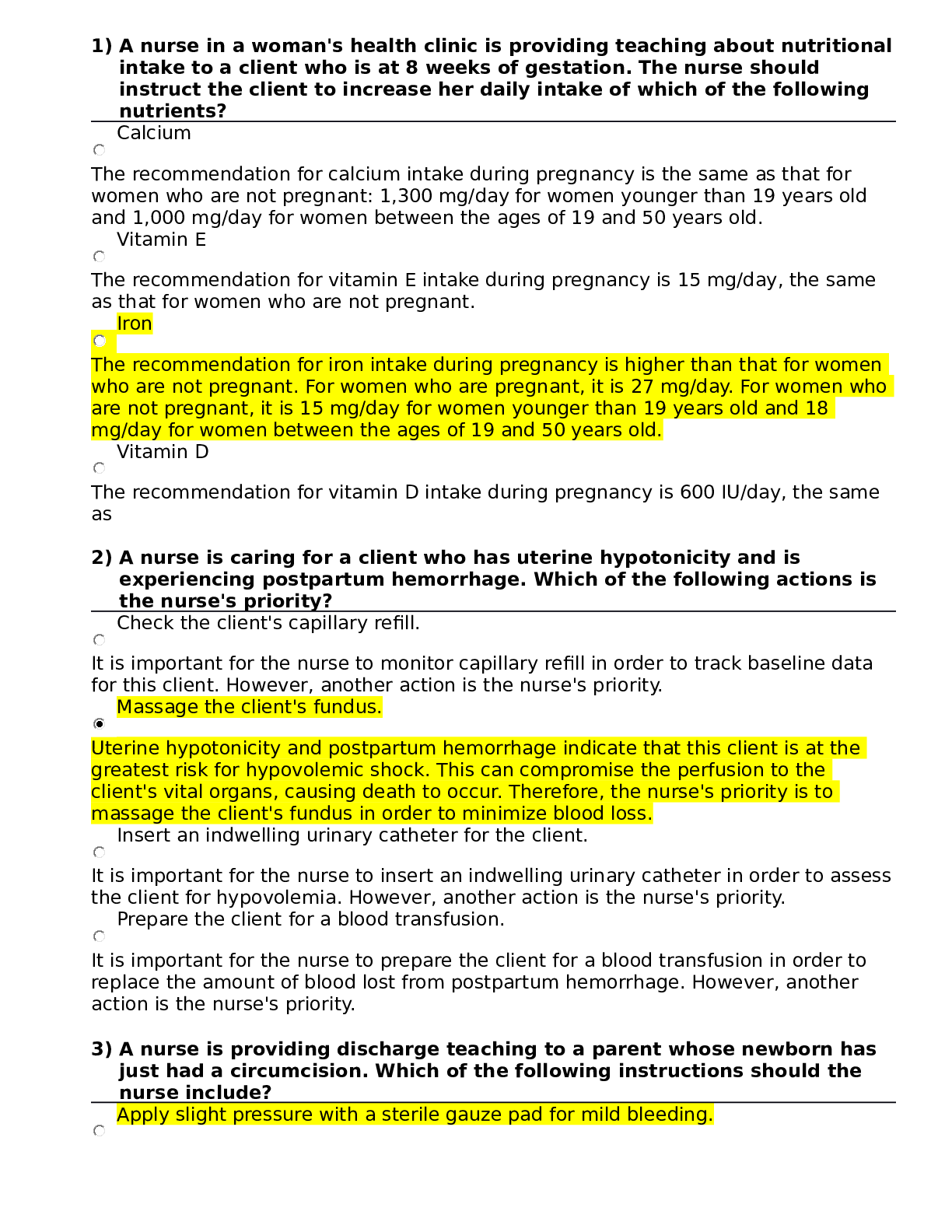
1) A nurse in a woman's health clinic is providing teaching about nutritional
intake to a client who is at 8 weeks of gestation. The nurse should
instruct the client to increase her daily intake of which of the followi
...
1) A nurse in a woman's health clinic is providing teaching about nutritional
intake to a client who is at 8 weeks of gestation. The nurse should
instruct the client to increase her daily intake of which of the following
nutrients?
Calcium
The recommendation for calcium intake during pregnancy is the same as that for
women who are not pregnant: 1,300 mg/day for women younger than 19 years old
and 1,000 mg/day for women between the ages of 19 and 50 years old.
Vitamin E
The recommendation for vitamin E intake during pregnancy is 15 mg/day, the same
as that for women who are not pregnant.
Iron
The recommendation for iron intake during pregnancy is higher than that for women
who are not pregnant. For women who are pregnant, it is 27 mg/day. For women who
are not pregnant, it is 15 mg/day for women younger than 19 years old and 18
mg/day for women between the ages of 19 and 50 years old.
Vitamin D
The recommendation for vitamin D intake during pregnancy is 600 IU/day, the same
as
2) A nurse is caring for a client who has uterine hypotonicity and is
experiencing postpartum hemorrhage. Which of the following actions is
the nurse's priority?
Check the client's capillary refill.
It is important for the nurse to monitor capillary refill in order to track baseline data
for this client. However, another action is the nurse's priority.
Massage the client's fundus.
Uterine hypotonicity and postpartum hemorrhage indicate that this client is at the
greatest risk for hypovolemic shock. This can compromise the perfusion to the
client's vital organs, causing death to occur. Therefore, the nurse's priority is to
massage the client's fundus in order to minimize blood loss.
Insert an indwelling urinary catheter for the client.
It is important for the nurse to insert an indwelling urinary catheter in order to assess
the client for hypovolemia. However, another action is the nurse's priority.
Prepare the client for a blood transfusion.
It is important for the nurse to prepare the client for a blood transfusion in order to
replace the amount of blood lost from postpartum hemorrhage. However, another
action is the nurse's priority.
3) A nurse is providing discharge teaching to a parent whose newborn has
just had a circumcision. Which of the following instructions should the
nurse include?
Apply slight pressure with a sterile gauze pad for mild bleeding.
The nurse should instruct the client to attempt to stop mild bleeding by applying
pressure with sterile gauze. If bleeding continues, the client should notify the
provider.
Inspect the circumcision site every 6 to 8 hr.
The client should change the newborn's diaper and examine the circumcision site at
least every 4 hr.
Use baby wipes containing alcohol to cleanse the penis with each diaper change.
Baby wipes containing alcohol can irritate the skin and should be avoided until the
circumcision has healed, which usually takes 5 to 6 days. During each diaper change,
the penis should be washed gently with warm water and have petroleum jelly applied
to the glans.
Remove yellow exudate daily using a warm, wet washcloth.
The client should not attempt to remove any yellow exudate from the circumcision
site because it is part of the healing process, which begins within 24 hr and continues
for 2 to 3 days. Disrupting it can cause pain and bleeding.
4) A nurse is teaching about effective breastfeeding to a client who is 3
days postpartum. Which of the following information should the nurse
include?
"Your milk will replace colostrum in about 10 days."
The nurse should inform the client that milk production occurs 3 or 4 days
postpartum. The breasts will feel firm and heavy. The client should continue to feed
the newborn on demand during this period.
"Your breasts should feel firm after breastfeeding."
The nurse should inform the client that her breasts should feel softer after feeding.
This change indicates that the newborn has emptied the breasts of milk.
"Your newborn should urinate at least 10 times per day."
The nurse should inform the client that the newborn should void six to eight times
per day. The newborn should also have at least three stools per day. It is not
uncommon for breastfed newborns to have a stool with each feeding.
"Your newborn should appear content after each feeding."
The nurse should inform the client that a baby who is sated will appear content after
feedings. A baby who continues to show indications of hunger (for example, rooting,
sucking on the hands, or crying) might not be effectively emptying the breasts during
feedings.
5) A nurse is teaching a client who has pregestational type 1 diabetes
mellitus about management during pregnancy. Which of the following
statements by the client indicates an understanding of the teaching?
"I should have a goal of maintaining my fasting blood glucose between 100 and
120."
The nurse should teach the client to maintain her fasting blood glucose level
between 60 and 99 mg/dL.
"I should engage in moderate exercise for 30 minutes if my blood glucose is 250 or
greater."
The nurse should teach the client to avoid exercise during periods of hyperglycemia
and when positive urine ketones are present.
"I will continue taking my insulin if I experience nausea and vomiting."
The nurse should teach the client to continue to take her insulin as prescribed during
illness to prevent hypoglycemic and hyperglycemic episodes.
6) A nurse is discussing the differences between true labor and false labor
with a group of expectant parents. Which of the following characteristics
should the nurse include when discussing true labor?
Contractions become stronger with walking.
The contractions that occur during true labor become stronger and more regular with
a change in activity, such as walking.
Discomfort can be suppressed with a back massage.
The discomfort of false labor can be suppressed by using comfort measures, such as
a back or foot massage. With true labor, the client discomfort continues regardless of
the use of comfort measures.
Contractions become irregular with a change in activity.
The contractions that occur during true labor will become stronger and more regular
with a change in activity.
Discomfort is felt above the umbilicus.
The discomfort experienced during the contractions of true labor is felt in the lower
back and lower abdomen. Discomfort during false labor is usually felt above the
umbilicus.
7) A nurse is teaching a group of parents about newborn safety. Which of
the following statements by a parent indicates an understanding of the
teaching?
"I will put a bib on my baby at night to keep her clothing dry."
The parents should avoid placing a bib around their newborns' necks at night to
prevent choking and suffocation.
"I will cover the crib mattress with plastic to prevent staining."
The parents should avoid placing plastic over the crib mattress to prevent
suffocation.
"I will warm my baby's formula using the lowest setting in the microwave."
The parents should avoid heating the formula in a microwave to prevent uneven
warming of the formula.
"I will dress my baby in flame-retardant clothing."
The parents should dress their newborns in flame-retardant clothing to prevent injury.
8) A nurse is assessing a client who is postpartum and has idiopathic
thrombocytopenia purpura (ITP). Which of the following findings should
the nurse expect?
Decreased platelet count
A client who has ITP has an autoimmune response that results in a decreased platelet
count.
Increased erythrocyte sedimentation rate (ESR)
An increased ESR is an indication of chronic renal failure.
Decreased megakaryocytes
A client who has ITP will have megakaryocytes within the expected reference range.
Increased WBC
An increased WBC is an indication of infection
9) A nurse is caring for a newborn who was transferred to the nursery 30
min after delivery. Which of the following actions should the nurse take
first?
Confirm the newborn's Apgar score.
The Apgar score is a physiologic assessment that occurs 1 min following birth and
again at 5 min. The nurse should confirm the score when the newborn arrives in the
nursery. However, there is another action the nurse should take first.
Verify the newborn's identification.
When using the safety/risk reduction approach to client care, the first action the
nurse should take is to verify the newborn's identity upon arrival to the nursery.
Administer vitamin K to the newborn.
The nurse should administer IM vitamin K to the newborn soon after birth to increase
clotting factors and prevent bleeding. However, the injection can be delayed until
after initial bonding time and the first breastfeeding if necessary. Therefore, there is
another action the nurse should take first.
Determine obstetrical risk factors.
The nurse should identify obstetrical risk factors to determine if interventions are
required for the newborn. However, there is another action the nurse should take
first.
10) A nurse is assessing a client who is in active labor and notes early
decelerations in the FHR on the monitor tracing. The client is at 39
weeks of gestation and is receiving a continuous IV infusion of oxytocin.
Which of the following actions should the nurse take?
Discontinue the oxytocin infusion.
Early decelerations in the FHR are considered benign. Early decelerations occur due
to compression of the fetal head during contractions, vaginal examinations, and
pushing during the second stage of labor. No interventions are necessary for early
decelerations.
Continue monitoring the client.
Early decelerations in the FHR are considered benign. Early decelerations occur due
to compression of the fetal head during contractions, vaginal examinations, and
pushing during the second stage of labor. No interventions are necessary for early
decelerations. Therefore, the nurse should continue to monitor the client.
Request that the provider assess the client.
Early decelerations in the FHR are considered benign. Early decelerations occur due
to compression of the fetal head during contractions, vaginal examinations, and
pushing during the second stage of labor. No interventions are necessary for early
decelerations.
Increase the infusion rate of the maintenance IV fluid.
Early decelerations in the FHR are considered benign. Early decelerations occur due
to compression of the fetal head during contractions, vaginal examinations, and
pushing during the second stage of labor. No interventions are necessary for early
decelerations.
11) A nurse in a provider's office is reviewing the medical record of a
client who is
in her first trimester of pregnancy. Which of the following findings should
the nurse identify as a risk factor for the development of preeclampsia?
Singleton pregnancy
Multifetal gestation, rather than a single fetus pregnancy, increases a client's risk for
the development of preeclampsia.
BMI of 20
Having a BMI greater than 30 increases a client's risk for the development of
preeclampsia.
Maternal age 32 years
A maternal age of younger than 19 or older than 40 increases the client's risk for the
development of preeclampsia.
Pregestational diabetes mellitus
Pregestational diabetes mellitus increases a client's risk for the development of
preeclampsia. Other risk factors include preexisting hypertension, renal disease,
systemic lupus erythematosus, and rheumatoid arthritis.
12) A nurse is assessing a client who received carboprost for postpartum
hemorrhage. Which of the following findings is an adverse effect of this
medication?
Hypertension
The nurse should recognize that carboprost is a vasoconstrictor that can cause
hypertension.
Hypothermia
Fever is a common adverse effect of carboprost.
Constipation
Diarrhea is a common adverse effect of carboprost.
Muscle weakness
Muscle weakness is not an adverse effect of carboprost.
13) A nurse is caring for a newborn who is undergoing phototherapy to treat hyperbilirubinemia.
Which of the following actions should the nurse take?
Cover the newborn's eyes while under the phototherapy light.
Applying an opaque eye mask prevents damage to the newborn's retinas and
corneas from the phototherapy light.
Keep the newborn in a shirt while under the phototherapy light.
It is acceptable for the nurse to keep a diaper or other covering over the newborn's
genitals and buttocks, but the nurse should remove all other clothing and blankets to
expose as much body surface area as possible to the phototherapy light.
Apply a light moisturizing lotion to the newborn's skin.
The nurse should not apply any cream or moisture to the newborn's skin because it
can absorb heat and cause burns.
Turn and reposition the newborn every 4 hr while undergoing phototherapy.
The nurse should turn and reposition the newborn every 2 to 3 hr to allow for
maximum exposure of body surfaces to the phototherapy light.
14) A nurse is caring for a client who is in labor and reports increasing rectal pressure. She is
experiencing contractions 2 to 3 min apart, each lasting 80 to 90 seconds, and a vaginal
examination reveals that her cervix is dilated to 9 cm. The nurse should identify that the client is
in which of the following phases of labor?
Active
The active phase of labor is characterized by a cervical dilatation of 4 to 7 cm and
contractions every 3 to 5 min, each lasting 40 to 70 seconds.
Transition
The nurse should identify that the client is in the transition phase of labor. This phase
is characterized by a cervical dilatation of 8 to 10 cm and contractions every 2 to 3
min, each lasting 45 to 90 seconds.
Latent
The latent phase of labor is characterized by cervical dilation of 0 to 3 cm and
contractions every 5 to 30 min, each lasting 30 to 45 seconds.
Descent
The descent phase of labor is characterized by active pushing with contractions
every 1 to 2 min, each lasting for 90 seconds.
15) A nurse in a family planning clinic is caring for a client who requests an oral contraceptive.
Which of the following findings in the client's history should the nurse recognize as a
contraindication to oral contraceptives? (Select all that apply.)
Cholecystitis
Hypertension
Human papillomavirus
Migraine headaches
Anxiety disorder
Cholecystitis is correct. A history of gallbladder disease is a contraindication for the use of oral
contraceptive .Hypertension is correct. Hypertension is a contraindication for the use of oral
contraceptives.
Human papillomavirus is incorrect. The presence of human papillomavirus is not a
contraindication for the use of oral contraceptives.
Migraine headaches is correct. A history of migraine headaches is a contraindication for the
use or oral contraceptives.
Anxiety disorder is incorrect. The presence of an anxiety disorder is not a contraindication for
the use of oral contraceptives.
16) A nurse is assessing a client who is 12 hr postpartum. The client's fundus is two fingerbreadths
above the umbilicus, deviated to the right of the midline, and less firm than previously noted. Which
of the following actions should the nurse take?
Place the client in a side-lying position.
Placing the client in a side-lying position is an action that the nurse should take for a
client who is experiencing hypovolemic shock.
Assist the client to the bathroom to void.
A distended bladder inhibits the uterus from contracting normally and can cause
uterine atony. Therefore, the nurse should assist the client to void.
Obtain a prescription for IV oxytocin.
Obtaining a prescription for IV oxytocin is an action that the nurse should take for a
client who requires labor induction and augmentation.
Administer methylergonovine.
Administering methylergonovine is an action that the nurse should take for a client
who is experiencing postpartum hemorrhage.
17) A nurse is performing a physical assessment of a newborn upon admission to the nursery. Which of
the following clinical manifestations should the nurse expect? (Select all that apply.)
Yellow sclera
Creases over two-thirds of the soles of the feet
Posterior fontanel larger than the anterior fontanel
Molding of the head
Lanugo on the shoulders
Yellow sclera is incorrect. Yellow sclera is an indication of hyperbilirubinemia and is not an
expected clinical manifestation.
Creases over two-thirds of the soles of the feet is correct. Fewer creases over the soles of
the feet is an indication of prematurity. Creases over the entire soles of the feet is an indication of
postmaturity.
Posterior fontanel larger than the anterior fontanel is incorrect. The posterior fontanel is
located on the back of the newborn's head and is a small triangular shape. The anterior fontanel
is diamond shaped and approximately 5 cm. It is located on the top of the newborn's head and is
larger than the posterior fontanel.
Molding of the head is correct. Molding occurs during the birth process as the newborn travels
through the birth canal, resulting in compression of the soft bones of the skull.
Lanugo on the shoulders is correct. Absence of lanugo is an indication of postmaturity.
Abundant lanugo is an indication of prematurity.
18) A nurse is developing an educational program for adolescents about nutrition during the third
trimester of pregnancy. Which of the following statements should the nurse include in the program?
"Consume three to four servings of dairy each day."
Calcium intake is especially important during an adolescent's pregnancy because
bone absorption of calcium is still occurring. Therefore, the nurse should instruct the
adolescents to consume three to four servings of dairy per day to meet their calcium
needs.
"Increase your daily caloric intake by 600 to 700 calories."
Consuming an additional 600 to 700 cal per day could lead to excessive weight gain,
which increases the adolescent's risk for complications related to pregnancy, labor,
and delivery. The nurse should instruct the adolescents that, if they have a BMI within
the expected reference range prior to pregnancy, they should increase their daily
caloric intake by 340 cal in the first trimester and 452 cal in the second and third
trimesters.
"Limit your daily sodium intake to less than 1 gram."
Sodium supports the increase in blood volume that occurs during pregnancy. An
adequate sodium intake is approximately 1.5 g per day. The nurse should instruct the
adolescents that an adequate intake of sodium is required during pregnancy.
"Increase your protein intake to 40 to 50 grams each day."
Adequate protein intake is necessary to support the rapid growth of the fetus,
maternal tissues, increasing blood volume, and the formation of amniotic fluid.
Therefore, the nurse should instruct the adolescents to increase their daily intake of
protein to approximately 71 g during the second and third trimesters of pregnancy.
19) A nurse is performing a vaginal exam on a client who is in labor and reports severe pressure and
pain in the lower back. The nurse notes that the fetal head is in a posterior position. The nurse
should identify that which of the following is the best nonpharmacological intervention to
perform to relieve the client's discomfort?
Back rub
A back rub is an effective nonpharmacological intervention to assist the client with
pain. However, there is a better nonpharmacological intervention the nurse should
use.
Counter-pressure
According to evidence-based practice, counter-pressure is the best
nonpharmacological technique to use when relieving the client's discomfort from the
fetus being in a posterior position because this intervention lifts the fetal head off of
the spinal nerve.
Playing music
Playing music is an effective nonpharmacological intervention to assist the client with
pain. However, there is a better nonpharmacological intervention the nurse should
use.
Foot massage
A foot massage is an effective nonpharmacological intervention to assist the client
with pain. However, there is a better nonpharmacological intervention the nurse
should use.
20) A nurse is developing a plan of care for a client who has preeclampsia and is receiving
magnesium sulfate via a continuous IV infusion. Which of the following interventions
should the nurse include in the plan?
Monitor the client's blood pressure every hour.
MY ANSWER
The nurse should monitor the client's vital signs, including blood pressure, every 15
to 30 min. Magnesium sulfate, which is used to prevent seizures in clients who have
preeclampsia, is a high-alert medication that requires close monitoring.
Restrict the total hourly intake to 200 mL.
The nurse should restrict the client's total hourly intake to no more than 125 mL.
Clients who have preeclampsia can have an alteration in kidney function, leading to
increases in edema.
Monitor the FHR continuously.
Magnesium sulfate, which is used to prevent seizures in clients who have
preeclampsia, is a high-alert medication that requires close monitoring. The FHR and
uterine contractions should be monitored continuously while the client is receiving
magnesium sulfate.
Administer protamine sulfate for manifestations of toxicity.
The nurse should administer calcium gluconate if the client shows manifestations of
magnesium sulfate toxicity. Findings of toxicity include loss of deep-tendon reflexes,
respiratory depression, slurred speech, and cardiac arrest.
21)A nurse is planning care for a client who is 2 hr postpartum. Which of the following
interventions should the nurse plan to implement during the taking-hold phase of postpartum
behavioral adjustment?
Discuss contraceptive options with the client and her partner.
The discussing of contraceptive options occurs during the letting-go phase. This
phase focuses on moving forward as a family with interchanging members.
Repeat information to ensure client understanding.
The repeating of information to ensure client understanding occurs during the takingin phase. During this phase, which is experienced on the first postpartum day, the
client displays dependent and passive behaviors. Due to excitement and fatigue, the
client is unable to retain information. Therefore, the nurse should repeat instructions
to ensure that the client understands what is being said.
Listen to the client and her partner as they reflect upon the birth experience.
Listening to the client and her partner reflect upon the birth experience occurs during
the taking-in phase. During this phase, the new mother is focused on herself and
meeting her basic needs. There is also much excitement about the newborn and the
birth experience. Therefore, the nurse should allow the client to reflect, ensuring a
healthy transition and a successful adaptation into the new family unit.
Demonstrate to the client how to perform a newborn bath.
Demonstrating to the client how to perform a newborn bath occurs during the takinghold phase. The new mother moves from being passively dependent to taking a
stronger interest in her new role as a mother. She is now focusing on the care her
newborn and acquiring parenting skills. The nurse should provide positive
reinforcement during this phase to give the new mother confidence and promote
maternal adjustment.
22) A nurse is preparing to collect a blood specimen from a newborn via a heel stick.
Which of the following techniques should the nurse use to help minimize the pain of the
procedure for the newborn?
Apply a cool pack for 10 min to the heel prior to the puncture.
A cool pack will constrict the blood vessels, making it more difficult to obtain an
adequate specimen. The nurse should apply a warm pack prior to the puncture.
Request a prescription for IM analgesic.
The pain experienced from a heel stick is too brief to warrant risking the adverse
effects of parenteral analgesia.
Use a manual lance blade to pierce the skin.
A spring-loaded, automatic puncture device is recommended to minimize pain by
ensuring that the depth of the puncture is not too deep, avoiding injury to the
newborn.
Place the newborn skin to skin on the mother's chest.
Placing the newborn skin to skin on the mother's chest is an effective technique to
significantly decrease the newborn's pain level and anxiety. The nurse should
implement this technique before, during, and after the procedure.
23) A nurse is caring for a client who is to receive oxytocin to augment her labor. Which of
the following findings contraindicates the initiation of the oxytocin infusion and should be
reported to the provider?
Late decelerations
Late decelerations are indicative of uteroplacental insufficiency. Therefore, this is a
contraindication for the administration of oxytocin and should be reported to the
provider.
Moderate variability of the FHR
Moderate variability of the FHR is an expected assessment finding associated with
normal fetal acid base balance. It is not a contraindication to the administration of
oxytocin.
Cessation of uterine dilation
Cessation of uterine dilation is an indication for the initiation of an oxytocin infusion
to augment the client's labor progression.
Prolonged active phase of labor
A prolonged active phase of labor is an indication for the initiation of an oxytocin
infusion to augment the client's labor progression.
24) A nurse is assessing a client who is at 38 weeks of gestation during a weekly prenatal visit.
Which of the following findings should the nurse report to the provider?
Blood pressure 136/88 mm Hg
A blood pressure of 136/88 mm Hg is within the expected reference range for a client
who is at 38 weeks of gestation. Therefore, this finding does not need to be reported
to the provider.
Report of insomnia
A regular occurrence of insomnia can be expected for a client who is at 38 weeks of
gestation. Therefore, this finding does not need to be reported to the provider.
Weight gain of 2.2 kg (4.8 lb)
A weight gain of 2.2 kg (4.8 lb) in a week is above the expected reference range and
could indicate complications. Therefore, this finding should be reported to the
provider.
Report of Braxton-Hicks contractions
Braxton-Hicks contractions can be expected for a client who is at 38 weeks of
gestation. Therefore, this finding does not need to be reported to the provide
25) A nurse is caring for a client who is at 15 weeks of gestation, is Rh-negative, and has just had an
amniocentesis. Which of the following interventions is the nurse's priority following the procedure?
Check the client's temperature.
The nurse should check the client's temperature to monitor for infection following an
amniocentesis. However, this is not the priority nursing intervention.
Observe for uterine contractions.
The nurse should observe for uterine contractions to identify preterm labor following
an amniocentesis. However, this is not the priority nursing intervention.
Administer Rho(D) immune globulin.
The nurse should administer Rho(D) immune globulin following an amniocentesis to
prevent Rh sensitization. However, this is not the priority nursing intervention.
Monitor the FHR.
The greatest risk to this client and her fetus is fetal death. Therefore, the priority
nursing intervention is to monitor the FHR following an amniocentesis.
26) A nurse is planning care for a client who is in labor and is requesting epidural anesthesia for pain
control. Which of the following actions should the nurse include in the plan of care?
Place the client in a supine position for 30 min following the first dose of anesthetic
solution.
The nurse should plan to position the client upright in order to allow the anesthetic
solution to flow downward. If additional pain management is needed for a cesarean
birth, the nurse can place the client supine with her head and shoulders elevated and
at a lateral tilt to increase perfusion to the fetus.
Administer 1,000 mL of dextrose 5% in water prior to the first dose of anesthetic solution.
The nurse should plan to administer 500 to 1,000 mL of lactated Ringer's or 0.9%
sodium chloride 15 to 30 min prior to the administration of the first dose of
anesthetic solution in order to decrease the maternal risk for hypotension. The nurse
should not administer dextrose because it can cause maternal hyperglycemia and
neonatal hypoglycemia.
Monitor the client's blood pressure every 5 min following the first dose of anesthetic solution.
The nurse should plan to obtain a baseline blood pressure prior to the initiation of
anesthetic solution. The nurse should then continue to monitor the client's blood
pressure every 5 to 10 min to assess for maternal hypotension caused by the
anesthetic solution.
Ensure the client has been NPO 4 hr prior to the placement of the epidural and the first dose
of anesthetic solution.
The nurse should not plan to restrict the client's intake prior to the epidural placement and the
27) A nurse is teaching a new mother how to use a bulb syringe to suction her newborn's secretions.
Which of the following instructions should the nurse include?
Insert the syringe tip before compressing the bulb.
The client should compress the bulb before inserting the syringe tip. Compressing the
bulb after it is in the newborn's nares or mouth could push the secretions and mucus
further inside.
Suction each of the nares before suctioning the mouth.
The client should suction the mouth before suctioning the nares. Otherwise, the
newborn could gasp and inhale pharyngeal secretions when the syringe tip touches
the nares.
Insert the tip of the syringe into the center of the newborn's mouth.
The client should insert the tip of the syringe into the side of the newborn's mouth.
Inserting it into the center of the newborn's mouth can trigger the gag reflex.
Stop suctioning when the newborn's cry sounds clear.
The nurse should instruct the client to stop suctioning when the newborn's cry no
longer sounds like it is coming through a bubble of fluid or mucus.
28) A nurse is assessing a late preterm newborn. Which of the following clinical manifestations is an
indication of hypoglycemia?
Hypertonia
A newborn who has hypoglycemia can exhibit hypotonia.
Increased feeding
MY ANSWER
A newborn who has hypoglycemia can exhibit poor feeding behaviors.
Hyperthermia
A newborn who has hypoglycemia can exhibit hypothermia.
Respiratory distress
Late preterm newborns are at an increased risk for hypoglycemia due to decreased
glycogen stores and immature insulin secretion. Respiratory distress is a clinical
manifestation of hypoglycemia. Other manifestations of hypoglycemia include an
abnormal cry, jitteriness, lethargy, poor feeding, apnea, and seizures.
29) A nurse is assessing four newborns. Which of the following findings should the nurse report to the
provider?
A newborn who is 26 hr old and has erythema toxicum on his face
Erythema toxicum is a transient rash that can appear anywhere on a newborn's body
during the first 24 to 72 hr following birth. This finding requires no treatment.
A newborn who is 32 hr old and has not passed a meconium stool
A newborn should pass the first meconium stool within the first 24 to 48 hr following
birth. Failure to pass a meconium stool can indicate a bowel obstruction or congenital
disorder. This finding is within the expected reference range.
A newborn who is 12 hr old and has pink-tinged urine
Pink-tinged urine is an indication of uric acid crystals and is an expected finding for a
newborn during the first week following birth.
A newborn who is 18 hr old and has an axillary temperature of 37.7° C (99.9° F)
An axillary temperature greater than 37.5° C (99.5° F) is above the expected
reference range for a newborn and can be an indication of sepsis. Therefore, the
nurse should report this finding to the provider.
30) A nurse is preparing to perform Leopold maneuvers for a client. Identify the sequence the nurse
should follow. (Move the steps into the box on the right, placing them in the selected order of
performance. Use all the steps.)
Palpate the fundus to identify the fetal part.
Determine the location of the fetal back.
Palpate for the fetal part presenting at the inlet
Identify the attitude of the head.
The first step the nurse should take when performing Leopold maneuvers is to palpate the
client's fundus to identify the fetal part. Second, the nurse should determine the location of the
fetal back. Third, the nurse should palpate for the fetal part presenting at the inlet. Finally, the
nurse should palpate the cephalic prominence to identify the attitude of the head.
31) A nurse is admitting a client to the labor and delivery unit when the client states, "My
water just broke." Which of the following interventions is the nurse's priority?
Perform Nitrazine testing.
The nurse should perform a Nitrazine test to determine the pH of the fluid. An
alkaline pH can indicate rupture of membranes. However, this is not the first action
the nurse should take.
Assess the fluid.
The nurse should observe the characteristics of the fluid to document color, odor,
and amount. However, this is not the first action the nurse should take.
Check cervical dilation.
The nurse should check the client's cervical dilation to assess progress of labor.
However, this is not the first action the nurse should take.
Begin FHR monitoring.
The greatest risk to the client and her fetus following a rupture of membranes is
umbilical cord prolapse. The nurse should monitor the fetus closely to ensure wellbeing. Therefore, this is the priority action the nurse should take.
32) A nurse is providing dietary teaching to a client who has hyperemesis gravidarum. Which of the
following statements by the client indicates an understanding of the teaching?
"I will eat foods that appeal to my taste instead of trying to balance my meals."
Clients who have hyperemesis gravidarum should eat to taste to avoid nausea.
"I will avoid having a snack at bedtime."
Clients who have hyperemesis gravidarum should avoid going to bed with an empty
stomach. The nurse should instruct the client to eat a healthy snack before going to
bed.
"I will have 8 ounces of hot tea with each meal."
Clients who have hyperemesis gravidarum should alternate liquids and solids every 2
to 3 hr to avoid an empty stomach and over filling at each meal.
"I will pair my sweets with a starch instead of eating them alone."
Clients who have hyperemesis gravidarum should eat protein following a sweet
snack.
33)A nurse is providing discharge teaching to a client who is postpartum. For which of the following
clinical manifestations should the nurse instruct the client to monitor and report to the provider?
Persistent abdominal striae
Persistent abdominal striae are caused by the separation of the underlying
connective tissue and are an expected postpartum finding.
Temperature 37.8° C (100.2° F)
The nurse should instruct the client to report a temperature of 38° C (100.4° F) or
higher because it could be an indication of infection.
Unilateral breast pain
Chills, fever, malaise, and unilateral breast pain can be indications of mastitis, an
infection of the breast tissue. The nurse should instruct the client to report this
clinical manifestation to the provider.
Brownish-red discharge on day 5
Brownish-red discharge is an expected clinical manifestation during days 3 to 10. The
client should report a large amount of lochia and large clots to the provider.
34) A nurse is assessing a client who is at 26 weeks of gestation. Which of the following clinical
manifestations should the nurse report to the provider?
Leukorrhea
Leukorrhea is an expected clinical manifestation during all stages of pregnancy. It is a
white discharge that is the result of hormone secretion during pregnancy.
Supine hypotension
Supine hypotension is an expected clinical manifestation during the second and third
trimesters. It is the result of pressure on the ascending vena cava from the gravid
uterus.
Periodic numbness of the fingers
Periodic numbness of the fingers is an expected clinical manifestation during the
second and third trimesters. It occurs from the slumping of the shoulders during
pregnancy.
Decreased urine output
Decreased urine output, increased blood pressure, proteinuria, and decreased fetal
activity can be indications of preeclampsia and should be reported to the provider.
35)A nurse is caring for a client who is at 40 weeks of gestation and is in early labor. The client has a
platelet count of 75,000/mm3
and is requesting pain relief. Which of the following treatment
modalities should the nurse anticipate?
Epidural analgesia
The placement of an epidural catheter places the client at risk for bleeding.
Therefore, a low platelet count is a contraindication for the placement of an epidural.
Naloxone hydrochloride
Naloxone hydrochloride is an opioid antagonist used to reverse respiratory
depression in newborns.
Attention-focusing
Attention-focusing and distraction techniques are types of nonpharmacological care
that are effective in relieving labor pain.
Pudendal nerve block
A pudendal nerve block is administered during the third stage of labor for the repair
of an episiotomy or laceration.
36) A nurse is teaching a client who is at 24 weeks of gestation regarding a 1-hr glucose tolerance test.
Which of the following statements should the nurse include in her teaching?
"You will need to drink the glucose solution 2 hours prior to the test."
The nurse should instruct the client to drink the glucose solution 1 hr prior to the
test.
"Limit your carbohydrate intake for 3 days prior to the test."
The nurse should teach the client that she should not limit her carbohydrate intake.
"A blood glucose of 130 to 140 is considered a positive screening result."
The nurse should teach the client that a blood glucose level of 130 to 140 mg/dL is
considered a positive screening. If the client receives a positive result, she will need
to undergo a 3-hr glucose tolerance test to confirm if she has gestational diabetes
mellitus.
"You will need to fast for 12 hours prior to the test."
The nurse should teach the client that fasting is not required for a 1-hr glucose
tolerance test.
37) A nurse is assessing a full-term newborn 15 min after birth. Which of the following findings
requires intervention by the nurse
Heart rate 168/min
During the first phase of a newborn's transition to extrauterine life, which is up to 30
min after birth, a heart rate between 160 to 180/min is an expected clinical
manifestation.
Respiratory rate 18/min
During the first phase of a newborn's transition to extrauterine life, which is up to 30
min after birth, the respiratory rate can range between 20 to 100/min. A respiratory
rate this low at this time requires further evaluation and intervention by the nurse.
Tremors
During the first phase of a newborn's transition to extrauterine life, which is up to 30
min after birth, the expected clinical manifestations include tremors, crying, and
startling motions.
Fine crackles
During the first phase of a newborn's transition to extrauterine life, which is up to 30
min after birth, fine crackles and nasal flaring are expected clinical manifestations.
38) A nurse is teaching a client who is at 36 weeks of gestation and has a prescription for a nonstress
test. Which of the following statements should the nurse include in the teaching?
"You will receive IV fluid prior to this test."
The nurse should state that IV fluids are initiated for the oxytocin-stimulated
contraction test.
"The procedure will take approximately 10 to 15 minutes."
The nurse should instruct the client that the procedure will take 20 to 40 min.
"You will be offered orange juice to drink during the test."
A nonstress test is performed to measure fetal activity. Having the client drink orange
juice, or another beverage high in glucose, will stimulate the fetus during the
procedure, helping to obtain results.
"You will need to sign an informed consent form each time you have this test."
A nonstress test is a noninvasive procedure. Therefore, informed consent does not
need to be obtained.
39) A nurse is caring for a client who has recently experienced a perinatal death. Which of the
following statements should the nurse make to the client?
"It must be a comfort to know you have another child."
The nurse is making a statement that minimizes the significance of the death of the
client's newborn. This type of response from the nurse will not facilitate further
communication.
"I'm sad for you."
The nurse is offering empathy to the client to facilitate further communication about
the perinatal death.
"There is usually something wrong with the baby."
The nurse is making a statement that minimizes the significance of the death of the
client's newborn. This type of response from the nurse will not facilitate further
communication.
"You will always have an angel in heaven."
The nurse is making a statement that uses a cliché. This type of response from the
nurse will not facilitate further communication
40) A nurse is planning care for a client who is at 24 weeks of gestation and reports daily mild
headaches. Which of the following instructions should the nurse include in the plan of care?
Administer ibuprofen 400 mg twice each day.
Daily ibuprofen administration can lead to increased bleeding and premature closure
of the ductus arteriosus in the fetus.
Recommend that the client perform conscious relaxation techniques daily.
The nurse should include conscious relaxation techniques in the plan of care as a way
to relieve tension and reduce stress, which can help to decrease and eliminate
headaches.
Give the client ginseng tea with each meal.
The nurse should not give the client ginseng tea with each meal because it is
contraindicated for use during pregnancy.
Instruct the client to soak in a bath with a water temperature of 105° F for 15 min daily.
Soaking in a bath with a water temperature of 105° F for 15 min daily can cause
maternal hyperthermia, interfering with cell metabolism and possibly causing birth
defects. The water temperature should be maintained at 96.8° F to 98.6° F.
.
41) A nurse is performing a vaginal examination for a client who is in active labor and reports back pain.
The nurse determines that the client is 8 cm dilated, 100% effaced, -2 station, and that the fetus is in the
occiput posterior position. Which of the following actions should the nurse take?
Perform effleurage during contractions.
To perform effleurage, the nurse lightly strokes the client's abdomen as the client
breaths through the contractions. It is used during the first stage of labor to distract
the client from the pain of contractions, but it will not facilitate the rotation of the
fetal head.
Place the client in lithotomy position.
Placing the client in the lithotomy position will prevent the rotation of the fetal head.
The client will likely be placed in the lithotomy position once the fetus has rotated
and she is ready to begin pushing with contractions.
Assist the client to the hands and knees position.
The nurse should assist the client into the hands and knees position during
contractions. This position can help relieve her back pain and it will enable the
rotation of the fetus from the posterior to an anterior occiput position.
Apply a scalp electrode to the fetus.
Applying a scalp electrode to the fetus is an invasive procedure that is performed to
monitor the FHR. There is no indication for internal monitoring at this time.
42) A nurse is caring for a client who is at 22 weeks of gestation and reports concern about the
blotchy hyperpigmentation on her forehead. Which of the following actions should the nurse
take?
Tell the client to follow up with a dermatologist.
An increase in melanotropin causes chloasma, which is an expected finding. It is
caused by an increase in the pigmentation of the skin during pregnancy. Treatment
by a dermatologist will not affect the client's condition.
Explain to the client this is an expected occurrence.
Chloasma, also referred to as the mask of pregnancy, is a blotchy, brown
hyperpigmentation of the skin over the cheeks, nose, and forehead. It is seen most
often in dark-skinned women and is caused by an increase in melanotropin during
pregnancy. This condition appears after 16 weeks of gestation and increases
gradually until delivery for 50 to 70% of women. Therefore, the nurse should reassure
the client that this is an expected occurrence which usually fades after delivery.
Instruct the client to increase her intake of vitamin D.
An increase in melanotropin causes chloasma, which is an expected finding. It is
caused by an increase in the pigmentation of the skin during pregnancy. Increasing
her vitamin D intake will not affect the client's condition.
Inform the client she might have an allergy to her skin care products.
An increase in melanotropin causes chloasma, which is an expected finding. It is
caused by an increase in the pigmentation of the skin during pregnancy. Changing
skin care products will not affect the client's condition.
43) A nurse is preparing to administer magnesium sulfate 2 g/hr IV to a client who is in preterm labor.
Available is 20 g magnesium sulfate in 500 mL of dextrose 5% in water (D5W). The nurse should set the
IV infusion pump to administer how many mL/hr? (Round the answer to the nearest whole number. Use
a leading zero if it applies. Do not use a trailing zero.)
mL/hr
MY ANSWER
Ratio and Proportion
STEP 1: What is the unit of measurement the nurse should calculate? mL
STEP 2: What is the dose the nurse should administer? Dose to administer = Desired
2 g
STEP 3: What is the dose available? Dose available = Have 20 g
STEP 4: Should the nurse convert the units of measurement? No
STEP 5: What is the quantity of the dose available? 500 mL
STEP 6: Set up an equation and solve for X.
Have/Quantity = Desired/X
20 g/500 mL = 2 g/X mL
X = 50
STEP 7: Round if necessary.
STEP 8: Reassess to determine whether the amount to administer makes sense. If
there are 20 g of magnesium sulfate in 500 mL D5W and the prescription reads 2 g, it
makes sense to administer 50 mL. The nurse should administer magnesium sulfate
50 mL/hr IV.
Desired Over Have
STEP 1: What is the unit of measurement the nurse should calculate? mL
STEP 2: What is the dose the nurse should administer? Dose to administer = Desired
2 g
STEP 3: What is the dose available? Dose available = Have 20 g
STEP 4: Should the nurse convert the units of measurement? No
STEP 5: What is the quantity of the dose available? 500 mL
STEP 6: Set up an equation and solve for X.
Desired x Quantity/Have = X
2 g x 500 mL/20 g = X mL
50 = X
STEP 7: Round if necessary.
STEP 8: Reassess to determine whether the amount to administer makes sense. If
there are 20 g of magnesium sulfate in 500 mL D5W and the prescription reads 2 g, it
makes sense to administer 50 mL. The nurse should administer magnesium sulfate
50
50 mL/hr IV.
Dimensional Analysis
STEP 1: What is the unit of measurement the nurse should calculate? mL
STEP 2: What is the quantity of the dose available? 500 mL
STEP 3: What is the dose available? Dose available = Have 20 g
STEP 4: What is the dose the nurse should administer? Dose to administer = Desired
2 g
STEP 5: Should the nurse convert the units of measurement? No
STEP 6: Set up an equation and solve for X.
X = Quantity/Have x Conversion (Have)/Conversion (Desired) x Desired/
X mL = 500 mL/20 g x 2 g/
X = 50
STEP 7: Round if necessary.
STEP 8: Reassess to determine whether the amount to administer makes sense. If
there are 20 g of magnesium sulfate in 500 mL D5W and the prescription reads 2 g, it
makes sense to administer 50 mL. The nurse should administer magnesium sulfate
50 mL/hr IV.
44) A nurse is providing education about family bonding to parents who recently adopted a newborn.
The nurse should make which of the following suggestions to aid the family's 7-year-old child in
accepting the new family member?
Allow the sibling to hold the newborn during a bath.
Allowing the sibling to hold the newborn during a bath is not an appropriate activity
for a school-age child because of the safety risk. However, the parents could let the
sibling assist with other things in regard to caring for the baby.
Make sure the sibling kisses the newborn each night.
Forcing interactions between the sibling and the adoptive newborn can cause anger
on the part of the sibling. It is more important to allow feelings to evolve naturally as
the family unit bonds.
Obtain a gift from the newborn to present to the sibling.
Presenting a gift from the newborn to the sibling is a strategy to facilitate a schoolage sibling's acceptance of a new family member. This ensures that the sibling does
not feel left out and that he understands his role in the family.
Switch the sibling's room with the nursery.
Switching the sibling's room with the newborn's room might cause jealousy of the
newborn or cause the sibling to feel that the newborn is taking his belongings.Bottom
of Form
45) A nurse is assessing fetal heart tones for a client who is pregnant. The nurse has determined the
fetal position as left occipital anterior. To which of the following areas of the client's abdomen should
the nurse apply the ultrasound transducer in order to assess the point of maximum intensity of the fetal
heart?
Left upper quadrant
The fetal heart tones of a fetus in the left sacrum anterior position are best heard in
the left upper quadrant.
Right upper quadrant
The fetal heart tones of a fetus in the right sacrum anterior position are best heard in
the right upper quadrant.
Left lower quadrant
The fetal heart tones of a fetus in the left occipital anterior position are best heard in
the left lower quadrant.
Right lower quadrant
The fetal heart tones of a fetus in the right occipital anterior position are best heard
in the right lower quadrant.
46) A school nurse is providing teaching to an adolescent about levonorgestrel
contraception. Which of the following information should the nurse include in the
teaching?
"You should take the medication within 72 hours following unprotected sexual intercourse."
Levonorgestrel is an emergency contraceptive which inhibits ovulation to prevent
conception. The nurse should instruct the adolescent to take this medication as soon
as possible within 72 hr after unprotected sexual intercourse.
"You should avoid taking this medication if you are on an oral contraceptive."
Levonorgestrel, an emergency contraceptive, has no effect on the other oral
contraceptive the adolescent might be taking. To prevent pregnancy, this medication
should be taken if an adolescent misses a dose of oral contraception.
"If you don't start your period within 5 days of taking this medication, you will need a
pregnancy test."
The adolescent should be evaluated for pregnancy if she does not menstruate within
21 days following administration of this medication.
"One dose of this medication will prevent you from becoming pregnant for 14 days after taking
it."
Levonorgestrel is an emergency contraceptive that prevents or delays ovulation.
Therefore, the nurse should inform the client that she will not be protected from
pregnancy if she has unprotected sexual intercourse in the days and weeks after
receiving this medication.
47) A nurse is teaching clients in a prenatal class about the importance of taking folic acid during
pregnancy. The nurse should instruct the clients to consume an adequate amount of folic acid from
various sources to prevent which of the following fetal abnormalities?
Neural tube defect
The nurse should inform the clients that neural tube defects are more common in
newborns born to mothers who had inadequate folic acid intake. Food sources of folic
acid include fortified cereals and grain products, oranges, artichokes, liver, broccoli,
and asparagus.
Trisomy 21
Trisomy 21 occurs when two gametes (egg and sperm) combine and one gamete has
an extra chromosome. Babies who are born with this disorder have 47 chromosomes
in most or all of their cells.
Cleft lip
Cleft lips are more common in newborns born to mothers who have been exposed to
environmental factors, such as infection or smoking, or who have predisposing
genetic factors.
Atrial septal defect
An atrial septal defect is an abnormal opening between the atria. It is more common
in newborns born to mothers who have septal defects.
48) A nurse is performing a newborn assessment. Which of the following images should the nurse
identify as an indication of spina bifida occulta?
The nurse should identify this as an image of spina bifida occulta. External
indications of this neural tube defect include a dimpled area over the defect and the
presence of a birthmark or hairy patch above the area.
The nurse should identify this as an image of spina bifida manifesta in the form of a
myelomeningocele that is closed. External indications of this neural tube defect
include a herniated sac over the site of the defect that is covered with skin.
The nurse should identify this as an image of spina bifida manifesta in the form of a
myelomeningocele that is open. External indications of this neural tube defect
include an open area over the defect that allows for leakage of cerebrospinal fluid
and entry of microorganisms.
The nurse should identify this as an image of Mongolian spots. These bluish-black
pigmented areas are most commonly found on the buttocks and back of newborns of
Mediterranean, Asian, African, and Latin American ethnicity and can be incorrectly
identified as areas of ecchymosis.
49) A nurse is providing discharge teaching to the parents of a newborn about using a car seat properly.
Which of the following instructions should the nurse include?
Place the shoulder harness in the slots above the newborn's shoulders.
The nurse should instruct the parents to place the shoulder harness in the slots that
are at or just below the newborn's shoulders.
Place the retainer clip at the level of the newborn's waist.
The nurse should instruct the parents to place the retainer clip at the level of the
newborn's axillae.
Position the newborn at a 60º angle in the car seat.
The nurse should instruct the parents to position the newborn at a 45º angle to
minimize the risk of airway obstruction from slumping forward.
Position the car seat rear-facing in the back seat of the vehicle.
The nurse should instruct the parents to position the car seat rear-facing in the back
seat of the vehicle because it avoids injury from front seat airbags and protects the
newborn's heavy head and weak neck in the event of a sudden stop or collision.
Infants and toddlers should remain rear-facing in the backseat until they are 2 years
old or reach the height and weight requirements of the car seat manufacturer.
50) A nurse is providing teaching to a client about the physiological changes that occur during
pregnancy. The client is at 10 weeks of gestation and has a BMI within the expected reference range.
Which of the following client statements indicates an understanding of the teaching?
"I will not gain more than 15 to 20 pounds during my pregnancy."
The recommended weight gain for a woman who has a BMI within the expected
reference range is 25 to 35 lb. The recommended weight gain for a woman who has a
BMI above the expected reference range is 15 to 20 lb.
"I will likely need to use alternative positions for sexual intercourse."
The weight gain of pregnancy will likely require alternative positions for sexual
intercourse. This client statement indicates that she understands the nurse's
teaching about the physiological changes that occur during pregnancy.
"I'm glad I had a breast reduction years ago so they will not enlarge with my pregnancy."
The mammary glands of the breasts grow during pregnancy, causing progressive
enlargement during the second and third trimesters of pregnancy. A breast reduction
will not prevent this from occurring.
"I'm glad I have a light complexion and will not get any stretch marks."
Stretch marks can occur as a response to pregnancy regardless of the client's
complexion.
51) A nurse is reviewing the medical record at 1800 for a client who is at 34 weeks of gestation. Based
on the chart findings and documentation, the nursing plan of care should include which of the following
actions? (Click on the "Exhibit" button for additional information about the client. There are three tabs
that contain separate categories of data.)
EXHIBIT
Administer terbutaline.
The nurse should administer terbutaline to stop contractions because the laboratory
results indicate that the fetus's lungs are not mature enough for delivery.
Discuss possible genetic anomalies with the client.
There is no indication of genetic anomalies based on the results of the
amniocentesis.
Administer nalbuphine.
Nalbuphine is an analgesic used for moderate to severe pain. A report of 2/10 is mild
pain.
Discontinue external fetal monitoring.
The nurse should not discontinue external fetal monitoring. Because the client is
exhibiting manifestations of preterm labor, fetal well-being and contraction patterns
should be continuously monitored.
Exhibit 1
Laboratory Results
Lecithin/sphingomyelin (L/S) ratio 1.4:1
Phosphatidylglycerol (PG) absent
ABO-Rh B-negative
Exhibit 2
Medication Administration Record
Terbutaline 0.25 mg SQ every hr PRN contractions
Rho(D) immune globulin 300 mcg IM once
Nalbuphine 10 mg IV every 3 hr PRN pain
Exhibit 3
Progress Notes
1655 – Amniocentesis completed, tocotransducer and external fetal monitor applied
1700 – Fetal heart rate 130/min with moderate variability
Uterine contractions q 5 to 8 min lasting 30 to 60 sec duration
Uterine contractions palpated at 1+ intensity
Client reports uterine contraction pain 2/10
52) A charge nurse on the postpartum unit is observing a newly licensed nurse who is preparing to
administer pain medication to a client. The charge nurse should intervene when the newly licensed
nurse uses which of the following secondary identifiers to identify the client?
The client's room number
Using the client's room number is not an acceptable identifier and places the client at
risk for a medication error. Therefore, the charge nurse should intervene.
The client's telephone number
The nurse should use at least two acceptable identifiers to confirm the client's
identity before administering medication. Using the client's telephone number is an
approved method for client identification.
The client's birth date
The nurse should use at least two acceptable identifiers to confirm the client's
identity before administering medication. Using the client's birth date is an approved
method for client identification.
The client's medical record number
The nurse should use at least two acceptable identifiers to confirm the client's
identity before administering medication. Using the client's medical record number is
an approved method for client identification.
53) A nurse is assessing a newborn who was delivered vaginally and experienced a tight
nuchal cord. Which of the following clinical manifestations should the nurse expect?
Bruising over the buttocks
A breech delivery can cause bruising over the buttocks and swollen genitalia.
Hard modules on the roof of the mouth
Inclusion cysts, or hard modules on the roof of the mouth, can be an expected
finding.
Petechiae over the head
Nuchal cord, or the umbilical cord being wrapped tightly around the neck, can cause
bruising and petechiae over the face, head, and neck.
Bilateral periauricular papillomas
Bilateral periauricular papillomas are benign skin tags that can be an expected
finding.
54) A nurse is speaking with a client who is trying to make a decision about uterine tube occlusion. The
client asks, "What effects will this procedure have on my sex life?" Which of the following responses
should the nurse make?
"I think that is something you should discuss with your doctor when she comes in."
The nurse is dismissing the client's question, providing no information to help the
client make an informed decision.
"This process should have no effect on your sexual performance or adequacy."
The nurse is giving the client the information she is seeking. Sexual function depends
on various hormonal and psychological factors. Therefore, tubal occlusion should
have no physiological effect on sexual performance or adequacy. It can actually
enhance enjoyment of sex because there is no fear of pregnancy.
"You'll be fine. I can't imagine you and your partner will have any problems with sexual function."
The nurse is giving the client unwarranted reassurance without addressing the
information the client is seeking.
"If this concerns you, perhaps you should reconsider and use another form of contraception."
The nurse is giving the client unwarranted advice which might imply that there is a
reason to be concerned about the effect of the procedure on sexual functions
55) A nurse is providing prenatal teaching to a client who is at 26 weeks of gestation. Which of the
following positions should the nurse recommend for the client to increase circulation to the placenta?
Supine
The supine position decreases blood return to the right atrium and the placenta.
Fowler's
The Fowler's position compresses the vena cava, decreasing placental circulation.
Side-lying
In order to increase placental circulation, the nurse should recommend the side-lying
position to a client who is pregnant, which avoids the compression of the vena cava.
Decreased circulation in the uterus can lead to having a child who is small for
gestational age.
Trendelenburg
The Trendelenburg position is used to provide postural drainage of the lower lung
lobes. It is accomplished when the head of the bed is lower than the foot of the bed,
in a straight incline. There is no indication this would be a recommended position for
a client who is pregnant or that it would increase circulation to the placenta.
56) A nurse is providing teaching for a client who gave birth 2 hr ago about the facility policy for
newborn safety. Which of the following client statements indicates an understanding of the teaching?
"My sister will be able to carry my baby from the nursery to my room when she arrives."
A newborn should always be transported in a bassinet when outside the mother's
room.
"The nurse will match my wrist band to my baby's crib card when she brings him to me."
The nurse will match the newborn's identification number with the mother's
identification number when she brings the baby to the mother's room.
"The person who comes to take my baby's pictures will be wearing a photo identification badge."
All personnel working on the unit should be wearing a photo identification badge. The
nurse should teach the mother to never allow anyone who is not wearing an
identification badge to come in contact with her newborn.
"My baby doesn't need to wear the electronic security bracelet when he's in my room."
The newborn should wear the electronic security bracelet at all times. The bracelet is
set to alarm if anyone removes the bracelet or if the newborn is brought near an exit
door.
57) A nurse is assessing a client who is 1 day postpartum and has a vaginal hematoma. Which of the
following manifestations should the nurse expect?
Lochia serosa vaginal drainage
A client who is 4 to 10 days postpartum will report lochia serosa.
Vaginal pressure
The nurse should expect a client who has a vaginal hematoma to report pressure in
the vagina due to the blood that leaked into the tissues.
Intermittent vaginal pain
A client who has a vaginal hematoma will report persistent vaginal or rectal pain.
Yellow exudate vaginal drainage
A client who is 1 day postpartum and has a vaginal hematoma will report lochia
rubra.
58) A nurse is providing teaching about nonpharmacological pain management to a client who is
breastfeeding and has engorgement. The nurse should recommend the application of which of the
following items?
Cold cabbage leaves
The application of fresh, raw cabbage leaves that have been chilled is an effective
nonpharmacological method to relieve the pain associated with engorgement. The
nurse should instruct the client to place the cabbage leaves on the breasts for 15 to
20 min, repeating the application for two to three sessions as needed. More frequent
applications could decrease the client's milk supply.
Purified lanolin cream
Purified lanolin cream is an over-the-counter product that is recommended for the
treatment of sore nipples.
A snug-fitting support bra
A snug-fitting support bra is recommended to suppress lactation for a client who is
not breastfeeding. The bra prevents strain on the breast muscles and places the
breasts in proper alignment to decrease engorgement.
Breast shells
Breast shells are recommended for clients who are postpartum and have sore
nipples. They are used as a barrier to keep clothing away from the nipples and to
allow air to circulate.
59) A nurse is providing discharge teaching to a client who had a cesarean birth 3 days
ago. Which of the following instructions should the nurse include?
"You can resume sexual activity in 1 week."
The nurse should instruct the client that it is safe to resume sexual activity once all
vaginal bleeding has stopped and the incision has healed, which can take 2 to 6
weeks. However, it is highly recommended that the client wait until after her 6-week
follow-up with the provider because the incision and healing process should be
assessed before sexual activity is resumed.
"You won't need to do Kegel exercises since you had a cesarean."
The nurse should instruct the client to continue to perform Kegel exercises in order to
maintain tone of the pelvic muscles. Maintaining tone of the pelvic floor muscles
helps to maintain urinary continence in the future.
"You can still become pregnant if you are breastfeeding."
The nurse should instruct the client that breastfeeding does not prevent ovulation.
Therefore, the client can become pregnant. The nurse should discuss contraception
that is safe to use while breastfeeding.
"You are safe to start adding sit-ups to your exercise routine in 2 weeks."
The nurse should instruct the client to avoid abdominal exercises for 4 to 6 weeks
following a cesarean birth. The nurse can instruct the client to perform other
exercises (for example, walking, arm raises, and leg rolls).
60) A nurse is assessing a newborn who is 12 hr old. Which of the following clinical manifestations
requires intervention by the nurse?
Acrocyanosis of the extremities
Acrocyanosis of the extremities is an expected clinical manifestation in newborns.
Acrocyanosis is a bluish discoloration of the newborn's hands and feet.
Murmur at the left sternal border
An audible murmur heard at the left sternal border is an expected clinical
manifestation in newborns.
Substernal chest retractions while sleeping
Substernal chest retractions can indicate respiratory distress syndrome in the
newborn. This clinical manifestation requires further assessment and intervention by
the nurse.
Positive Babinski reflex
A positive Babinski reflex is an expected clinical manifestation in newborns. This
reflex is elicited when a newborn's sole is stroked and, in response, the toes
hyperextend and the large toe dorsiflexes.
[Show More]