HSM 340 MIDTERM EXAM
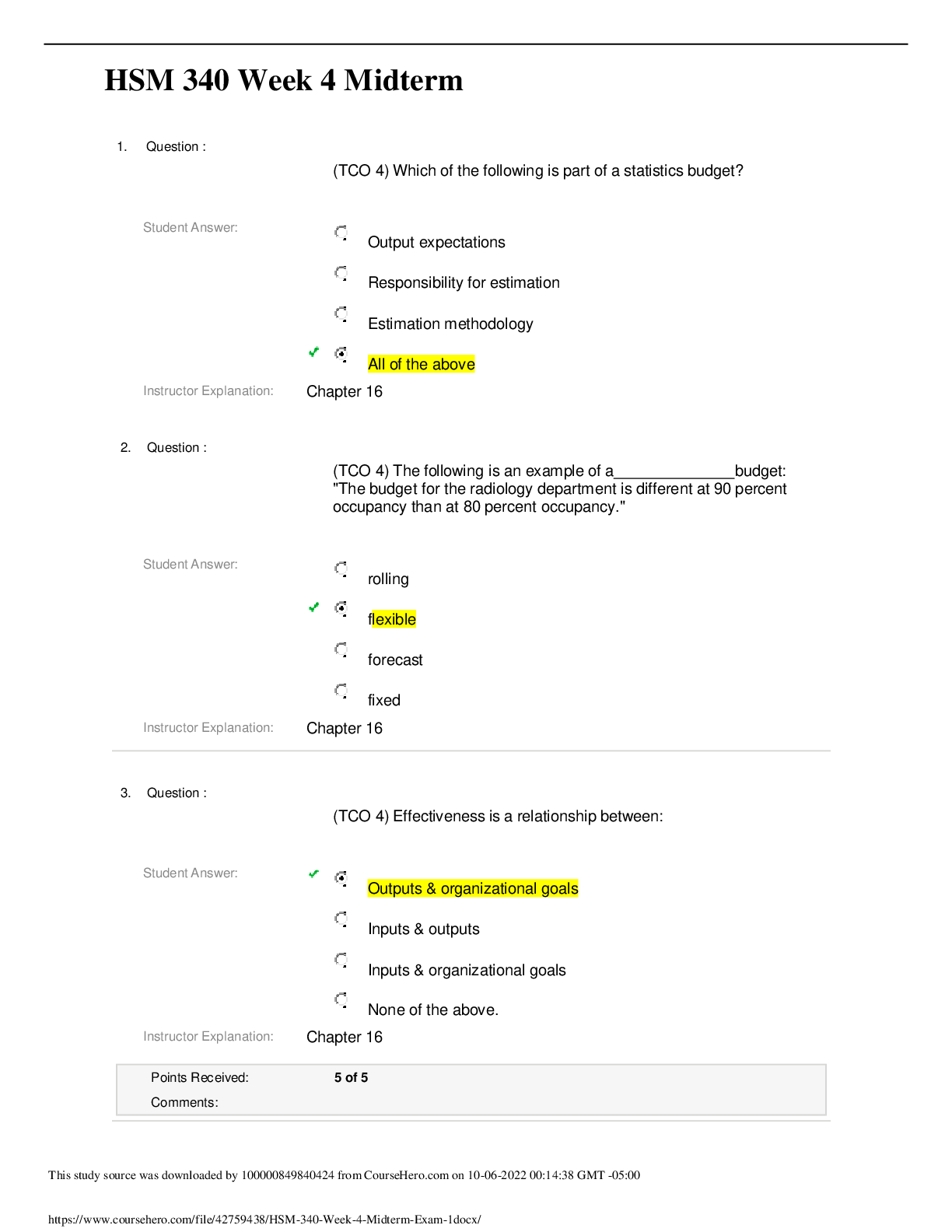
Question 1.1. (TCO 4) Which of the following is part of a statistics budget? (Points : 5) Output expectations
Responsibility for estimation Estimation methodology
All of the above
...
HSM 340 MIDTERM EXAM
Question 1.1. (TCO 4) Which of the following is part of a statistics budget? (Points : 5) Output expectations
Responsibility for estimation Estimation methodology
All of the above
Question 2.2. (TCO 4) Which budgetary issue causes the most strife in all areas of a health care organization? (Points : 5) Setting volume levels
Setting prices
Allocation of indirect costs
Deciding whether to use a fixed or flexible budget
Question 3.3. (TCO 4) Effectiveness is a relationship between: (Points : 5) Outputs and organizational goals
Inputs and outputs
Inputs and organizational goals None of the above.
Question 4.4. (TCO 3) Estimate the total variable cost (i.e., including both routine and ancillary) per MSDRG 505 using the departmental cost/charge ratios and variable cost percentages. (Your answer might be slightly different due to rounding. Pick the closest.) (Points : 5)
$5,213 $3,892 $7,613 $5,452 $8,070
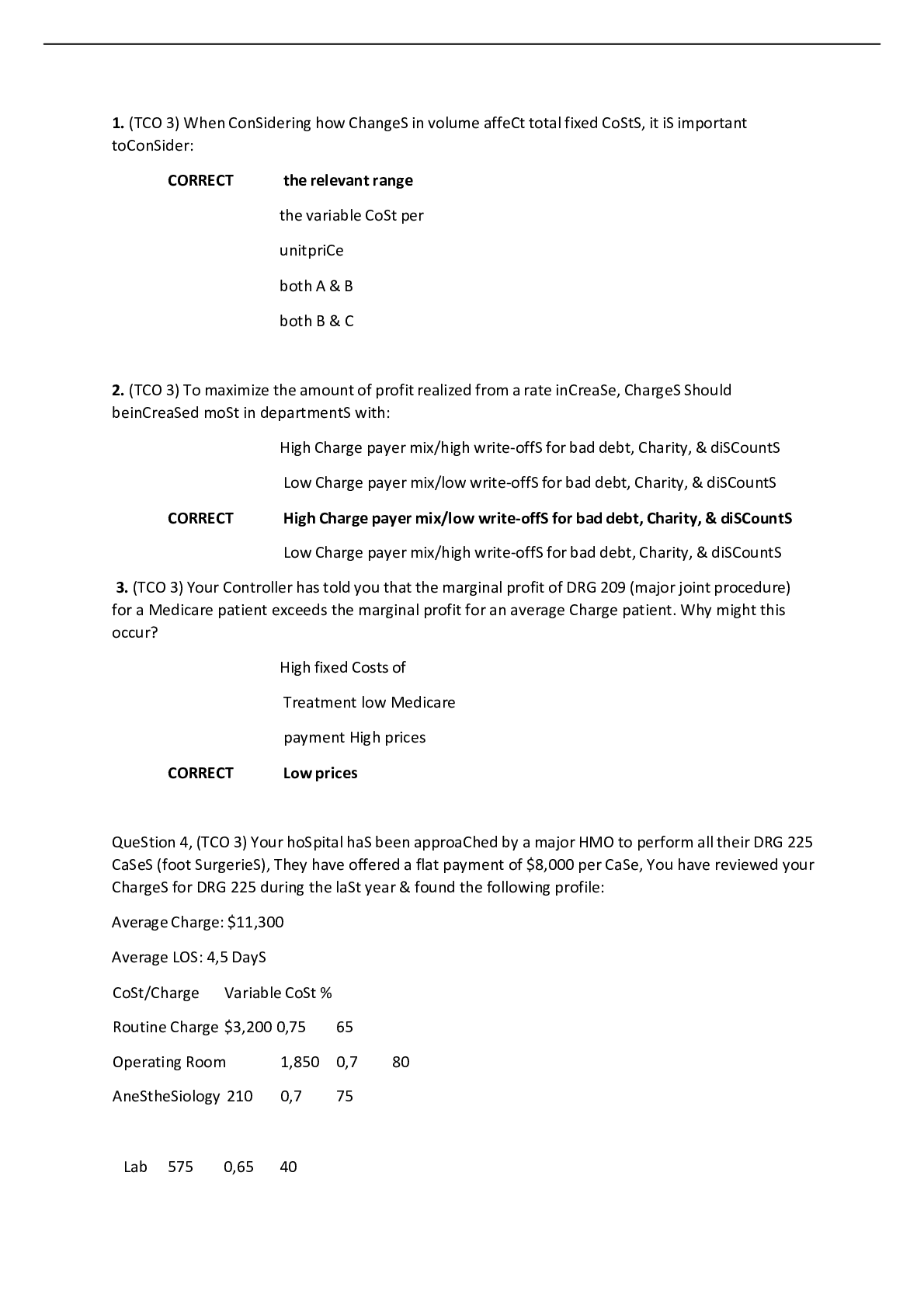
Question 5.5. (TCO 3) Your controller has told you that the marginal profit of DRG 209 (major joint procedure) for a Medicare patient exceeds the marginal profit for an average charge patient. Why might this occur? (Points : 5)
High fixed costs of treatment Low Medicare payment
High prices Low prices
Question 6.6. (TCO 2) A statement that reports the financial position (assets, liabilities, and stockholders' equity) of an accounting entity at a point in time is called a(an): (Points : 5)
Income statement
Statement of retained earnings Balance sheet
This study soSutracetewmasednotwonflocaadsehd bflyo1w00s000822442696 from CourseHero.com on 01-08-2022 20:57:38 GMT -06:00
Report of management
Question 7.7. (TCO 2) Which of the following is the BEST example of a financial metric? (Points : 5) Degree of innovation
Employee empowerment
Accreditation by the Joint Commission on Accreditation of Healthcare Organizations Total margin
Length of stay
1. (TCO 4) Based on the below information, what dollar effect did the increased admission rate have on cost?
You have been asked by management to explain the variances in costs under your inpatient capitated contract. The following data is provided. Use the following data to calculate the variances.
Budget Actual
Inpatient Costs $12,568,500 $16,618,350
Members 42,000 42,000
Admission Rate 0.070 0.095
Case Mix Index 0.90 0.85
Cost per Case (CMI = 1.0)
(Points : 10)
$4,750 $4,900
Question 2.2. (TCO 4) Based on the information below, what rate must be set to generate the required $80,000 in profit in the preceding example?
You have been asked to establish a pricing structure for radiology on a per-procedure basis. Present budgetary data is presented below:
Budgeted Procedures
$10,000
Budgeted Cost $400,00 0
Desired Profit $80,000
It is estimated that Medicare patients comprise 40 percent of total radiology volume and will pay on average $38.00 per procedure. Approximately 10 percent of the patients are cost payers. The remaining charge payers are summarized below:
Payer Volume% Discount%
Blue Cross
20 4
Unity PPO 15 10
Kaiser 10 10
Self Pay 5 40
This study source was downloaded by 100000822442696 from CourseHero.com on 01-08-2022 20:57:38 GMT -06:00
50%
(Points : 10)
Question 3.3. (TCO 4) What is the amount of variance that is attributed to the change in labor productivity? Use the following data to calculate the variances.
The following information has been prepared for a home health agency.
Budget Actual
Wage Rate per Hour $16.00 $17.00
Fixed Hours 320 320
Variable Hours per Relative 1.0 1.1
Value Unit (RVU)
Relative Value Units (RVUs) 1,000 1,200
Total Labor Hours 1,320 1,640
Labor Costs $21,12
0
$27,880
Cost per RVU $21.12 $23.23
Budgeted costs at actual volume would be $25,344 ($21.12 × 1,200), and the total variance to be explained is $2,536 Unfavorable ($27,880 - $25,344). Be sure to specify whether the variance is favorable or unfavorable. (Points : 5)
DL Rate Variance = ( SR ? AR ) × AH Where,
SR is the standard direct labor rate AR is the actual direct labor rate AH are the actual direct labor hours
DL Rate variance = 1640*(16-17) = -$1640 unfavorable
Question 4.4. (TCO 2) How are revenues and expenses defined under accrual accounting? (Points : 5)
A system of accounting based on the accrual principal, under which revenue is recognized (recorded) when earned, and expenses are recognized when incurred.
Totals of revenues and expenses are shown in the financial statements (prepared at the end of an accounting period), whether or not cash was received or paid out in that period. Accruals basis accounting conforms to the provisions of GAAP in preparing financial statements for external users, and is employed by most companies except the very small ones (which use cash basis accounting)
Read more: http://www.businessdictionary.com/definition/accrual-basis-accounting.html#ixzz3bPbUH3gB
Question 5.5. (TCO 2) What are the double-entry accounting system and the duality concept? How are they related? (Points : 5) DEFINITION of 'Double Entry'
The fundamental concept underlying present-day bookkeeping and accounting. Double entry accounting is based on the fact that every financial transaction has equal and opposite effects in at least two different accounts. It is used to satisfy the equation Assets = Liabilities + Equity, whereby each entry is recorded so as to maintain the relationship.
INVESTOPEDIA EXPLAINS 'Double Entry'
In the double entry system, transactions are recorded in terms of debits and credits. Since a debit in one account will be offset by a credit in another account, the sum of all debits must therefore be exactly equal to the sum of all credits. The double-entry system of Thbios ostkukdyeesopuinrcge worasadcocwonulonatdinedgbmy 1a0k0e0s00it82e2a4s4ie26r9t6ofarocmcuCroautresleyHperroe.cpoamreonfi0n1a-n08c-i2a0l2s2ta2t0e:5m7:e3n8tGs MdiTre-c06tl:y00from the books of account and detect errors.
Read more: http://www.investopedia.com/terms/d/double-entry.asp#ixzz3bPc8y6hK Follow us: @Investopedia on Twitter
[Show More]
.png)

 (1).png)


 (1).png)