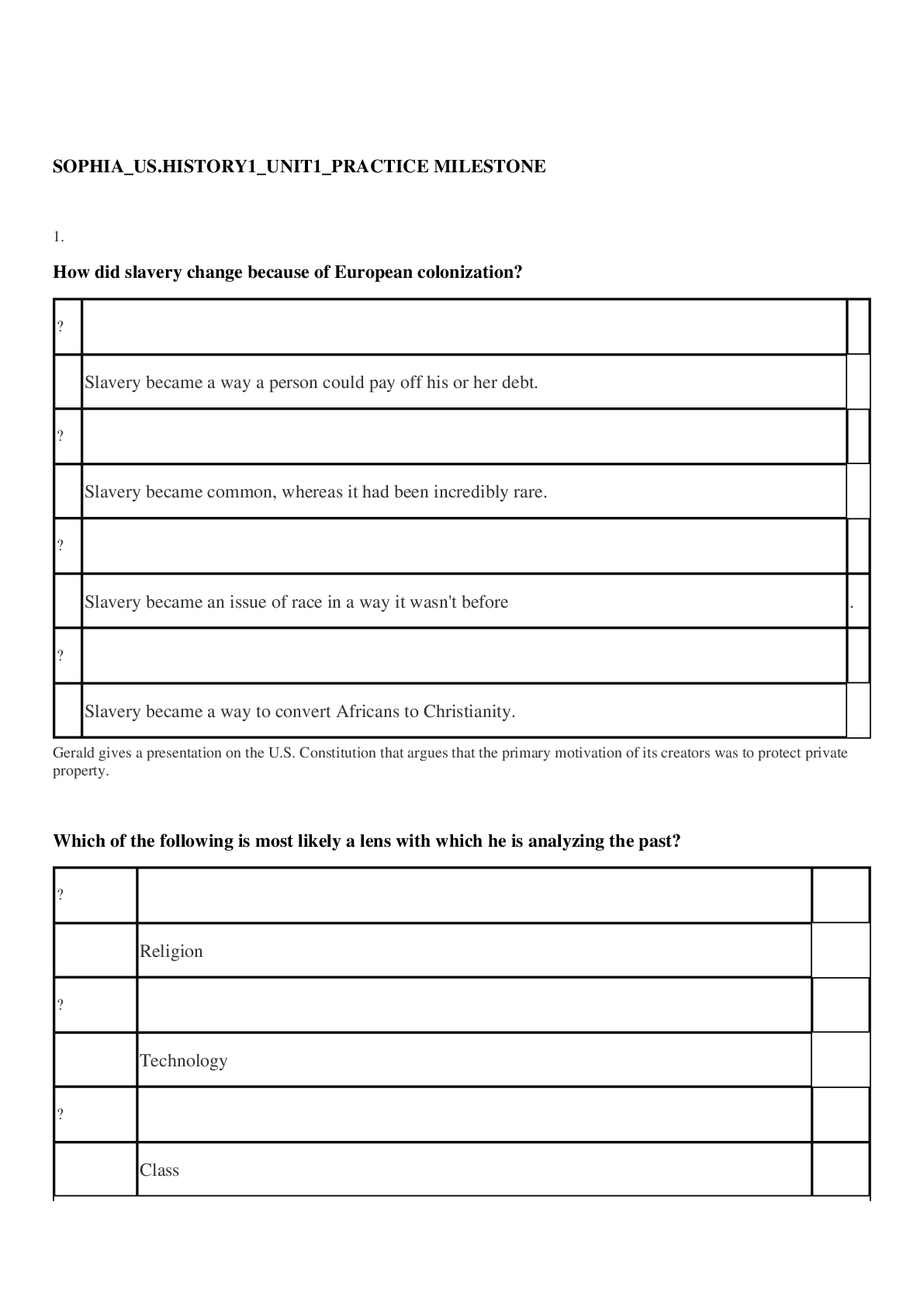
How did slavery change because of European colonization?
•
Slavery became a way a person could pay off his or her debt.
•
Slavery became common, whereas it had been incredibly rare.
•
Slavery became an issue
...
How did slavery change because of European colonization?
•
Slavery became a way a person could pay off his or her debt.
•
Slavery became common, whereas it had been incredibly rare.
•
Slavery became an issue of race in a way it wasn't before.
•
Slavery became a way to convert Africans to Christianity.
2
Gerald gives a presentation on the U.S. Constitution that argues that the primary motivation of its creators was to protect private property.
Which of the following is most likely a lens with which he is analyzing the past?
•
Religion
•
Technology
•
Class
•
Gender
3
Which of the following was a source of tension between English colonists and Native Americans?
•
Native Americans viewed colonists as an impediment to their economic expansion.
•
Efforts to convert Native Americans to Protestantism sometimes led to conflict.
•
Colonists killed Native Americans indiscriminately, but the reverse was not true.
•
Colonists enslaved huge numbers of Native Americans.
4
"We entered into a mutual exchange of culture with the native peoples before going on our way."
The above statement is most representative of which group of European explorers?
•
Portuguese
•
Spanish
•
French
•
English
5
Which of the following historians is collecting oral history?
•
Owen listens to his grandfather tell stories about fighting in World War II.
•
Octavio uses a guidebook to translate German codes from World War II.
•
Olive makes a scrapbook of food stamps, war bonds and propaganda materials from World War II.
•
Ona reads a scholarly article about German attitudes toward World War II today.
6
Read the excerpt from History and Present State of Virginia, published in 1705:
"Slaves are the Negroes, and their Posterity, following the condition of the Mother, according to the Maxim, partus sequitur ventrem [status follows the womb]. They are call’d Slaves, in respect of the time of their Servitude, because it is for Life.
Servants, are those which serve only for a few years, according to the time of their Indenture, or the Custom of the Country. The Custom of the Country takes place upon such as have no Indentures. The Law in this case is, that if such Servants be under Nineteen years of Age, they must be brought into Court, to have their Age adjudged; and from the Age they are judg’d to be of, they must serve until they reach four and twenty: But if they be adjudged upwards of Nineteen, they are then only to be Servants for the term of five Years."
An analysis of the excerpt reveals two different labor systems at work in the Southern colonies.
Choose the true statement about these systems.
•
Servants were assigned to household work while slaves were assigned to outside work.
•
Slaves were held permanently while servants worked for a predetermined length of time.
•
Servants were allowed to choose where they worked, whereas slaves were not.
•
Both slaves and servants were considered property, and their eventual release was determined by their owner.
7
Which of the following statements about Quakers is true?
•
Quakers generally settled in New York after the Dutch relinquished it to the King of England.
•
Quakers became some of the first European Americans to reject the practice of slavery in North America.
•
Quakers frequently were intolerant of other religious groups and banished them from the Middle Colonies.
•
Quakers encouraged trade through Philadelphia, but not immigration to their colonies.
8
Which English colony initially received settlers who were not prepared for the work required to survive in the New World?
•
Plymouth
•
Jamestown
•
Maryland
•
Rhode Island
9
Which geographical area was initially explored by the Dutch?
•
The Mississippi River
•
The Great Lakes
•
New Jersey, Manhattan, and Long Island
•
The Gulf of St. Lawrence
10
Which of the following statements is true?
•
Considering dates, names and locations is the main way of examining historical events.
•
The writing of history isn’t influenced by current social or cultural environments.
•
Historians from different eras often disagree on how to interpret the same events.
•
Historians have to include all related information, even if it isn't relevant to their narratives.
11
Which of the following political factors first motivated Spain to explore the Atlantic World in the 15th century?
•
Land grants that Pope Sixtus IV gave to Portugal in the 1480s
•
The Treaty of Tordesillas between Spain and Portugal.
•
The election of Alexander VI, a native of Spain, as pope
•
The consolidation of Spanish power over the Iberian Peninsula.
12
Native Americans increased their production of shell beads, which they used as jewelry and as currency, in response to which European goods being introduced?
•
Iron tools
•
Woolen clothing
•
Advanced weaponry
•
Livestock
13
Which of the following terms best describes the new economic and political relationship that developed between Europe, Africa and the Americas in the 16th and 17th centuries?
•
Middle Passage
•
Triangular Trade
•
Atlantic World
•
Mercantilism
14
Which European nations were Protestant?
•
England and France
•
England and Holland
•
Spain and Holland
•
Spain and France
15
"What caused the Great Depression of the 1930s?"
Consider the above research question and choose the secondary source that is best suited to answer it.
•
A documentary made by a historian from 2009 on American economics in the 20th century
•
A newspaper article from 1935 that blamed Italian immigrants for creating the Depression
•
A textbook on economic theory from the early 1920s
•
A book published by a historian in 1955 on the history of the stock market
16
Which of the following is characteristic of Puritanism?
•
A strong commitment to universal literacy
•
Belief in the basic equality of all people
•
Obedience to one's conscience before all else
•
Coexistence with and tolerance of other religions
17
What impact did gold and silver found in the Americas have back in Spain?
•
A golden age was spurred, in which art and literature flourished.
•
Native Americans migrated to and settled throughout Spain.
•
The monarchy kept everything for itself, so nothing much happened.
•
The upper classes overthrew the monarchy out of envy for the riches.
18
In North America, beaver pelts became extremely valuable to European traders.
Which of the following concepts does this statement best exemplify?
•
Commodification
•
Colonization
•
Globalization
•
None of the above.
19
Which civilization had an extensive trade network of waterways?
•
The Pueblo
•
The Maya
•
The Inca
•
The Hopewell
[Show More]