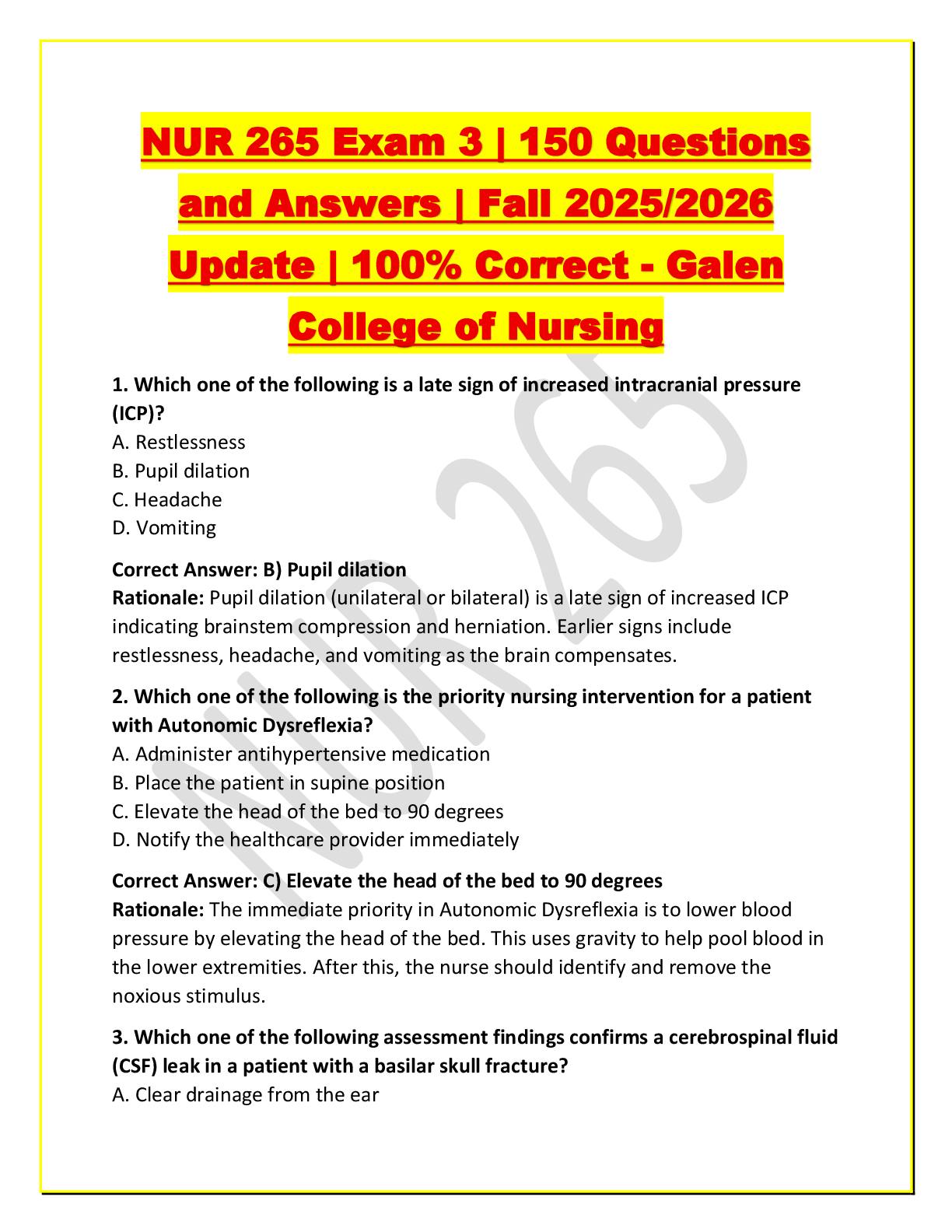
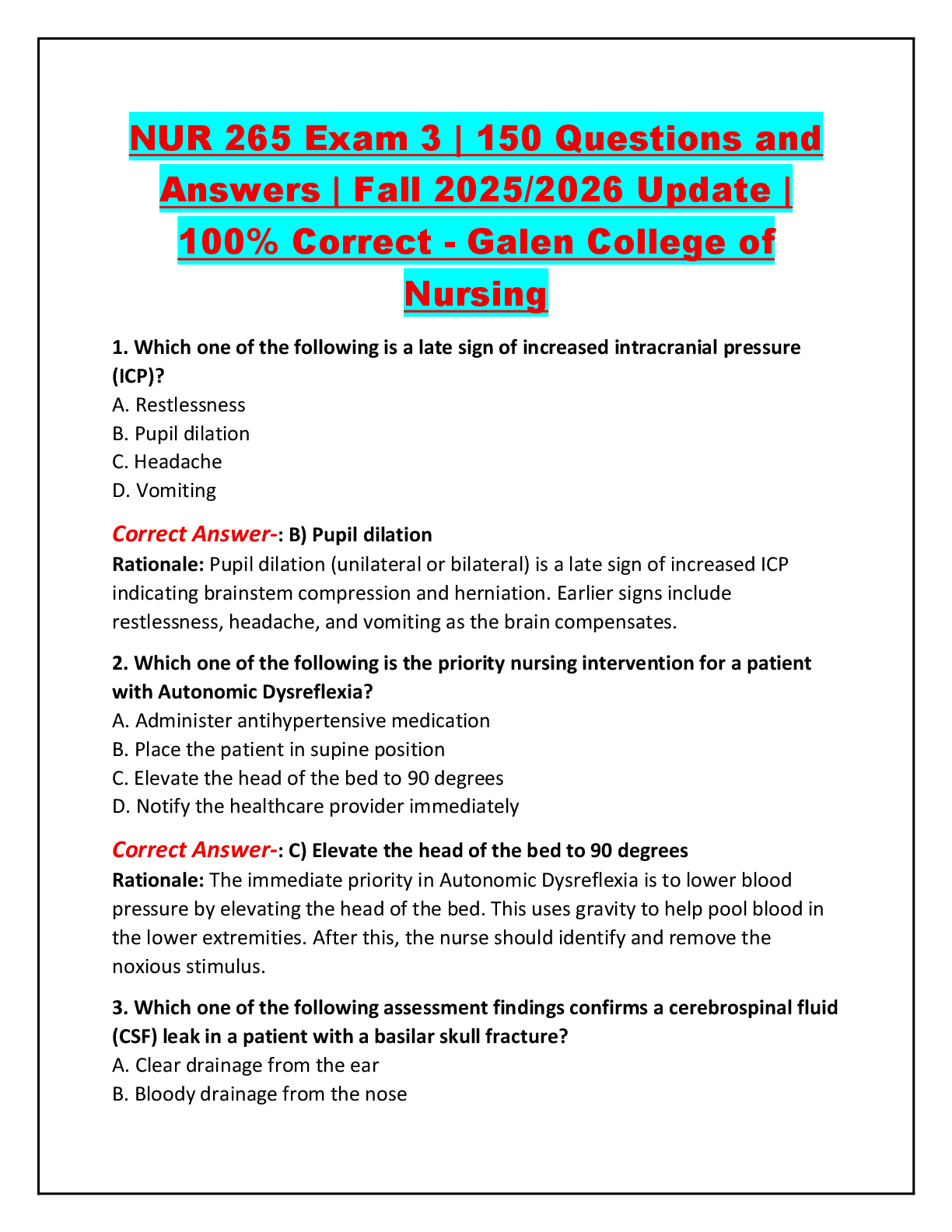
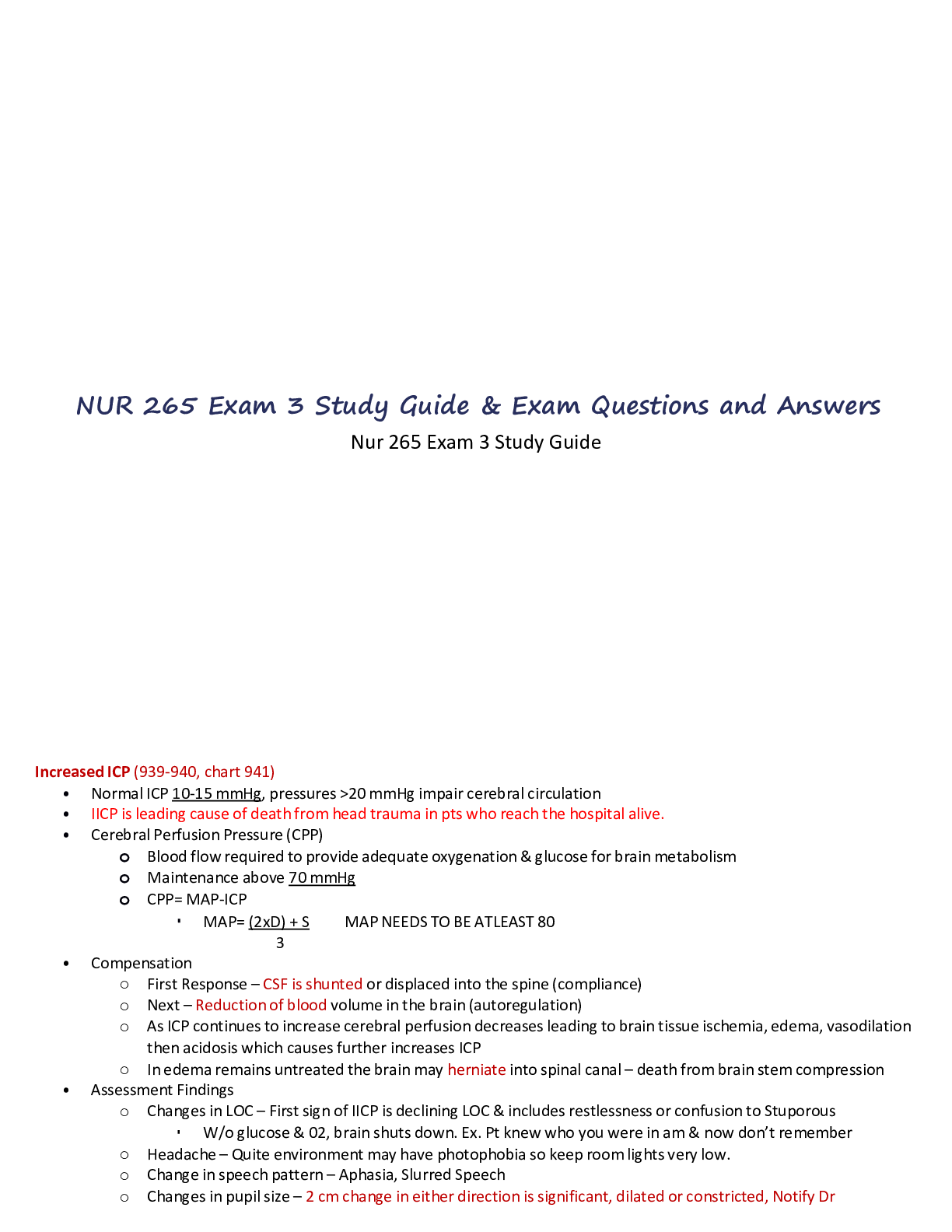
NUR 265 Nursing Concepts Test # 3 Care of Critically Ill Patients with Neurologic Problems / Chapter 47 (25 questions) Traumatic Brain Injury 1. Contrecoup injury Coup is an impact to the frontal ... lobe; countrecoup is the impact to the occipital area from the brain bouncing backwards. 2. Contusion Bruising of the brain tissue; structural damage 3. Concussion Shaky movement of the brain; may lose consciousness; retrograde amnesia; NO structural damage. Client teaching: have pt. woken every 3-4hrs to assess LOC; EXPECT headache, nausea and dizziness for 24hrs, if gets worse or does not subside, go back to hospital; no alcohol, sedatives or sleeping pills, give Tylenol prn every 4hrs; GO BACK TO HOSPITAL IF THESE SYMPTOMS OCCUR: blurred vision, rhinorrhea or ottorrhea, weakness, slurred speech, progressive sleepiness, vomiting, unequal pupil size, and worsening headache. 4. Basilar skull fracture (unique fracture)* Fracture at base of skull; causes CSF leakage of the nose (rhinorrhea) and the ears (ottorrhea); Risk for INFECTION r/t direct access to subarachnoid space. Potential for hemorrhage: Raccoon eyes (bleeding around orbits of eyes) and Battle Sign (bruising behind ears) Hemorrhage (Brain) *All hematomas are potentially life-threatening because they act as space-occupying lesions and are surrounded by edema, thus increasing ICP. 1. Epidural hematoma Located above dura; primarily an arterial bleed. 2. Subdural hematoma Located below dura and above arachnoid; primarily a venous bleed. Slow bleed; acute stage happens within 48hrs. after impact; high mortality rate; usually goes unrecognized. Earliest sign is a change in personality; Ask pt. if they fell or hit their headhowcheck headput on gloves and palpate. 1 This study resource was shared via CourseH 3. Intracerebral hemorrhage Can be both venous and an arterial bleed; usually results from a blown aneurysm; causes increased ICP. Increased Intracranial Pressure **Normal ICP: 10-15 mmHg 1. Earliest change: Change in LOC r/t pressure on frontal lobe, best indicator!!!! Other early s/s: headache and projectile N/V 2. Cushing’s triad-: classic, late sign: severe hypertension with widened pulse pressure and bradycardia 3. Pupillary changes : ovoid pupil: midstage between a normal pupil and a dilated pupil pupils that are dilated and fixed (‘blown’) r/t pressure exerted onto III cranial nerve. Cranial nerve III directly affects pupils. 4. EOMs diminished- CN III, IV, and VI EOM: Extra Ocular Eye Movement These nerves regulate eye muscle movement Diminished cranial nerves r/t increased pressure on brain stem (where these nerves are located); since pressure moves downward from frontal lobe to brainstem, once pressure gets to this point, it means increased ICP is severe. Pinpoint and nonresponsive pupils are indicative of brainstem dysfunction at the level of the pons. 5. Papilledema Choked disk (edema and hyperemia; increased blood flow of optic disk; only seen with an ophthalmoscope) 6. Decorticate and decerebrate posturing Decorticate: Upper extremeties are flexed inwards at core Decerebrate: upper extremeties/wrists are tensed outwards at sides; this is more severe than decorticate, indicates more damage to brain. 7. CSF leak- “halo” sign CSF contains glucose and protein To assess for CSF leak, obtain gauze to absorb fluid, fluid will scatter outwards forming a “yellowish halo”. 8. Glasgow Coma Scale Three major areas assessed on scale: Eye opening, motor response and verbal response Graded from 3-15; 3 being the worst, 15 the best. [Show More]
Last updated: 3 years ago
Preview 1 out of 9 pages
Buy this document to get the full access instantly
Instant Download Access after purchase
Buy NowInstant download
We Accept:
Can't find what you want? Try our AI powered Search
Connected school, study & course
About the document
Uploaded On
Jan 21, 2022
Number of pages
9
Written in
All
This document has been written for:
Uploaded
Jan 21, 2022
Downloads
0
Views
84
Scholarfriends.com Online Platform by Browsegrades Inc. 651N South Broad St, Middletown DE. United States.
We're available through e-mail, Twitter, and live chat.
FAQ
Questions? Leave a message!
Copyright © Scholarfriends · High quality services·