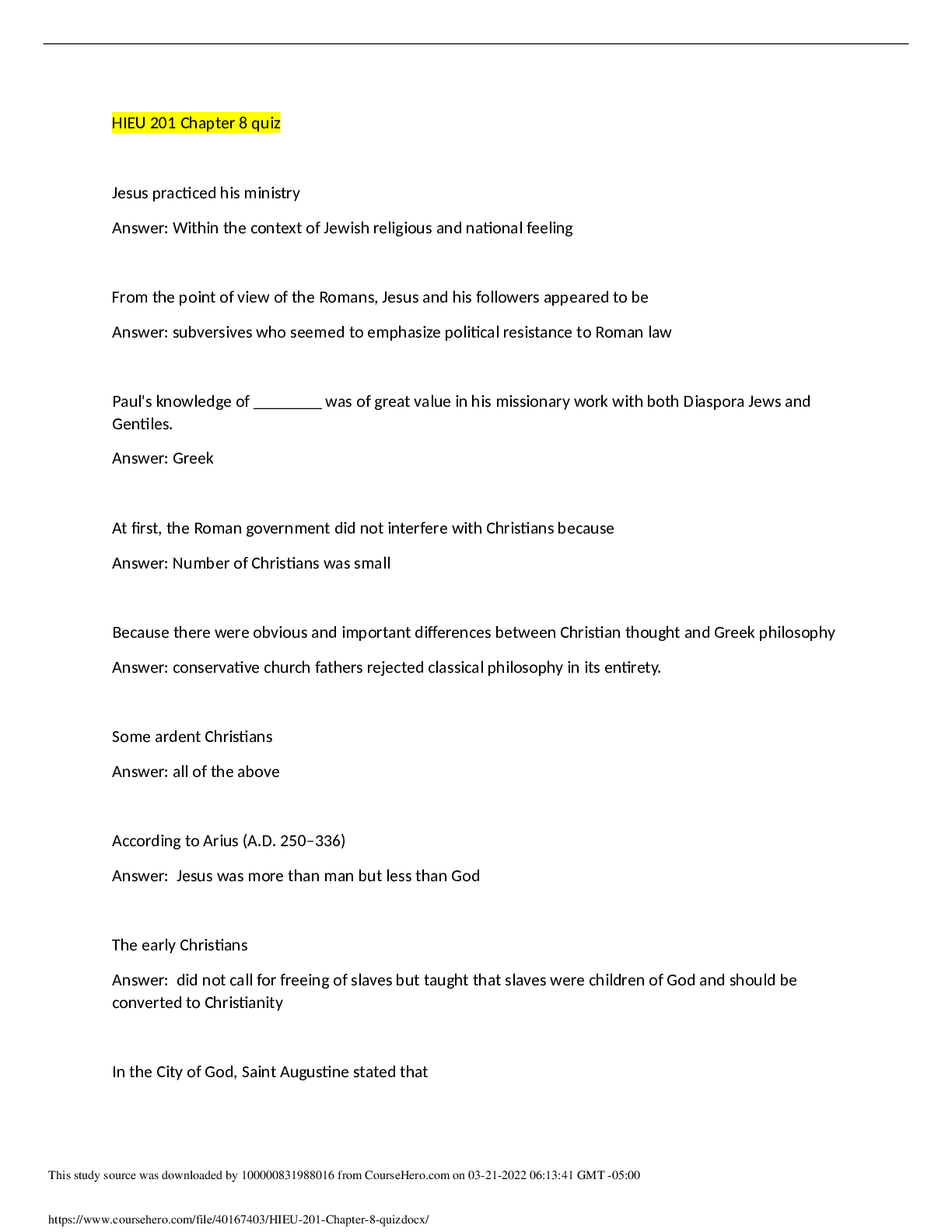
Jesus practiced his ministry
a. in a manner completely consistent with the beliefs of the Pharisees.
b. within the context of Jewish religious and national feeling.
c. in complete defiance of all Jewish tradition.
d.
...
Jesus practiced his ministry
a. in a manner completely consistent with the beliefs of the Pharisees.
b. within the context of Jewish religious and national feeling.
c. in complete defiance of all Jewish tradition.
d. in a manner completely consistent with the beliefs of the Zealots.
Hide Feedback
Correct
From the point of view of the Romans, Jesus and his followers appeared to be
a. subversives who seemed to emphasize political resistance to Roman rule.
b. potential allies in their efforts to control Judea.
c. harmless idealists.
d. just another mystery religion, no different from any other.
Hide Feedback
Correct
Paul's knowledge of ________ was of great value in his missionary work with both
Diaspora Jews and Gentiles.
a. Latin
b. Aramaic
c. Germanic languages
d. Greek
Hide Feedback
Correct
At first, the Roman government did not interfere with Christians because
a. Christian values basically supported the social order and popular morality in Rome.
b. they were preoccupied with other issues.
c. the number of Christians was small, and the Roman government was generally tolerant of local religions.
d. Christians were seen as excellent citizens.
Hide Feedback
Correct
Because there were obvious and important differences between Christian thought and
Greek philosophy
a. all early Christians rejected classical learning as a dangerous influence.
b. only Jews continued to study Greek philosophy.
c. conservative church fathers rejected classical philosophy in its entirety.
d. most early Christians rejected the mysterious elements in Christianity, such as the belief in miracles.
Hide Feedback
Correct
This study source was downloaded by 100000831988016 from CourseHero.com on 01-29-2022 07:07:16 GMT -06:00
https://www.coursehero.com/file/54744050/HIEU-201-Chapter-8-Quizdocx/
Some ardent Christians
a. withdrew to deserts and mountains seeking spiritual renewal.
b. committed extreme acts of self-denial in their zeal to emulate Jesus.
c. were dismayed by the moral laxity of some of the clergy.
d. all of the above
Hide Feedback
Correct
According to Arius (A.D. 250–336)
a. Jesus was more than man but less than God.
b. only celibate men and women were worthy of salvation.
c. all priests should marry and have children.
d. God and Christ were the same substance, coequal and coeternal.
Hide Feedback
Correct
The early Christians
a. denounced slavery as a contradiction of the common humanity of all people.
b. mildly disapproved of slavery, saying it should be tolerated, but not encouraged.
c. actively supported slavery, claiming that slaves could not be converted.
d. did not call for freeing of slaves but taught that slaves were children of God and should be converted to
Christianity.
[Show More]