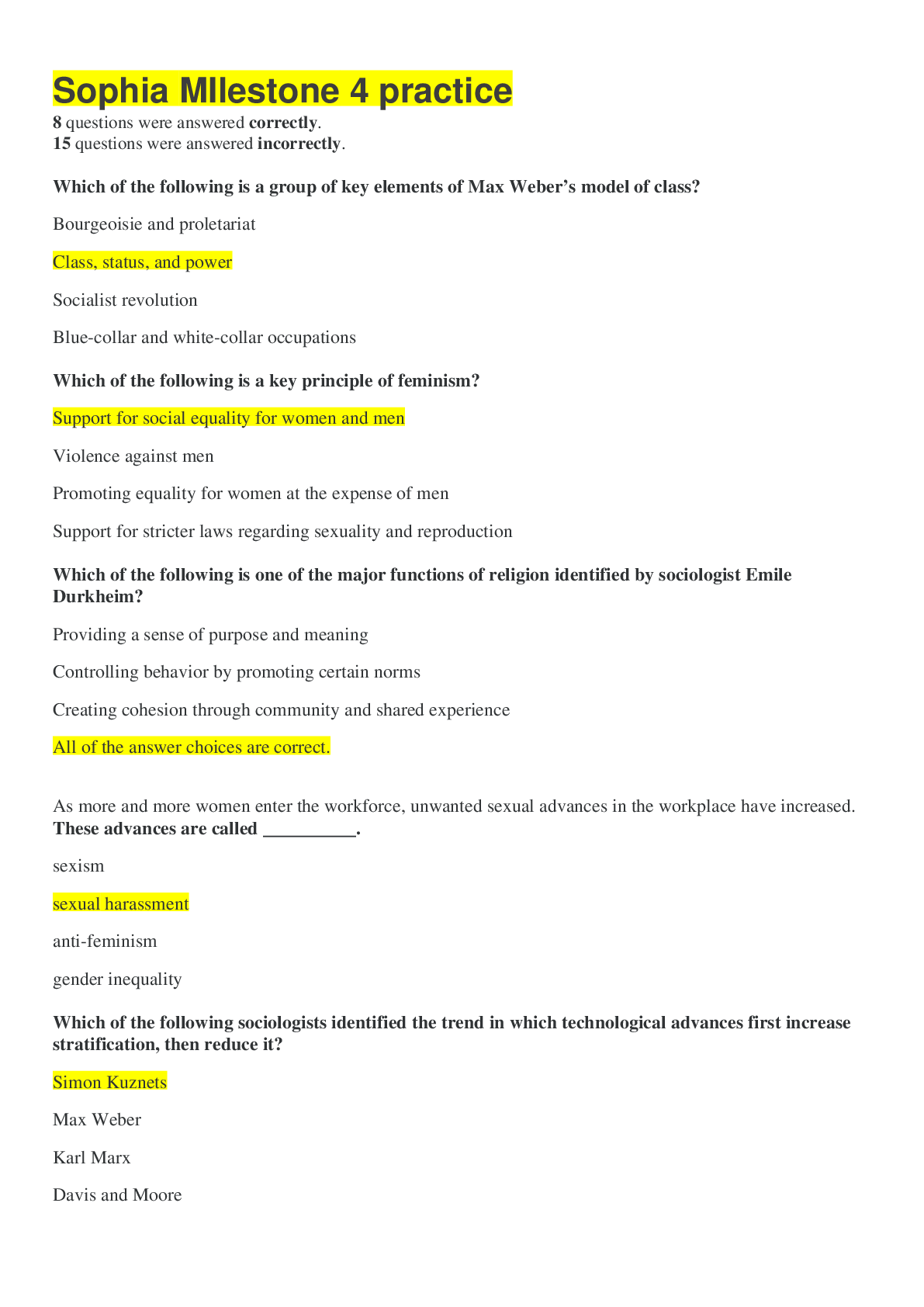
Which of the following is a group of key elements of Max Weber’s model of class?
•
Bourgeoisie and proletariat
•
Class, status, and power
•
Socialist revolution
•
Blue-collar and white-collar occupations
...
Which of the following is a group of key elements of Max Weber’s model of class?
•
Bourgeoisie and proletariat
•
Class, status, and power
•
Socialist revolution
•
Blue-collar and white-collar occupations
2
Which of the following is a key principle of feminism?
•
Support for social equality for women and men
•
Violence against men
•
Promoting equality for women at the expense of men
•
Support for stricter laws regarding sexuality and reproduction
3
Which of the following is one of the major functions of religion identified by sociologist Emile Durkheim?
•
Providing a sense of purpose and meaning
•
Controlling behavior by promoting certain norms
•
Creating cohesion through community and shared experience
•
All of the answer choices are correct.
4
As more and more women enter the workforce, unwanted sexual advances in the workplace have increased.
These advances are called __________.
•
sexism
•
sexual harassment
•
anti-feminism
•
gender inequality
5
Which of the following sociologists identified the trend in which technological advances first increase stratification, then reduce it?
•
Simon Kuznets
•
Max Weber
•
Karl Marx
•
Davis and Moore
6
Which of the following is an example of institutional discrimination?
•
A business monitoring performances
•
The school segregation doctrine of "separate but equal"
•
The federal government healthcare reform
7
Which of the following statements is NOT consistent with Immanuel Wallerstein’s model of the capitalist world economy?
•
The world economy makes poor nations dependent on rich nations.
•
The periphery of the global economy is where low-income countries reside.
•
The core of the global economy consists of low-income countries.
•
The roots of the global economy can be traced back to the beginning of colonization.
8
A __________ typically features a powerful leader who introduces followers to a new way of life.
•
denomination
•
sect
•
cult
•
church
9
Socially-constructed responsibilities assigned to a gender are called __________.
•
gender roles
•
assimilation
•
stereotype
10
Which of the following is the sociological term for a transformation in the social standing of large numbers of people due to changes in society (e.g. expansion of industry and government)?
•
Status consistency
•
Social mobility
•
Structural social mobility
•
Meritocracy
11
Pakistan and Nigeria are examples of which of the following?
•
High-income countries
•
Low-income countries
•
Core countries
•
Middle-income countries
12
__________ poverty is a form of poverty in which people are considered poor in comparison to other people.
•
Feminine
•
Absolute
•
Relative
•
Functional
13
The process by which some nations enrich themselves through political and economic control of other nations is called __________.
•
global stratification
•
colonialism
•
human trafficking
•
neocolonialism
14
A form of slavery that involves relocating people from one place to another and forcing them to work is called __________.
•
chattel slavery
•
debt bondage
•
human trafficking
•
child slavery
15
Jack drives a luxury vehicle and only wears expensive suits.
Jack demonstrates what sociologists call __________: buying and using products and services to display one’s wealth and social standing.
•
meritocracy
•
conspicuous consumption
•
capitalism
•
prestige
16
While researching income data from the US Census, Katie finds that the median income for African American women who work full-time is 84% of what white women who work full-time earn. Similarly, Hispanic women earn about 72% of the full-time income of white women.
To explain the data, Katie applies __________, an analysis of how race, class, and gender combine to produce hardship.
•
gender roles
•
social inequality
•
gender stratification
•
intersectionality
17
Historically, India has been an example of which type of society?
•
Meritocracy
•
Apartheid
•
Open society or class system
•
Closed society or caste system
18
In Brown v. Board of Education of Topeka (1954), the Supreme Court decided that __________ in public schooling is unconstitutional.
•
miscegenation
•
apartheid
•
pluralism
•
segregation
19
A nation that has just begun to shift toward individualism, a desire for material wealth, and a market economy is at which of Rostow’s stages of modernization?
•
Traditional stage
•
Drive to technological maturity
•
Preconditions for take-off
•
Take-off stage
20
Which of the following describes the Davis Moore Thesis?
•
All societies have experienced social stratification of some kind.
•
Social stratification will decrease (or vanish) when a society reaches the period of post-industrialism.
•
Social stratification decreases as technological advances occur.
21
Which of the following correctly describes Native Americans?
•
Americans who trace their ancestry to Spanish-speaking Latin American countries
•
None of the answer choices are correct.
•
Americans who trace their ancestry to the original inhabitants of North and Central America
•
Americans who trace their ancestry to Africa
22
Which of the following describes prejudice?
•
A group that is different from the dominant majority
•
Stereotypes put into action
•
Negative attitudes towards immigrants
23
A white man blames the low pay he earns at his factory job on the presence of a large number of minority coworkers.
This example demonstrates which of the following theories of prejudice?
•
Scapegoat theory
•
Culture theory
•
Authoritarian personality theory
•
Conflict theory
[Show More]