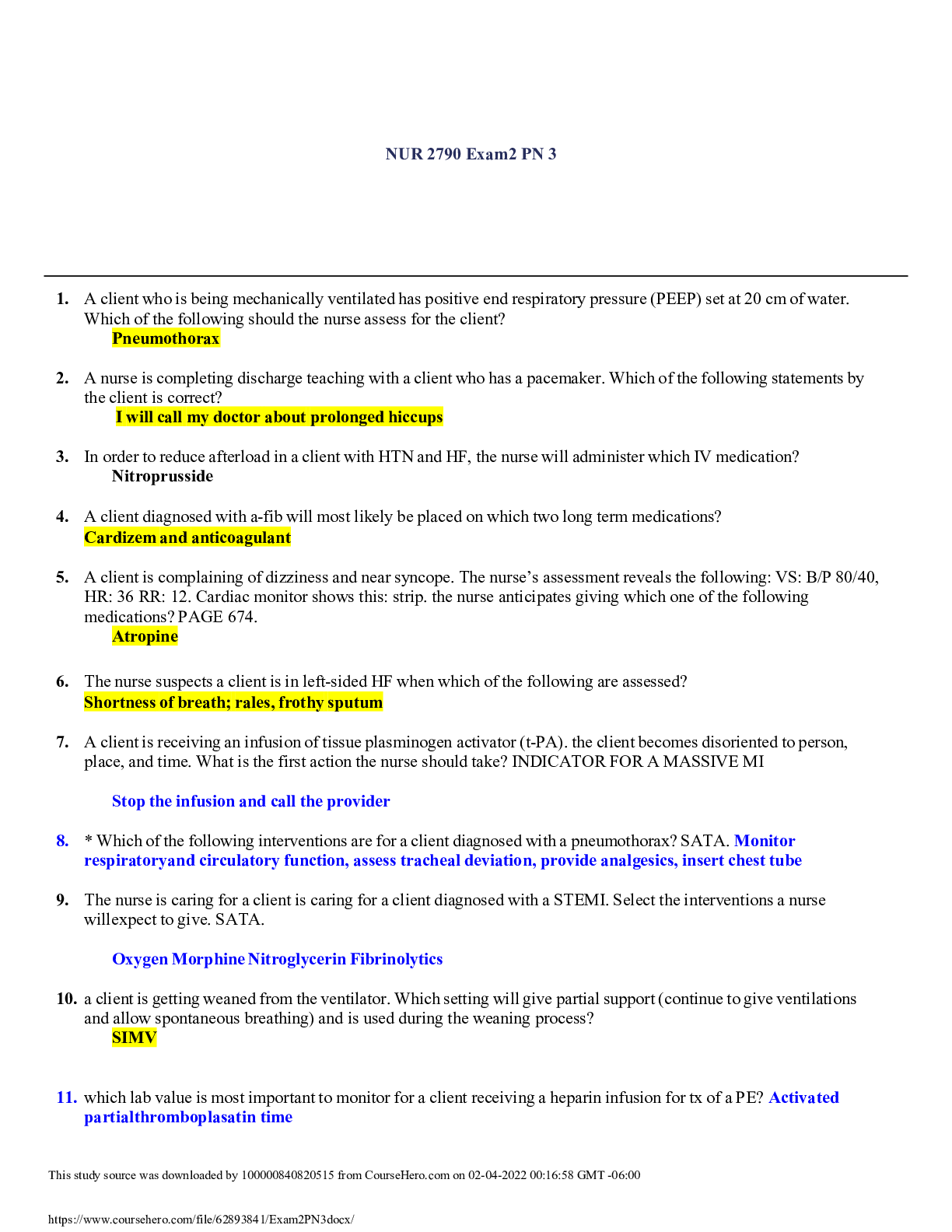
1.A client who is being mechanically ventilated has positive end respiratory pressure (PEEP) set at 20 cm of water. Which of the following should the nurse assess for the client?
Pneumothorax
2.A nurse is completing
...
1.A client who is being mechanically ventilated has positive end respiratory pressure (PEEP) set at 20 cm of water. Which of the following should the nurse assess for the client?
Pneumothorax
2.A nurse is completing discharge teaching with a client who has a pacemaker. Which of the following statements by the client is correct?
I will call my doctor about prolonged hiccups
3.In order to reduce afterload in a client with HTN and HF, the nurse will administer which IV medication?
Nitroprusside
4.A client diagnosed with a-fib will most likely be placed on which two long term medications?
Cardizem and anticoagulant
5.A client is complaining of dizziness and near syncope. The nurse’s assessment reveals the following: VS: B/P 80/40, HR: 36 RR: 12. Cardiac monitor shows this: strip. the nurse anticipates giving which one of the following medications? PAGE 674.
Atropine
6.The nurse suspects a client is in left-sided HF when which of the following are assessed?
Shortness of breath; rales, frothy sputum
7.A client is receiving an infusion of tissue plasminogen activator (t-PA). the client becomes disoriented to person, place, and time. What is the first action the nurse should take? INDICATOR FOR A MASSIVE MI
Stop the infusion and call the provider
8.* Which of the following interventions are for a client diagnosed with a pneumothorax? SATA. Monitor respiratory and circulatory function, assess tracheal deviation, provide analgesics, insert chest tube
9.The nurse is caring for a client is caring for a client diagnosed with a STEMI. Select the interventions a nurse will expect to give. SATA.
[Show More]