Philosophy > EXAMs > PHIL 347 WEEK 2 CHECKPOINT QUIZ. 100% CORRECT QUESTION AND ANSWER (All)
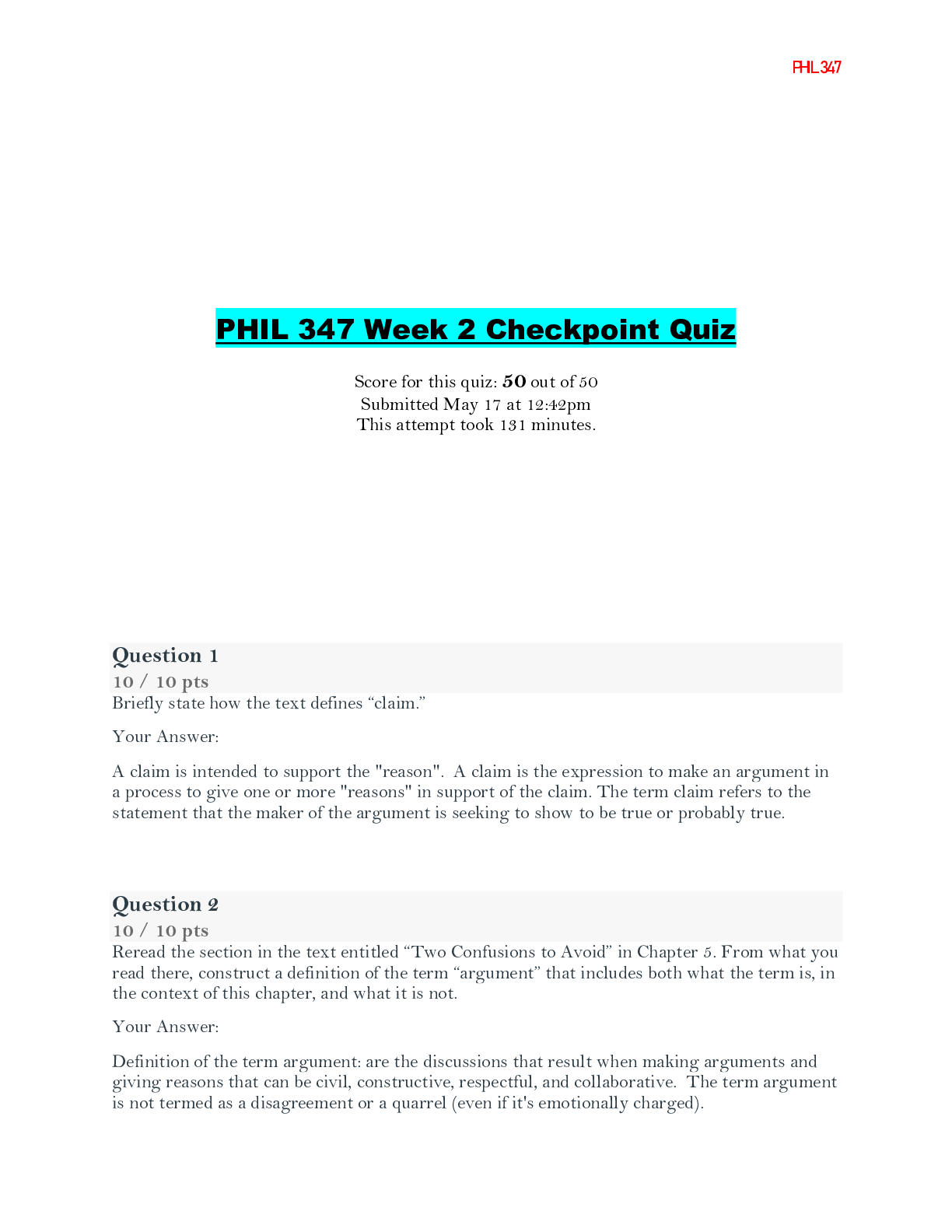
PHIL 347 Week 2 Checkpoint Quiz Score for this quiz: 50 out of 50 Submitted May 17 at 12:42pm This attempt took 131 minutes. Question 1 10 / 10 pts Briefly state how the te ... xt defines “claim.” Your Answer: A claim is intended to support the "reason". A claim is the expression to make an argument in a process to give one or more "reasons" in support of the claim. The term claim refers to the statement that the maker of the argument is seeking to show to be true or probably true. Question 2 10 / 10 pts Reread the section in the text entitled “Two Confusions to Avoid” in Chapter 5. From what you read there, construct a definition of the term “argument” that includes both what the term is, in the context of this chapter, and what it is not. Your Answer: Definition of the term argument: are the discussions that result when making arguments and giving reasons that can be civil, constructive, respectful, and collaborative. The term argument is not termed as a disagreement or a quarrel (even if it's emotionally charged). Question 3 10 / 10 pts What questions does the text suggest we ask to distinguish conclusions and reasons? Your Answer: Questions to distinguish conclusions and reasons are as follows: "What is the conclusion that the speaker is trying to establish as true?" "What is the decision that the speaker is trying to explain or justify" "What considerations does the speaker present to establish the truth of that claim or the basis of that decision" Question 4 10 / 10 pts What are the component premises are there in the following statement: "If it weren’t for how much it costs and how big it is, I’d buy that TV for our bedroom." Your Answer: The two component premises in this statement are as follows: 1) this person has a small bedroom/cannot fit the TV in their room 2) this person does not have enough money to afford the TV or is unwilling to spend so much money on the TV. Question 5 10 / 10 pts Below are four common misconceptions about mapping an argument. Choose any two and briefly explain why each is wrong. • o When making an analysis and map of another person’s argument, you should correct obvious mistakes. o Every line of reasoning in an argument map eventually leads to a conclusion. o Unless the speaker actually states a reason, we can’t tell what they are thinking. o In analyzing and mapping the statements in an argument, context is not important. Your Answer: • When making an analysis and map of another person’s argument, you should correct obvious mistakes. As an analyst, fixing an argument is not our job. Our job is to describe the speakers argument while being objective about the speakers claims, reasons and unspoken assumptions [Show More]
Last updated: 3 years ago
Preview 1 out of 3 pages
Buy this document to get the full access instantly
Instant Download Access after purchase
Buy NowInstant download
We Accept:
Can't find what you want? Try our AI powered Search
Connected school, study & course
About the document
Uploaded On
Feb 15, 2022
Number of pages
3
Written in
All
This document has been written for:
Uploaded
Feb 15, 2022
Downloads
0
Views
105
Scholarfriends.com Online Platform by Browsegrades Inc. 651N South Broad St, Middletown DE. United States.
We're available through e-mail, Twitter, Facebook, and live chat.
FAQ
Questions? Leave a message!
Copyright © Scholarfriends · High quality services·