HESI 101/ HESI V Module 2 Exam LATEST 2021
Question 1
1 / 1 pts
A nurse assisting with data collection of a client gathers both subjective and objective data. Which finding would the nurse document as sub
...
HESI 101/ HESI V Module 2 Exam LATEST 2021
Question 1
1 / 1 pts
A nurse assisting with data collection of a client gathers both subjective and objective data. Which finding would the nurse document as subjective data?
The client appears anxious.
Blood pressure is 170/80 mm Hg.
Correct!
The client states that he has a rash.
The client has diminished reflexes in the legs.
Rationale: The purpose of a physical assessment is to collect both subjective and objective data. Subjective data, collected during the health history, consist of information that the client gives about himself or herself. Objective data are obtained through physical examination and vital signs measurements, what the nurse observes, and laboratory study and diagnostic test results.
Test-Taking Strategy: Use the process of elimination. Eliminate the comparable or alike options that include data that the nurse would obtain during the physical examination. Review the difference between subjective and objective data if you had difficulty with this question.
Cognitive Ability: Applying
Client Needs: Health Promotion and Maintenance Integrated Process: Communication and Documentation Content Area: Health Assessment/Physical Exam
information does the nurse recognize as objective data?
The client is allergic to strawberries.
The last menstrual period was 30 days ago.
The client takes acetaminophen (Tylenol) for headaches.
Correct!
A 1 × 2-inch scar is present on the lower right portion of the abdomen.
Rationale: Subjective data, collected during the health history, consist of information that the client gives about himself or herself. Objective data are obtained through physical examination and vital signs measurements, what the nurse observes, and laboratory study and diagnostic test results. Allergies, the date of the client’s last menstrual period, and the reported use of medication for headaches are all subjective data.
Test-Taking Strategy: Use the process of elimination. Eliminate the comparable or alike options that include data that the nurse would obtain from the client during the health history. Review the difference between subjective and objective data if you had difficulty with this question.
Cognitive Ability: Understanding
Client Needs: Health Promotion and Maintenance Integrated Process: Nursing Process/Data Collection Content Area: Health Assessment/Physical Exam
Episodic
Follow-up
Emergency
Correct!
Complete
Rationale: A complete database includes a complete health history and a full physical examination. It describes the client’s current and past state of health and forms a baseline against which all future changes can be measured. The complete database is collected in a primary care setting, such as a pediatric or family practice clinic; an independent or group private practice; a college health service; a women’s health care agency; a visiting nurse agency; or a community health agency. An episodic database is compiled for a limited or short-term problem and is focused mainly on one problem or one body system. A follow-up database is used to evaluate an identified problem at regular and appropriate intervals. An emergency database involves the rapid collection of the data that are often compiled as lifesaving measures are being performed.
Test-Taking Strategy: Use the process of elimination. Noting the strategic words “initial home visit” in the question will direct you to the correct option. Review the different types of databases if you had difficulty with this question.
Cognitive Ability: Applying
Client Needs: Health Promotion and Maintenance Integrated Process: Nursing Process/Data Collection Content Area: Health Assessment/Physical Exam
and cough. The nurse should assist with the data collection by collecting which information?
Data related to follow-up care
A complete (total health) database
Correct!
Data related to the respiratory system
Data related to the treatment for the cold
Rationale: An episodic database is compiled for a limited or short-term problem and is focused mainly on one problem or body system. The history and examination will be focused primarily on the respiratory system in this client. A complete database includes a complete health history and a full physical examination. It describes the client's current and past state of health and forms a baseline against which all future changes can be measured. A follow-up database is used to evaluate an identified problem at regular and appropriate intervals.
Test-Taking Strategy: Use the process of elimination. Focusing on the data in the question and noting the words “now complaining of chest congestion and cough” will direct you to the correct option. Review the different types of databases if you had difficulty with this question.
Cognitive Ability: Applying
Client Needs: Health Promotion and Maintenance Integrated Process: Nursing Process/Data Collection Content Area: Health Assessment/Physical Exam
Collect health history information first, then perform the physical examination.
Correct!
Ask health history questions while performing the examination and initiating emergency measures.
Collect all information requested on the history form, including social support, strengths, and coping patterns.
Perform emergency measures and not ask any health history questions until the client’s fractures have been treated in the operating room.
Rationale: If the client is alert and cooperative and if the situation is not life-threatening, the nurse should attempt to obtain as much subjective and objective data as possible while caring for the client. Collecting health history information and then performing the physical examination does not address the priority, which is treating the client.
Collecting all data requested on the history does not specifically address the client's immediate problems. Performing emergency measures and not asking any health history questions does not address data collection before treatment.
Test-Taking Strategy: Use the process of elimination. Focus on the data in the question and note the strategic words “alert and cooperative.” Noting that the client has not sustained life-threatening injuries will direct you to the correct option. Review the different types of databases if you had difficulty with this question.
Cognitive Ability: Applying
Client Needs: Health Promotion and Maintenance Integrated Process: Nursing Process/Data Collection Content Area: Health Assessment/Physical Exam
Question 6
1 / 1 pts
A client who was given a diagnosis of hypertension 3 months ago is at the clinic for a checkup. Which type of database does the nurse use in performing an assessment?
Emergency
Correct!
Follow-up
Complete (total)
Problem-centered
Rationale: A follow-up database is compiled to evaluate the status of an identified problem at regular and appropriate intervals. An emergency database calls for rapid collection of the data, often at the same time lifesaving measures are being performed. A complete database includes a complete health history and a full physical examination. It describes the client's current and past state of health and forms a baseline against which all future changes can be measured. An episodic database (problem-centered) is compiled for a limited or short-term problem. It is focused mainly on one problem or body system.
Test-Taking Strategy: Focus on the data in the question. Noting the strategic words “at the clinic for a checkup” in the question will direct you to the correct option. Review the different types of databases if you had difficulty with this question.
Cognitive Ability: Applying
Client Needs: Health Promotion and Maintenance Integrated Process: Nursing Process/Data Collection Content Area: Health Assessment/Physical Exam
A Mexican American client with epilepsy is being seen at the clinic for an initial examination. The nurse understands which primary purpose of including cultural information in the health assessment?
Confirm the medical diagnosis.
Make accurate nursing diagnoses.
Identify any hereditary traits related to the epilepsy.
Correct!
Determine what the client believes has caused the epilepsy.
Rationale: The primary purpose for including cultural information in the health assessment is to determine what the client believes has caused the illness. In Mexican American culture, epilepsy is seen as a reflection of physical imbalance. Although the nurse may obtain data related to family history (hereditary) and formulate nursing diagnoses, these are not the primary reasons for including cultural information in the health assessment. A nurse gathers assessment data but does not confirm a medical diagnosis.
Test-Taking Strategy: Use knowledge of the subject, Mexican American cultural beliefs, to begin the process of elimination. Eliminate the option that indicates to confirm a medical diagnosis because this is not the role of the nurse. To select from the remaining options, recall that cultural beliefs exist in relation to the cause of a disease; this will direct you to the correct option. Review the nurse’s role in data collection and cultural considerations if you had difficulty with this question.
Cognitive Ability: Applying
Client Needs: Health Promotion and Maintenance Integrated Process: Nursing Process/Data Collection Content Area: Cultural Diversity
Question 8
1 / 1 pts
A nurse assisting with data collection uses the back of the hand to feel the client’s skin on both arms and notes that the skin is warm. The nurse makes which determination?
The client has a fever.
Correct!
The skin temperature is normal.
The client needs to drink additional fluids.
The client needs to have the blanket removed.
Rationale: To assess skin temperature, the nurse would first note the temperature of his or her own hands, then use the backs (dorsa) of the hands to palpate the client’s skin bilaterally. The skin should be warm, and the temperature should be equal bilaterally; warmth suggests normal circulatory status. The hands and feet may feel slightly cooler in a cool environment. Giving the client additional fluids, removing the blanket, and checking for a fever are all incorrect responses to this finding.
Test-Taking Strategy: Focus on the data in the question. Note the strategic word “warm.” Recalling that warmth suggests normal circulatory status will direct you to the correct option. Review normal skin temperature if you had difficulty with this question.
Cognitive Ability: Analyzing
Client Needs: Health Promotion and Maintenance Integrated Process: Nursing Process/Data Collection Content Area: Adult Health/Integumentary
A nurse assisting with data collection notes that the client’s skin is very dry. The nurse documents this finding using which term?
Correct!
Xerosis
Pruritus
Seborrhea
Actinic keratoses
Rationale: Dry skin is also called xerosis. In this condition, the epidermis lacks moisture or sebum and is often marked by a pattern of fine lines, scaling, and itching.
Causes include too-frequent bathing, low humidity, and decreased production of sebum in aging skin. Pruritus is the symptom of itching, an uncomfortable sensation that prompts the urge to scratch the skin. Seborrhea is one of several common skin conditions in which an overproduction of sebum results in excessive oiliness or dry scales. Actinic keratoses are red-tan scaly plaques that grow over the years, becoming raised and roughened. A silvery-white scale may adhere to the plaque. They occur on sun-exposed surfaces and are directly related to sun exposure. Actinic keratoses are premalignant and may develop into squamous cell carcinoma.
Test-Taking Strategy: Knowledge of the subject, the characteristics of various skin conditions and lesions, is needed to answer this question. This knowledge and noting the words “very dry” in the question will direct you to the correct option. Review the skin conditions identified in the options if you had difficulty with this question.
Cognitive Ability: Applying
Client Needs: Health Promotion and Maintenance Integrated Process: Communication and Documentation Content Area: Adult Health/Integumentary
Question 10
1 / 1 pts
A nurse is preparing to assist the health care provider examine a client’s skin with the use of a Wood light. In preparing for this diagnostic test, the nurse should perform which action?
Correct!
Darken the room
Obtain informed consent from the client
Obtain a scalpel and a slide for diagnostic evaluation
Obtain medication to anesthetize the skin area before proceeding with the examination
Rationale: A handheld long-wavelength ultraviolet (black) light, or Wood light, is sometimes used during physical examination of the skin. Areas of blue-green or red fluorescence are associated with certain skin conditions. Hypopigmented skin appears more prominent when it is viewed under black light, greatly facilitating the evaluation of pigment changes in fair-skinned clients. Examination of the skin is always carried out in a darkened room. The test is noninvasive, and the nurse should reassure the client that no discomfort is associated with a Wood light examination.
Test-Taking Strategy: Use data in the question to focus on the name of the test. Recalling that this test is noninvasive will assist you in eliminating the incorrect options. Review the procedure for performing a Wood light test if you had difficulty with this question.
Cognitive Ability: Applying
Client Needs: Health Promotion and Maintenance
Integrated Process: Nursing Process/Planning
Content Area: Adult Health/Integumentary
Question 11
1 / 1 pts
A nurse assisting with data collection for a client with kidney failure notes that the client has the appearance of generalized edema over the entire body. The nurse documents this finding using which terminology?
Correct!
Anasarca
Ecchymosis
Unilateral edema
Increased vascularity of the skin tissue
Rationale: Bilateral edema, or edema that is generalized over the entire body, is known as anasarca. This finding is indicative of a central problem such as congestive heart failure or kidney failure. It does not indicate increased vascularity of skin tissue. Ecchymosis is a large patch of capillary bleeding into the tissues (bruise).
Test-Taking Strategy: Use the process of elimination. Focusing on the data in the question, noting the strategic words “appearance of generalized edema” in the question and visualizing the appearance of each condition in the options will help you answer correctly. Review the terms related to edema if you had difficulty with this question.
Cognitive Ability: Applying
Client Needs: Health Promotion and Maintenance Integrated Process: Communication and Documentation Content Area: Adult Health/Renal
client has deep pitting edema, that the indentation remains for a short time, and that the leg looks swollen. How does the nurse document this finding?
1+ edema
2+ edema
Correct!
3+ edema
4+ edema
Rationale: Edema, the accumulation of fluid in the intercellular spaces, is not normally present. To check for edema, the nurse presses his or her thumbs firmly against the ankle malleolus or the tibia. Normally the skin surface stays smooth. If the pressure leaves a dent in the skin, “pitting” edema is present. Its presence is graded on the following 4-point scale: 1+ denotes mild pitting and slight indentation but no perceptible swelling of the leg, 2+ indicates moderate pitting in which the indentation subsides rapidly, 3+ indicates deep pitting in which the indentation remains for a short time and the leg looks swollen, and 4+ denotes very deep pitting in which the indentation lasts a long time and the leg is very swollen.
Test-Taking Strategy: Focus on the data in the question. Noting the words “indentation remains for a short time” in the question will help direct you to the correct option.
Review the grading scale for edema if you had difficulty with this question.
Cognitive Ability: Applying
Client Needs: Health Promotion and Maintenance Integrated Process: Communication and Documentation Content Area: Adult Health/Cardiovascular
A client complains that her skin is redder than normal. The nurse notes the client’s skin, documents hyperemia, and explains to the client that this condition is caused by which factor?
Contraction of the underlying blood vessels
A reduced amount of bilirubin in the blood
Diminished perfusion of the surrounding tissues
Correct!
Excess blood in the dilated superficial capillaries
Rationale: Hyperemia is an excess of blood in a part of the body. The skin over a hyperemic area usually becomes reddened or warm. The condition is caused by increased blood flow, local relaxation of arterioles, or obstruction of the outflow of blood from an area. A reduced amount of bilirubin in the blood, diminished perfusion of the surrounding tissues, and contraction of the underlying blood vessels are all incorrect explanations for hyperemia.
Test-Taking Strategy: Use the process of elimination. Note the relationship between the strategic words “skin is redder” in the question and “excess blood” in the correct option. Review the description and cause of hyperemia if you had difficulty with this question.
Cognitive Ability: Applying
Client Needs: Health Promotion and Maintenance Integrated Process: Nursing Process/Implementation Content Area: Adult Health/Integumentary
Asks the client to stand 40 feet from the chart and read the line that can be read 200 feet away by someone with unimpaired vision
Rationale: To test visual acuity with the use of a Snellen chart, the nurse places the chart in a well-lit spot with the chart at the client’s eye level. The client is positioned on a mark exactly 20 feet from the chart. The client uses an opaque card to shield one eye at a time during the test; after each eye is tested, both eyes are assessed together. The client is asked to read through the chart to the smallest line of letters he or she can discern. The client is encouraged to read the next smallest line as well.
Therefore the other options are incorrect.
Test-Taking Strategy: Focus on the subject, a vision screening test. Visualizing each of the descriptions in the options will direct you to the correct one. Review the procedure for using the Snellen eye chart if you had difficulty with this question.
Cognitive Ability: Applying
Client Needs: Health Promotion and Maintenance Integrated Process: Nursing Process/Data Collection Content Area: Health Assessment/Physical Exam
Correct!
The client can read at a distance of 20 feet what a client with normal vision can read at 80 feet.
The client can read at a distance of 80 feet what a client with normal vision can read at 20 feet.
Rationale: When recording the results of visual acuity testing with the use of the Snellen chart, the nurse would use the numeric fraction noted at the end of the last line on the chart read successfully by the client. The top number (numerator) indicates the distance the client is standing from the chart; the denominator is the distance at which a normal eye could have read that particular line.
Therefore a reading of 20/80 means that the client can read at a distance of 20 feet what a client with normal vision can read at 80 feet.. Legal blindness is defined as the best corrected vision in the better eye of 20/200 or worse. Normal visual acuity is 20/20.
Test-Taking Strategy: Use knowledge of the subject, Snellen testing. Recalling that the client stands 20 feet from the Snellen chart when visual acuity is being tested will direct you to the correct option. Review the procedure for interpreting the results from the Snellen visual acuity test if you had difficulty with this question.
Cognitive Ability: Analyzing
Client Needs: Health Promotion and Maintenance Integrated Process: Nursing Process/Assessment Content Area: Health Assessment/Physical Exam
Asks the client to discriminate numbers on a chart composed of colored dots
Darkens the room and asks the client to identify colored blocks and shapes that appear in the visual field
Has both the client and nurse cover the right eye, stare at each other's uncovered eye, and bring a small object into the visual field, then repeat the test with the left eye
Correct!
Sits at eye level with the client, covers one eye, and has the client cover the eye directly opposite the nurse’s, after which each stares at the other’s uncovered eye, and the nurse brings a small object into the visual field
Rationale: The confrontation test is a gross measure of peripheral vision. It compares the client’s peripheral vision with the examiner’s vision under the assumption that the examiner’s vision is normal. The examiner positions himself or herself at eye level with the client, about 2 feet away. The examiner directs the client to cover one eye with an opaque card and look straight at the examiner with the other. The examiner covers his or her own eye opposite the client’s covered one. Next the examiner holds a pencil or flicking finger as a target midline between himself or herself and the client and slowly advances it from the periphery in several directions. The examiner asks the client to say “now” as the target is first seen. This sighting should occur just as the examiner sees the object for the first time. Asking the client to discriminate numbers on a chart composed of colored dots and darkening the room and asking the client to identify colored blocks and shapes that appear in the visual field are both components of testing for color vision.
Test-Taking Strategy: Use knowledge of the subject, and recall that the confrontation test assesses peripheral vision. This will assist you in eliminating the options that do not address this concept. To select from the remaining options, visualize each. This will direct you to the correct option. Review the confrontation vision test if you had difficulty with this question.
Cognitive Ability: Applying
Client Needs: Health Promotion and Maintenance Integrated Process: Nursing Process/Data Collection Content Area: Health Assessment/Physical Exam
Correct! Optic disc
Conjunctiva
Rationale: The ophthalmoscope enlarges the examiner’s view of the eye so that the media (anterior chamber, lens, vitreous humor) and the ocular fundus (the internal surface of the retina) can be examined. The optic disc is located on the internal surface of the retina. The iris, conjunctiva, and cornea can be examined without the use of an ophthalmoscope.
Test-Taking Strategy: Use knowledge of the subject, and think about the anatomic structures of the eye. Recalling that the optic disc is located on the internal surface of the retina will direct you to the correct option. Review the structures that need to be examined with the use of an ophthalmoscope if you had difficulty with this question.
Cognitive Ability: Applying
Client Needs: Health Promotion and Maintenance Integrated Process: Nursing Process/Data Collection Content Area: Health Assessment/Physical Exam
Rationale: Leading the client’s eyes through the six cardinal fields of gaze will elicit any muscle weakness during movement. This test assesses the function of the medial rectus muscle, superior rectus muscle, superior oblique muscle, lateral rectus muscle, inferior rectus muscle, and inferior oblique muscle. Near vision is tested with the use of a handheld vision screener that contains various sizes of print. Central vision is measured with the use of a Snellen chart. Peripheral vision is measured with the confrontation test.
Test-Taking Strategy: Use the process of elimination. Recalling that the six cardinal fields of gaze are used to test for muscle weakness will direct you to the correct option. Also note the relationship of the strategic words “moved” in the question and “movements” in the correct option. Review the six cardinal fields of gaze if you had difficulty with this question.
Cognitive Ability: Analyzing
Client Needs: Health Promotion and Maintenance Integrated Process: Nursing Process/Data Collection Content Area: Adult Health/Eye
Rationale: Nystagmus is a fine oscillating movement, most notable around the iris. The nurse checks for nystagmus when assessing a client for ocular muscle weakness. Mild nystagmus at extreme lateral gaze is normal; nystagmus at any other position is not. Ptosis is a drooping of the eyelid. Scleral icterus is a yellowing of the sclera, extending up to the cornea, that indicates jaundice.
Exophthalmos, a noticeable protrusion of the eyeball, is a characteristic sign of hyperthyroidism.
Test-Taking Strategy: Use the process of elimination. Recalling that exophthalmos is a protrusion of the eyeball associated with hyperthyroidism will assist you in eliminating this option. To select from the remaining options, focus on the data in the question. Note the words “oscillating movements” in the question and read each option carefully to find the correct one. Review the description of nystagmus if you had difficulty with this question.
Cognitive Ability: Applying
Client Needs: Health Promotion and Maintenance Integrated Process: Communication and Documentation Content Area: Adult Health/Eye
Correct Answer
You Answered
Rationale: Otitis media (middle ear infection) is associated with colds, allergies, sore throats, and blockage of the eustachian tubes. Risk factors include youth (otitis media is usually a childhood disease), congenital abnormalities, immune deficiencies, exposure to cigarette smoke, family history of otitis media, recent upper respiratory infections, and allergies. Loud music, the use of power tools, and occupational noise can all cause hearing loss. Hearing loss may occur as a result of an acute loud noise (acoustic trauma) or long-term exposure to loud noise (noise- induced hearing loss).
Test-Taking Strategy: Use the process of elimination and focus on the word “infection” in the question. Eliminate the comparable or alike options that refer to noise. Review the causes of middle ear infections if you had difficulty with this question.
Cognitive Ability: Applying
Client Needs: Health Promotion and Maintenance Integrated Process: Nursing Process/Data Collection Content Area: Adult Health/Ear
Rationale: In performing the voice test, the nurse tests one ear at a time while masking hearing in the other ear to prevent transmission around the head. The nurse shields his or her lips so that the client cannot compensate for hearing loss (consciously or unconsciously) by lip-reading or using the “good” ear. The nurse stands 1 to 2 feet from the client's ear, exhales, and slowly whispers some two- syllable words. A client with normal hearing repeats each word correctly.
Test-Taking Strategy: Visualize each option. Eliminate the comparable or alike options that indicate that the nurse must stand in front of the client; if the nurse did this, the client would be able to lip-read. To select from the remaining options, note the words “about 10 feet”; this will help you eliminate this option. Review the procedure for the voice test if you had difficulty with this question.
Cognitive Ability: Applying
Client Needs: Health Promotion and Maintenance Integrated Process: Nursing Process/Data Collection Content Area: Health Assessment/Physical Exam
Rationale: In the Rinne test, the base of an activated tuning fork is held first against the mastoid bone, behind the ear, and then in front of the ear canal (0.5 to 2 inches). When the client no longer perceives the sound behind the ear, the fork is moved in front of the ear canal until the client indicates that the sound can no longer be heard.
The client reports whether the sound from the tuning fork is louder behind the ear (on the mastoid bone) or in front of the ear canal. In the Weber test, an activated tuning fork is placed on the midline of the skull, the forehead, or the teeth.
Test-Taking Strategy: Knowledge of the subject, the Rinne test, is needed to answer this question. Visualizing the procedure for performing this test will direct you to the correct option. Review the Rinne test if you had difficulty with this question.
Cognitive Ability: Applying
Client Needs: Health Promotion and Maintenance Integrated Process: Nursing Process/Data Collection Content Area: Health Assessment/Physical Exam
Rationale: Cerumen (ear wax) is a yellowish or brownish waxy secretion produced by vestigial apocrine sweat glands in the external ear canal. It becomes impacted because of the narrow tortuous canal or as a result of poor cleaning methods. Cerumen may partially obscure the eardrum or totally occlude the ear canal. Even when the canal is 90% to 95% blocked, hearing is normal, but when the last 5% to 10% becomes occluded (e.g., when cerumen expands after the client swims or showers), the client experiences sudden hearing loss and a feeling of fullness in the ear. Redness and swelling of the tympanic membrane, edema in the external auditory canal, and an external auditory canal that is longer than normal are not descriptions of cerumen.
Test-Taking Strategy: Use the process of elimination and focus on the strategic word “cerumen” in the question.
Recalling that cerumen is ear wax will direct you to the correct option. Review the characteristics of cerumen if you had difficulty with this question.
Cognitive Ability: Applying
Client Needs: Health Promotion and Maintenance Integrated Process: Nursing Process/Data Collection Content Area: Health Assessment/Physical Exam
Correct!
Placing his or her hands on the client’s shoulders and asking the client to shrug the shoulders against resistance from the nurse’s hands
Rationale: To assess the function of cranial nerve XI (spinal accessory nerve), the nurse examines the sternomastoid and trapezius muscles for equal size. The nurse checks that these muscles are equal in strength by asking the client to rotate the head forcibly against resistance to the side of the chin and to shrug the shoulders against resistance from the nurse’s hands.
Asking the client to stick out the tongue and watching for tremors is the method for assessing the function of cranial nerve XII (hypoglossal nerve). Assessment of pharyngeal function reveals the function of cranial nerves IX (glossopharyngeal nerve) and X (vagus nerve).
Test-Taking Strategy: Use the process of elimination. Eliminate the comparable or alike options that address pharyngeal function. To select from the remaining options, recall that cranial nerve XI is the spinal accessory nerve, which will direct you to the correct option. Review the procedure for assessing the function of cranial nerve XI if you had difficulty with this question.
Cognitive Ability: Applying
Client Needs: Health Promotion and Maintenance Integrated Process: Nursing Process/Data Collection Content Area: Health Assessment/Physical Exam
A wisp of cotton
An ophthalmoscope
Rationale: To assess the function of cranial nerve I (olfactory nerve), the nurse tests the sense of smell in a client who reports loss of smell. The nurse assesses the patency of the client s nostrils by occluding one nostril at a time and asking the client to sniff. Next, with the client s eyes closed, the nurse occludes one nostril and presents a nonnoxious aromatic substance such as coffee, toothpaste, orange, vanilla, soap, or peppermint. A tuning fork is used to assess the function of cranial nerve VIII (acoustic nerve). A wisp of cotton is used to assess the sensory function of cranial nerve V (trigeminal nerve). An ophthalmoscope is used to assess the internal structures of the eye.
Test-Taking Strategy: Note the strategic word “olfactory,” and recall this has to do with the sense of smell. Eliminate comparable or alike options that involve functions other than the olfactory sense. Recalling that cranial nerve I is the olfactory nerve will direct you to the correct option.
Review cranial nerve I and the method of testing its function if you had difficulty with this question.
Cognitive Ability: Applying
Client Needs: Health Promotion and Maintenance Integrated Process: Nursing Process/Implementation Content Area: Health Assessment/Physical Exam
You Answered
Cranial nerves XII and VIII
Cranial nerves I and II
Correct Answer
Cranial nerves IX and X
Rationale: The motor function of cranial nerve IX (glossopharyngeal nerve) and cranial nerve X (vagus nerve) is tested by depressing the tongue with a tongue blade and noting the pharyngeal movement as the client says “ah.” Motor function of these nerves is also tested by touching the posterior pharyngeal wall with a tongue blade and noting the gag reflex. Eliciting a response from cranial nerve V (trigeminal nerve) tests the muscles of mastication. Eliciting a response from cranial nerve I (olfactory nerve) tests the function of smell. Eliciting a response from cranial nerve II (optic nerve) involves eye examinations. In testing cranial nerve XII (hypoglossal nerve), the examiner inspects symmetry and movement of the tongue.
Test-Taking Strategy: Focus on the data in the question. Recalling that cranial nerve IX is the glossopharyngeal nerve and cranial nerve X is the vagus nerve will direct you to the correct option. Review the cranial nerves if you had difficulty with this question.
Cognitive Ability: Applying
Client Needs: Health Promotion and Maintenance Integrated Process: Communication and Documentation Content Area: Health Assessment/Physical Exam
Cranial nerve V
You Answered
Cranial nerve IX
Correct Answer
Cranial nerve XII
Rationale: To test cranial nerve XII (hypoglossal nerve), the examiner inspects symmetry and movement of the tongue. The nurse looks for a forward thrust in the midline as the client sticks out the tongue. The examiner tests the motor function of cranial nerves IX (glossopharyngeal nerve) and X (vagus nerve) by depressing the client’s tongue with a tongue blade and noting the pharyngeal movement as the client says “ah.” Motor function of these nerves is also tested by touching the posterior pharyngeal wall with a tongue blade and noting the gag reflex. Eliciting a response from cranial nerve V (trigeminal nerve) tests the muscles of mastication.
Test-Taking Strategy: Focus on the data in the question. Recalling that cranial nerve XII is the hypoglossal nerve will direct you to the correct option. Review the method of testing cranial nerve XII if you had difficulty with this question.
Cognitive Ability: Applying
Client Needs: Health Promotion and Maintenance Integrated Process: Nursing Process/Data Collection Content Area: Health Assessment/Physical Exam
Hold the bell of the stethoscope lightly against the chest.
Correct!
Listen for at least one full respiration in each location on the chest.
Rationale: To best listen to breath sounds, the nurse asks the client to sit, leaning slightly forward, with the arms resting comfortably across the lap. The client is instructed to breathe through the mouth, a little deeper than usual, but to stop if he or she feels dizzy. The flat diaphragm endpiece of the stethoscope is held firmly against the client’s chest wall. The nurse listens for at least one full respiration in each location on the chest. Side-to-side comparison is most important in the assessment of breath sounds.
Test-Taking Strategy: Use knowledge of the subject, listening to breath sounds, to assist with the process of elimination. Read carefully and visualize each of the options. Thinking about the procedure for listening to breath sounds and noting the words “one full respiration” will direct you to the correct option. Review the procedure for listening to breath sounds if you had difficulty with this question.
Cognitive Ability: Applying
Client Needs: Health Promotion and Maintenance Integrated Process: Nursing Process/Data Collection Content Area: Health Assessment/Physical Exam
Abnormal vesicular breath sounds
Correct!
Abnormal bronchophony
Normal whispered pectoriloquy
Rationale: The quality of voice resonance can be performed by testing for the presence of bronchophony, egophony, and whispered pectoriloquy. In bronchophony, the nurse asks the client to repeat the word “ninety-nine” as the nurse listens to the client’s chest with a stethoscope. Normal voice transmission is soft, muffled, and indistinct. The nurse normally hears sound through the stethoscope but cannot distinguish exactly what is being said. A pathologic condition that increases lung density enhances the transmission of voice sounds; in such a case, the nurse will hear “ninety-nine” clearly.
Vesicular breath sounds are heard over peripheral lung fields where air flows through smaller bronchioles and alveoli. In egophony, the client’s chest is auscultated while the client phonates a long “ee-ee-ee-ee” sound. Normally the nurse hears “eeeeee” through the stethoscope. In whispered pectoriloquy, the client is asked to whisper a phrase such as “one-two-three” as the nurse listens to the chest. The normal response is a muffled, almost inaudible sound.
Test-Taking Strategy: Knowledge of the subject, the methods for determining the quality of breath sounds, is needed to answer this question. For this question it is necessary to remember that in bronchophony normal voice transmission is soft, muffled, and indistinct. Review bronchophony, egophony, and whispered pectoriloquy and the normal findings if you had difficulty with this question.
Cognitive Ability: Applying
Client Needs: Health Promotion and Maintenance Integrated Process: Communication and Documentation Content Area: Health Assessment/Physical Exam
A nurse is preparing to check the breath sounds of a client. Over which anatomic area does the nurse place the stethoscope when auscultating for bronchial breath sounds?
1
Correct! 2
3
4
Rationale: Adventitious breath sounds are added sounds that are not normally heard in the lungs. If present, they are heard as being superimposed on the breath sounds. They are caused when moving air collides with secretions in the tracheobronchial passageways or when previously deflated airways pop open. Hollow sounds heard over the trachea and larynx are normal bronchial (tracheal) breath sounds. Rustling sounds heard over the peripheral lung fields are normal vesicular breath sounds.
Test-Taking Strategy: Note that two options are opposing statements (normally heard and abnormal sounds). This may indicate that one of these options is correct. From this point, recall the definition of adventitious and that adventitious breath sounds are abnormal. Review adventitious breath sounds if you had difficulty with this question.
Cognitive Ability: Understanding
Client Needs: Health Promotion and Maintenance Integrated Process: Nursing Process/Data Collection Content Area: Adult Health/Respiratory
Rationale: To assess the carotid artery, the nurse uses the techniques of palpation and auscultation. The nurse palpates each carotid artery medial to the sternomastoid muscle in the neck. The nurse should avoid putting pressure on the carotid sinus higher in the neck because of the risk of excessive vagal stimulation, which could slow the heart rate. The nurse should palpate one artery at a time to avoid compromising arterial blood flow to the brain. The nurse should auscultate each carotid artery for the presence of a bruit. A bruit is a blowing, swishing sound indicating blood flow turbulence; normally a bruit is not present. The nurse should lightly place the bell of the stethoscope over the carotid artery and ask the client to hold his or her breath briefly so that tracheal breath sounds do not mask or mimic a carotid artery bruit.
Test-Taking Strategy: Use knowledge of the subject, assessment of the carotid artery, to assist with the process of elimination. Palpating both arteries simultaneously will obstruct blood flow to the brain, so eliminate this option.
Next, recalling the location of the carotid artery will assist you in eliminating the option that indicates that the nurse should palpate in the upper third of the neck. To select from the remaining options, eliminate the option that instructs the client to take slow, deep breaths, because this client action would prevent the nurse from hearing a bruit if one is present. Review the technique for assessing the carotid arteries if you had difficulty with this question.
Cognitive Ability: Applying
Client Needs: Health Promotion and Maintenance Integrated Process: Nursing Process/Data Collection Content Area: Adult Health/Cardiovascular
Second right interspace
Left lower sternal border
Correct!
Fifth left interspace at the midclavicular line
Rationale: The mitral valve is located in the area of the fifth left interspace, at the midclavicular line. The pulmonic valve is located in the area of the second left interspace. The aortic valve is located in the area of the second right interspace. The tricuspid valve is located in the area of the left lower sternal border.
Test-Taking Strategy: Focus on the subject, the area in which the mitral valve is located. Visualizing the anatomy of the heart will direct you to the correct option. Review the anatomy of the heart and areas of auscultation of the heart valves if you had difficulty with this question.
Cognitive Ability: Applying
Client Needs: Health Promotion and Maintenance Integrated Process: Nursing Process/Data Collection Content Area: Health Assessment/Physical Exam
Below the inguinal ligament, halfway between the pubis and the anterior superior iliac spines
Rationale: The dorsalis pedis pulse is palpated lateral to and parallel with the extensor tendon of the big toe. The popliteal pulse is palpated behind the knee. The posterior tibial pulse is palpated in the groove between the malleolus and the Achilles tendon. The femoral artery is located below the inguinal ligament, halfway between the pubis and the anterior superior iliac spines.
Test-Taking Strategy: Use data in the question to assist with the process of elimination. Focusing on the name of the pulse, the dorsalis pedis, and recalling the location of the pulse points in the body will direct you to the correct option. Recall that the term “pedis” refers to the feet.
Review the location of the various pulses if you had difficulty with this question.
Cognitive Ability: Applying
Client Needs: Health Promotion and Maintenance Integrated Process: Nursing Process/Data Collection Content Area: Health Assessment/Physical Exam
Rationale: Leg pain characteristic of peripheral artery disease is known as intermittent claudication. Usually the client can walk only a certain distance before cramping, burning, muscle discomfort, or pain forces him or her to stop; the pain subsides after rest. When the client resumes walking, he or she can walk the same distance before the pain returns. The pain is reproducible. As the disease progresses, the client walks shorter and shorter distances before pain recurs. Ultimately pain may even occur while the client is at rest. Therefore the other options are incorrect.
Test-Taking Strategy: Use the process of elimination. Eliminate the comparable or alike options that address the muscles. To select from the remaining options, focusing on the client’s diagnosis will assist you in eliminating the option that addresses a venous problem. Review the characteristics of intermittent claudication if you had difficulty with this question.
Cognitive Ability: Applying
Client Needs: Health Promotion and Maintenance Integrated Process: Communication and Documentation Content Area: Adult Health/Cardiovascular
Rationale: The nurse would perform the Allen test to determine the patency of the radial and ulnar arteries. The nurse applies direct pressure over the client’s ulnar and radial arteries simultaneously. While the nurse is applying pressure, the client is asked to open and close the hand repeatedly; the hand should blanch. The nurse then releases pressure from the ulnar artery while compressing the radial artery and assesses the color of the extremity distal to the pressure point. If pinkness fails to return within 6 seconds, the ulnar artery is insufficient, indicating that the radial artery should not be used to obtain a blood specimen.
Test-Taking Strategy: Knowledge of the subject, the purpose of the Allen test, is needed to answer this question. Recalling that this test is performed before a specimen for arterial blood gases is drawn from the radial artery will direct you to the correct option. Review the Allen test if you had difficulty with this question.
Cognitive Ability: Understanding
Client Needs: Health Promotion and Maintenance Integrated Process: Nursing Process/Data Collection Content Area: Adult Health/Cardiovascular
Rationale: BSE is performed monthly and should be carried out after the menstrual period, on the seventh day of the menstrual cycle, when the breasts are smallest and least congested. A woman who is not having menstrual periods should select a specific day of the month and perform BSE on that day each month. BSE is not the only way to detect early breast cancer. Women should get regular physical examinations and mammograms as prescribed. The woman is taught to inspect the breasts while standing in front of a mirror, to palpate the breasts while in the shower (because soap and water assist in palpation), and, finally, to perform palpation while lying supine.
Test-Taking Strategy: Use the process of elimination. Eliminate the option that contains the closed-ended word “only.” Knowing that BSE is performed monthly on the seventh day of the menstrual cycle will assist you in eliminating the remaining incorrect options. Review the teaching points related to BSE if you had difficulty with this question.
Cognitive Ability: Evaluating
Client Needs: Health Promotion and Maintenance Integrated Process: Nursing Process/Evaluation Content Area: Health assessment/physical exam
Rationale: When assessing for costovertebral angle tenderness, the nurse is checking for kidney tenderness. Sharp pain that occurs on percussion of the costovertebral angle indicates inflammation of the kidney or paranephric area. To assess the kidney, the nurse places one hand over the 12th rib, at the costovertebral angle, on the back. The nurse then thumps that hand with the ulnar edge of the other fist. The client normally feels a thud and should not experience pain. Ovarian infection, liver, or spleen enlargement are not associated with the costovertebral angle.
Test-Taking Strategy: Recalling the anatomic location of the costovertebral angle will direct you to the correct option. Eliminate the incorrect comparable or alike options that are not associated with kidney disorders. Review the indications associated with costovertebral angle tenderness if you had difficulty with this question.
Cognitive Ability: Understanding
Client Needs: Health Promotion and Maintenance Integrated Process: Nursing Process/Data Collection Content Area: Health Assessment/Physical Exam
Rationale: The Murphy sign is an indicator of gallbladder disease. The client is asked to inhale while the examiner’s fingers are hooked under the liver border, at the bottom of the rib cage. Inspiration causes the gallbladder to descend onto the fingers, producing pain if the gallbladder is inflamed. The Homan sign is pain in the calf area on sharp dorsiflexion of the client’s foot. The Blumberg sign is the presence of rebound tenderness on palpation of the abdomen. Rebound tenderness is a reliable sign of peritoneal irritation. The McBurney sign is a reaction of the client indicating severe pain and extreme tenderness when the McBurney point (midway between the umbilicus and the anterior iliac crest in the right lower quadrant of the abdomen) is palpated. Such a reaction indicates appendicitis.
Test-Taking Strategy: Specific knowledge regarding the subject, the physical assessment findings in the presence of cholecystitis, is needed to answer this question.
Visualizing the anatomic location of the gallbladder and recalling the definition of each sign in the options will direct you to the correct one. Review the findings noted in cholecystitis and the signs noted in the options if you had difficulty with this question.
Cognitive Ability: Analyzing
Client Needs: Health Promotion and Maintenance Integrated Process: Nursing Process/Data Collection Content Area: Adult Health/Gastrointestinal
Correct!
Hold the hands back to back while flexing the wrists 90 degrees for 60 seconds
Hyperextend the fingers with the palmar surfaces of the hands touching, holding the position for 60 seconds
Rationale: In the Phalen test, the nurse asks the client to hold the hands back to back while flexing the wrists 90 degrees. Dorsiflexing or plantarflexing the foot and hyperextending the fingers are not associated with testing for carpal tunnel syndrome. Acute flexion of the wrist for 60 seconds produces no symptoms in the normal hand.
Test-Taking Strategy: Use the knowledge of the subject, and visualize each option. Recalling that carpal tunnel syndrome occurs in the wrist will assist you in eliminating the options that address the foot and fingers. Review this diagnostic test for carpal tunnel syndrome if you had difficulty with this question.
Cognitive Ability: Applying
Client Needs: Health Promotion and Maintenance Integrated Process: Nursing Process/Data Collection Content Area: Adult Health/Musculoskeletal
Carpal tunnel syndrome
Rationale: Osteoarthritis is characterized by hard, nontender nodules of 2 to 3 mm or larger. These osteophytes (bony overgrowths) of the distal interphalangeal joints are called Heberden nodes. In this disorder, when these nodes occur on the proximal interphalangeal joints they are called Bouchard nodes.
Heberden nodes are not associated with scoliosis, rotator cuff lesions, or carpal tunnel syndrome.
Test-Taking Strategy: Think about the pathophysiologic findings associated with each item in the options to assist in answering correctly. Also, noting the strategic words “interphalangeal joints” will direct you to the correct option. Review the significance of Heberden nodes if you had difficulty with this question.
Cognitive Ability: Analyzing
Client Needs: Health Promotion and Maintenance Integrated Process: Nursing Process/Data Collection Content Area: Adult Health/Musculoskeletal
Rationale: A nurse performing a musculoskeletal assessment would not test ROM in a client who has sustained neck trauma, which may have resulted in a cervical fracture. If a cervical fracture is present, further movement of the neck could result in spinal cord injury. ROM testing does not need to be avoided if the client is experiencing a headache, sinus infection, or muscle spasms.
Test-Taking Strategy: Use the process of elimination and note the strategic word “avoid” in the query of the question. This word indicates a negative event query and the need to select the unsafe action. Noting the relationship between the words “cervical spine” in the question and “neck” will direct you the correct option.
Review the procedure for musculoskeletal assessment if you had difficulty with this question.
Cognitive Ability: Applying
Client Needs: Safe and Effective Care Environment Integrated Process: Nursing Process/Implementation Content Area: Adult Health/Musculoskeletal
Rationale: Muscle strength is graded on a scale of 0 to 5. A grade of 5 indicates normal strength and is described as full ROM against gravity with full resistance. Grade 4 indicates good strength and full ROM against gravity with some resistance. Grade 3 indicates fair strength and full ROM with gravity. Grade 2 indicates poor strength and full ROM with gravity eliminated (passive motion). Grade 1 indicates trace strength and slight contraction. Grade 0 indicates zero strength and no contraction.
Test-Taking Strategy: Use knowledge of the subject, grading scale for muscle strength, to assist with the process of elimination. Recall that muscle strength is graded from 0 to 5, with 5 indicating normal muscle strength. This will direct you to the correct option. Review the scale for grading muscle strength if you had difficulty with this question.
Cognitive Ability: Understanding
Client Needs: Health Promotion and Maintenance Integrated Process: Nursing Process/Data Collection Content Area: Adult Health/Musculoskeletal
Obtains additional subjective data from the client, focusing on the scrotal abnormality
Rationale: The penile skin is normally wrinkled and hairless, without lesions. The dorsal vein may also be apparent on inspection of the penis. Scrotal skin also has a wrinkled appearance (rugae). Asymmetry is normal, with the left half of the scrotum usually lower than the right.
Wrinkled skin on the penis and scrotum is a normal finding; therefore the nurse would document the finding. The other options are incorrect.
Test-Taking Strategy: Use the process of elimination and focus on the data in the question. Recalling the normal findings of the male genital examination will direct you to the correct option. Review these normal findings of the male genitalia if you had difficulty with this question.
Cognitive Ability: Applying
Client Needs: Health Promotion and Maintenance Integrated Process: Nursing Process/Data Collection Content Area: Health Assessment/Physical Exam
“The testicle is egg-shaped and movable. It feels firm and has a lumpy consistency.”
“Perform a testicular exam at least every 2 months to detect early signs of testicular cancer.”
Rationale: During a shower or bath is the best time to examine the testes because warm temperatures make the testes hang lower in the scrotum. The testes should feel round and smooth, without lumps. Self-examination should be performed monthly. The physician is to be notified immediately if any abnormalities are found.
Test-Taking Strategy: Use knowledge of the subject, TSE, to assist with the process of elimination. Eliminate the option containing the words “before you take a shower.” Next, recalling the words “every 2 months” will assist you in eliminating this option. To select from the remaining options, recall that lumps are an abnormal finding; this will direct you to the correct option. Review the procedure for testicular self-examination if you had difficulty with this question.
Cognitive Ability: Applying
Client Needs: Health Promotion and Maintenance Integrated Process: Nursing Process/Implementation Content Area: Health Assessment/Physical Exam
Instructing the client to take several deep breaths and bear down
Telling the client that the procedure is very uncomfortable but that the discomfort will only last for a few moments
Rationale: Transillumination of the testes is a painless procedure that is performed when swelling or a lump is noted on palpation. After the room is darkened, a strong flashlight is shined from behind the scrotal contents.
Normal scrotal contents do not appear on transillumination. Instructing the client to drink fluids or to take deep breaths and bear down is not necessary.
Test-Taking Strategy: Note the strategic word “transillumination” in the question. Note the relationship between this word and the word “flashlight” in the correct option. Review this assessment technique for the testes, if you had difficulty with this question.
Cognitive Ability: Applying
Client Needs: Health Promotion and Maintenance
Integrated Process: Nursing Process/Planning
Content Area: Health Assessment/Physical Exam
The presence of vaginal drainage
Rationale: The nurse should begin collecting subjective data by asking the client about her menstrual history because this information is usually nonthreatening to the client. Questions about sexual history, obstetrical history, and the presence of vaginal discharge would be asked, but this information may be perceived by the client as more sensitive and the questions more threatening.
Test-Taking Strategy: Use the process of elimination and note the strategic words “first.” Use therapeutic communication techniques and guidelines for developing a therapeutic relationship to answer correctly. Remember to ask nonthreatening questions first. Review the procedure for collecting subjective data during a gynecological examination if you had difficulty with this question.
Cognitive Ability: Applying
Client Needs: Health Promotion and Maintenance Integrated Process: Nursing Process/Data Collection Content Area: Health Assessment/Physical Exam
Correct!
“I need some more information about the discharge. What color is it?”
Rationale: If the client says that she has had some vaginal drainage, the nurse should obtain additional data about the discharge. The nurse would ask about the character and color of the discharge, when the discharge began, any factors associated with the discharge, medications being taken, and self-care behaviors. Normal discharge is sparse, clear, or cloudy and is always nonirritating.
Unprotected sexual intercourse suggests that the discharge is associated with a STI and would cause more concern on the part of the client. Telling the client not to worry is a nontherapeutic communication technique.
Asking about her last gynecological checkup may be an appropriate question but is not related to the subject of the question.
Test-Taking Strategy: Use therapeutic communication techniques to eliminate the nontherapeutic option. Asking the client about unprotected sexual intercourse will cause additional concern on the part of the client, so eliminate this option. To select from the remaining options, note the relationship between the data in the question and the correct option. Review the components of a gynecological examination if you had difficulty with this question.
Cognitive Ability: Applying
Client Needs: Health Promotion and Maintenance Integrated Process: Nursing Process/Data Collection Content Area: Health Assessment/Physical Exam
Prone
Left side–lying
Sims
Correct!
Lithotomy
Rationale: An internal gynecological examination is performed with the client in the lithotomy position. In this position, the client is supine, with the feet in stirrups, the knees apart, and the buttocks at the end of the examining table. The client is draped so that only the vulva is exposed. In the prone position, the client would be lying on her stomach. The Sims position, a left side–lying position, is most often used in administering an enema.
Test-Taking Strategy: Use the process of elimination. Eliminate the comparable or alike options (the Sims position is a side-lying position). To select from the remaining options, recall that the prone position is a stomach-lying position; this will direct you to the correct option. Review the procedure for an internal gynecological examination if you had difficulty with this question.
Cognitive Ability: Applying
Client Needs: Health Promotion and Maintenance Integrated Process: Nursing Process/Implementation Content Area: Health Assessment/Physical Exam
Correct!
“Avoid intercourse for 24 hours before the scheduled examination.”
“Get a douching kit from the pharmacy and douche 2 hours before the examination.”
“If you are having a vaginal discharge, obtain a sample of the discharge for inspection.”
Rationale: The Pap test is used to screen for cervical cancer. It is not performed during menses or if a heavy infectious discharge is present. The woman is instructed not to douche, have intercourse, or insert anything into the vagina in the 24 hours before the test. Telling the client to use tampons, douche before the exam, or obtain a sample of the discharge for inspection is incorrect.
Test-Taking Strategy: Use the process of elimination and focus on the subject, the Pap test. Recalling that the Papanicolaou (Pap) test is used to screen for cervical cancer and that a cervical specimen is obtained will direct you to the correct option. Review client teaching in preparation for the Pap test if you had difficulty with this question.
Cognitive Ability: Applying
Client Needs: Health Promotion and Maintenance Integrated Process: Nursing Process/Implementation Content Area: Health Assessment/Physical Exam
The cervix is pink.
The cervix is midline.
The cervix is about 1 inch in diameter.
Correct!
Clear secretions with a foul odor are noted on the cervix.
Rationale: Normally the cervix is pink, midline, and about 1 inch in diameter. Depending on the day of the menstrual cycle, secretions may be clear and thin or thick, opaque, and stringy. Secretions should always be odorless and nonirritating. Secretions with a foul odor are associated with infection.
Test-Taking Strategy: Use data in the question to assist with the process of elimination. Note the relationship between the words “abnormality” in the query of the question and “foul odor” in the correct option. Review the normal findings on inspection of the cervix if you had difficulty with this question.
Cognitive Ability: Analyzing
Client Needs: Health Promotion and Maintenance
Integrated Process: Nursing Process/Analysis
Content Area: Health Assessment/Physical Exam
Correct!
Left lateral
Rationale: A female client is placed in the left lateral position for a rectal examination. If the examiner is examining the genitalia as well as the rectum, the woman is placed in the lithotomy position. A male client is placed in the left lateral or standing position. It would be difficult to perform a rectal examination on a client in the supine position.
Test-Taking Strategy: Use the process of elimination and focus on the subject, a rectal examination of a female client. Recalling that the left lateral position is used to administer an enema will assist in directing you to the correct option. Review the procedure for performing a rectal examination of a female client if you had difficulty with this question.
Cognitive Ability: Applying
Client Needs: Health Promotion and Maintenance Integrated Process: Nursing Process/Implementation Content Area: Health Assessment/Physical Exam
Rationale: The olfactory nerve is tested by determining the sense of smell in clients who report loss of smell, those with head trauma, those with abnormal mental status, and those in whom the presence of an intracranial lesion is suspected. The optic nerve is assessed by testing visual acuity and visual fields. The abducens nerve is usually assessed with the oculomotor and trochlear nerves; testing involves checking the pupils for size, regularity, equality, direct and consensual light reaction, and accommodation and testing extraocular movements through the cardinal positions of gaze. The hypoglossal nerve is assessed through inspection of the tongue.
Test-Taking Strategy: Knowledge of the function of the various cranial nerves is needed to answer this question. Use data in the question to assist with selection of the correct option. Recalling that the olfactory nerve relates to the sense of smell will direct you to the correct option.
Review the function of the olfactory nerve if you had difficulty with this question.
Cognitive Ability: Applying
Client Needs: Health Promotion and Maintenance Integrated Process: Nursing Process/Data Collection Content Area: Health Assessment/Physical Exam
Rationale: Testing of the oculomotor, trochlear, and abducens nerves, which are usually assessed together, involves checking the pupils for size, regularity, equality, direct and consensual light reaction, and accommodation, as well as testing of extraocular movements through the cardinal positions of gaze. Inspection of the tongue for symmetry reveals the function of cranial nerve XII (hypoglossal nerve). Assessment of facial symmetry reveals the function of cranial nerve VII (facial nerve). The corneal reflex reflects the function of the sensory afferent in cranial nerve V (trigeminal nerve) and the motor efferent in cranial nerve VII (facial nerve).
Test-Taking Strategy: Knowledge regarding the subject, the function of the various cranial nerves, is needed to answer this question. Recalling that the oculomotor, trochlear, and abducens nerves are related to pupil function and eye movements will direct you to the correct option. Review the functions of the cranial nerves if you had difficulty with this question.
Cognitive Ability: Applying
Client Needs: Health Promotion and Maintenance Integrated Process: Nursing Process/Data Collection Content Area: Health Assessment/Physical Exam
Rationale: To test the motor function of cranial nerve V (trigeminal nerve), the nurse assesses the muscles of mastication by palpating the temporal and masseter muscles as the client clenches the teeth. The nurse tries to separate the jaws by pushing down on the client’s chin. Normally the nurse cannot separate the jaws. Testing of the trochlear, abducens, and oculomotor nerves, which are usually assessed together, involves checking the pupils for size, regularity, equality, direct and consensual light reaction, and accommodation and assessing extraocular movements through the cardinal positions of gaze.
Test-Taking Strategy: Use the process of elimination and focus on the data in the question. Recalling that the trochlear, abducens, and oculomotor nerves are usually assessed together will assist you in eliminating these options. Review the techniques for assessing the trigeminal nerve if you had difficulty with this question.
Cognitive Ability: Applying
Client Needs: Health Promotion and Maintenance Integrated Process: Nursing Process/Data Collection Content Area: Health Assessment/Physical Exam
Rationale: Assessment of cranial nerve VII (facial nerve) involves noting mobility and symmetry as the client smiles, frowns, closes the eyes tightly (against the nurse’s attempt to open them), lifts the eyebrows, shows the teeth, and puffs out the cheeks. Cranial nerve IX (glossopharyngeal nerve) and cranial nerve X (vagus nerve) are tested together. Testing the motor function of these nerves entails depressing the client’s tongue with a tongue blade and noting pharyngeal movement as the client says “ah” and touching the posterior pharyngeal wall with a tongue blade and noting the gag reflex. Testing of the abducens, oculomotor, and trochlear nerves, which are usually assessed together, involves checking the pupils for size, regularity, equality, direct and consensual light reaction, and accommodation and testing extraocular movements through the cardinal positions of gaze.
Test-Taking Strategy: Use the process of elimination. Recalling that the abducens and the oculomotor nerves are tested together will assist you in eliminating these options. To select from the remaining options, focus on the data in the question; this will direct you to the correct option. Review the technique for assessing the facial nerve if you had difficulty with this question.
Cognitive Ability: Applying
Client Needs: Health Promotion and Maintenance Integrated Process: Nursing Process/Data Collection Content Area: Health Assessment/Physical Exam
Checks the client’s ability to clench the teeth
Rationale: Testing of cranial nerve VIII (acoustic nerve) entails checking hearing acuity by assessing the client’s ability to hear normal conversation, assessing the client’s performance on the whispered voice test, and performing the Weber and Rinne tuning fork tests. Asking the client to puff out the cheeks is used to test the function of cranial nerve VII (facial nerve). Testing of taste perception is used to assess the sensory function of cranial nerve IX (glossopharyngeal nerve). Checking the client’s ability to clench the teeth is used to assess the motor function of cranial nerve V (trigeminal nerve).
Test-Taking Strategy: Use the process of elimination. Focusing on the strategic word “acoustic” in the question will direct you to the correct option. “Acoustic” is associated with hearing, and a tuning fork can be used to determine the client’s hearing function. Review the techniques for assessing the acoustic nerve if you had difficulty with this question.
Cognitive Ability: Applying
Client Needs: Health Promotion and Maintenance Integrated Process: Nursing Process/Data Collection Content Area: Health Assessment/Physical Exam
Identifying by taste a substance placed on the back of the tongue
Rationale: To assess cranial nerve XI (spinal accessory nerve), the examiner checks the sternomastoid and trapezius muscles for equal size. Equal strength is assessed by asking the client to rotate the head forcibly against resistance applied to the side of the chin and by asking the client to shrug the shoulders against resistance. These movements should feel equally strong on the two sides. The client is asked to smile as a test of the function of cranial nerve VII (facial nerve). The client’s ability to clench the teeth is used to assess the motor function of cranial nerve V (trigeminal nerve). The client’s taste perception is used to assess the sensory function of cranial nerve IX (glossopharyngeal nerve).
Test-Taking Strategy: Knowledge regarding the subject, the function of the various cranial nerves, is needed to answer this question. Recalling that the spinal accessory nerve is related to the size and strength of the sternomastoid and trapezius muscles will direct you to the correct option. Review the function of the spinal accessory nerve if you had difficulty with this question.
Cognitive Ability: Applying
Client Needs: Health Promotion and Maintenance Integrated Process: Nursing Process/Data Collection Content Area: Health Assessment/Physical Exam
Asking the client to clench the teeth, then palpating the masseter muscles just above the mandibular angle
Asking the client to close the eyes and then identify light and sharp touch with a cotton ball and a pin on both sides of the face
Correct!
Asking the client to close his or her eyes and then indicate when a ticking watch is heard as the nurse brings the watch closer to the client’s ear
Rationale: To test the cochlear portion of the acoustic nerve, the nurse has the client close the eyes and indicate when a ticking watch or rustling of the examiner’s fingertips is heard as the stimulus is brought closer to the ear. To test the motor component of the trigeminal nerve, the nurse asks the client to clench the teeth and palpates the masseter muscles just above the mandibular angle. To test the sensory component of the trigeminal nerve (cranial nerve V), the nurse has the client identify light and sharp touch on both sides of the face. Asking the client to raise the eyebrows and watching for symmetry is one method of testing the function of the facial nerve (cranial nerve VII).
Test-Taking Strategy: Use the process of elimination. Noting the strategic word “acoustic” in the question and recalling that this nerve is related to hearing will direct you to the correct option. Review the procedure for testing the acoustic nerve if you had difficulty with this question.
Cognitive Ability: Applying
Client Needs: Health Promotion and Maintenance Integrated Process: Nursing Process/Data Collection Content Area: Health Assessment/Physical Exam
A nurse reviewing the physical assessment findings in a client’s health care record notes documentation that the Phalen test caused numbness and burning. Which disorder does the nurse, on the basis of this finding, conclude that the client has?
Scoliosis
Bone deformity
Heberden nodules
Correct!
Carpal tunnel syndrome
Rationale: The Phalen test is performed to check for the presence of carpal tunnel syndrome. The client is asked to hold the hands back to back while flexing the wrists 90 degrees. Acute flexion of the wrist for 60 seconds produces no symptoms in the normal hand. The Phalen test reproduces the numbness and burning experienced by a client with carpal tunnel syndrome. This test does not reveal the presence of scoliosis, bone deformity, or Heberden nodules, which occur in osteoarthritis.
Test-Taking Strategy: Use the process of elimination. Use data in the question, “numbness and burning,” which indicate a nerve disorder. Eliminate the comparable or alike options that relate to disorders of the bones or joints. Review the significance of the Phalen test if you had difficulty with this question.
Cognitive Ability: Analyzing
Client Needs: Health Promotion and Maintenance Integrated Process: Nursing Process/Data Collection Content Area: Adult Health/Neurological
A nurse is preparing to assess a client for the presence of the Tinel sign. Which action does the nurse take to elicit this sign?
Testing the strength of each muscle joint
Correct!
Percussing at the location of the median nerve
Checking for repetitive movements in the joints
Asking the client to hold the hands back to back while flexing the wrist 90 degrees
Rationale: The Tinel sign is elicited with direct percussion in the location of the median nerve at the wrist. The test produces no symptoms in the normal hand. In the presence of carpal tunnel syndrome, percussion of the median nerve produces burning and tingling along its distribution (Tinel sign). Asking the client to hold the hands back to back while flexing the wrist 90 degrees is the Phalen test, another test for the presence of carpal tunnel syndrome. Testing the strength of each joint and checking for repetitive movements in the joints involve the assessment of muscle strength and range of motion.
Test-Taking Strategy: Use the process of elimination. Eliminate the comparable or alike options that address muscle strength and range of motion. To select from the remaining options, it is necessary to distinguish between the Phalen test and the Tinel sign. Review the tests used to identify carpal tunnel syndrome if you had difficulty with this question.
Cognitive Ability: Applying
Client Needs: Health Promotion and Maintenance Integrated Process: Nursing Process/Data Collection Content Area: Adult Health/Neurological
A nurse assisting with data collection is preparing to auscultate for bowel sounds. The nurse should use which technique?
Correct!
Begin in the right lower quadrant.
Use the bell end of the stethoscope.
Hold the stethoscope firmly and deeply against the skin.
Listen for at least 1 minute before deciding that bowel sounds are absent.
Rationale: To auscultate for bowel sounds, the nurse uses the diaphragm endpiece, because bowel sounds are relatively high pitched. The stethoscope is held lightly against the skin, because pushing too hard can stimulate more bowel sounds. The nurse begins in the right lower quadrant of the abdomen at the ileocecal valve, because bowel sounds are always present there normally. The nurse should listen for 5 minutes before deciding that bowel sounds are absent.
Test-Taking Strategy: Use knowledge of the subject, auscultating bowel sounds, to assist with the process of elimination. Eliminate the option containing the words “bell end.” Next, eliminate the option that uses the word “deeply.” To select from the remaining options, visualizing this procedure will direct you to the correct option. Review the procedure for auscultating bowel sounds if you had difficulty with this question.
Cognitive Ability: Applying
Client Needs: Health Promotion and Maintenance Integrated Process: Nursing Process/Data Collection Content Area: Health Assessment/Physical Exam
A nurse preparing to assisting with data collection of the abdomen asks the client to void and then assists the client into a supine position. Which primary finding does the nurse expect to note on percussing all four quadrants of the abdominal cavity?
Dullness
Correct!
Tympany
Borborygmus
Hyperresonance
Rationale: The nurse expects to primarily note tympany when percussing the abdomen. Tympany should predominate because air in the intestines rises to the surface when the client is supine. Dullness occurs over a distended bladder, adipose tissue, fluid, or a mass.
Borborygmus (the term used to describe hyperperistalsis) may be noted on auscultation, not percussion.
Hyperresonance is present with gaseous distention.
Test-Taking Strategy: Use knowledge of the subject, percussion of the abdomen, to assist you with the process of elimination. The fact that borborygmus would be noted on auscultation will assist you in eliminating this option. To select from the remaining options, recall that tympanic sounds are the normal sounds heard with percussion of the abdomen. Eliminate the incorrect comparable or alike options that mention a sound other than normal tympanic sounds, which will direct you to the correct option. Review the expected findings on percussion of the abdomen if you had difficulty with this question.
Cognitive Ability: Applying
Client Needs: Health Promotion and Maintenance Integrated Process: Nursing Process/Data Collection Content Area: Health Assessment/Physical Exam
Question 85
1 / 1 pts
On assessing a client’s skin, the nurse notes the presence of several large red-blue and purple areas on the client’s body that do not blanch when pressure is applied. The nurse documents this finding using which term?
Psoriasis
Anasarca
Petechiae
Correct!
Ecchymosis
Rationale: Ecchymosis refers to a large patch of capillary bleeding into the tissues (bruise). The color of such an area changes from red-blue or purple to green, yellow, and brown before the area disappears. Pressure on the area will not cause it to blanch. Psoriasis is noted as scaly erythematous patches with silvery scales on top that usually occur on the scalp, the outsides of elbows and knees, the low back, and the anogenital area. Bilateral edema or edema that is generalized over the entire body is known as anasarca. This finding is indicative of a central problem such as congestive heart failure or kidney failure. Petechiae are tiny purple or red spots that appear on the skin as a result of tiny hemorrhages within the dermal and subdermal areas.
Test-Taking Strategy: Use the process of elimination. Noting the data in the question the words “red-blue and purple” in the question will assist in directing you to the correct option. Also, recalling that ecchymosis refers to a bruise will direct you to the correct option. Review the description of ecchymosis if you had difficulty with this question.
Cognitive Ability: Understanding
Client Needs: Health Promotion and Maintenance Integrated Process: Communication and Documentation Content Area: Adult Health/Integumentary
You Answered
Correct Answer
Peripheral vision
Rationale: The confrontation test is a gross measure of peripheral vision. It compares the client’s peripheral vision with the nurse’s, assuming that the nurse’s vision is normal. The nurse positions himself or herself at eye level with the client, about 2 feet away, then directs the client to cover one eye with an opaque card and look straight at the nurse with the other eye. The nurse covers the eye opposite the client’s covered one. The nurse then holds a pencil or flicking finger as the target, midline between the nurse and the client, and slowly advances it from the periphery in several directions. The nurse asks the client to say “now” as the target is first seen. This should occur just as the nurse sees the object. Near vision is tested with a handheld vision screener that contains various sizes of print. Color vision is tested with the use of the Ishihara test, which comprises a series of cards bearing a pattern of dots printed against a background of many colored dots. Distant vision is tested with the use of a Snellen chart.
Test-Taking Strategy: Specific knowledge regarding the subject, the purpose of the confrontation test, is needed to answer this question. Remember that the confrontation test is a gross measure of peripheral vision. Review the visual confrontation test if you had difficulty with this question.
Cognitive Ability: Applying
Client Needs: Health Promotion and Maintenance Integrated Process: Nursing Process/Implementation Content Area: Health Assessment/Physical Exam
Loss of hearing acuity
Correct Answer
A problem with balance
A problem with distant hearing
You Answered
A problem discriminating high-pitched and low-pitched sounds
Rationale: The Romberg test, a balance test, is used to assess cerebellar function. The client stands with his or her feet together and arms at the side. Once he or she is in a stable position, the client is asked to close the eyes and hold the position for about 20 seconds. Normally the client can maintain posture and balance, although slight swaying may occur. Hearing acuity, including distant hearing and the ability to discriminate high- and low- pitched sounds, is assessed with the use of the voice and tuning-fork tests.
Test-Taking Strategy: Use the process of elimination. Eliminate the comparable or alike options that refer to hearing. Review the purpose of the Romberg test if you had difficulty with this question.
Cognitive Ability: Applying
Client Needs: Health Promotion and Maintenance Integrated Process: Nursing Process/Implementation Content Area: Health Assessment/Physical Exam
Auscultating the breath sounds over the trachea and larynx
Auscultating the breath sounds over the peripheral lung fields
Correct!
Palpating the thorax, comparing vibrations from side to side as the client repeats the word "ninety-nine"
Rationale: Palpation over the lung is used to assess tactile (vocal) fremitus. The nurse begins by palpating over the lung apices in the supraclavicular areas. The nurse compares vibrations from side to side as the client repeats the word “ninety-nine.” To palpate for symmetric chest expansion, the nurse places the hands on the anterolateral wall, with the thumbs along the costal margins and pointing toward the xiphoid process. The client is asked to take a deep breath; as he or she does so, the nurse watches his or her thumbs move apart and watches for symmetry. Auscultation of breath sounds over the trachea and larynx is used to assess bronchial breath sounds. Auscultation of breath sounds over the peripheral lung fields is used to assess vesicular breath sounds.
Test-Taking Strategy: Use the data in the question to assist with the process of elimination. Note the relationship between the words “tactile (vocal) fremitus” in the question and “vibrations” in the correct option. Review this respiratory assessment technique if you had difficulty with this question.
Cognitive Ability: Applying
Client Needs: Health Promotion and Maintenance Integrated Process: Nursing Process/Data Collection Content Area: Health Assessment/Physical Exam
Ask the client to lie down.
Listen to the right lung, then the left lung.
Ask the client to take shallow rapid breaths through the mouth.
Correct!
Use the diaphragm of the stethoscope, holding it firmly against the client’s chest.
Rationale: The nurse asks the client to sit and lean forward slightly, with the arms resting comfortably across the lap. The client is asked to breathe through the mouth a little more deeply than usual but is told to stop if he or she begins to feel dizzy. The nurse uses the flat diaphragm endpiece of the stethoscope, holding it firmly on the chest wall, and listens for at least one full respiration in each location, moving from side to side to compare sounds.
Test-Taking Strategy: Use knowledge of the subject, breath sound auscultation, to assist with the process of elimination. The fact that it would be difficult to listen to breath sounds if the client were lying down will assist you in eliminating this option. Next eliminate the option containing the word “rapid.” To select from the remaining options, visualize the procedure and recall that side-to- side comparison is important in the assessment of breath sounds. Review the procedure for breath sound auscultation if you had difficulty with this question.
Cognitive Ability: Applying
Client Needs: Health Promotion and Maintenance Integrated Process: Nursing Process/Data Collection Content Area: Health Assessment/Physical Exam
stethoscope over which area?
Major bronchi
The xiphoid process
The trachea and larynx
Correct!
The peripheral lung fields
Rationale: Vesicular breath sounds are heard over the peripheral lung fields, where air flows through the smaller bronchioles and alveoli. Bronchovesicular breath sounds are heard over the major bronchi. Bronchial (tracheal) breath sounds are heard over the trachea and larynx.
Breath sounds are not heard over the xiphoid process.
Test-Taking Strategy: Focus on the subject, assessing vesicular breath sounds. Recalling the location of these types of breath sounds and remembering that they are heard over the peripheral lung fields will direct you to the correct option. Review the characteristics and locations of various breath sounds if you had difficulty with this question.
Cognitive Ability: Applying
Client Needs: Health Promotion and Maintenance Integrated Process: Nursing Process/Data Collection Content Area: Health Assessment/Physical Exam
Correct Answer
By checking the client’s stool for blood
By checking the client’s urine for a decrease in output
You Answered
By checking the client’s bowel movements for diarrhea
Rationale: “Melena” is the term used to describe abnormal black tarry stool that has a distinctive odor and contains digested blood. It usually results from bleeding in the upper gastrointestinal tract and is often a sign of peptic ulcer disease or small bowel disease. Blood in the client’s urine, decreased urine output, and diarrhea are not associated with the assessment for melena.
Test-Taking Strategy: Specific knowledge regarding the subject, the description of melena, will assist you in answering the question. Remember that melena indicates blood in the stool. Review the term “melena” if you had difficulty with this question.
Cognitive Ability: Understanding
Client Needs: Health Promotion and Maintenance Integrated Process: Nursing Process/Data Collection Content Area: Adult Health/Gastrointestinal
An absence of bowel sounds
Rationale: Normally a bladder is not percussible until it contains 150 mL of urine. If the bladder is full, dullness is heard over the symphysis pubis. Hyperresonance is present with gaseous distention of the abdomen. Bowel sounds are auscultated, not percussed.
Test-Taking Strategy: Use the process of elimination and note the strategic word “percussing” in the question. This will assist you in eliminating the options related to bowel sounds because bowel sounds are auscultated, not percussed. To select from the remaining options, focus on the subject, a distended bladder, which will direct you to the correct option. Review the normal and abnormal assessment findings on percussion of the abdomen if you had difficulty with this question.
Cognitive Ability: Understanding
Client Needs: Health Promotion and Maintenance Integrated Process: Nursing Process/Data Collection Content Area: Health Assessment/Physical Exam
Yearly mammograms are recommended starting at age 20 and continuing until menopause begins.
Rationale: The American Cancer Society recommends yearly mammograms starting at age 40 and continuing for as long as a woman is in good health. Clinical breast examination should be done about every 3 years for women in their 20s and 30s and every year for women age 40 and older. Women should know how their breasts normally look and feel and report any breast change promptly to the health care provider. Breast self- examination should be done monthly starting when a woman is in her 20s. The American Cancer Society also recommends that some women, because of their family history, a genetic tendency, or certain other factors, be screened with magnetic resonance imaging in addition to mammograms.
Test-Taking Strategy: Specific knowledge regarding the subject, American Cancer Society recommendations for the early detection of breast cancer, is needed to answer this question. Using data in the question and focusing on the client’s age may assist in directing you to the correct option. Remember that the according to the American Cancer Society, yearly mammograms are recommended starting at age 40 and continuing for as long as a woman is in good health. Review the American Cancer Society recommendations if you had difficulty with this question.
Cognitive Ability: Applying
Client Needs: Health Promotion and Maintenance
Integrated Process: Teaching and Learning
Content Area: Adult Health/Oncology
One-quarter
One-third
Correct!
One-half
Two-thirds
Rationale: According to the MyPlate food plan, at least half of grains eaten daily should be whole grains. Although it is acceptable to make more than half of your grains whole grains, MyPlate does not require it.
Test-Taking Strategy: Specific knowledge regarding the subject, MyPlate, is needed to answer this question.
Remember that according to the MyPlate food plan, half of grains eaten daily should be whole grains. Review the MyPlate nutritional guide if you had difficulty with this question.
Cognitive Ability: Evaluating
Client Needs: Health Promotion and Maintenance
Integrated Process: Teaching and Learning
Content Area: Nutrition
Tell the client that for her age and lifestyle, birth control pills would be the easiest method of contraception.
Give the client written material about various birth control methods and ask her to read them and to call if she has any questions.
Rationale: Learning occurs more readily when new information complements existing knowledge. Therefore it is important for the nurse to assess the client’s level of knowledge of the subject matter. Although the use of written material assists in the learning process, this would not be the first nursing intervention. Telling the client that because of her age and lifestyle birth control pills would be the easiest method of contraception provides advice from the nurse’s perspective and does not allow the client the opportunity to make her own decision. Telling the client that birth control methods cannot be discussed unless the client’s boyfriend is present is incorrect and nontherapeutic.
Test-Taking Strategy: Use teaching and learning principles and the steps of the nursing process to answer the question. This will direct you to the correct option and the only option that addresses assessment. Review teaching and learning principles if you had difficulty with this question.
Cognitive Ability: Applying
Client Needs: Health Promotion and Maintenance
Integrated Process: Teaching and Learning
Content Area: Reproductive
diphtheria/tetanus/acellular pertussis (DTaP) vaccine (at 2, 4, and 6 months of age); four doses of Haemophilus influenzae type b (Hib) conjugate vaccine (at 2, 4, 6, and 12 months of age); three doses of inactivated poliovirus vaccine (IPV) (at 2, 4, and 6 months of age); one dose of measles/mumps/rubella vaccine (MMR) (at 12 months of age); varicella zoster vaccine at 12 months of age; and four doses of pneumococcal vaccine (at 2, 4, 6, and 12 months of age). After reviewing the child’s immunization record, which scheduled vaccine does the nurse prepare to administer?
Hib
IPV
MMR
Correct!
DTaP
Rationale: DTaP is administered at 2, 4, and 6 months of age; between 15 and 18 months of age; and between 4 and 6 years of age. Because the child has received only three doses of this vaccine, the DTaP should be administered. Hepatitis B vaccine is administered at birth and at 1 and 6 months of age. Hib is administered at 2, 4, and 6 months of age and between 12 and 15 months. IPV is administered at 2, 4, and 6 months of age and between 4 and 6 years of age. MMR is administered between 12 and 15 months of age and again between 4 and 6 years of age. Varicella zoster vaccine is administered between 12 and 15 months of age. Pneumococcal vaccine is administered at 2, 4, and 6 months of age and at 12 to 15 months of age.
Test-Taking Strategy: Specific knowledge regarding the subject, the recommended immunization schedule, is needed to answer this question. Remember that DTaP is administered at 2, 4, and 6 months of age and between 15 and 18 months of age. Review the recommended immunization schedule if you had difficulty with this question.
Cognitive Ability: Applying
Client Needs: Health Promotion and Maintenance
Integrated Process: Nursing Process/Planning
Content Area: Child Health—Infectious Diseases
Setting up seating so that the client and nurse are not at eye level
Rationale: When preparing the physical environment for an interview with a client, the nurse sets the room temperature at a comfortable level. The nurse also provides privacy and sufficient lighting and removes distracting objects or equipment and noise from the environment. The distance between the client and the nurse should be 4 to 5 feet (twice arm’s length). The nurse arranges the seating so that client and nurse are at eye level. Barriers (e.g., facing a client across a desk or table) are avoided.
Test-Taking Strategy: Focus on the subject, the physical environment for an interview. Read each option carefully to assist in directing you to the correct option. Review the procedure for performing an interview with a client if you had difficulty with this question.
Cognitive Ability: Evaluating
Client Needs: Health Promotion and Maintenance
Integrated Process: Teaching and Learning
Content Area: Health Assessment/Physical Exam
perform the Weber test?
1
2
3
Correct! 4
Rationale: Tuning fork tests measure hearing by way of air conduction or by bone conduction, in which sound vibrates through the cranial bones to the inner ear. The Weber test is a tuning fork test that is performed when the client reports hearing better with one ear than with the other. In the Weber test, a vibrating tuning fork is placed in the midline of the client’s skull and the client is asked whether the tone sounds the same in both ears or better in one.
The client should hear the tone by bone conduction through the skull, and it should sound equally loud in both ears. The otoscope, reflex hammer, and stethoscope may be used when performing the physical examination but are not needed to perform the Weber test.
Test-Taking Strategy: Knowledge of the subject, Weber testing, is necessary to answer this question. Recalling that the Weber test is a test that assesses hearing and requires the use of a tuning fork will assist you in answering the question. Review the Weber test if you had difficulty with this question.
Cognitive Ability: Understanding
Client Needs: Health Promotion and Maintenance Integrated Process: Nursing Process/Data Collection Content Area: Health Assessment/Physical Exam
Rationale: The assessment techniques used for a physical examination are inspection, palpation, percussion, and auscultation. These techniques are performed one at a time and normally in this order. The exception to this order is an abdominal examination: During the abdominal examination, auscultation is performed after inspection and before palpation and percussion, because palpation and percussion can increase peristalsis, which would yield a false interpretation of bowel sounds.
Test-Taking Strategy: Focus on the subject, an abdominal examination. Recall that the order of assessment is normally inspection, palpation, percussion, and auscultation and that palpation and percussion can increase peristalsis. This will assist you in identifying the correct order of an abdominal examination. Review the procedure for performing an abdominal examination if you had difficulty with this question.
Cognitive Ability: Applying
Client Needs: Health Promotion and Maintenance Integrated Process: Nursing Process/Data Collection Content Area: Health Assessment/Physical Exam
Quiz Score: 89.5 out of 99
[Show More]
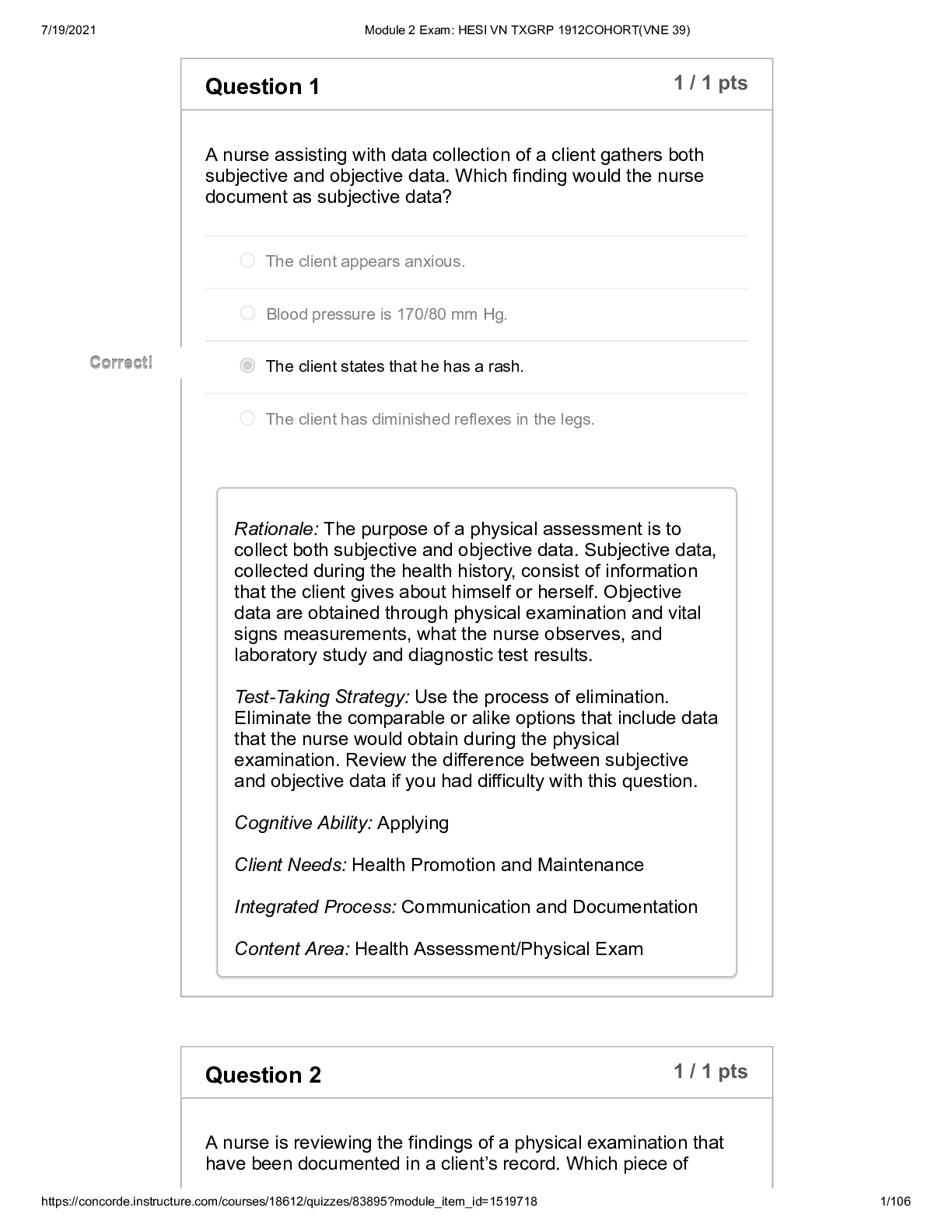



 Questions, Answers & Rationale, A+ Guide.png)
![Preview of eBook [PDF] Barash, Cullen, and Stoelting's Clinical Anesthesia 9th Edition By Bruce F. Cu](https://browseimages.nyc3.digitaloceanspaces.com/paper-images/2024/Aug/29/8DF2QRTq2024-08-29-10-3966d0259b7c4b5.png)
![Preview of eBook [PDF] Burns' Pediatric Primary Care 7th Edition BY Dawn Lee Garzon Maaks,, Nancy Bar](https://browseimages.nyc3.digitaloceanspaces.com/paper-images/2024/Aug/26/WR2rowXX2024-08-26-02-0966cc625bea839.png)


![Preview of eBook [PDF] AACN Essentials of Progressive Care Nursing 5th Edition By Sarah A. Delgado](https://browseimages.nyc3.digitaloceanspaces.com/paper-images/2024/Aug/29/ipbdJSTN2024-08-29-11-1466d02df30fc96.png)
![Preview of [eTextbook] [PDF] Labor Economics 9th Edition By George Borjas](https://browseimages.nyc3.digitaloceanspaces.com/paper-images/2025/Jan/13/JcsHZtUb2025-01-13-07-42678542822cb77.png)


.png)



.png)