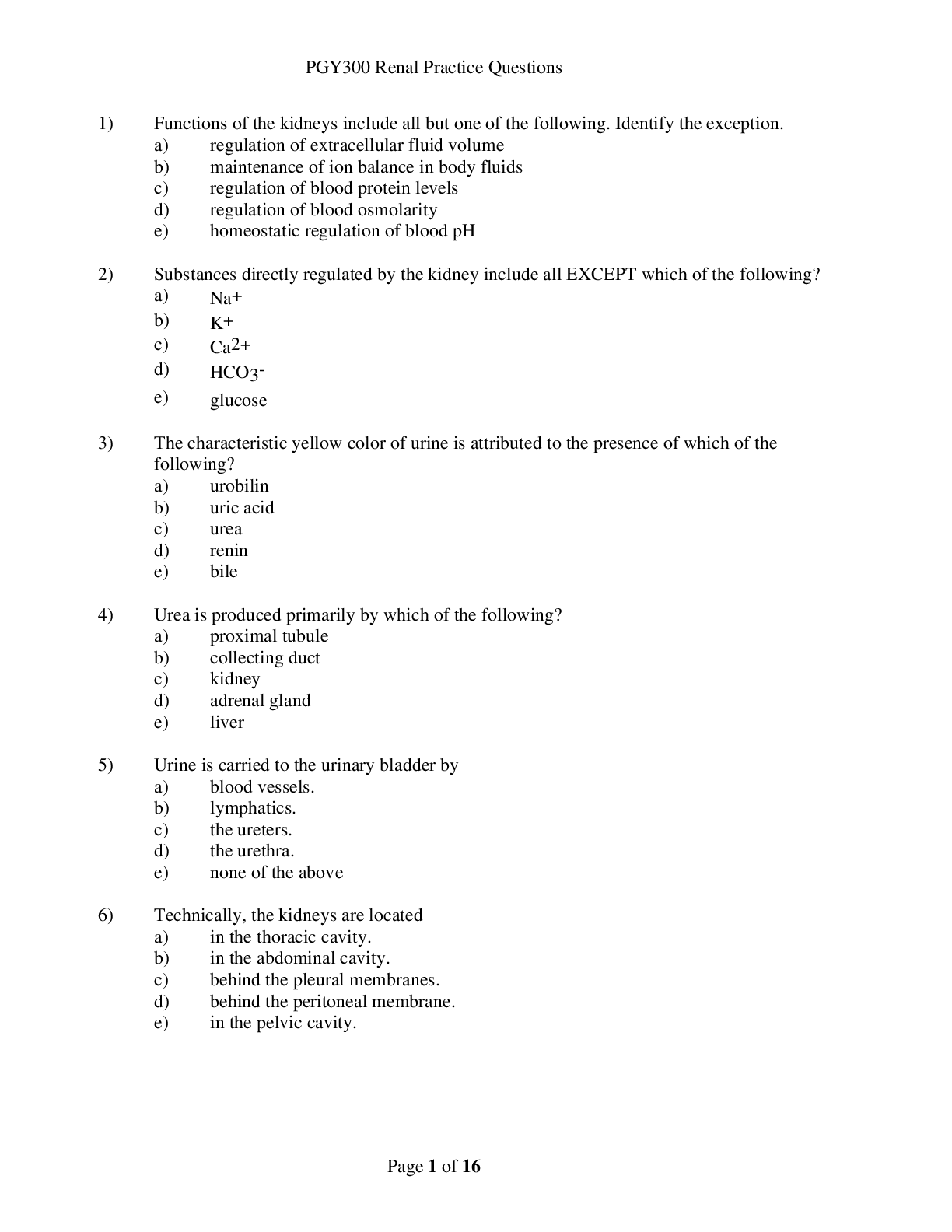
PGY300 Renal Practice Questions
Page 1 of 16
1) Functions of the kidneys include all but one of the following. Identify the exception.
a) regulation of extracellular fluid volume
b) maintenance of ion balance in body
...
PGY300 Renal Practice Questions
Page 1 of 16
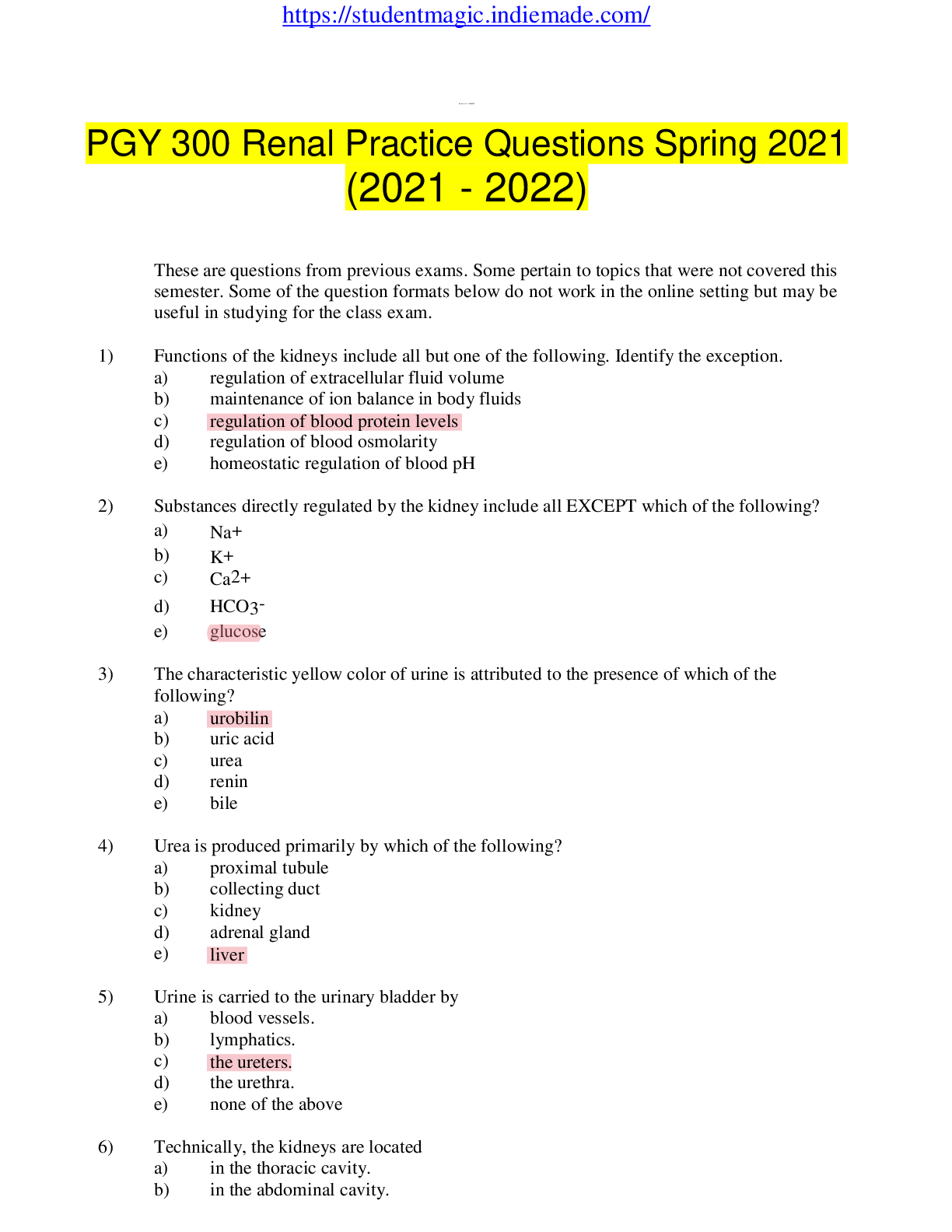
1) Functions of the kidneys include all but one of the following. Identify the exception.
a) regulation of extracellular fluid volume
b) maintenance of ion balance in body fluids
c) regulation of blood protein levels
d) regulation of blood osmolarity
e) homeostatic regulation of blood pH
2) Substances directly regulated by the kidney include all EXCEPT which of the following?
a) Na+
b) K+
c) Ca2+
d) HCO3
-
e) glucose
3) The characteristic yellow color of urine is attributed to the presence of which of the
following?
a) urobilin
b) uric acid
c) urea
d) renin
e) bile
4) Urea is produced primarily by which of the following?
a) proximal tubule
b) collecting duct
c) kidney
d) adrenal gland
e) liver
5) Urine is carried to the urinary bladder by
a) blood vessels.
b) lymphatics.
c) the ureters.
d) the urethra.
e) none of the above
6) Technically, the kidneys are located
a) in the thoracic cavity.
b) in the abdominal cavity.
c) behind the pleural membranes.
d) behind the peritoneal membrane.
e) in the pelvic cavity.
PGY300 Renal Practice Questions
Page 2 of 16
7) Blood flow through the kidney includes a feature seen in only a few organs. What is it?
a) portal system
b) arterial shunts
c) vascular sinuses
d) veins containing highly oxygenated blood
e) anastomoses
8) Which structure is NOT part of the blood circulation through the kidney?
a) vasa recta
b) loop of Henle
c) glomerulus
d) renal corpuscle
9) Which statement is NOT true?
a) The blood supply to the kidneys comes through the renal arteries.
b) As much as one fourth of the cardiac output may flow to the kidneys at any given
moment.
c) The kidneys do not reabsorb filtered waste products.
d) The urinary bladder is filled by two ducts, called ureters, and emptied by the single
urethra.
e) Women are more likely to develop urinary tract infections than men.
10) The Bowman's capsule and glomerulus make up the
a) renal pyramid.
b) loop of Henle.
c) renal corpuscle.
d) renal papilla.
e) collecting system.
11) A glomerulus is
a) the expanded end of a nephron.
b) a "knot" of capillaries that lies within the Bowman's capsule.
c) the portion of the nephron closest to the renal corpuscle.
d) the portion of the nephron that attaches to the collecting duct.
e) the hairpin-shaped segment of the nephron.
12) The portion of the nephron closest to the renal corpuscle is the ___________
a) loop of Henle.
b) proximal tubule.
c) distal tubule.
d) collecting duct.
e) minor calyx.
PGY300 Renal Practice Questions
Page 3 of 16
13) The portion of the nephron that precedes the collecting duct is the __________ .
a) loop of Henle
b) proximal tubule
c) distal tubule
d) renal pelvis
e) minor calyx
14) The hairpin-shaped segment of the nephron is the ___________
a) loop of Henle.
b) proximal tubule.
c) distal tubule.
d) vasa recta.
e) minor calyx.
15) The process of filtration in the kidney is most accurately described as
a) highly specific.
b) completely nonspecific.
c) relatively nonspecific.
16) The filtration fraction of a normal kidney is approximately __________ of the renal plasma
flow.
a) 4/5
b) 1/5
c) 3/4
d) 1/2
e) 90%
17) In normal kidneys, blood cells and plasma proteins are
a) filtered then reabsorbed.
b) secreted then reabsorbed.
c) not filtered.
d) filtered and secreted.
18) Which is NOT a kidney filtration barrier?
a) glomerular capillary endothelium
b) basal lamina
c) podocyte foot process
d) juxtaglomerular apparatus
19) The major force for glomerular filtration is the
a) blood pressure in the glomerular capillaries.
b) oncotic pressure in the glomerular capillaries.
c) hydrostatic pressure of the filtrate.
d) reabsorption in the nephron.
e) none of the above
PGY300 Renal Practice Questions
Page 4 of 16
20) Which of the following would be the most important function of the proximal tubule?
a) filtration
b) reabsorption of ions, organic molecules, and water
c) excretion of acids and ammonia
d) secretion of drugs
e) adjusting the urine volume
21) Glucose and amino acids are reabsorbed by which of the following?
a) diffusion
b) sodium coupled symporter
c) facilitated diffusion
d) sodium coupled antiporter
e) sodium channel
22) Which of the following statements about autoregulation is NOT true?
a) Myogenic response is the intrinsic ability of vascular smooth muscle to respond to
pressure changes.
b) Myogenic response is a paracrine signaling mechanism.
c) In tubuloglomerular feedback, adenosine is released by the macula densa, resulting
in depolarization of smooth muscle cells.
d) In the myogenic response, the macula densa cells send a paracrine message to the
neighboring afferent arteriole.
e) b and d
Match each step in urine formation to its description.
(a) excretion
(b) filtration
(c) reabsorption
(d) secretion
23) movement from the nephron lumen to the external environment
24) movement from the nephron lumen to the blood
25) movement from the glomerulus to the nephron lumen
26) movement from the peritubular capillaries to the nephron lumen
PGY300 Renal Practice Questions
Page 5 of 16
Match each substance with its primary mode of transport across the kidney epithelium.
(a) transcytosis
(b) active transport
(c) symport with a cation
(d) passive reabsorption/diffusion
27) sodium
28) glucose
29) urea
30) small plasma proteins
Match the following terms to one of the next five questions.
a) filtration fraction
b) urethra
c) GFR or glomerular filtration rate
d) renal threshold
e) urinary bladder
31) After it is formed, urine is temporarily stored in the __________.
32) Urine is carried to the external environment by the __________.
33) The plasma concentration at which all of the renal carriers for a given substance are
saturated is the __________.
34) The amount of filtrate entering the proximal tubules of the kidneys each minute is the
__________.
35) The percentage of total plasma volume that is filtered is called the __________.
PGY300 Renal Practice Questions
Page 6 of 16
Match the following terms to one of the next five questions.
a) renal arteries, abdominal aorta
b) cortex, juxtamedullary, medulla
c) tubuloglomerular feedback
d) vasa recta
e) renal veins, inferior vena cava
36) When fluid flow through the distal tubule increases as a result of increased GFR, the
macula densa cells send a chemical message to the neighboring afferent arteriole. The
afferent arteriole constricts, increasing resistance and decreasing GFR. This type of
autoregulation involving both the kidney tubule and the arteriole is known as __________.
37) The __________ branch off the __________ and supply blood to the kidneys.
38) The __________ carry blood from the kidneys back to the __________.
39) Eighty percent of the nephrons in a kidney are contained within the __________, but the
other 20%, called the __________ nephrons, dip down into the __________.
40) The __________ are the long peritubular capillaries that dip into the medulla.
Match the following terms to one of the next five questions.
a) sympathetic neurons, alpha, vasoconstriction
b) glucosuria or glycosuria
c) mesangial cells
d) podocytes; foot processes
e) Bowman's capsule
41) The nephron begins with a hollow, ball-like structure called __________.
42) The __________ lie between and around the glomerular capillaries.
43) The specialized cells found in the capsule epithelium are called __________. These cells
have long cytoplasmic extensions called __________.
44) Neural control of GFR is mediated by __________ that innervate __________ receptors on
vascular smooth muscle causing __________.
45) The excretion of glucose in the urine is called __________.
PGY300 Renal Practice Questions
Page 7 of 16
46) Place the following blood vessels that carry blood to and within the kidney in the order in
which blood passes through them.
1. afferent arteriole
2. efferent arteriole
3. glomerulus
4. peritubular capillary
a) 4, 2, 3, 1
b) 1, 3, 2, 4
c) 4, 3, 2, 1
d) 1, 2, 3, 4
e) 3, 4, 2, 1
47) When the clearance of a substance exceeds inulin clearance, then ____________ must be
greater than ______________.
a) reabsorption, secretion
b) secretion, excretion
c) secretion, reabsorption
d) none of the above
48) Damage to the renal medulla would interfere first with the functioning of the
a) Bowman's capsule.
b) distal tubule.
c) collecting ducts.
d) proximal tubule.
e) glomerulus.
49) An obstruction in a glomerulus would affect first the flow of blood into
a) the renal artery.
b) the efferent arteriole.
c) the afferent arteriole.
d) the renal vein.
e) none of the above.
50) If blood flow through the afferent arterioles increases,
a) stretch reflexes trigger vasoconstriction to reduce the flow.
b) the smooth muscle in the vessel walls stretches to accommodate the increased flow.
c) the stretch triggers further relaxation of the arteriolar wall, lessening blood pressure.
d) B and C
51) Urea is
a) actively secreted in the distal tubule.
b) actively reabsorbed in the proximal tubule.
c) passively reabsorbed in the proximal tubule.
d) completely eliminated in the urine.
e) actively transported into the filtrate by the cells of the collecting duct.
PGY300 Renal Practice Questions
Page 8 of 16
52) Proximal tubular fluid has a Na+ concentration __________ the Na+ concentration inside
the cells of the tubule epithelium.
a) is much higher than
b) is slightly higher than
c) is about the same as
d) is slightly lower than
e) is much lower than
53) The typical pattern for molecules absorbed by Na+-dependent transport involves this: an
apical __________ and a basolateral __________.
a) facilitated diffusion carrier, osmotic gradient
b) symport protein, facilitated diffusion carrier
c) symport protein, osmotic gradient
d) osmotic gradient, symport protein
e) facilitated diffusion carrier, symport protein
54) One substance has no membrane transporters to move it but can diffuse freely through open
leak channels if there is a concentration gradient. Initially, this substance's concentrations
in the filtrate and extracellular fluid are equal. Later, however, the active transport of Na+
and other solutes creates a gradient by removing water from the lumen of the tubule where
it is located. What substance is this?
a) glucose
b) glycine
c) urea
d) A and B
e) A, B, and C
55) Measurements in a nephron reveal a glomerular hydraulic pressure of 69 mm Hg, and a
fluid pressure in the Bowman's capsule of 15 mm Hg. Assuming that the plasma osmotic
pressure is 30 mm Hg, and that essentially no plasma proteins are filtered by the
glomerulus, what is the net glomerular filtration pressure in this case?
a) -6 mm Hg
b) 24 mm Hg
c) 54 mm Hg
d) 84 mm Hg
e) 114 mm Hg
56) In a normal kidney, which of the following conditions would cause an increase in the
glomerular filtration rate (GFR)?
a) constriction of the afferent arteriole
b) a decrease in the hydraulic pressure of the glomerulus
c) an increase in the capsular hydraulic pressure
d) a decrease in the concentration of plasma proteins in the blood
e) a decrease in the net glomerular filtration pressure
PGY300 Renal Practice Questions
Page 9 of 16
57) A person with cirrhosis of the liver has lower than normal levels of plasma proteins and a
higher than normal GFR. Which of the following statements are true?
a) A decrease in plasma protein concentration would cause an increase in GFR.
b) The primary driving force for GFR is blood pressure, opposed by fluid pressure in
Bowman's capsule and the glomerular capillary oncotic pressure due to plasma
proteins.
c) If a person has fewer plasma proteins due to liver disease, the plasma will have a
lower oncotic pressure.
d) With less oncotic pressure opposing the GFR, GFR will increase.
e) All of the above.
58) Patrick's urine sample reveals a high concentration of glucose. Which of the following
statements are true?
a) Glucose is normally present in the urine and is not a concern.
b) Glucose transporters in the proximal tubule may not be functional.
c) Tubular fluid glucose concentration may be below the transport maximum for
glucose.
59) Trace a water molecule through the urinary system, beginning with the plasma in the renal
artery.
1) urethra
2) glomeruli
3) urinary bladder
4) afferent arterioles
5) nephrons
6) renal calyces
7) ureter
8) renal pelvis
9) collecting ducts
a) 4,2,5,9,6, 8,7,3,1
b) 2,4,5,9,8,6,3,7,1
c) 4,2,9,5,6,8,7,3,1
d) 2,4,9,5,6,8,3,7,1
e) 4,2,5,9,6,8,1,3,7
60) Which of the following “real” volumes plays the most important role in determining an
optimum effective circulating volume?
a) intracellular volume
b) interstitial volume
c) cerebral spinal fluid volume
d) transcellular volume
e) plasma volume
PGY300 Renal Practice Questions
Page 10 of 16
61) Which of the following fluid compartments has the smallest volume?
a) intracellular volume.
b) extracellular volume.
c) interstitial volume.
d) blood volume.
e) plasma volume.
62) What percentage of the body weight of a normal adult human is composed of water?
a) 30 %
b) 40 %
c) 60%
d) 75 %
e) There is no predictable relationship between body weight and body water.
63) Which of the following sensors will detect an increase in the vascular volume?
a) Osmoreceptors
b) Baroreceptors
c) ADH receptors
d) Aldosterone receptors
e) ANP receptors
64) Which of the following actions will result from a sustained increase in the mean arterial
pressure (MAP)?
a) release of antidiuretic hormone (ADH)
b) release of atrial naturetic peptide (ANP)
c) release of renin release
d) release of aldosterone
e) decrease in sodium excretion
65) Which of the following occur immediately after severe hemorrhage?
a) The arterial blood pressure will go up.
b) The blood pressure proximal to the afferent arteriole will go up.
c) Renin release will increase.
d) The activity of angiotensin II will decrease.
66) The antidiuretic hormone is released from which of the following locations?
a) The carotid bodies.
b) The right atrium of the heart.
c) The posterior pituitary.
d) The cerebral cortex.
e) The adrenal glands.
67. Which of the following is correct?
a) Excretion = Filtration + Reabsorption + Secretion
b) Excretion = Filtration + Reabsorption – Secretion
c) Excretion = Filtration – Reabsorption – Secretion
d) Excretion = Filtration – Reabsorption + Secretion
e) Filtration = Reabsorption – Secretion – Excretion
PGY300 Renal Practice Questions
Page 11 of 16
68. Approximately _____ of total body water is contained in the extracellular fluid compartment. The
remaining _____ of total body water is contained in the intracellular fluid compartment. The extracellular
fluid compartment is subdivided into the plasma and interstitial compartments in a ______ to
______ratio.
a) 2/3, 1/3, 1/4, 3/4
b) 1/3, 3/4, 1/4, 2/3
c) 1/3, 2/3, 1/4, 3/4
d) 3/4, 1/4, 1/3, 2/3
e) 1/4, 3/4, 2/3, 1/3
69. The effective circulating blood volume (ECBV) has its greatest effect on ____________.
a) Tissue perfusion
b) Total body water
c) Total body weight
d) Interstitial fluid volume
e) Extracellular fluid volume
70. On average, the percentage of body weight contributed by body water is _______ in females as
compared to males due to the larger amount of ________ tissue in females.
a) Larger, adipose
b) Larger, muscle
c) Smaller, adipose
d) Smaller, muscle
e) None of the above are correct.
71. The assessment of ______by the kidney can be determined by measuring the clearance of ______?
a) Renal plasma flow, inulin
b) Renal blood flow, inulin
c) Tubular metabolism, para-aminohippurate
d) Glomerular filtration rate, para-aminohippurate
e) Glomerular filtration rate, inulin
72. A decrease in the effective circulating blood volume is first detected by _________.
a) Osmoreceptors
b) Baroreceptors
c) Chemoreceptors
d) Vasoreceptors
e) Renal V-2 receptors
73. Liver failure will lead to the loss of production of plasma proteins, which will ________ net filtration
pressure due to the ____________ in oncotic pressure.
a) Increase, decrease
b) Increase, increase
c) Decrease, increase
d) Decrease, decrease
e) Not change, increase
74. Glucose is reabsorbed at the lumen-facing membrane of the __________ by _________ active
transport.
a) Proximal tubule, primary
b) Distal tubule, primary
c) Loop of Henle, secondary
d) Distal tubule, secondary
e) Proximal tubule, secondary
PGY300 Renal Practice Questions
Page 12 of 16
75. As blood passes along the glomerular capillaries from the afferent arteriole to the efferent arteriole, the
oncotic pressure of the plasma in the glomerular capillaries______________.
a) Remains constant
b) Decreases
c) First decreases, reaches a minimum halfway along the glomerular capillary, then increases.
d) First increase, reaches a maximum halfway along the glomerular capillary, then decreases
e) Increases
76. The human body contains many salts, of which sodium chloride is the major one, making up around 0.4
per cent of the body’s weight at a concentration around 140 millimoles/liter. Most of the sodium is found
in the _______________.
a) Plasma
b) Intracellular fluid
c) Extracellular fluid
d) Blood
e) Interstitial fluid
77. The renal system is responsible for regulating the excretion of sodium from the body. The primary
hormone responsible for this action is __________ and its primary nephron target is ____________.
a) Vasopressin, Henle’s loop
b) Vasopressin, proximal tubule
c) Angiotensin converting enzyme, collecting duct
d) Aldosterone, collecting duct
e) Aldosterone, proximal tubule
78. The antidiuretic hormone is released from which of the following locations?
a) Adrenal gland
b) Pituitary
c) Pinal gland
d) Afferent arteriole
e) Efferent arteriole
79. Changing the relative resistances of the afferent and efferent arterioles is an important mechanism of
controlling renal plasma flow (RPF) and glomerular filtration rate (GFR). If the resistance of the afferent
arteriole is made to be ______ than that of the efferent arteriole, then the RPF will ________and GFR
______________. Assume the efferent arteriole resistance does not change.
a) more, decrease, increase
b) less, increase, increase
c) less, increase, decrease
d) less, decrease, increase
e) more, increase, decrease
80. Tubuloglomerular feedback (TGF) is an important renal mechanism that _____________.
a) adjusts tubular filtration to match tubular secretion capacity
b) regulates tubular reabsorption capacity to match glomerular filtration
c) Involves the hypothalamic-pituitary-renal-neuro-endocrine system
d) adjusts tubular filtration to match tubular reabsorption capacity
e) adjust tubular secretion to match tubular reabsorption capacity
81. The normal amount of glucose in urine should be between 0 - 0.8 millimoles / liter. A diabetic that is not
under good control may have values much higher than the normal. Which of the following statements
best explain the higher levels of glucose in the urine of these patients?
a) It is a result of hypoglycemia.
b) It occurs when there is too much sugar in the diet.
c) Gluconeogenesis by the diabetic proximal tubule will increase glucose excretion.
d) The transport maximum of the proximal tubule has been exceeded.
e) The diabetic proximal tubule is secreting too much glucose.
PGY300 Renal Practice Questions
Page 13 of 16
82. The reabsorption (conservation) of filtered bicarbonate occurs mainly in the __________ by
____________.
a) Proximal tubule, hydrogen ion secretion
b) Proximal tubule, active transport of bicarbonate
c) Proximal tubule, endocytosis
d) Loop of Henle, diffusion through the paracellular pathway
e) Collecting duct, diffusion through the paracellular pathway
83. The plasma osmolality of a person who does not have access to water (e.g., someone lost in the
desert) would be expected to rise above the normal value. The first response to this change would be
________________.
a) Activation of osmoreceptors will increase ADH secretion.
b) Inhibition of osmoreceptors will increase ADH secretion.
c) Stimulation of chemoreceptors will decrease ADH secretion.
d) Inhibition of chemoreceptors will decrease ADH secretion.
e) Inhibition of osmoreceptors will increase aldosterone secretion.
84. Which of the following is NOT a function of the kidney?
a) Regulation of extracellular osmolality.
b) Regulation of acid-base balance.
c) Excretion of end products of muscle metabolism.’
d) Regulation of extracellular volume.
e) Synthesis of the antidiuretic hormone (ADH)
85. Which of the following factor(s) tend(s) to INCREASE glomerular filtration rate (GFR):
a) Decreased plasma protein concentration.
b) Vasodilation of the afferent arteriole.
c) Vasoconstriction of the efferent arteriole.
d) A and C only.
e) A, B, and C.
86. Which of the following cations is found in the greatest concentration within the intracellular
compartment?
a) Sodium ion
b) Calcium ion
c) Chloride ion
d) Potassium ion
e) Hydrogen ion
87. An increase in sympathetic nerve activity to the kidney most rapidly occurs following a/an
a) Increase in atrial natriuretic peptide excretion.
b) Increase in atrial natriuretic peptide secretion.
c) Decrease in the effective circulating blood volume.
d) Decrease in plasma osmolality.
e) None of the above are correct.
88. As tubular fluid flows past the macula densa, it next flows through which nephron segment?
a) Bowman’s space
b) Distal tubule
c) Proximal tubule
d) Loop of Henle
e) Collecting duct
PGY300 Renal Practice Questions
Page 14 of 16
89. If the clearance of substance "x" is less than the clearance of inulin, then "x" is most likely
a) Only filtered.
b) Filtered and reabsorbed
c) Filtered and secreted
d) Secreted only
e) Not filtered but secreted
90. Which of the following is the largest?
a) Total blood volume.
b) Intracellular volume.
c) Volume of urine produced in a day.
d) Volume of fluid reabsorbed by the loop of Henle each day.
e) Volume of fluid reabsorbed by the proximal tubule each day.
91. Filtration occurs in the _____, most reabsorption occurs in the _____, and urine is transported from the
kidney to the bladder in the ______.
a) Proximal tubule, distal tubule, urethra
b) Glomerulus, proximal tubule, ureter
c) Afferent arteriole, loop of Henle, urethra
d) Peritubular capillaries, vasa recta, ureter
e) None of these is correct
92. A major effect of the antidiuretic hormone (ADH) will be to ______________________.
a) increase the water permeability of the collecting duct.
b) decrease the water permeability of the collecting duct.
c) increase the water permeability of the proximal tubule.
d) decrease the water permeability of the proximal tubule.
e) none of the above are correct.
93. A normal human kidney can produce urine with a maximal urinary concentration of ______
milliosmoles/liter, which is _______ times the normal plasma osmolarity.
a) 600, 2
b) 1200, 4
c) 600, 4
d) 1200, 2
e) None of the above are correct.
94. Glomerular filtration takes place across a barrier made up of the
a) afferent arteriole, efferent arteriole, and Bowman’s capsule.
b) afferent arteriole, macula densa, and the distal tubule.
c) endothelium, basal lamina, and podocyte.
d) apical membrane, basolateral membrane, and the basement membrane.
e) afferent arteriole and efferent arteriole only.
95. Most of the filtered load of water is reabsorbed in the kidney by which nephron segment?
a) Proximal tubule
b) Thick ascending limb of Henle’s loop
c) Thin descending limb of Henle’s loop
d) Distal tubule
e) Collecting duct
PGY300 Renal Practice Questions
Page 15 of 16
96. In a healthy individual, all of the following will be found in Bowman’s space at normal plasma
concentrations EXCEPT:
a) water
b) sodium
c) chloride
d) protein.
e) glucose
97. The net glomerular filtration pressure is ____________ when the glomerular capillary hydraulic
pressure is 69 mmHg, the fluid pressure in the Bowman’s capsule is 15 mmHg, and the plasma oncotic
pressure is 30 mmHg. Assume that there is no filtration of plasma proteins by the glomerulus.
a) 114 mmHg
b) 84 mmHg
c) 54 mmHg
d) 24 mmHg
e) 12 mmHg
98. The vasa recta ___________________________________.
a) are the straight portion of the proximal tubule
b) extend from the efferent arterioles to the afferent arterioles
c) are the straight portion of the afferent arteriole
d) supporting cells of the macula densa
e) are the capillary bed found in the medulla of the kidney
99. What is the clearance of a substance when its concentration in the plasma is 10 mg/dl, its concentration
in the urine is 100 mg/dl, and the urine flow is 2 ml/min?
a) 2 ml/min
b) 10 ml/min
c) 20 ml/min
d) 100 ml/min
e) 200 ml/min
PGY300 Renal Practice Questions
Page 16 of 16
Answer Key
Hopefully this key is correct, but sometimes a typo sneaks in. Do not blindly memorize answers. This is not
meant to be a crib sheet. It is as important to know why a choice is WRONG as well as knowing the correct
[Show More]


![Preview of [eBook] [PDF] Clinical Nursing Calculations 3rd Edition By Susan Sienkiewicz, Sandra Meg](https://browseimages.nyc3.digitaloceanspaces.com/paper-images/2025/Jul/04/4jF14r9I2025-07-04-05-586867ec3011731.png)




.png)



.png)


