NR 328 2020 EVOLVE HESI RN PSYCHIATRIC-MENTAL HEALTH EXIT EXAM
HESI: Psychiatric-Mental Health Nursing 1
NR 328 2020 EVOLVE HESI RN
PSYCHIATRIC-MENTAL HEALTH EXIT
EXAM
1. A male client is admitted to the mental heal
...
NR 328 2020 EVOLVE HESI RN PSYCHIATRIC-MENTAL HEALTH EXIT EXAM
HESI: Psychiatric-Mental Health Nursing 1
NR 328 2020 EVOLVE HESI RN
PSYCHIATRIC-MENTAL HEALTH EXIT
EXAM
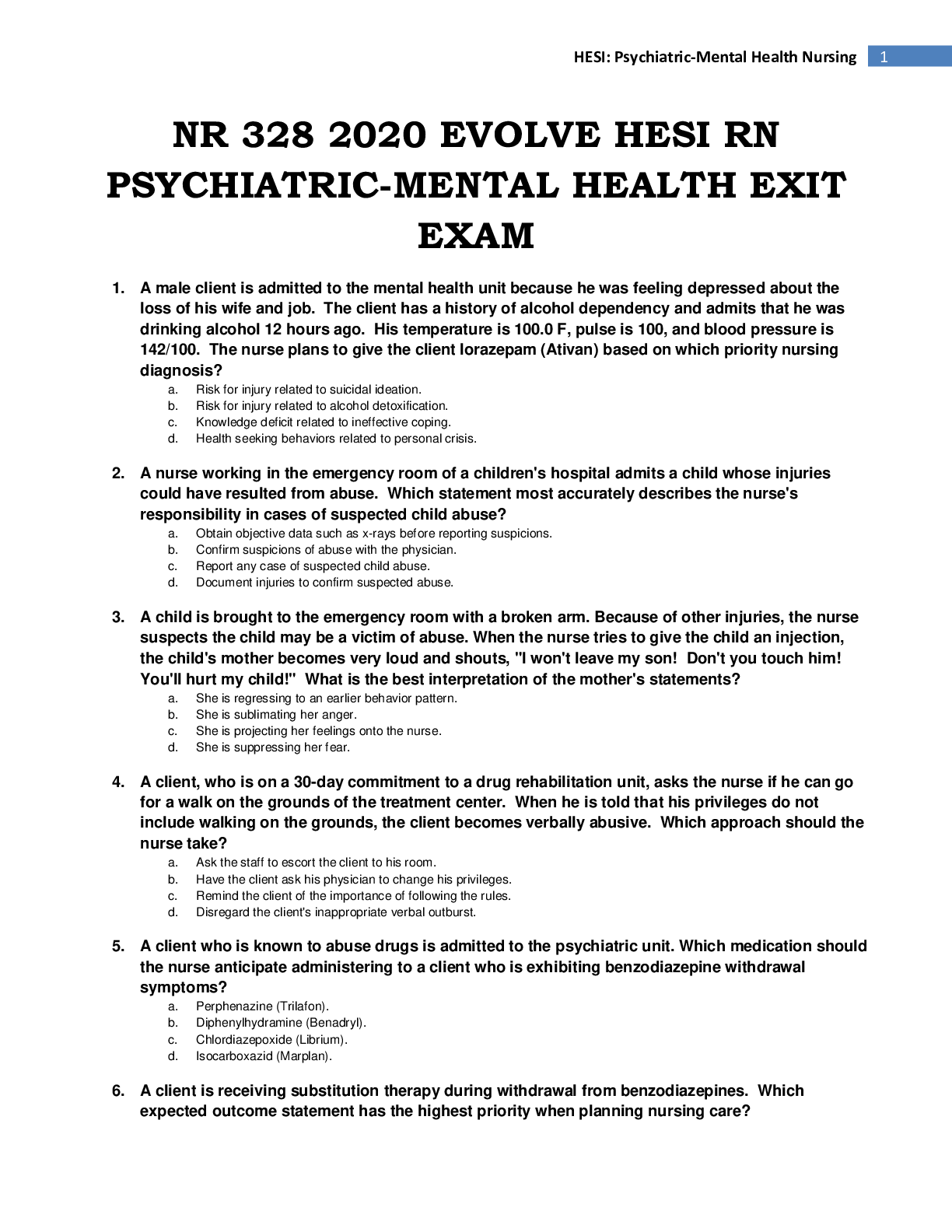
1. A male client is admitted to the mental health unit because he was feeling depressed about the
loss of his wife and job. The client has a history of alcohol dependency and admits that he was
drinking alcohol 12 hours ago. His temperature is 100.0 F, pulse is 100, and blood pressure is
142/100. The nurse plans to give the client lorazepam (Ativan) based on which priority nursing
diagnosis?
a. Risk for injury related to suicidal ideation.
b. Risk for injury related to alcohol detoxification.
c. Knowledge deficit related to ineffective coping.
d. Health seeking behaviors related to personal crisis.
2. A nurse working in the emergency room of a children's hospital admits a child whose injuries
could have resulted from abuse. Which statement most accurately describes the nurse's
responsibility in cases of suspected child abuse?
a. Obtain objective data such as x-rays before reporting suspicions.
b. Confirm suspicions of abuse with the physician.
c. Report any case of suspected child abuse.
d. Document injuries to confirm suspected abuse.
3. A child is brought to the emergency room with a broken arm. Because of other injuries, the nurse
suspects the child may be a victim of abuse. When the nurse tries to give the child an injection,
the child's mother becomes very loud and shouts, "I won't leave my son! Don't you touch him!
You'll hurt my child!" What is the best interpretation of the mother's statements?
a. She is regressing to an earlier behavior pattern.
b. She is sublimating her anger.
c. She is projecting her feelings onto the nurse.
d. She is suppressing her fear.
4. A client, who is on a 30-day commitment to a drug rehabilitation unit, asks the nurse if he can go
for a walk on the grounds of the treatment center. When he is told that his privileges do not
include walking on the grounds, the client becomes verbally abusive. Which approach should the
nurse take?
a. Ask the staff to escort the client to his room.
b. Have the client ask his physician to change his privileges.
c. Remind the client of the importance of following the rules.
d. Disregard the client's inappropriate verbal outburst.
5. A client who is known to abuse drugs is admitted to the psychiatric unit. Which medication should
the nurse anticipate administering to a client who is exhibiting benzodiazepine withdrawal
symptoms?
a. Perphenazine (Trilafon).
b. Diphenylhydramine (Benadryl).
c. Chlordiazepoxide (Librium).
d. Isocarboxazid (Marplan).
6. A client is receiving substitution therapy during withdrawal from benzodiazepines. Which
expected outcome statement has the highest priority when planning nursing care?HESI: Psychiatric-Mental Health Nursing 2
a. Client will not demonstrate cross addiction.
b. Co-dependent behaviors will be decreased.
c. Excessive CNS stimulation will be reduced.
d. Client's level of consciousness will increase.
7. A 45-year-old female client is admitted to the psychiatric unit for evaluation. Her husband states
that she has been reluctant to leave home for the last six months. The client has not gone to work
for a month and has been terminated from her job. She has not left the house since that time. This
client is displaying symptoms of which disorder?
a. Claustrophobia.
b. Acrophobia.
c. Agoraphobia.
d. Necrophobia.
8. A 19-year-old female client with a diagnosis of anorexia nervosa wants to help serve dinner trays
to other clients on a psychiatric unit. What action should the nurse take?
a. Encourage the client's self motivation by asking her to pass trays for the rest of the week.
b. Provide an additional challenge by asking the client to help feed the older clients.
c. Suggest another way for this client to participate in the unit's activities.
d. Tell the client that hospital guidelines allow only staff to pass the trays.
9. A female client with depression attends a group and states that she sometimes misses her
medication appointments because she feels very anxious about riding the bus. Which statement
is the nurse's best response?
a. "Can your case manager take you to your appointments?"
b. "Take your medication for anxiety before you ride the bus."
c. "Let's talk about what happens when you feel very anxious."
d. "What are some ways that you can cope with your anxiety?"
10. A woman brings her 48-year-old husband to the outpatient psychiatric unit and describes his
behavior to the admitting nurse. She states that he has been sleepwalking, cannot remember who
he is, and exhibits multiple personalities. The nurse knows that these behaviors are often
associated with which condition?
a. Dissociative disorder.
b. Obsessive-compulsive disorder.
c. Panic disorder.
d. Post-traumatic stress syndrome.
11. At the first meeting of a group of older adults at a day care center for the elderly, the nurse asks
one of the members what kinds of things she would like to do with the group. The older woman
shrugs her shoulders and says, "You tell me, you're the leader." What would be the best
response for the nurse to make?
a. "Yes, I am the leader today. Would you like to be the leader tomorrow?"
b. "Yes, I will be leading this group. What would you like to accomplish?"
c. "Yes, I have been assigned to lead this group. I will be here for the next six weeks."
d. "Yes, I am the leader. You seem angry about not being the leader yourself."
12. Over a period of several weeks, one male client participant of a socialization group at a
community day care center for the elderly monopolizes most of the group's time and interrupts
others when they are talking. What is the best action for the nurse to take in this situation?
a. Talk to the client outside the group about his behavior.
b. Ask the client to give others a chance to talk.
c. Allow the group to handle the problem.HESI: Psychiatric-Mental Health Nursing 3
d. Ask the client to join another group.
13. A client in the critical care unit who has been oriented suddenly becomes disoriented and fearful.
Assessment of vital signs and other physical parameters reveal no significant changes, and the
nurse formulates the diagnosis: "Confusion related to ICU psychosis." Which intervention is
best to implement based on this client's behavior?
a. Move all machines away from the client's bedside at once.
b. Allay fears by teaching the client about disease etiology.
c. Cluster care to allow for brief rest periods during the day.
d. Encourage visitation by the client's family members.
14. A client on the psychiatric unit appears to imitate a certain nurse on the unit. The client seeks out
this particular nurse and imitates her mannerisms. Which defense mechanism does the nurse
recognize in this client?
a. Sublimation.
b. Identification.
c. Introjection.
d. Repression.
15. A nurse working on a mental health unit receives a community call from a person who is tearful
and states, "I just feel so nervous all of the time. I don't know what to do about my problems. I
haven't been able to sleep at night and have hardly eaten for the past 3 to 4 days." The nurse
should initiate a referral based on which assessment?
a. Altered thought processes.
b. Moderate levels of anxiety.
c. Inadequate social support.
d. Altered health maintenance.
16. An anxious client expressing a fear of people and open places is admitted to the psychiatric unit.
What is the most effective way for the nurse to assist this client?
a. Plan an outing within the first week of admission.
b. Distract her whenever she expresses her discomfort about being with others.
c. Confront her fears and discuss the possible causes of these fears.
d. Accompany her outside for an increasing amount of time each day.
17. Within several days of hospitalization, a client is repeatedly washing the top of the same table.
Which initial intervention is best for the nurse to implement to help the client cope with anxiety
related to this behavior?
a. Administer a prescribed PRN anti-anxiety medication.
b. Assist the client to identify stimuli that precipitates the ritualistic activity.
c. Allow time for the ritualistic behavior, then redirect the client to other activities.
d. Teach the client relaxation and thought stopping techniques.
18. The nurse is planning to initiate a socialization group for older residents of a long-term facility.
Which information would be most useful to the nurse when planning activities for the group?
a. Each resident's length of stay at this nursing home.
b. A brief description of each resident's family life.
c. The age and medication regimen of each group member.
d. The usual activity patterns of each group member.
19. Which ego-defense mechanisms are exhibited by a client with a phobia related to refusal to leave
home?HESI: Psychiatric-Mental Health Nursing 4
a. Denial.
b. Symbolization.
c. Fantasy.
d. Intellectualization.
20. A client who has been admitted to the psychiatric unit tells the nurse, "My problems are so bad.
No one can help me." Which response would be best for the nurse to make?
a. "How can I help you? Tell me more about your problems."
b. "Things probably aren't as bad as they seem right now."
c. "Let's talk about what is right with your life."
d. "I hear your misery, but things will get better soon."
21. A 22-year-old male client is admitted to the emergency center following a suicide attempt. His
records reveal that this is his third suicide attempt in the past two years. He is conscious, but
does not respond to verbal commands for treatment. Which assessment finding should prompt
the nurse to prepare the client for gastric lavage?
a. He ingested the drug 3 hours prior to admission to the emergency center.
b. The family reports that he took an entire bottle of acetaminophen (Tylenol).
c. He is unresponsive to instructions and is unable to cooperate with emetic therapy.
d. Those with repeated suicide attempts desire punishment to relieve their guilt.
22. A 68-year-old retired secretary is admitted to the psychiatric inpatient unit with a diagnosis of
major depression. The initial nursing care plan includes the goal, "Assist client to express
feelings of guilt." What is true about the goal statement referring to the client's depression?
a. Implementation of this goal should be deferred until further data can be gathered.
b. The depression is most likely age-related and will dissipate once she becomes accustomed to retirement.
c. Depressed clients are often unaware of guilt feelings, and should be encouraged to increase self-awareness.
d. Nursing goals should be approved by the treatment team before they are initiated.
23. The nurse is planning care for a 32-year-old male client diagnosed with HIV infection who has a
history of chronic depression. Recently, the client's viral load has begun to increase rather than
decrease despite his adherence to the HIV drug regimen. What should the nurse do first while
taking the client's history upon admission to the hospital?
a. Determine if the client attends a support group weekly.
b. Hold all anti-depressant medications until further notice.
c. Ask the client if he takes St. John's Wort routinely.
d. Have the client describe any recent changes in mood.
24. The nurse admits a client with depression to the mental health unit. The client reports difficulty
concentrating, losing 10 pounds in two weeks, and sleeping 12 hours a day. Which outcome is
most important for the client to meet by discharge?
a. Tries to interact with a few peers and staff.
b. Reports feeling better and less depressed.
c. Sits attentively with peers in group therapy.
d. Easily awakens for morning medications.
25. Which diet selection by a depressed client taking tranylcypromine sulfate (Parnate), an MAO
inhibitor, indicates to the nurse that the client understands the dietary restrictions imposed by
this medication regimen?
a. Hamburger, french fries, and chocolate milkshake.
b. Liver and onions, broccoli, and decaffeinated coffee.
c. Pepperoni and cheese pizza, tossed salad, and soda.
d. Roast beef, baked potato with butter, and iced tea.HESI: Psychiatric-Mental Health Nursing 5
26. A 72-year-old female is admitted to the psychiatric unit with a medical diagnosis of major
depression. Which statement by the client would be of greatest concern to the nurse and would
require further assessment?
a. "I think my cat is going to die."
b. "I don't feel like eating this morning."
c. "I just went to my friend's funeral."
d. "Don't you have more important things to do?"
27. A 33-year-old is admitted to a Psychiatric facility with a medical diagnosis of major depression.
When the nurse is assigning the client to a room, which roommate is best for this client?
a. A 35-year-old who recently attempted suicide.
b. A manic client who has started lithium carbonate treatment.
c. A client who is bipolar and is pacing the floor telling jokes to everyone.
d. A paranoid client who believes that the staff is trying to poison the food.
28. A client is admitted with a diagnosis of depression. The nurse knows that which characteristic is
most indicative of depression?
a. Grandiose ideation.
b. Self-destructive thoughts.
c. Suspiciousness of others.
d. Negative views of self.
29. A 22-year-old female is admitted to the psychiatric unit from the medical unit following a suicide
attempt with an overdose of diazepam (Valium). When developing the nursing care plan for this
client, what intervention would be most important to include?
a. Assist the client to focus on her strengths.
b. Set limits on the client's self-defacing comments.
c. Remind the client of daily activities in the milieu.
d. Assist the client to identify why she was self-destructive.
30. A female client in an acute care facility has been on antipsychotic medications for the past three
days. Her psychotic behaviors have decreased and she has had no adverse reactions. On the
fourth day, the client's blood pressure increases, she becomes pale and febrile, and demonstrates
muscular rigidity. What action should the nurse initiate?
a. Place the client on seizure precautions and monitor frequently.
b. Take the client's vital signs and notify the physician immediately.
c. Describe the symptoms to the charge nurse and document them in the client's record.
d. No action is required at this time as these are known side effects of her medications.
31. A 27-year-old female is admitted to the psychiatric hospital with a diagnosis of bipolar disorder,
manic phase. She is demanding and active. What intervention should the nurse include in this
client's plan of care?
a. Schedule the client to attend various group activities.
b. Reinforce the client's ability to make her own decisions.
c. Encourage the client to identify feelings of anger.
d. Provide a structured environment with little stimuli.
32. A manic depressive male client on the psychiatric unit becomes loud, and shouts at one of the
nurses, "You fat tub of lard, get something done around here." What is the best initial action for
the nurse to take?
a. Have the staff escort the client to his room.
b. Tell the client that his behavior will be recorded in his record.
c. Redirect the client by asking him to play card games with peers.
d. Review the medication record for an antipsychotic drug.HESI: Psychiatric-Mental Health Nursing 6
33. A 45-year-old male client tells the nurse that he used to believe that he was Jesus Christ, but now
he knows he is not. Which response is best for the nurse to make?
a. "Did you really believe you were Jesus Christ?"
b. "I think you're getting well."
c. "Others have had similar thoughts when under stress."
d. "Why did you think you were Jesus Christ?"
34. A 38-year-old woman is admitted with a diagnosis of paranoid schizophrenia. When her tray is
brought to her room, she refuses to eat and tells the nurse, "I know you are trying to poison me
with that food." What response by the nurse is the most therapeutic?
a. "I'll leave your tray here; I am available if you need anything else."
b. "You're not being poisoned. Why do you think someone is trying to poison you?"
c. "No one on this unit has ever died from poisoning. You're safe here."
d. "I will talk to your physician about the possibility of changing your diet."
35. A 35-year-old male client admitted to the psychiatric unit of an acute care hospital tells the nurse
that he believes someone is trying to poison him. The client's delusions are most likely related to
which factor?
a. Authority issues in childhood.
b. Anger about being hospitalized.
c. Low self-esteem.
d. Phobia of food.
36. A 35-year-old male client who has been hospitalized for two weeks for paranoia complains
continuously to the staff that someone is trying to steal his clothing. What is the correct action for
the nurse to take based on this client's complaints?
a. Enroll the client in an exercise class to promote self-esteem.
b. Place a lock on the client's closet to deter any theft.
c. Promote extinction of the ideation by ignoring the client.
d. Explain to the client that these suspicions are false.
37. An 86-year-old female client with Alzheimer's disease is wandering the busy halls of the extended
care facility and asks the nurse, "Where should I stand for the parade?" Which response is best
for the nurse to provide?
a. "Anywhere you want to stand as long as you do not get hurt by those in the parade."
b. "You are confused because of all the activity in the hall. There is no parade."
c. "Let's go back to the activity room and see what is going on in there."
d. "Remember I told you that this is a nursing home and I am your nurse."
38. The nurse is planning discharge for a male client with schizophrenia. The client insists that he is
returning to his apartment, although the physician informed him that he will be moving to a
boarding home. What is the most important nursing diagnosis for discharge planning?
a. Ineffective denial related to situational anxiety.
b. Ineffective coping related to inadequate support.
c. Social isolation related to difficult interactions.
d. Self-care deficit related to cognitive impairment.
39. A client who is diagnosed as schizophrenic is admitted to the hospital. The nurse assesses the
client's mental status. Which assessment finding is most characteristic of a client with
schizophrenia?
a. Mood swings.
b. Extreme sadness.
c. Manipulative behavior.
d. Flat affect.HESI: Psychiatric-Mental Health Nursing 7
40. On admission, a highly anxious client is described as delusional. The nurse understands that
delusions are most likely to occur with which disorder?
a. Dissociative disorders.
b. Personality disorders.
c. Anxiety disorders.
d. Psychotic disorders.
41. A 25-year-old female client has been particularly restless and the nurse finds her trying to leave
the psychiatric unit. She tells the nurse, "Please let me go. I must leave because the secret police
are after me." What response is best for the nurse to make?
a. "No one is after you, you're safe here."
b. "You'll feel better after you have rested."
c. "I know you must feel lonely and frightened."
d. "Come with me to your room and I will sit with you."
42. A client who is being treated with lithium carbonate for manic depression begins to develop
diarrhea, vomiting, and drowsiness. What action should the nurse take?
a. Notify the physician immediately and force fluids.
b. Prior to giving the next dose, notify the physician of the symptoms.
c. Record the symptoms and continue medication as prescribed.
d. Hold the medication and refuse to administer additional amounts of the drug.
43. A male schizophrenic client, taking fluphenazine deconate (Prolixin deconate), is being
discharged in the morning. A repeat dose of medication is scheduled for 20 days after discharge.
The client tells the nurse that he is going on vacation and will return in 18 days. Which statement
by the client indicates a need for health teaching?
a. "I am going to have lots of time in the sun."
b. "While I am on vacation, I will not eat or drink anything that contains alcohol."
c. "I will notify the doctor if I have a sore throat or flu-like symptoms."
d. "I will continue to take my benzotropine mesylate (Congentin) every day."
44. An adult client with a medical diagnosis of substance abuse and schizophrenia was recently
switched from oral fluphenazine HCl (Prolixin) to IM fluphenazine decanoate (Prolixin Decanoate)
because of medication noncompliance. What is important to teach the client and family about this
change in medication regimen?
a. Long-acting medication is more effective than daily medication.
b. A client with substance abuse must not take any oral medications.
c. There will continue to be a risk of alcohol and drug interaction.
d. Support groups are only helpful for substance abuse treatment.
45. The nurse develops a plan of care for a client with symptoms of paranoia and psychosis. The
priority nursing diagnosis is "Impaired social interactions related to inability to trust." Which
intervention is most important for the nurse to implement?
a. Greet the client by first name during each social interaction.
b. Determine if the client is experiencing auditory hallucinations.
c. Introduce the client to peers on the unit as soon as possible.
d. Assign the client to a group about developing social skills.
46. The nurse is conducting discharge teaching for a client who has schizophrenia and plans to live
in a group home. Which statement is most indicative of the need for careful follow-up after
discharge?
a. "Crickets are a good source of protein."
b. "I have not heard any voices for a week."
c. "Only my belief in God can help me."
d. "Sometimes I have a hard time sitting still."HESI: Psychiatric-Mental Health Nursing 8
47. An 8-year-old child is seen in the clinic with a green vaginal discharge. What action is most
important for the nurse to implement?
a. Assess the child's blood pressure.
b. Counsel the child to wear cotton underwear.
c. Report as suspected child abuse.
d. Determine if the child takes bubble baths.
48. Clients are preparing to leave the mental health unit for an outdoor smoke break. A client on
constant observation cannot leave and becomes agitated and demands to smoke a cigarette.
What action should the nurse take first?
a. Remind the client to wear the nicoderm (nicotine) patch.
b. Determine if the client still needs constant observation.
c. Encourage the client to attend the smoking cessation group.
d. Explain that clients on constant observation cannot smoke.
49. The nurse collaborates with the nursing staff about the plan of care for a client who is very
depressed. What is the most important intervention to implement during the first 48 hours of
hospital admission?
a. Assign the client a case manager.
b. Document activities.
c. Maintain safety in the client's milieu.
d. Identify current psychosocial stresses.
50. The charge nurse collaborates with the nursing staff members about the plan of care for a client
who is depressed. What is the most important intervention to implement during the first 48 hours
after the client's admission to the unit?
a. Monitor appetite and observe intake at meals.
b. Maintain safety in the client's milieu.
c. Provide ongoing, supportive contact.
d. Encourage participation in activities.HESI: Psychiatric-Mental Health Nursing 9
ANSWERS and RATIONALES
1. B - The most important nursing diagnosis is related to alcohol detoxification (B) because the client
has elevated vital signs, a sign of alcohol detoxification. Maintaining client safety related to
suicidal ideation (A) should be addressed after giving the client Ativan for elevated vital signs
secondary to alcohol withdrawal. The client's knowledge deficit and health seeking behaviors (C
and D) can be addressed when immediate needs for safety are met.
2. C - It is the nurse's legal responsibility to report all suspected cases of child abuse (C), and
notifying the nurse manager or charge nurse starts the legal reporting process. (A, B, and D)
delay the first step in reporting the abuse.
3. C - Projection is attributing one's own thoughts, impulses, or behaviors onto another--it is the
mother who is probably harming the child and she is attributing her actions to the nurse (C). The
mother may be immature, but regression (A) is not the best description of her behavior.
Sublimation (B) is substituting a socially acceptable feeling for an unacceptable one. These are
not socially acceptable feelings. The mother may be suppressing her fear (D) by displaying anger,
but such an interpretation cannot be concluded from the data presented.
4. D - The client is trying to engage the nurse in a dispute. Ignoring the behavior (D) provides no
reinforcement for the inappropriate behavior. (A) is not necessary unless the client becomes a
physical threat to the nurse. It is inappropriate to delegate the situation to the physician (B) and is
not in keeping with good health team management. Consistent limits must be established and
enforced. (C) would subject the nurse to more verbal abuse. The client could use any response
as an excuse to attack the nurse once again.
5. C - Librium (C), an antianxiety drug, as well as other benzodiazepines, are used for benzodiazepine
withdrawal. (A) is an antipsychotic agent. (B) is an antihistamine and antianxiety drug. (D) is an
MAO inhibitor.
6. C - Substitution therapy with another CNS depressant is intended to decrease the excessive CNS
stimulation that can occur during benzodiazepine withdrawal (C). (A, B, and D) are all appropriate
outcome statements for the client described, but do not have the priority of (C).
7. C - Agoraphobia (C) is the fear of crowds or being in an open place. Claustrophobia (A) is the fear
of being in closed places. Acrophobia (B) is the fear of high places. Necrophobia is an abnormal
fear of death or bodies after death (D). A phobia is an unrealistic fear associated with severe
anxiety.
8. C - Clients with anorexia gain pleasure from providing others with food and watching them eat.
Such behaviors reinforce their perception of self-control. These clients should not be allowed to
plan or prepare food for unit activities and their desires to do so should be redirected (C). (A and
B) are contraindicated for a client with anorexia nervosa. (D) avoids addressing the problem, so it
is best to suggest another activity for the client.HESI: Psychiatric-Mental Health Nursing 10
9. D - The best response is to explore ways for the client to cope with anxiety (D). The nurse should
encourage problem-solving rather than dependence on the case manager (A) for transportation.
Strategies for coping with anxiety should be encouraged before suggesting medication (B).
Talking about anxious feelings (C) is therapeutic, but the best response is an open-ended
question to explore ways to cope with the anxiety.
10. A - Sleepwalking, amnesia, and multiple personalities are examples of detaching emotional
conflict from one's consciousness (A). (B) is characterized by persistent, recurrent intrusive
thoughts or urges (obsessions) that are unwilled and cannot be ignored, and provoke impulsive
acts (compulsions) such as handwashing. Panic (C) is an acute attack of anxiety characterized by
personality disorganization. (D) is re-experiencing a psychologically terrifying or distressing
event that is outside the usual range of human experience, such as war, rape, etc.
11. B - Anxiety over participation in a group and testing of the leader characteristically occur in the
initial phase of group dynamics. (B) provides information and refocuses the group to defining its
function. (A) is manipulative bargaining. (C) does not focus the group on its purpose or task. (D)
is interpreting the client's feelings and is almost challenging.
12. C - After several weeks, the group is in the working phase and the group members should be
allowed to determine the direction of the group. The nurse should ignore the client's comments
and allow the group to handle the situation (C). A good leader should not have separate meetings
with group members (A), as such behavior is manipulative on the part of the leader. (B) is
dictatorial and is not in keeping with good leadership skills. (D) is avoiding the problem.
Remember, identify what phase the group is in--initial, working, or termination--as an aid to
determining expected communication style.
13. C - The critical care unit contains many life-saving treatment modalities that offer clients an array
of auditory, visual, and even painful stimuli. These stressers can result in isolation and
confusion. The best intervention is to provide the client with rest periods (C). Removing
machinery (A) is not practical because the client may not survive without it. The client is too ill to
receive an in-depth overview of his disease process (B). Although family members' presence (D)
may be supportive, young children are routinely prohibited from critical care units due to
increased risk of infectious disease transmission.
14. B - Identification (B) is an attempt to be like someone or emulate the personality traits of another.
Sublimation (A) is substituting an unacceptable feeling for one that is more socially acceptable.
Introjection (C) is incorporating the values or qualities of an admired person or group into one's
own ego structure. Repression (D) is the involuntary exclusion of painful thoughts or memories
from one's awareness.
15. B - The nurse should initiate a referral based on anxiety levels (B) and feelings of nervousness
that interfere with sleep, appetite, and the inability to solve problems. The client does not report
symptoms of altered thoughts (A) or evidence of inadequate social support (C). There is not
enough information to initiate a referral based on altered health maintenance (D).HESI: Psychiatric-Mental Health Nursing 11
16. D - The process of gradual desensitization by controlled exposure to the situation which is feared
(D), is the treatment of choice in phobic reactions. (A and C) are far too aggressive for the initial
treatment period and could even be considered hostile. (B) promotes denial of the problem, and
gives the client the message that discussion of the phobia is not permitted.
17. C - Initially, the nurse should allow time for the ritual (C) to prevent anxiety. Administering a
prescribed antianxiety medication (A) may help reduce the client's anxiety, but will not prevent
ritualistic behavior resulting from the client's ineffective coping ability. (B) is a long-term goal of
individual therapy, but is not directly related to controlling the behavior at this time. Thought
stopping and relaxation (D) are techniques that can be used to assist the client in learning new
ways of interrupting obsessive thoughts and resulting ritualistic behavior.
18. D - An older person's level of activity (D) is a determining factor in adjustment to aging as
described by the Activity Theory of Aging. All information described in (A, B, and C) might be
useful to the nurse, but is not as helpful during the initiation of the socialization group. The most
useful initial information would be an assessment of each individual's adjustment to the aging
process.
19. B - Symbolization (B) allows external objects to carry the internal emotional feeling through some
act such as refusing to leave a "safe" harbor. Denial (A) is the unconscious failure to
acknowledge an event, thought, or feeling. Fantasy (C) is pretending, usually of a more desirable
situation. Intellectualization (D) is using reason to avoid emotional conflicts.
20. A - Offering self shows empathy and caring (A), and offers the client the opportunity to talk while
the nurse listens. (B) dismisses the client's perception that things are really bad, and potentially
shuts down further communication with the client. (C) avoids the client's problems and promotes
denial. "I hear your misery" (D) is an example of reflective dialogue and would be the best choice
if it were not for the rest of the sentence--"but things will get better soon," which offers false
reassurance.
21. C - Because the client is unable to follow instructions, emetic therapy would be very difficult to
implement and gastric lavage would be necessary (C). (A and B) should be considered in
determining the course of treatment, but they are not the basis for determining if gastric lavage
will be implemented. Medical treatments should never be used as "punitive" measures (D).
22. C - Depression is associated with feelings of guilt, and clients are often not aware of these feelings
(C). Awareness is the first step in dealing with guilt (or any other feeling), so the nurse's efforts
should be directed toward increasing the client's awareness of feelings. Although a goal may be
changed based on an evaluation of interventions to meet the goal, a goal should never be
"ignored" (A). (B) dismisses the client's symptoms as "age-related." Setting goals for the nursing
care plan is a function of the nurse (D), although the nurse can collaborate with the treatment
team.
23. C - St. John's Wort, an herbal preparation, is an alternative (non-conventional) therapy for
depression, but it may adversely interact with medications used to treat HIV infection (C). Thus,
the nurse's top priority upon admission is to determine if the client has been taking this herbHESI: Psychiatric-Mental Health Nursing 12
concurrently with HIV anti-viral drugs, which may explain the rise in the viral load. Asking about
attendance at a support group (A) or mood changes (D) may be helpful in gathering more data
about the client's depressive state, but these issues do not have the priority of (C). Holding
antidepressants may be harmful to the client (B).
24. B - The client is experiencing symptoms of depression, and the outcome by discharge for this
client would be that the client reports feeling better and less depressed (B). The client may
interact with peers and staff (A) and sit attentively in groups (C) without any improvement in
depression. Difficulty awakening is usually due to the medication regimen for depression, so
awakening (D) is not an indication of improvement.
25. D - Parnate is classified as an MAOI antidepressant. Tyramine in foods interacts with MAOI in the
body causing a hypertensive crisis which is life-threatening. (D) contains no tyramine. Chocolate
in milk (A), liver (B), and pepperoni and cheese (C) contain tyramine and would not be permitted
for a client taking Parnate.
26. A - Sometimes a client will use an analogy to describe themselves, and (A) would be an indication
for conducting a suicide assessment. (B) could have a variety of etiologies, and while further
assessment is indicated, this statement does not indicate potential suicide. Normal grief process
differs from depression, and at this client's age peer/cohort deaths are more frequent, so (C)
would be within normal limits. (D) is an expression of low self-esteem typical of depression. (B,
C, and D) are examples of decreased energy and mood levels which would negate suicide ideation
at this time.
27. B – (B) appears to be the most stable client described since he has begun treatment with lithium
carbonate (treatment of choice for manic depression). Being around another depressed individual
might enhance this client's own depression and possibly support suicidal ideation (A). Clients in
the manic stage of bipolar disease (C), enhance the level of anxiety of those around them which
would not be therapeutic for this client at this time. Paranoid ideation (D), which is characterized
by suspiciousness, would also increase anxiety in this client.
28. D - A negative self-image (D) is a specific indicator for depression. Grandiose ideation (A) occurs
with paranoia or paranoid ideation (C). Self-destructive thoughts (B) may be seen in depressed
clients, but are not always present.
29. A - Encouraging the client to focus on her strengths (A) helps her become aware of her positive
qualities, assists in improving her self-image, and aids her in coping with past and present
situations. Although nursing actions should assist the client in decreasing self-defacing
behaviors (B) and inform the client of milieu activities (C), these interventions are not a priority at
this time. "Why" the client attempted suicide (D), is not as important as assisting her to overcome
the depression, which resulted in the overdose, and asking "why" is non-therapeutic.
30. B - These symptoms are descriptive of neuroleptic malignant syndrome (NMS), which is an
extremely serious/life threatening reaction to neuroleptic drugs. The major symptoms of this
syndrome are fever, rigidity, autonomic instability, and encephalopathy. Respiratory failure,
cardiovascular collapse, arrhythmias, and/or renal failure can result in death. This is anHESI: Psychiatric-Mental Health Nursing 13
emergency situation, and the client requires immediate management in a critical care setting (B).
Seizure precautions (A) are not indicated in this situation. (C) does not consider the seriousness
of the situation. (D) is a false statement.
31. D - Clients in the manic phase of a bipolar disorder require decreased stimuli and a structured
environment (D). Plan noncompetitive activities that can be carried out alone. Group activities (A)
are contraindicated; stimuli should be reduced as much as possible. Impulsive decision-making is
characteristic of clients with bipolar disorder. To prevent future complications, the nurse should
monitor these clients' decisions and assist them in the decision-making process (B). Suppressed
anger (C) is more often associated with depression than with bipolar disorder.
32. C - Distracting the client, or redirecting him toward a constructive activity (C), prevents further
escalation of the inappropriate behavior. (A) could result in escalating the abuse and
unnecessarily involve another staff member in the abusive situation. (B) may be more threatening
to the client. (D) may be indicated if the behavior escalates, but at this time, the best initial action
is (C).
33. C - (C) offers support by assuring the client that others have experienced similar situations. (A) is
belittling. (B) is making an inappropriate judgement. You may have narrowed your choices to (C
and D). However, you should eliminate (D) because it is a "why" question, and the client does not
know why!
34. A - (A) is the best choice because the nurse does not argue with the client nor demand that she
eat, but offers support by agreeing to "be there if needed," which provides an open, rather than
closed, response to the client's statement. (B and C) are challenging the client's delusions, and
(B) asks "why." Probing questions, which usually start with "why," are usually not therapeutic
communication for a psychotic client. (D) has nothing to do with the actual problem, i.e., the
problem is not with any particular diet, but with client delusions.
35. C - Delusional clients have difficulty with trust and have low self-esteem (C). Nursing care should
be directed at building trust and promoting positive self-esteem. Activities with limited
concentration and no competition should be encouraged to build self-esteem. (A, B, and D) are
not specifically related to the development of delusions.
36. A - Diverting the client's attention from paranoid ideation (A) and encouraging him to engage in
positive activities can be helpful in assisting him to develop a positive self-image. Placing a lock
on the closet (B) actually supports his paranoid ideation. Ignoring the client's symptoms (C) may
lower his self-esteem. The nurse should not argue with the client about his delusions (D).
37. C - It is common for those with Alzheimer's disease to use the wrong words. Redirecting the client
(using an accepting non-judgmental dialogue) to a safer place and familiar activities (C) is most
helpful because clients experience short-term memory loss. (A) dismisses the client's attempt to
find order and does not help her relate to her surroundings. (B) dismisses the client and may
increase her anxiety level because it merely labels the client's behavior and offers no solution. It
is very frustrating for those with Alzheimer's disease to "remember," and scolding them (D) may
hurt their feelings.HESI: Psychiatric-Mental Health Nursing 14
38. A - The best nursing diagnosis is (A) because the client is unable to acknowledge the move to a
boarding home. Ineffective coping (B), social isolation (C), and self-care deficit (D) are potential
nursing diagnoses, but denial is most important because it is a defense mechanism that keeps the
client from dealing with his feelings about living arrangements.
39. D - Disinterest, and diminished or lack of facial expression is characteristic of schizophrenia and
is referred to as a flat affect (D). (A) is associated with bipolar disorder. (B) is associated with
depression. (C) is usually associated with personality disorders and is often seen in clients who
abuse substances.
40. D - Delusions are false beliefs characteristic of psychosis (D). Delusions are generally not
characteristic of (A, B, and C).
41. D - (D) is the best response because it offers support without judgment or demands. (A) is
challenging the client's delusion. (B) is offering false reassurance. (C) is a violation of
therapeutic communication in that the nurse is telling the client how she feels (frightened and
lonely), rather than allowing the client to describe her own feelings. Hallucinating and/or
delusional clients are not capable of discussing their feelings, particularly when they perceive a
crisis.
42. B - Early side effects of lithium carbonate (occurring with serum lithium levels below 2.0 mEq per
liter) generally follow a progressive pattern beginning with diarrhea, vomiting, drowsiness, and
muscular weakness (B). At higher levels, ataxia, tinnitus, blurred vision, and large dilute urine
output may occur. Forcing fluids (A) will lower the lithium level. Although these are expected
symptoms, the physician should be notified prior to the next administration of the drug (C).
Refusing to administer the medication (D) is not warranted.
43. A - Photosensitivity is a side effect of Prolixin, therefore the client should be instructed to avoid
the sun (A). (B, C, and D) indicate accurate knowledge. Alcohol acts synergistically with Prolixin
(B). A sore throat and flu-like symptoms (C) are signs of agranulocytosis which is also a side
effect of Prolixin. To avoid extrapyramidal symptoms (EPS), anticholinergic drugs, such as
Cogentin (D), are often prescribed prophylactically with Prolixin.
44. C - Alcohol enhances the side effects of Prolixin. The half-life of Prolixin po is 8 hours, whereas
the half-life of the Prolixin Decanoate IM is 2 to 4 weeks. Therefore, the side effects of drinking
alcohol are far more severe when the client drinks alcohol after taking the long acting Prolixin
Decanoate IM. (A, B, and D) provide incorrect information.
45. A - The most important nursing intervention is to greet the client by name (A) and provide short,
frequent contact to establish trust. The presence of auditory hallucinations can impact social
interactions (B), but it is not a priority intervention. Introducing the client to peers (C) and
assigning the client to a group about social skills (D) are effective interventions after individual
rapport has been established with the client.HESI: Psychiatric-Mental Health Nursing 15
46. C - The most frequent cause of increased symptoms in psychotic clients is non-compliance with
the medication regime. If clients believe that "God alone" is going to heal them (C), then they may
discontinue their medication. Therefore (C) would pose the greatest threat to this client's
prognosis. ( A) would require further teaching, but is not as significant a statement as (C). (B)
indicates an improvement in the client's condition. (D) may be a sign of anxiety that could
improve with treatment, but does not have the priority of (C).
47. C - A green vaginal discharge is indicative of gonorrhea, a sexually transmitted disease. Since the
child is 8 years old, the nurse should suspect child abuse and should report the incident to the
proper authorities (C). Blood pressure (A) is usually not related to infection. Wearing cotton
underwear (B) and avoiding bubble baths (D) are helpful in preventing bladder infections, but a
green vaginal discharge is not a symptom of a bladder infection.
48. B - The nurse should continually reassess the need for constant observation (B) so that the client
can have unit privileges such as outdoor breaks. (A and C) do not meet the client's need and
desire to smoke. (D) will cause more agitation.
49. C - It is most important to maintain safety (C) in the milieu, or environment, since suicide can be a
risk with depression. Though (A, B, and D) are also important to include in this client's plan of
care, these interventions do not have the priority of (C).
[Show More]