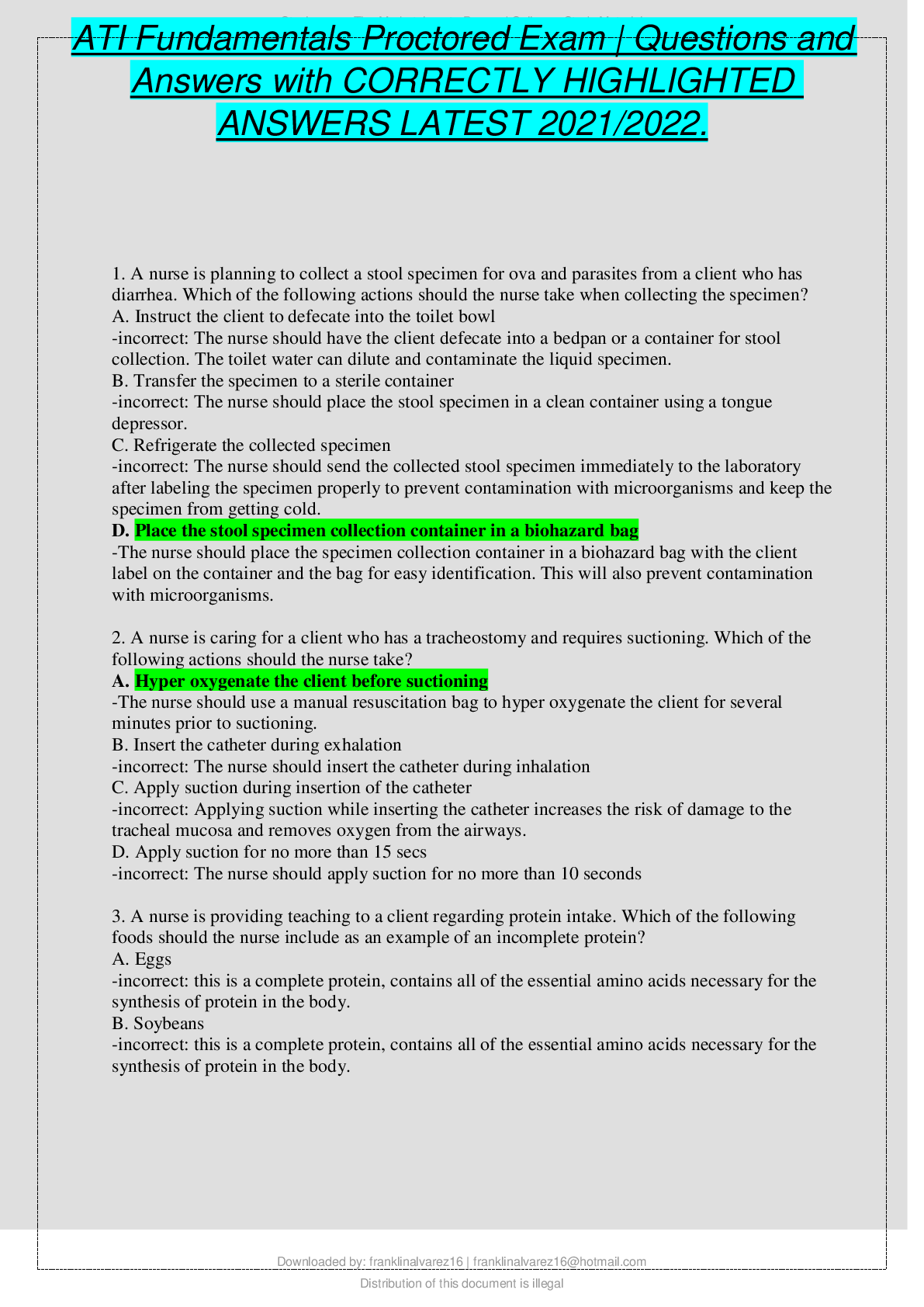
NR-509-APEA-3P-EXAM-WEEK-8
NR-509-APEA-3P-EXAM-WEEK-8
Question 1
A 3 year-old presents with a history of fever and cough over the past 24 hours. Findings on exam
reveal: temperature of 102°F, apical heart rate of 157
...
NR-509-APEA-3P-EXAM-WEEK-8
NR-509-APEA-3P-EXAM-WEEK-8
Question 1
A 3 year-old presents with a history of fever and cough over the past 24 hours. Findings on exam
reveal: temperature of 102°F, apical heart rate of 157 beats/minute, and respiratory rate of 40
breaths/minute. Tachypnea in this child is most likely related to
Paradoxical respirations.
the child's febrile state. Correct
the child's age.
an airway obstruction.
Explanation:
In children, heart and respiratory rates will increase with fever. For every degree of fever the
respiratory rate will increase 3-4 breaths/minutes and the heart rate will increase 8-10
beats/minute.
Question 2
When percussing the lower posterior chest, begin by:
standing on the side rather than directly behind the patient.
Correct: having the patient lie supine on the examining table.
carefully palpating any area the patient has reported pain.
using the ball or the ulnar surface of the hand.
Explanation:
When percussing the lower posterior chest, stand on the side rather than directly behind the
patient. This position allows the ability to place the pleximeter finger more firmly on the chest and
the plexor is more effective in making a better percussion note. If the patient is lying supine, the
posterior chest will not be able to be percussed. Palpating painful areas is not percussion, so is not
correct. Using the bony part of the palm at the base of the fingers or the ulnar surface is a technique
used to detect tactile fremitus.
Question 3The palpation technique used to assess respiratory expansion of the chest is placing the hands on
the eight or tenth ribs posteriorly with the thumbs close to the vertebrae, sliding the hand medially
and grasping a small fold of skin between the thumbs. Then:
ask the patient to cough and note chest expansion.
ask the patient to take a deep breathe and note any delay in expansion during inhalation.
Correct have the patient hold his breath for 15 seconds then note chest expansion.
have the patient exhale forcefully noting expansion on expiration.
Explanation:
To assess the respiratory expansion of the chest, the examiner places his hands on the eight or tenth
ribs posteriorly with the thumbs close to the vertebrae, slides the hand medially and grasps a small
fold of skin between the thumbs then asks the patient to take a deep breath. The thumbs should
move evenly away from the vertebrae during inspiration and there should be no delay in expansion.
Question 4
When trying to differentiate between hemoptysis or blood streaked material, which one of the
following observations is correct?
Hemoptysis is seen frequently in infants, children, and adolescents with allergic rhinitis.
Blood originating in the stomach is usually brighter than blood originating from the respiratory
tract.
IncorrectHemoptysis is common in children with cystic fibrosis.
Correct: Blood streaked material often originates from the gastrointestinal tract.
Explanation:
Hemoptysis is rare in infants, children, and adolescents, although common in those with cystic
fibrosis. Blood originating in the stomach is usually darker than blood from the respiratory tract and
may be mixed with food particles. Blood or blood-streaked material may originate in the mouth,
pharynx, or less commonly from the gastrointestinal tract.
Question 5
When percussing the chest in a patient who has left sided heart failure, the sound emanated would
be:
resonant. Correct
dulltympany.Diffusely
hyperresonant. Incorrect
Explanation:
A patient with left sided heart failure experiences increased pressure in the pulmonary veins causing
congestion and interstitial edema. Percussion sounds emitted would most likely be resonant.
Consolidation in the lungs produces a dull sound on percussion. Tympany (low-high pitched musical
sound) is usually audible when percussing a distended abdomen or when a pneumothorax is
present. Chronic obstructive lung disease produces diffusely hyperresonant sound on percussion.
Question 6
The line that extends through the inferior angle of the scapula when the arms are at the sides of the
body is the:
mid vertebral line.
scapular line.
Correct: midclavicular line.
mid-spinal line.
Explanation:
The line that extends through the inferior angle of the scapula when the arms are at the sides of the
body is the scapular line.
Question 7
A condition associated with a chronic cough that produces copious amounts of purulent sputum is
most likely:
tracheobronchitis.
chronic bronchitis.
Incorrectbronchiectasis.
Correct: laryngitis.
Explanation:
An acute viral illness that presents with a burning retrosternal discomfort and a dry cough is
tracheobronchitis. An acute, mild illness often associated with viral nasopharyngitis and hoarseness
is laryngitis. The initial cough is dry and nonproductive but may become productive over time. A
chronic bronchitis cough is characteristically productive with mucoid to purulent sputum and may be
blood tinged. Bronchiectasis produces a chronic cough with sputum that is copious and foulsmelling. It may be blood tinged.Question 8
A patient who walked into the examination room, may be observed to be sitting and leaning forward
in his chair. Lips were pursed during exhalation and arms are supported on the table. This position
could be consistent with patients who have:
pneumonia.
chronic
obstructive pulmonary disease.
Correct: asthma.
croup.
Explanation:
People who have chronic obstructive pulmonary disease experience shortness of breath and
dyspnea. Breathing with pursed lips and use of abdominal muscles help reduce shortness of breath
and dyspnea. Leaning forward while seated and having arms supported on the table facilitate
breathing. This position is not characteristic of the other diseases.
Question 9
Breath sounds heard over the periphery of the lung fields are:
bronchial.
abnormal.
bronchovesicular.
Incorrectvesicular. Correct
Explanation:
Bronchial, vesicular, and bronchovesicular breath sounds are considered normal. Vesicular breath
sounds consist of a quiet, wispy inspiratory phase followed by a short, almost silent expiratory
phase. They are heard over the periphery of the lung field. Bronchial breath sounds consist of a full
inspiratory and expiratory phase with the inspiratory phase usually being louder. They are normally
heard over the trachea and larynx. Bronchovesicular breath sounds consist of a full inspiratory phase
with a shortened and softer expiratory phase. They are normally heard over the hilar region (center
of the lungs near the heart).
Question 10
When percussing the posterior chest, which one of the following techniques would be omitted?When comparing two areas on the chest, use the same percussion technique in both areas.
Percuss one side of the chest then the other at each level.
Percuss the areas over the scapulae.
Correct: If a louder note is needed, apply more pressure with the
pleximeter finger.
Explanation:
All of the percussion techniques listed are useful when percussing the chest except the areas over
the scapulae. These areas are not percussed because the thickness of the muscle and bone alters the
percussion notes over the lungs.
Question 11
When auscultating breath sounds in a patient who has left sided heart failure, the breath sounds
are:
vesicular with late inspiratory crackles in the dependent portions of the lungs and resonant on
percussion.
Correct: bronchial with late inspiratory crackles over the involved area and dull on percussion.
vesicular without adventitious sounds and resonant on percussion.
Incorrect: decreased with some audible wheezes and diffusely
hyperresonant on percussion.
Explanation:
A patient with left sided heart failure experiences increased pressure in the pulmonary veins causing
congestion and interstitial edema. The breath sounds are vesicular with late inspiratory crackles in
the dependent portions of the lungs and are resonant on percussion. Consolidation in the lungs
produces bronchial breath sounds with late inspiratory crackles over the involved area and is dull on
percussion. A normal lung has vesicular breath sounds without adventitious sounds and is resonant
on percussion. Chronic obstructive lung disease produces decreased breath sounds with some
audible wheezes and is hyperresonant on percussion.
Question 12
Breath sounds consisting of a full inspiratory phase and a shortened and softer expiratory phase
normally audible over the hilar region of the chest are termed:vesicular.bronchial.bronchovesicular. Correctrhonchi.
Explanation:
Bronchovesicular breath sounds consist of a full inspiratory phase with a shortened and softer
expiratory phase. They are normally heard over the hilar region (center of the lungs near the heart).
Vesicular breath sounds consist of a quiet, wispy inspiratory phase followed by a short, almost silent
expiratory phase. They are heard over the periphery of the lung field. Bronchial breath sounds
consist of a full inspiratory and expiratory phase with the inspiratory phase usually being louder.
They are normally heard over the trachea and larynx.
Question 13
An acute viral illness that presents with a burning retrosternal discomfort and a dry cough is
suggestive of:
tracheobronchitis.
Correctchronicbronchitis.
bronchiectasis.
laryngitis. Incorrect
Explanation:
An acute viral illness that presents with a burning retrosternal discomfort and a dry cough is
tracheobronchitis. An acute, mild illness associated with viral nasopharyngitis and hoarseness is
laryngitis. The initial cough is dry and nonproductive but may become productive over time. A
chronic bronchitis cough is characteristically productive with mucoid to purulent sputum and may be
blood tinged. Bronchiectasis produces a chronic cough with sputum that is copious and foulsmelling. It may be blood tinged or bloody.
Question 14
One of the anterior thoracic landmarks is the costal angle. It is located:
where the manubrium and body of the sternum intersect.
where the right and left costal margins form an angle where they meet at the xiphoid process.
Correct: where the suprasternal notch and the sternum form an angle.Incorrectat the angle where the ninth and tenth ribs are fused.
Explanation:
The right and left costal margins form an angle where they meet at the xiphoid process. This is the
costal angle. The angle should be 90 degrees or less. However, the angle increases when the rib cage
is chronically over inflated, as in emphysema.
Question 15
Atypical respiratory symptoms associated with gastroesophageal disease (GERD) may include all of
the following except:
coughing.wheezing.aspirationpneumonia.rhinitis. Correct
Explanation:
Atypical respiratory symptoms associated with gastroesophageal disease may include coughing,
wheezing, asthma, and aspiration pneumonia. Rhinitis is rarely associated with GERD.
Question 16
On auscultation of the chest, if the patient says "ninety-nine" and it is clearly heard, this is indicative
of:
a normal sounding chest. Incorrectlung density in the area. Correctconsolidation or compression in
the area.of inflammation in the area.
Explanation:
Bronchophony indicates density and usually repeating the words ninety-nine produces that sound.
Egophony, saying ee-ee-ee-ee, is more indicative of consolidation or compression in the area.
Whispered pectoriloquy, whispering one-two-three, is more faint than bronchophony, and heard
over areas of small amounts of consolidation. Inflammation would produce more of a wheezing
sound in the chest and is associated with narrowed airways (as heard during asthma exacerbation).
Question 17
Respiratory effort in the neonate is initiated at birth as a result of:
an increase in the PO2 and a decrease in PCO2.the continued functioning of the foramen ovale.
chemical, thermal, and mechanical factors.
Correctdrying off the infant.
Explanation:
Chemical, thermal, and mechanical factors influence respiration as follows: breathing is initiated by a
lack of oxygen and a high level of carbon dioxide in the blood stream. This stimulates the respiratory
center in the medulla of the brain. Initiation of respiration is aided by the compression of the chest
wall during the birth process, the cool air on the wet face, and the general handling of the body and
limbs. A healthy baby cries almost immediately, but he has to breathe to be able to cry. With the
first breath, the blood vessels in the lung expand. Spontaneous breathing is now established.
Pulmonary venous return to the heart increases. This results in left arterial pressure exceeding right
arterial pressure. Right to left shunting through the foramen ovale is reduced.
Question 18
Adventitious breath sounds, such as crackles, are:
low-pitched, dry, grating sounds heard on inspiration and expiration.continuous, high-pitched, and
musical heard on inspiration and expiration. Incorrectcontinuous, low-pitched and prolonged and
heard on expiration.popping, frying sounds, may be low or high-pitched and usually heard on
inspiration. Correct
Explanation:
Crackles are termed coarse, medium, or fine and usually produce a popping, frying sound. Coarse
crackles are low-pitched while fine crackles are high-pitched. Coarse sounds are heard on inspiration
and sometimes expiration, medium crackles in the middle of inspiration, and fine crackles at the end
of inspiration. Rhonchi are continuous, low-pitched and heard on expiration. Wheezes are
continuous high-pitched and musical. A pleural friction rub produces a dry, grating sound.
Question 19
Breath sounds heard on chest over the hilar region are:
bronchial.abnormal.bronchovesicular. Correctvesicular.
Explanation:Bronchial, vesicular, and bronchovesicular breath sounds are considered normal. Bronchovesicular
breath sounds consist of a full inspiratory phase with a shortened and softer expiratory phase. They
are normally heard over the hilar region (center of the lungs near the heart). Bronchial breath
sounds consist of a full inspiratory and expiratory phase with the inspiratory phase usually being
louder. They are normally heard over the trachea and larynx. Vesicular breath sounds consist of a
quiet, wispy inspiratory phase followed by a short, almost silent expiratory phase. They are heard
over the periphery of the lung field.
Question 20
Breath sounds consisting of a full inspiratory and expiratory phase with the inspiratory phase usually
being louder and normally heard over the trachea and larynx are considered:
bronchial. Correctabnormal.bronchovesicular.vesicular.
Explanation:
Bronchial, vesicular, and bronchovesicular breath sounds are considered normal. Bronchial breath
sounds consist of a full inspiratory and expiratory phase with the inspiratory phase usually being
louder. They are normally heard over the trachea and larynx. Bronchovesicular breath sounds
consist of a full inspiratory phase with a shortened and softer expiratory phase. They are normally
heard over the hilar region (center of the lungs near the heart). Vesicular breath sounds consist of a
quiet, wispy inspiratory phase followed by a short, almost silent expiratory phase. They are heard
over the periphery of the lung field.
Question 21
Pain from pleurisy may be referred to the:
rightshoulder.retrosternal area. Incorrectepigastric area. Correctback.
Explanation:
Referred pain is defined as pain that is felt in more distal sites than the initial pain site. Pain from
pleurisy or inferior wall myocardial infarction may be referred to the epigastric area. Referred pain
from the biliary tree may be perceived in the right shoulder or the right posterior chest. Referred
pain of duodenal or pancreatic origin may be referred to the back. Heartburn may be associated
with retrosternal burning pain.
Question 22When performing a respiratory assessment on a 4-year-old child, further evaluation is warranted in
the presence of:
the use of the abdominal muscles.eupneicrespirations.supraclavicular retractions. Correctvesicular
sounds in the chest periphery.
Explanation:
Retractions would be abnormal and require further evaluation. A 4-year-old has diaphragmatic
breathing so using the abdominal muscles would be normal. Eupneic respirations is a term for
normal breathing. Vesicular sounds in the chest periphery is considered normal for this age group.
Question 23
Which technique best determines whether the tissues in the chest are air-filled, fluid-filled, or solid?
AuscultationPalpationInspectionPercussion Correct
Explanation:
Percussion of the chest produces audible sounds and palpable vibrations, thus, assisting in
determining if the underlying tissues are filled with air or fluid or if they are solid. However,
percussion will not help detect deep seated lesions. Auscultation assesses the flow of air through the
tracheobronchial tree. Palpation focuses on tenderness and abnormalities in the overlying skin ,
respiratory expansion, and fremitus. Inspection notes the shape of the chest and they way it moves
with inspiration and expiration.
Question 24
Breath sounds auscultated over the periphery of the lung fields are quiet and wispy during the
inspiratory phase followed by a short, almost silent expiratory phase. These breath sounds are
considered:
vesicular. Correctbronchovesicular.bronchial. Incorrectcrackles.
Explanation:The three normal breath sounds are vesicular, bronchovesicular, and bronchial. Vesicular breath
sounds consist of a quiet, wispy inspiratory phase followed by a short, almost silent expiratory
phase. They are heard over the periphery of the lung field. Bronchial breath sounds consist of a full
inspiratory and expiratory phase with the inspiratory phase usually being louder. They are normally
heard over the trachea and larynx. Bronchovesicular breath sounds consist of a full inspiratory phase
with a shortened and softer expiratory phase. They are normally heard over the hilar region.
Crackles are adventitious sounds heard in the lungs and may be due to abnormalities in the lungs.
Question 25
A patient who presents with a long history of cigarette smoking exhibits a dry to productive cough
with dyspnea and weight loss. These symptoms could be consistent with:
a pulmonary embolus.asthma.a neoplasm of the lung. Correctchronic obstructive pulmonary
disease. Incorrect
Explanation:
The characteristic cough associated with smoking is usually productive. A long history of smoking,
dry cough, dyspnea, and weight loss could be suggestive of cancer of the lung. A pulmonary embolus
is usually accompanied by a dry to productive bloody cough, dyspnea, anxiety, chest pain, and fever.
Cigarette smoking is not directly linked to pulmonary embolus. Episodic wheezing and dyspnea are
characteristic of asthma. Symptoms associated with chronic obstructive lung disease include slowly
progressive dyspnea accompanied by a scant mucoid sputum. The dyspnea is aggravated by
exertion.
Question 26
The hilar region of the lungs describes:
the area around the heart. Correctthe base of the lungs.the posterior chest.the upper, anterior area
of the chest. Incorrect
Explanation:
The area around the heart near the center of the lungs describes the hilar region. The hila are
structures consisting of the major bronchi and pulmonary veins and arteries. Hilar lymph nodes are
not normally visible on chest X-ray.
Question 27The anterior surface landmark on the thorax that is denoted by a hollow U-shaped depression just
above the sternum and between the clavicles is termed the:
sternum.suprasternal notch. Correctsubsternalnodule.spinous process.
Explanation 28
The suprasternal notch is a hollow U-shaped depression just above the sternum and between the
clavicles on the anterior surface of the chest. The sternum is the breastbone which the ribs are
attached. The spinous processes are the "knobs" felt along the vertebrae.
Question 29
Factors that aggravate costochondritis may include:
hypertension.
emotionalstress.
swallowing cold foods. Incorrect
movement of the chest, trunk, and arms. Correct
Explanation:
Costochondritis occurs when there is inflammation of the cartilage that connects the rib to the
sternum. It presents as a stabbing, sticking, dull, or aching pain and is aggravated by movement of
the chest, trunk, and arms. There is no evidence to support costochondritis with hypertension,
emotional stress, or swallowing of cold foods.
Question 30
To locate the twelfth rib, palpate:
anteriorly at the costal margin.
between the spine and the lateral chest.
Correct: at the tip of the scapula.
below the eleventh spinous process.
Explanation:Palpate midway between the spine and the lateral chest to identify its free tip. As you palpate
toward the vertebral column, you may lose contact with the twelfth rib because it is deep to the
quadratus lumborum muscle.
Question 31
To document chest findings located between the scapulae, which one of the following terms would
be used?
InfraclavicularSupraclavicularInterscapular CorrectInfrascapular
Explanation:
The general anatomical terms used to locate chest findings should include the following:
interscapular is between the scapulae; supraclavicular denotes above the clavicles; infraclavicular
refers to that area below the clavicles; and infrascapular refers to below the scapulae.
Question 32
The midaxillary line:
extends from the anterior axillary fold where the pectoralis major muscle
inserts. Incorrectcontinues from the posterior axillary fold where the latissimus dorsi muscle
inserts.runs down from the apex of the axilla and lies between and parallel to the anterior and
posterior lines. Correctextends through the inferior angle of the scapula when the arms are at the
sides of the body.
Explanation:
The anterior axillary line extends from the anterior axillary fold where the pectoralis major muscle
inserts. The posterior axillary line continues from the posterior axillary fold where the latissimus
dorsi muscle inserts. The midaxillary line runs from the apex of the axilla and lies between and
parallel to the other two. The scapular line extends through the inferior angle of the scapula when
the arms are at the sides of the body.
Question 33
Retractions are observed in all the following areas except the:
supraventriculararea.hilar area. Correctintercostal area. Incorrectcostal marginal area.Explanation:
Retractions are a pulling inward of the soft tissue and are associated with respiratory difficulty.
Usually retractions are noted in the supraventricular, intercostal, and costal margin areas of the
chest.
Question 34
When examining a patient for chest expansion, begin by:
hyperextending the examiner's middle finger of the left hand (pleximeter finger) and pressing its
distal interphalangeal joint firmly on the surface to be examined.placing the thumbs of the examiner
at about the level of the tenth ribs with the fingers loosely grasping and parallel to the lateral rib
cage. Correctpositioning the examiner's right forearm close to the chest surface with the hand
cocked upward.standing on the side rather than directly behind the patient. Incorrect
Explanation:
When examining a patient for chest expansion, begin by placing the thumbs of the examiner at
about the level of the tenth ribs with the fingers loosely grasping and parallel to the lateral rib cage
and slide them medially just enough to raise a loose fold of skin on each side of between the thumb
and the spine. Watch chest expansion as the patient inhales and exhales checking for symmetry and
range. The other choices are steps used when percussing the chest.
Question 35
The lower tip of the scapula is located:
near the fourth rib. Incorrectaround the seventh or eighth rib. Correctmidway between the ninth
and tenth rib.at the angle just above the twelfth rib.
Explanation:
The scapulae are located symmetrically in each hemithorax. The lower tip is usually at the seventh or
eighth rib.
Question 36
A patient presents with a productive cough. Which one of the following descriptions of the mucus is
correct?Mucoid sputum is green, white, or pale yellow. IncorrectTenacious sputum is consistent with
patients who have cystic fibrosis. CorrectFoul-smelling sputum is present in bronchitis.Large
volumes of purulent sputum are present in patients who have asthma.
Explanation:
Purulent sputum is yellow or green whereas mucoid sputum is translucent, white, or gray. Foulsmelling sputum is present in anaerobic lung abscess. Tenacious sputum is present in patients who
have cystic fibrosis. Large volumes of purulent sputum are present in bronchiectasis or lung abscess.
Question 37
Diminished breath sounds should be interpreted as:
suggestive of chronic pulmonary disease. Incorrectsuggestive of severe respiratory failure.an
abnormal finding warranting further evaluation. Correcta normal finding.
Explanation:
Diminished breath sounds in any patient are considered abnormal and would suggest a need for
further evaluation. It is too early to determine that one finding would indicate chronic pulmonary
disease and without other symptoms, it would not indicate respiratory failure.
Question 38
When inspecting the chest for respiratory effort, which one of the following is not part of the
inspection?
Overall patient appearanceContour and movement of the chestColor of the skin, nail beds, and
lips IncorrectAssessment for tactile fremitus. Correct
Explanation:
When inspecting the chest for respiratory effort, note the overall appearance, nutritional status,
ability to breathe, abnormal respirations, contour and movement of the chest, color of the skin, nail
beds, and lips, and presence of retractions. To assess for tactile fremitus, one would palpate the
chest, not inspect it.
Question 39
The angle of Louis is a useful place to start counting ribs. This landmark is located:on the manubrium and body of the sternum. Correctnear the xiphoid process.just above the
sternum. Incorrectbetween the two scapulae.
Explanation:
The sternal angle or the “angle of Louis,” is the articulation of the manubrium and body of the
sternum, and it is continuous with the second rib. The angle of Louis is a useful place to start
counting ribs, which helps localize a respiratory finding horizontally.
Question 40
When auscultating breath sounds, use the diaphragm of the stethoscope by placing it initially on the:
anterior chest at the nipple line.lateral surface of the chest near the axilla.posterior chest at the
cervical 7 level. Correctanterior chest in the upper sternal area. Incorrect
Explanation:
To auscultate all the lung fields, begin by placing the diaphragm of the stethoscope on the posterior
chest and listen from the apices (Cervical 7 level) to the bases located around the thoracic 10 level.
Then listen laterally from the axilla to the 7th or 8th ribs, then repeat the entire assessment on the
anterior chest.
Question 41
The line that bisects the center of each clavicle at a point halfway between the palpated
sternoclavicular and acromioclavicular joints is the:
midsternal line.
Incorrectmidclavicular line.
Correctmid vertebral line.
mid scapular line.
Explanation:The midclavicular line bisects the center of each clavicle at a point halfway between the palpated
sternoclavicular and acromioclavicular joints. It is used as a reference line to pinpoint a finding
vertically on the chest.
Question 42
When palpating the thorax, a crackling, popping noise under the skin is heard. On auscultation, a
sound similar to hair being rubbed between the fingers is noted. These symptoms could be
consistent with:
pneumonia.hemothorax.pneumothorax. Correctbronchitis. Incorrect
Explanation:
Subcutaneous emphysema is the condition described in the question. This can be caused by
pneumothorax because this condition allows air to be introduced into the tissue. Hemothorax refers
to blood in the chest and crepitus is not associated with this condition. Pneumonia and bronchitis do
not produce subcutaneous emphysema.
Question 43
To document chest findings located below the scapulae, which one of the following terms would be
used?
InfraclavicularSupraclavicularInterscapularInfrascapular Correct
Explanation:
The general anatomical terms used to locate chest findings should include the following:
infrascapular refers to below the scapulae; supraclavicular denotes above the clavicles;
infraclavicular refers to that area below the clavicles; and interscapular is between the scapulae.
Question 44
A 37-year-old female has audible stridor. This type of stridor is consistent with:
bronchiectasis.
Incorrect pulmonary fibrosis.
cysticfibrosis.a foreign object lodged in the upper trachea. Correct
Explanation:
Audible stridor is a high-pitched wheeze. This is an ominous sign of upper airway obstruction in the
larynx or trachea. Clubbing of the nails occurs in bronchiectasis, congenital heart disease, pulmonary
fibrosis, cystic fibrosis, lung abscess, and malignancy. These conditions are more characteristic of
lower airway diseases.
Question 45
When percussing the right upper posterior area of the chest, a dullness replaces the resonance
sound usually heard in the lung. This sound would be suggestive of:
lobar pneumonia.
Correct: emphysema.
asthma.
pneumothorax. Incorrect
Explanation:
Normal lungs are resonant and produce loud low-pitched sounds when percussed. If dullness
replaces resonance, consider a lung with fluid or solid tissue replacing the air. Examples include
pleural effusion, hemothorax, lobar pneumonia, or empyema. Emphysema, asthma, and a
pneumothorax produce hyperresonance when the lungs are percussed.
Question 46
Orthopnea is typically associated with all of the following conditions except:
left ventricular hypertrophy.
pulmonary embolus.
Correct: mitralstenosis.
obstructive lung disease.
Explanation:Orthopnea is defined as dyspnea that occurs when the patient is lying down and improves when the
patient sits or stands up. It is generally seen in patients with mitral stenosis, left ventricular
hypertrophy, and in obstructive lung disease. With a pulmonary embolus, the dyspnea is sudden and
uncomfortable in any position.
Question 47
Stridor heard louder in the neck than over the chest wall indicates:
an obstruction in the alveoli.
an obstruction in the main bronchus.
a partial obstruction in the larynx.
Correct: an obstruction in the bronchioles.
Explanation:
A wheeze that is entirely or predominately inspiratory is termed stridor. It is often louder in the neck
than over the chest wall and indicates a partial obstruction of the larynx or trachea and is considered
an emergency. An obstruction in the alveoli or bronchioles are generalized wheezes heard
throughout the chest. With an obstruction in the main bronchus, the wheeze would be persistent
and more localized.
Question 48
Increased anteroposterior diameter of the chest, purse-lipped breathing, and dyspnea with talking,
suggest:
pneumonia.
Lung cancer.
bronchitis.
chronic obstructive pulmonary disease. Correct
Explanation:
Increased anteroposterior diameter of the chest, known as "barrel chest", purse-lipped breathing,
and dyspnea with talking or minimal exertion suggest chronic obstructive pulmonary disease.
Question 49The middle section of the thoracic cavity containing the esophagus, trachea, heart, and great vessels
is the:
mediastinum.
Correctpleuralcavity.
visceralcavity.
pericardium.
Explanation:
The middle section of the thoracic cavity containing the esophagus, trachea, heart, and great vessels
is the mediastinum. The right and left pleural cavities, are on either side of the mediastinum and
those contain the lungs. The visceral pleura encloses the lung. The pericardium surrounds the heart.
Question 50
To document chest findings located at the lowermost portion of the lungs, which one of the
following terms would be used?
Lower lung fields.
Visceralpleura
Parietalpleura
Bases of the lungs Correct
Explanation:
The bases of the lungs refers to the lowermost portion of the lungs. The visceral surface refers to the
pleural space that covers the outer surface of the lungs. The parietal pleura lines the inner rib cage
and the upper surface of the diaphragm.
Question 51
Which one of the following infants should be seen immediately by the nurse practitioner?
A two- week- old infant with nasal congestion and a respiratory rate of 64 breaths/minute
CorrectA one- week-old infant with a diaper rash and a respiratory rate of 44 breaths/minuteIncorrectA one –month- old infant with an axillary temperature of 99.0 degrees Fahrenheit
A three- week- old breastfed infant who has had two loose stools today
[Show More]


 2019 AG21.png)


![Preview of PHARMACOLOGY ATI PROCTORED EXAM ASSESSMENT [100 Q & A]](https://scholarfriends.com/storage/ATI PHARMACOLOGY PROCTORED EXAM ASSESSMENT JN21.png)