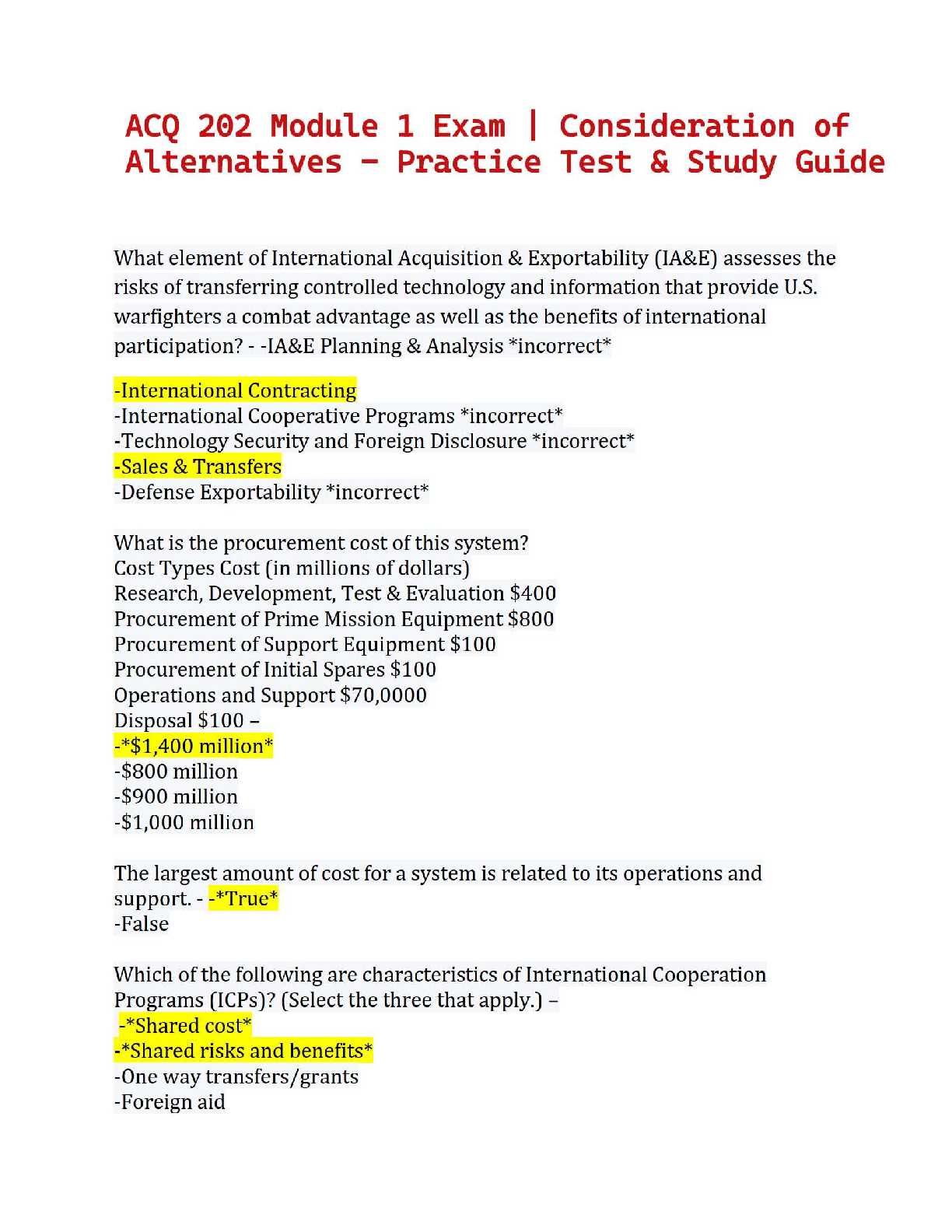
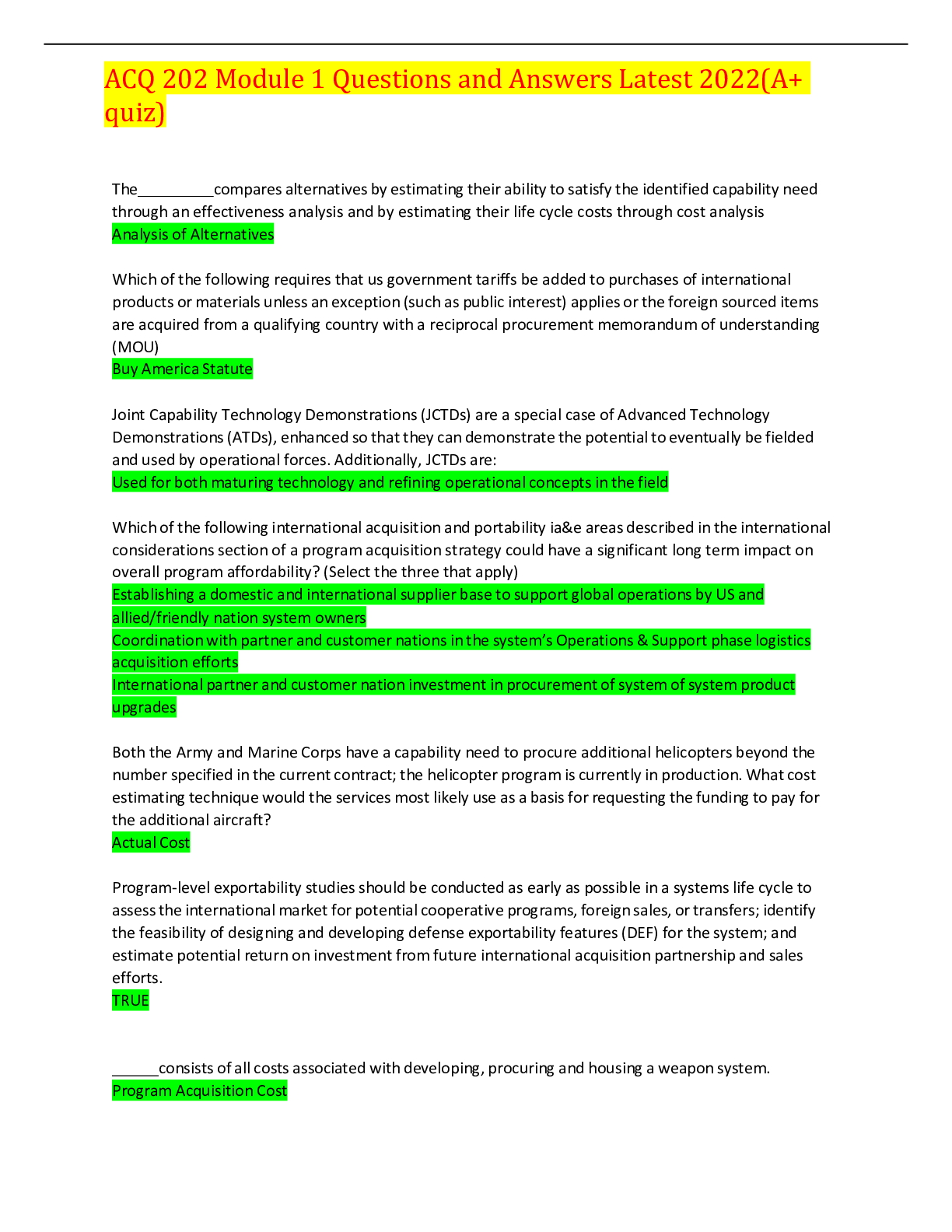
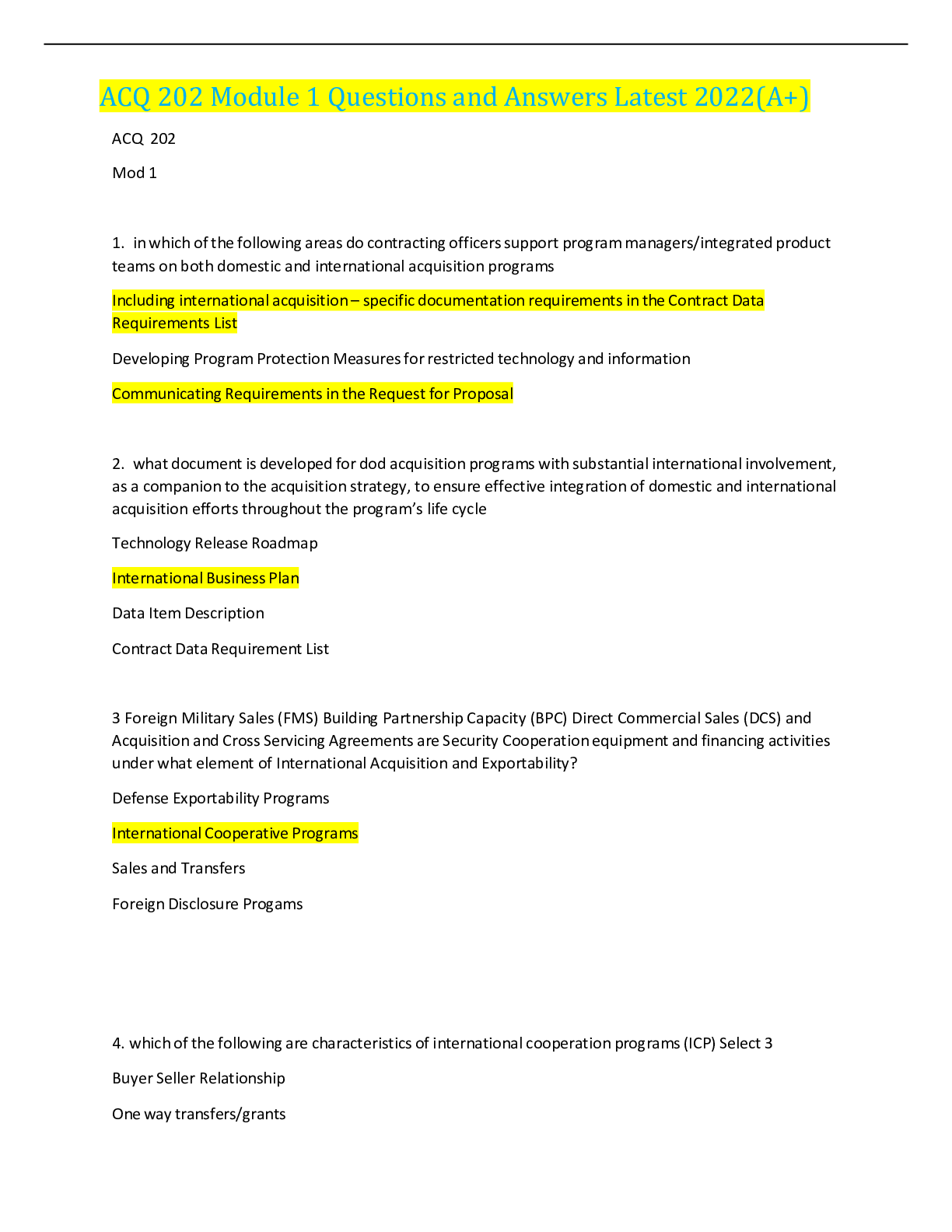
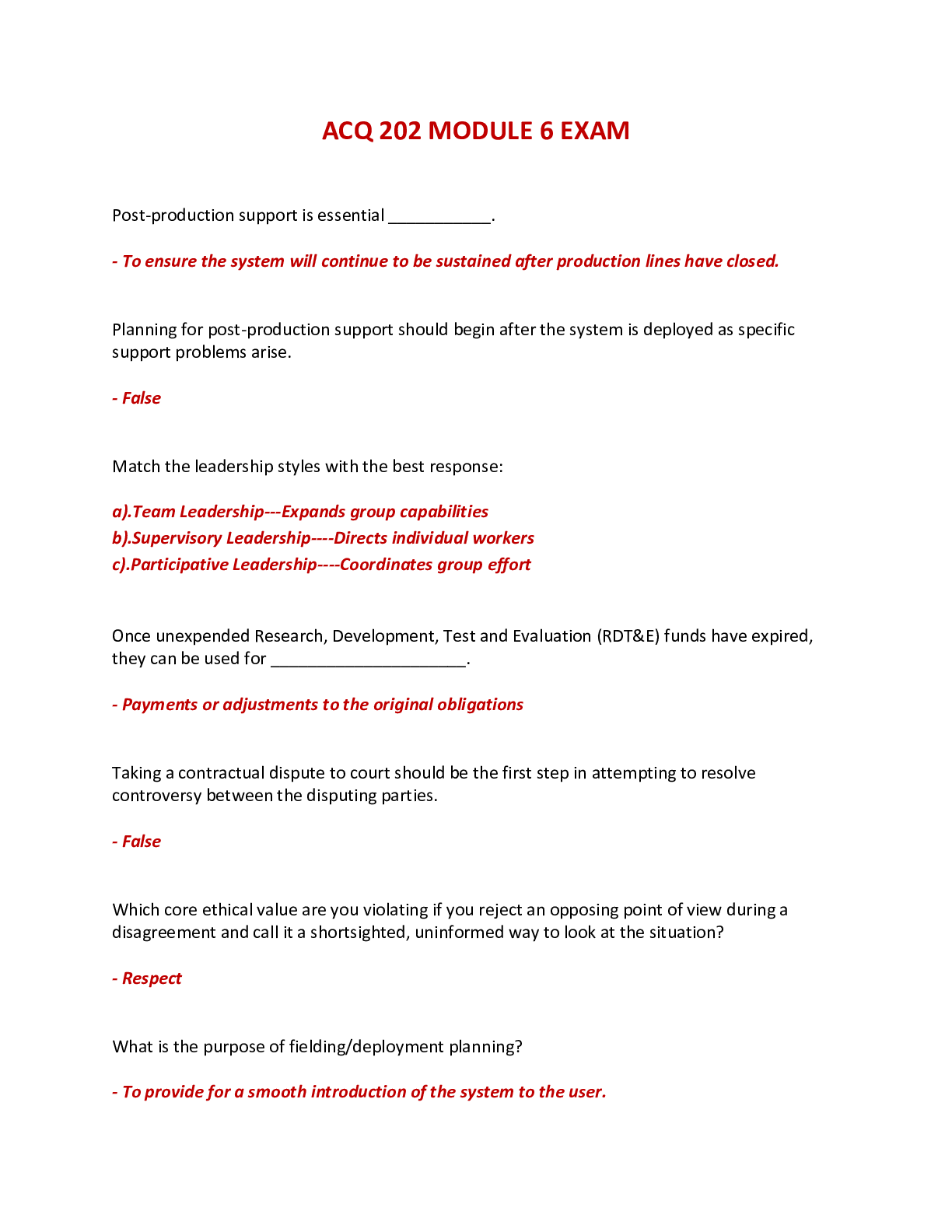
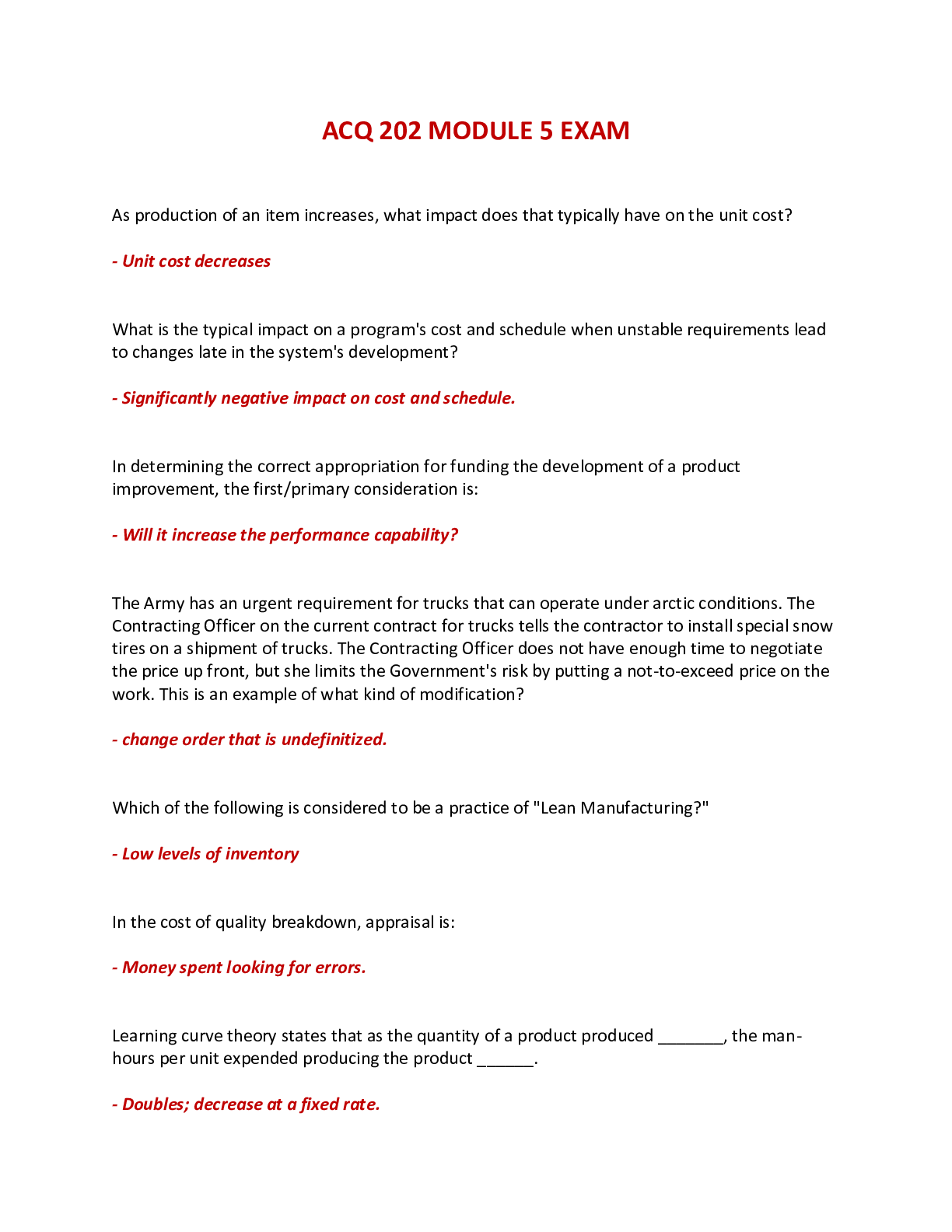
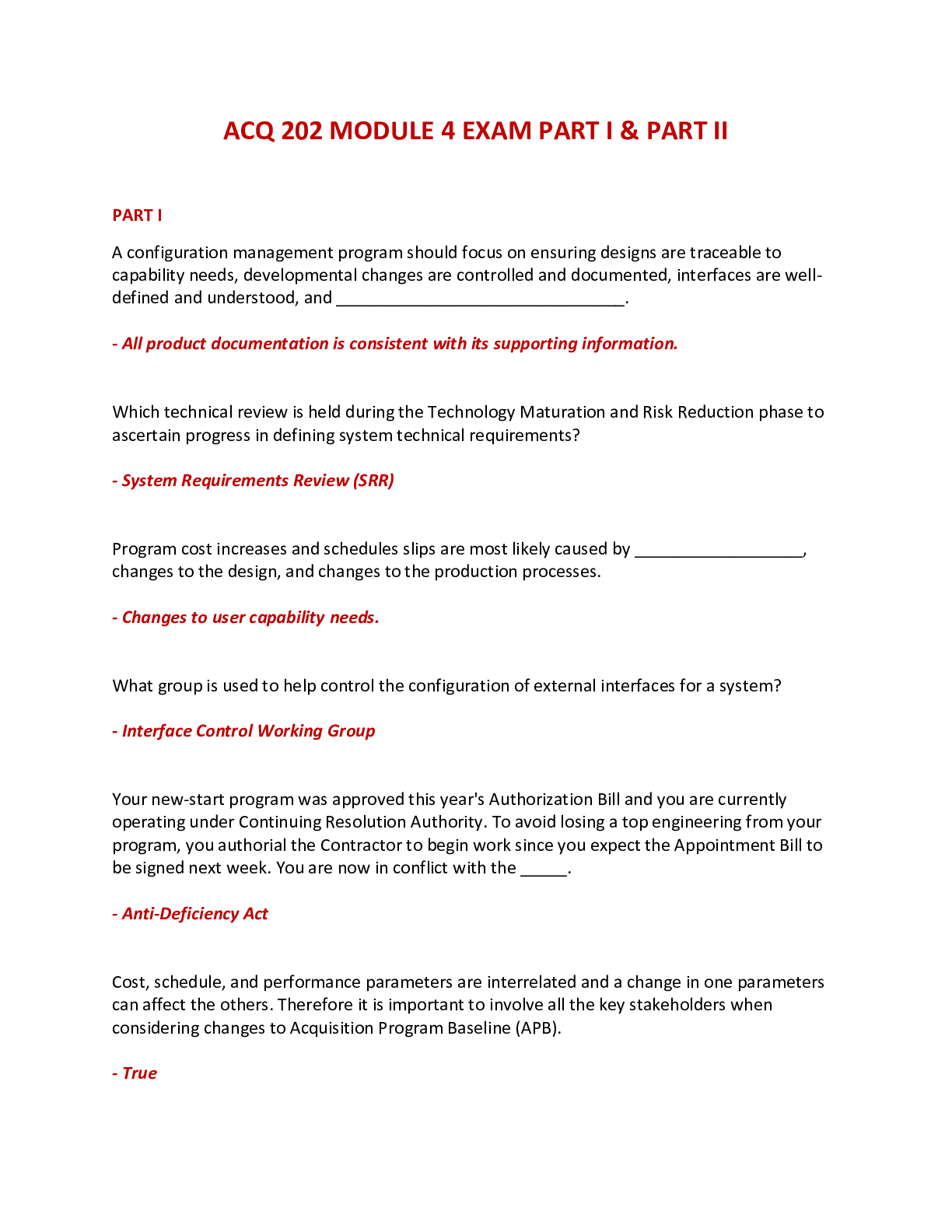
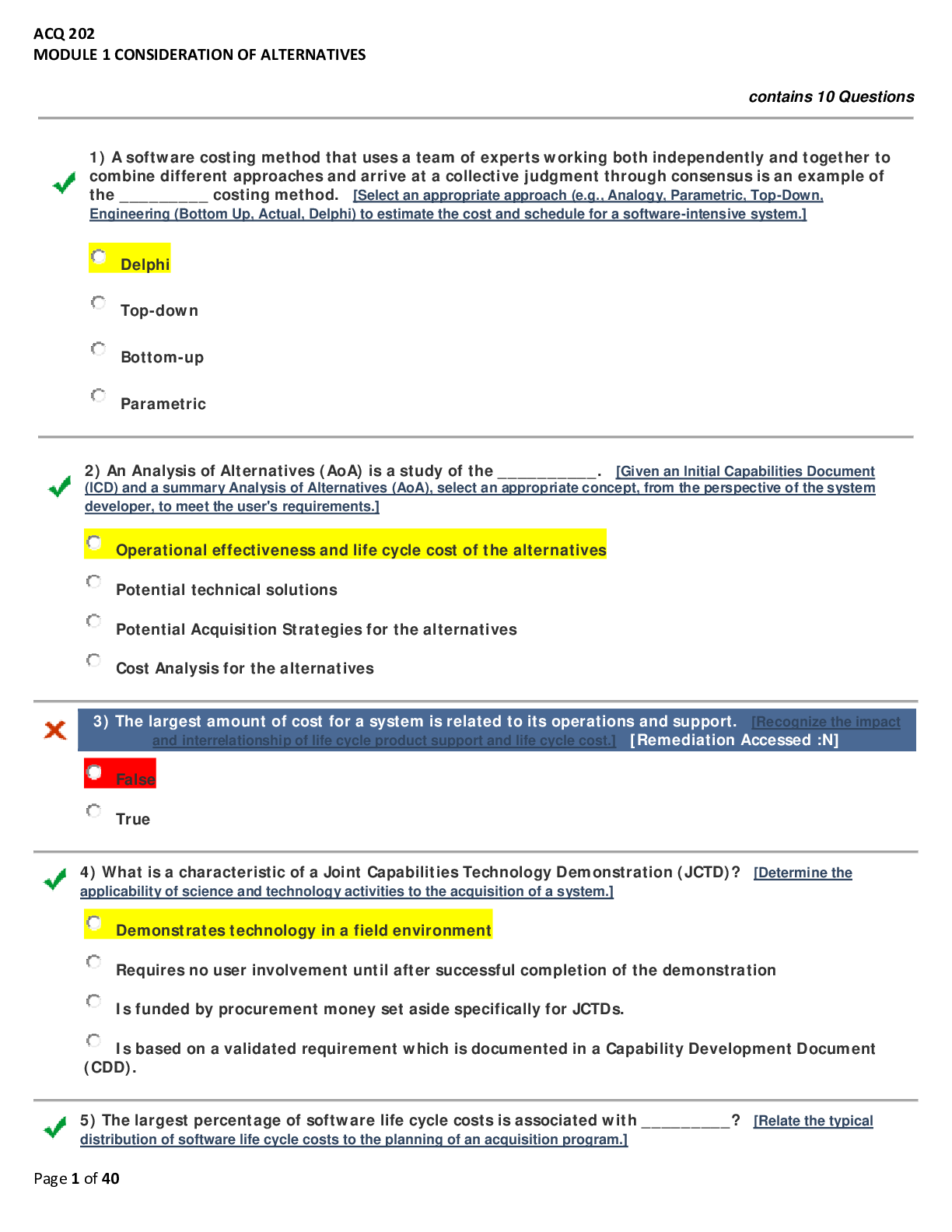
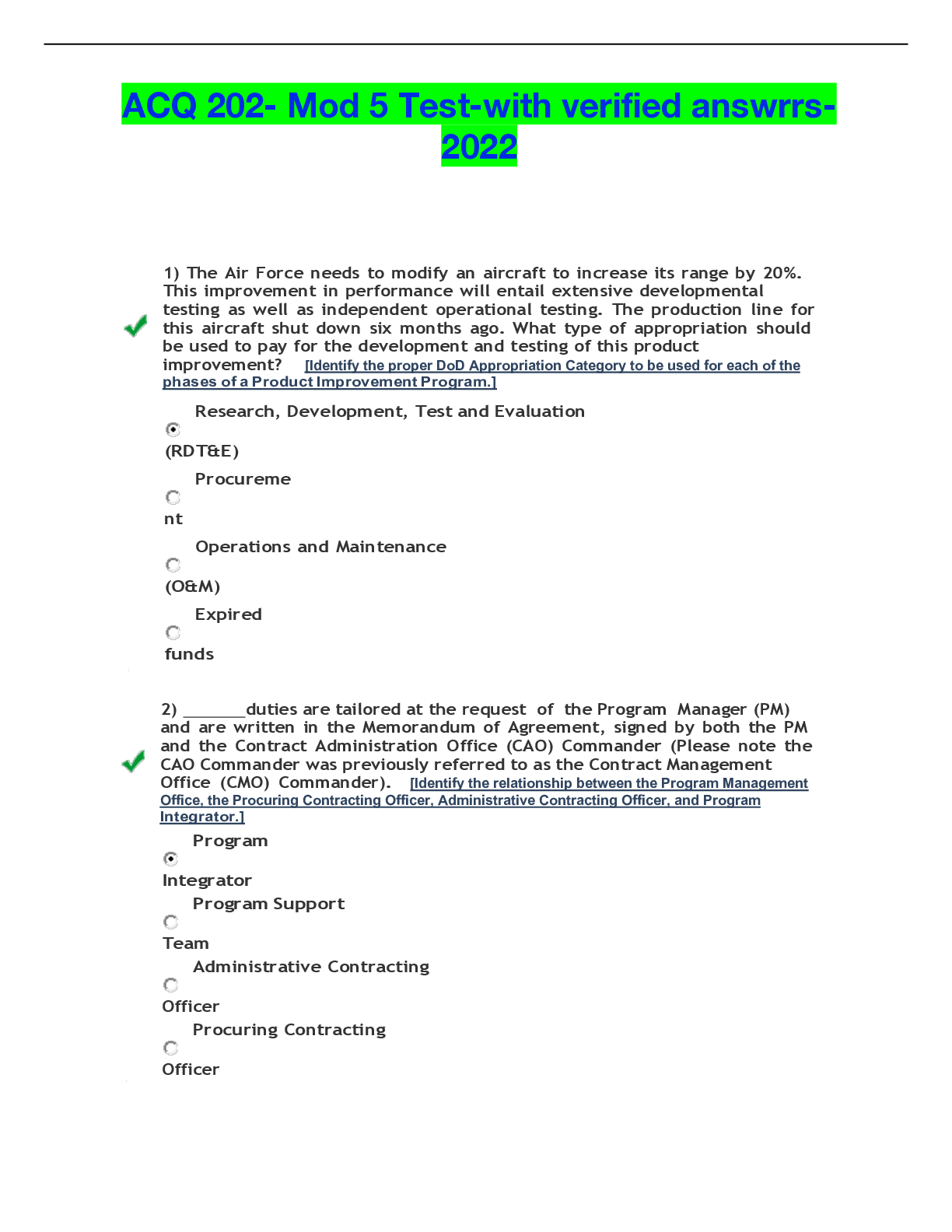
ACQ 202 Module 2 Exam Test Bank; answered_ Already graded A.
Module 2 Exam, Part I (contains 18 questions)
Here is your test result.The dots represent the choices you have made.
The highlighted questions are the quest
...
ACQ 202 Module 2 Exam Test Bank; answered_ Already graded A.
Module 2 Exam, Part I (contains 18 questions)
Here is your test result.The dots represent the choices you have made.
The highlighted questions are the questions you have missed.
Remediation Accessed shows whether you accessed those links.'N' represents links not visited and 'Y'
represents visited links.
1.) As part of the DoD-recommended Test
and Evaluation Master Plan (TEMP)
format, which of the following
documents is considered to be one of
the four parts of the TEMP that serve
as a starting point for organizing a
successful T&E program?
[21a. Recognize how the Test
and Evaluation Master Plan
(TEMP) generation, staffing
and approval process
integrates all functional
disciplines throughout the
acquisition life cycle.]
[Remediation
Accessed:
Y]
Acquisition Strategy
Program Management Schedule
Logistics Funding Resource Summary
Test and Evaluation Strategy
2.) Which one of the following organizations
would conduct testing on the flight controls of
a fighter aircraft to ensure it will meet the
critical technical parameters (CTPs) derived
from the Capability Development Document
(CDD)?
[29b. Identify the key
T&E support
organizations within
DoD.]
[Remediation
Accessed: N]
Joint Interoperability Test Command (JITC)
Defense Contract Management Agency (DCMA)
Air Force Operational Test and Evaluation Center (AFOTEC)
Air Force Materiel Command (AFMC)
F
3.) Which one of the following test and evaluation (T&E) products is required at
Milestone C?
Early Operational Assessment (EOA)Live Fire Test and Evaluation (LFT&E) Report
DOT&E Report on Initial Operational Test and Evaluation (IOT&E)
Operational Assessment (OA) Results
4.) The operational effectiveness and operational suitability questions that must be
addressed during Operational Test and Evaluation (OT&E) to assess the system's
capability to perform its mission are called ___________.
Critical Operational Issues (COI)
Critical Technical Parameters (CTP)
Measures of Performance (MOP)
Key Performance Parameters (KPP)
5.) How does a program
management office show the
sequence and interrelationship of
all the business and technical
activities required to accomplish
the acquisition?
[3a(3). Identify the information
required for a decision review
and recognize the significance of
the Acquisition Program Baseline
(APB), Key Performance
Parameters (KPPs), and
Acquisition Strategy.]
[Remediation
Accessed:
N]
Acquisition Strategy - Program Structure Chart
Integrated Systems Engineering/Business Management Plan
Risk Management Plan
Integrated Product and Process Development (IPPD) Plan
6.) What is the preferred method of controlling environmentally hazardous materials
during manufacturing, operations, and disposal?
Disposal is the preferred method because of new technologies and improved landfill
processes.Recycling is preferred over source reduction because reuse of hazardous substances
costs less than substituting alternate processes.
Source reduction or elimination is the most highly preferred control strategy.
Treatment of hazardous wastes is preferred over recycling because of lower
manufacturing costs.
7.) One of the primary disadvantages of international cooperative development includes
Schedule improvements
Increased interoperability
Increased documentation
Technology enhancements
8.) Monitoring the performance of risk-handling actions is involved in which step of the
risk management model?
Risk identification
Risk monitoring
Risk mitigation
Risk analysis
9.) The four common risk mitigation strategies are:
Researching, Adopting, Adapting, and Constraining
Avoiding, Controlling, Transferring, and Assuming
Handling, Tracking, Incurring, and Reacting
Accepting, Researching, Allocating, and Delimiting10.) Transitioning to Integrated Product and Process Development (IPPD) will involve
application of certain key tenets, such as customer focus, concurrent development,
and:
Event-driven scheduling
Supervisory leadership
Reliance on independent organizations
Risk avoidance
11.) Barriers to successful implementation of Integrated Product and Process
Development (IPPD) include the following (Select all that apply):
Contractor uses IPPD / DoD does not
Need for significant cultural change
Poorly run meetings or reviews
Open discussions with no secrets
Empowered, qualified team members
12.) By implementing Integrated Product and Process Development (IPPD), gains realized
by the early integration of business, contracting, manufacturing, testing, training, and
support considerations in the design process can result in ___________________.
complicated detail design reviews
fewer costly changes made later in the process
increased logistics footprint
unnecessary schedule delays
13.) Responsibility for reviewing and analyzing the results of operational test and
evaluation (OT&E) conducted for each major DoD acquisition program belongs to?
CongressDeputy Assistant Secretary of Defense, Developmental Test and Evaluation
(DASD(DT&E))
Assistant Secretary of Defense for Research and Engineering (ASD(R&E))
Director, Operational Test and Evaluation (DOT&E)
14.) Regarding test and evaluation (T&E) issues that may affect a program’s acquisition
strategy, the program office can use ______________ to aid in understanding the
implications of any necessary tradeoffs among testing constraints.
Early Operational Assessments
Modeling and Simulation
Design of Experiments (DOE)
Simulation-Based Acquisitions
15.) The first key step of the Product Support Strategy Process Model includes which of
the following?
Establishing the Product Support Management IPT, consisting of Government and
private-sector functional experts and appropriate stakeholders
Understanding Warfighter requirements in terms of performance
Creating a Business Case Analysis
Designating Product Support Integrator(s)
16.) At which point in the life cycle does the Life Cycle Sustainment Plan (LCSP) focus on
development of sustainment metrics to influence design, the product support
strategy, and on actions that can be taken prior to the next milestone to reduce future
operating and support costs?
IOC (O&S Phase)
Milestone B (EMD Phase)FRP (P&D Phase)
Milestone A (TMRR Phase)
17.) Defense policy requires designated systems to be certified as interoperable. In part,
testing to ensure interoperability is conducted to determine if the system is:
Consistent with commercial standards and best industry practices.
Fully compatible with potential threat force systems, units, and doctrine.
Configured in such a manner that the user is able to operate the system without any
specialized training.
Able to provide and receive services from other systems.
18.) What documentation must be completed prior to a milestone review for a program
that will significantly affect the quality of the environment?
A Categorical Exclusion (CATEX)
A Request for Waiver
An Environmental Assessment (EA)
An Environmental Impact Statement (EIS)
Module 2 Exam, Part I (contains 3 questions)
Here is your test result.The dots represent the choices you have made.
The highlighted questions are the questions you have missed.
Remediation Accessed shows whether you accessed those links.'N' represents links not
visited and 'Y' represents visited links.
1.) The Test and Evaluation Master Plan (TEMP) links together, and must be
consistent with, which of the following related program documents (Select all
that apply)?
Acquisition Program Baseline (APB)Initial Capabilities Document (ICD)
Systems Threat Assessment (STA)
Systems Engineering Management Plan (SEMP)
2.) Who would certify the interoperability performance of a command and
control system used by both the Army and the Navy?
Joint Requirements Oversight Council (JROC)
Joint Staff
Army Test and Evaluation Command (ATEC) and Navy Operational Test and Evaluation
Activity (OPTEVFOR)
Joint Interoperability Test Command (JITC)
3.) Threshold values, establishing (minimum) parameters for a system, and
objective values, establishing desired parameters for a system, can be found in
the:
Acquisition Program Baseline
Initial Capabilities Document
Integrated Systems Engineering/Business Management Plan
Acquisition StrategyModule 2 Exam, Part I
Here is your test result.The dots represent the choices you have made.
The highlighted questions are the questions you have missed.
Remediation Accessed shows whether you accessed those links.'N' represents links not visited
and 'Y' represents visited links.
Back to Status page
contains 18 Questions
1) The Test and Evaluation Master Plan (TEMP) is mandated by DoD policy and must be
updated periodically to ensure that it stays current as the program evolves through the life
cycle. [21a. Recognize how the Test and Evaluation Master Plan (TEMP) generation,
staffing and approval process integrates all functional disciplines throughout the
acquisition life cycle.]
True
False
2) Which one of the following organizations would evaluate measures of effectiveness (MOEs) to
determine how well a munitions system can perform its mission? [29b. Identify the key T&E
support organizations within DoD.]
Marine Corps Operational Test and Evaluation Activity (MCOTEA)
Marine Corps Systems Command (MARCORSYSCOM)Defense Contract Management Agency (DCMA)
Joint Interoperability Test Command (JITC)
3) If the program is on the DOT&E Oversight List, which one of the following test and evaluation
(T&E) products is required before the Full Rate Production Decision Review? [29c (2). Identify
the primary Test and Evaluation (T&E) products required at each acquisition milestone.]
[Remediation Accessed :N]
DOT&E Report on Initial Operational Test and Evaluation (IOT&E)
Live Fire T&E Waiver
LRIP Article Quantities Approval
Early Operational Assessment
4) The operational effectiveness and operational suitability questions that must be addressed
during Operational Test and Evaluation (OT&E) to assess the system's capability to perform its
mission are called ___________. [29c. Identify the primary Test and Evaluation (T&E)
products required at each acquisition milestone.]
Critical Operational Issues (COI)
Critical Technical Parameters (CTP)
Measures of Performance (MOP)
Key Performance Parameters (KPP)
5) Threshold values, establishing (minimum) parameters for a system, and objective values,
establishing desired parameters for a system, can be found in the: [3a(3). Identify the
information required for a decision review and recognize the significance of the Acquisition
Program Baseline (APB), Key Performance Parameters (KPPs), and Acquisition Strategy.]
Acquisition Program Baseline
Acquisition Strategy
Integrated Systems Engineering/Business Management Plan
Initial Capabilities Document6) Executive Orders 13423 & 13514, sometimes referred to as “Greening the Government": [3b.
Identify key federal and DoD policies governing environmental, safety, and health issues
associated with defense systems acquisition.]
Directs all Federal Agencies to establish plans to improve energy efficiency, reduce
greenhouse gas emissions, conserve and protect water resources and reduce or eliminate toxic
or hazardous materials.
States that Major Program Managers must take and pass formal training in environmental
protection.
Applies only to ACAT I and ACAT II programs.
Exempts less-than-ACAT I programs from compliance with National Environmental Policy Act
(NEPA) procedures if they have an approved Environmental Impact Statement.
7) DoD policy is to consider international cooperative development only after U.S.-only solutions
have been shown to be impractical. [3d. Identify the advantages and disadvantages of
international armaments cooperative development in an acquisition strategy.]
True
False
8) The risk management model includes risk planning, risk identification, ___________, risk
handling, and risk monitoring. [4d. Identify the five activities of the risk management
process.]
Risk analysis
Risk avoidance
Risk handling
Risk control
9) Identification of the possible consequences in terms of performance, schedule, and cost occurs
in which step of the risk management process? [4e. Use the risk management process to
identify the major areas/sources of risk in an acquisition program strategy.]
Risk analysisRisk tracking
Risk mitigation
Risk monitoring
10) Transitioning to Integrated Product and Process Development (IPPD) will involve application
of certain key tenets, such as customer focus, concurrent development, and: [5a. Relate the
key tenets of Integrated Produce and Process Development (IPPD) to planning and executing
an acquisition program.]
Event-driven scheduling
Supervisory leadership
Reliance on independent organizations
Risk avoidance
11) Barriers to successful implementation of Integrated Product and Process Development (IPPD)
include the following (Select all that apply): [Identify the barriers to successful Integrated
Product Team (IPT) implementation.]
Need for significant cultural change
Empowered, qualified team members
Contractor uses IPPD / DoD does not
Open discussions with no secrets
Poorly run meetings or reviews
12) By implementing Integrated Product and Process Development (IPPD), gains realized by the
early integration of business, contracting, manufacturing, testing, training, and support
considerations in the design process can result in ___________________. [Identify the key
acquisition best practices related to IPPD and IPTs, including commercial practices that
impact the relationship between Government and industry.]
fewer costly changes made later in the process
increased logistics footprintunnecessary schedule delays
complicated detail design reviews
13) A TEMP (either initial or updated, as appropriate) must be provided for consideration and
approval before each milestone review, starting with Milestone B. [Identify the key
Operational Test & Evaluation (OT&E) activities that must be coordinated with the Director,
Operational Test & Evaluation (DOT&E) staff and the Operational Test Agencies (OTAs).]
False
True
14) Design of Experiments (DOE) can have a positive impact on test and evaluation (T&E)
resources by providing an efficient/effective means to ascertain the appropriate test sample
sizes and therefore enable reductions in cost and schedule. [Identify issues affecting T&E
resource requirements, test planning, and test execution activities in support of a program’s
acquisition strategy.]
False
True
15) Which of the following is a true statement about the Product Support Strategy Process
Model? [Identify long term supportability and sustainment strategies through the
application of the Product Support Business Model (PSBM).] [Remediation Accessed :N]
It is an iterative process in which the sustainment of a system (or systems) is adapted and
evolved to optimally support the needs and requirements of the Warfighter.
It is a one-time process that defines the needs and requirements of the Warfighter early in
the life cycle.
It enables the identification of supportability and sustainment strategies near the end of the
life.
It is a continuing process that assists in the identification and evolution of the PSM IPT.
16) At which point in the life cycle does the Life Cycle Sustainment Plan (LCSP) focus on
development of sustainment metrics to influence design, the product support strategy, and on
actions that can be taken prior to the next milestone to reduce future operating and support
costs? [Capture the Product Support Strategy and specific planning and execution details in
the Life Cycle Sustainment Plan (LCSP).]Milestone A (TMRR Phase)
Milestone B (EMD Phase)
IOC (O&S Phase)
FRP (P&D Phase)
17) The Joint Staff has oversight for certifying interoperability capability requirements for the
Army, Navy, Air Force, and Marine Corps are valid. [32d. Identify the requirements for
interoperability testing.] [Remediation Accessed :N]
False
True
18) The final approval authority for system-related National Environmental Policy Act (NEPA)
documentation is the: [3a (2). Identify the information required for a milestone review
regarding environmental, safety, and occupational health issues.]
Component Acquisition Executive (CAE)
Program Manager (PM)
Environmental coordinator
Under Secretary of Defense (Environmental Security)
1) The Test and Evaluation Master Plan (TEMP) links together, and must
be consistent with, which of the following related program documents
(Select all that apply)? [21a. Recognize how the Test and Evaluation Master Plan
(TEMP) generation, staffing and approval process integrates all functional disciplines
throughout the acquisition life cycle.]
Systems Threat Assessment
(STA)
Initial Capabilities Document
(ICD)
Systems Engineering Management Plan(SEMP)
Acquisition Program Baseline
(APB)
2) Who would certify the interoperability performance of a command and
control system used by both the Army and the Navy? [29b. Identify the key
T&E support organizations within DoD.]
Joint Interoperability Test Command
(JITC)
Joint
Staf
Army Test and Evaluation Command (ATEC) and Navy Operational Test
and Evaluation Activity (OPTEVFOR)
Joint Requirements Oversight Council
(JROC)
3) Which one of the following test and evaluation (T&E) products is required
at Milestone C? [29c (2). Identify the primary Test and Evaluation (T&E) products
required at each acquisition milestone.]
Operational Assessment (OA)
Results
Live Fire Test and Evaluation (LFT&E)
Report
Early Operational Assessment
(EOA)
DOT&E Report on Initial Operational Test and Evaluation
(IOT&E)
4) Operational Measures of Efectiveness (MOE) and Measures of Suitability
(MOS) are formally documented in the ________. [29c. Identify the primary Test
and Evaluation (T&E) products required at each acquisition milestone.]
Test and Evaluation Master Plan
(TEMP)
Acquisition
StrategyInitial Capabilities Document
(ICD)
Work Breakdown Structure
(WBS)
5) Joint Interoperability Test Command (JITC) has primary responsibility for
developmental test and evaluation (T&E) functions throughout DoD. [32d.
Identify the requirements for interoperability testing.]
Fals
e
True
6) The final approval authority for system-related National Environmental
Policy Act (NEPA) documentation is the: [3a (2). Identify the information required
for a milestone review regarding environmental, safety, and occupational health issues.]
Component Acquisition Executive
(CAE)
Program Manager
(PM)
Environmental
coordinator
Under Secretary of Defense (Environmental
Security)
7) The Acquisition Strategy should normally be generated using an
integrated product team (IPT) approach, including representation from all
of the players listed below EXCEPT the _________. [3a(3). Identify the information
required for a decision review and recognize the significance of the Acquisition Program
Baseline (APB), Key Performance Parameters (KPPs), and Acquisition Strategy.]
[Remediation Accessed :N]
Milestone Decision
Authority
Contracting
Officer
End
UserFunds
Manager
8) What is the preferred method of controlling environmentally hazardous
materials during manufacturing, operations, and disposal? [3b. Identify key
federal and DoD policies governing environmental, safety, and health issues associated with
defense systems acquisition.]
Source reduction or elimination is the most highly preferred control
strategy.
Treatment of hazardous wastes is preferred over recycling because of
lower manufacturing costs.
Disposal is the preferred method because of new technologies and
improved landfill processes.
Recycling is preferred over source reduction because reuse of hazardous
substances costs less than substituting alternate processes.
9) One of the primary disadvantages of international cooperative
development includes [3d. Identify the advantages and disadvantages of international
armaments cooperative development in an acquisition strategy.]
Increased
documentation
Technology
enhancements
Schedule
improvements
Increased
interoperability
10) The risk management model includes risk planning, risk identification,
___________, risk handling, and risk monitoring. [4d. Identify the five activities of
the risk management process.]
Risk
analysis
Risk
avoidanceRisk
handling
Risk
control
11) Identification of the possible consequences in terms of performance,
schedule, and cost occurs in which step of the risk management process?
[4e. Use the risk management process to identify the major areas/sources of risk in an
acquisition program strategy.]
Risk
analysis
Risk
tracking
Risk
mitigation
Risk
monitoring
12) Which of the following is NOT a key tenet of Integrated Product and
Process Development (IPPD)? [5a. Relate the key tenets of Integrated Produce and
Process Development (IPPD) to planning and executing an acquisition program.]
Serial development of products and
processes
Customer
focus
Robust
design
Empowerme
nt
13) Barriers to successful implementation of Integrated Product and Process
Development (IPPD) include the following (Select all that apply): [Identify
the barriers to successful Integrated Product Team (IPT) implementation.]
Need for significant cultural
changeOpen discussions with no
secrets
Empowered, qualified team
members
Contractor uses IPPD / DoD does
not
Poorly run meetings or
reviews
14) Applying the Integrated Product and Process Development (IPPD)
Management philosophy can result in significant benefits to the customer,
DoD, and industry. Some of the primary benefits are reduced cost,
increased quality, and _________________. [Identify the key acquisition best practices
related to IPPD and IPT processes, including commercial practices that impact the relationship
between Government and industry.]
reduced
risk
increased schedule
time
lower training
requirements
reduced planning
time
15) Which of the following is a duty of the Director, Operational Test and
Evaluation (DOT&E)? [Identify the key Operational Test & Evaluation (OT&E) activities
that must be coordinated with the Director, Operational Test & Evaluation (DOT&E) staff and
the Operational Test Agencies (OTAs).]
Reviewing and analyzing the results of operational test and evaluation
(OT&E) conducted for each major DoD acquisition program
Supporting developmental test and evaluation (DT&E) by participating in
integrated product teams (IPTs)
Providing statutory oversight and annual reporting to Congress on
Electronic Combat Test Process
Representing the Office of the Under Secretary of Defense forAcquisition, Technology and Logistics OUSD(AT&L) on Test Range and
Resource Management Activities
16) Each of the following issues impact test planning and execution
activities except one. Select the one that is NOT a test planning/execution
issue. [Identify issues affecting T&E resource requirements, test planning, and test
execution activities in support of a program’s acquisition strategy.]
Limited test
reports
Limited test
resources
Limited test
time
Limited test
articles
17) Which of the following is a true statement about the Product Support
Strategy Process Model? [Identify long term supportability and sustainment strategies
through the application of the Product Support Business Model (PSBM).]
It is an iterative process in which the sustainment of a system (or
systems) is adapted and evolved to optimally support the needs and
requirements of the Warfighter.
It is a one-time process that defines the needs and requirements of the
Warfighter early in the life cycle.
It enables the identification of supportability and sustainment strategies
near the end of the life.
It is a continuing process that assists in the identification and evolution
of the PSM IPT.
18) At which point in the life cycle does the Life Cycle Sustainment Plan
(LCSP) focus on development of sustainment metrics to influence design,
the product support strategy, and on actions that can be taken prior to
the next milestone to reduce future operating and support costs? [Capture
the Product Support Strategy and specific planning and execution details in the Life Cycle
Sustainment Plan (LCSP).]
Milestone A (TMRR
Phase)Milestone B (EMD
Phase)
IOC (O&S
Phase)
FRP (P&D
Phase)
Program
1) How does a program management office show the sequence and
interrelationship of all the business and technical activities required to
accomplish the acquisition? [3a(3). Identify the information required for a decision
review and recognize the significance of the Acquisition Program Baseline (APB), Key
Performance Parameters (KPPs), and Acquisition Strategy.]
Acquisition Strategy - Program Structure
Chart
Integrated Product and Process Development
(IPPD) Plan
Risk Management
Plan
Integrated Systems Engineering/Business
Management Plan
1) One of the primary advantages of international cooperative development includes:
Improved currency exchange
Reduced cost
Foreign dependencyIncreased administrative requirements
2) An 8a small disadvantaged business graduates from the 8a program after ____ years.
7
5
9
11
3) The Acquisition Strategy should normally be generated using an integrated product team (IPT)
approach, including representation from all of the players listed below EXCEPT the _________.
Funds Manager
End User
Milestone Decision Authority
Contracting Officer
4) Which of the following are "best practices" that may be appropriate for software intensive programs
(Select all that apply)?
Consider the risks of reusing existing software
Generate new code whenever possible
To speed development, only test software at completion
Use metrics to manage and monitor risk
5) The __________ phase translates planning decisions, OSD programming guidance, and
Congressional guidance into detailed allocations of time-phased resource requirements.
Execution
Programming
Planning
Budgeting
6) The final approval authority for system-related National Environmental Policy Act (NEPA)documentation is the:
Component Acquisition Executive (CAE)
Program Manager (PM)
Environmental coordinator
Under Secretary of Defense (Environmental Security)
7) Monitoring the performance of risk-handling actions is involved in which step of the risk
management model?
Risk tracking
Risk analysis
Risk identification
Risk mitigation planning
8) If the Government has funded the entire development of an item, the Government is entitled to
_______ rights.
Limited
Restricted
Unlimited
Government purpose
9) A _______ is an aggregation of program elements that reflects a macro-level force mission or
support mission of DoD.
Budget
Major Force Program (MFP)
Program Objectives Memorandum (POM)
Future Years Defense Program (FYDP)
10) A "not invented here" mentality is considered:
A barrier to IPPD implementationA key tenet of Integrated Product and Process Development (IPPD)
A "Rule of the Road" for effective IPPD implementation
A guiding principle of successful Integrated Product Teams (IPTs)
11) Responsibility for awarding the contract and any modifications for Government contracts rests with
the _______.
Defense Contract Audit Agency
Contracting Officer
Program Manager
Head of the Contracting Agency
12) Applying the Integrated Product and Process Development (IPPD) Management philosophy can
result in significant benefits to the customer, DoD, and industry. Some of the primary benefits are
reduced cost, increased quality, and _________________.
reduced risk
increased schedule time
reduced planning time
lower training requirements
13) As part of the DoD-recommended Test and Evaluation Master Plan (TEMP) format, which of the
following documents is considered to be one of the four parts of the TEMP that serve as a starting
point for organizing a successful T&E program?
SEE LESSON 2.5
Logistics Funding Resource Summary
Test and Evaluation Strategy
Program Management Schedule
Acquisition Strategy
14) The Deputy Secretary of Defense documents his/her decisions about Component
(Service/Agencies) proposals for allocating resources in this document, which later serves as the
baseline for the service's Budget Estimate Submission (BES) during the budgeting phase. This
document is known as the:SEE LESSON 2.7
Program Objectives Memorandum (POM)
Future Years Defense Program (FYDP)
Resource Management Decision (RMD)
Acquisition Program Baseline (APB)
15) Which one of the following test and evaluation (T&E) products is required at Milestone C?
Live Fire Test and Evaluation (LFT&E) Report
Operational Assessment (OA) Results
Early Operational Assessment (EOA)
Beyond Low Rate Initial Production (BLRIP) Report
16) Responsibility for reviewing and analyzing the results of operational test and evaluation (OT&E)
conducted for each major DoD acquisition program belongs to?
Deputy Assistant Secretary of Defense, Developmental Test and Evaluation (DASD(DT&E))
Director, Operational Test and Evaluation (DOT&E)
Assistant Secretary of Defense for Research and Engineering (ASD(R&E))
Congress
17) Incremental funding policy applies to the _______ appropriation category and states that
____________.
RDT&E; DoD is to fund the total costs incurred to develop and test a given quantity of useable
end items.
Research, Development, Test, and Evaluation (RDT&E); DoD is to fund each fiscal year for the
costs expected to be incurred that year.
Procurement; DoD is to fund each fiscal year for procurement costs to be incurred that year.
Procurement; DoD is to fund the total costs incurred to deliver a given quantity of useable end
items.
18) Which of the following is NOT a key tenet of Integrated Product and Process Development (IPPD)?Serial development of products and processes
Empowerment
Robust design
Customer focus
19) What is the Government's basic purpose of using the Capability Maturity Model Integrated (CMMI)
and the associated Standard CMMI Appraisal Method for Process Improvement (SCAMPI)
assessment process?
Allows the contractor to rate their own software development processes and experience on a
five-level scale. The Government would then look at the contractor's self-assessment to produce
defect-free software at a predicted cost and schedule.
It is a model of the specific software to be used in a program.
Uses a five-level scale to rate potential commercial software developers’ capabilities on their
ability to produce software at a predicted cost and schedule.
Is used by contractors to show clients how capable they are in developing various types of
software.
20) If a contractor chooses to use their own quality system, they must demonstrate compliance with
the established military standard through formal third party certification.
True
False
21) When are all seven Integrated Program Management Report (IPMR) formats required?
Cost and incentive contracts of $15 million or less
All DoD contracts
Fixed price contracts of $15 million or less
Cost and incentive contracts of $50 million or more
22) Which of the following exceptions to the full funding policy would allow the Government to budget
for buying three years’ worth of engines under one contract in order to save money?
IncrementalLow Rate Initial Production (LRIP)
Advance Procurement
Multiyear Procurement
23) The operational effectiveness and operational suitability questions that must be addressed during
Operational Test and Evaluation (OT&E) to assess the system's capability to perform its mission are
called ___________.
Critical Operational Issues (COI)
Critical Technical Parameters (CTP)
Key Performance Parameters (KPP)
Measures of Performance (MOP)
24) Sources of risk include:
Production
All of the answers are correct
Design
Schedule
25) To ensure interoperability, compliance with the DoD IT Standards Registry (DISR) is required for all
command, control, communications, computers, and intelligence (C4I) systems and automated
information systems acquired within DoD.
True
False
26) Joint Interoperability Test Command (JITC) has primary responsibility for developmental test and
evaluation (T&E) functions throughout DoD.
SEE LESSON 2.5
True
False
27) Regarding test and evaluation (T&E) issues that may affect a program’s acquisition strategy, the
program office can use ______________ to aid in understanding the implications of any necessarytradeoffs among testing constraints.
Design of Experiments (DOE)
Modeling and Simulation
Simulation-Based Acquisitions
Early Operational Assessments
28) An example of participation in market research by the technical Integrated Product Team (IPT)
members would be their evaluation of existing commercial products and non-developmental items
(NDI).
True
False
29) Financial managers use escalation to consider the effects of inflation on an acquisition program by
applying:
SEE ELSSON 2.7
Inflation factors to actual costs incurred by the contractor
Full funding policy to defense procurement appropriations requested in the budget
Compound and composite indices to program cost estimates
Incremental funding policy to Research, Development, Test, and Evaluation (RDT&E)
appropriations requested in the Program Objectives Memorandum (POM)
30) What is the preferred method of controlling environmentally hazardous materials during
manufacturing, operations, and disposal?
Treatment of hazardous wastes is preferred over recycling because of lower manufacturing costs.
Disposal is the preferred method because of new technologies and improved landfill processes.
Source reduction or elimination is the most highly preferred control strategy.
Recycling is preferred over source reduction because reuse of hazardous substances costs less
than substituting alternate processes.
31) To minimize software development risk, select a contractor who:
Is rated Level 1 on the Standard Capability Maturity Model Integrated Appraisal Method forProcess Improvement (SCAMPI)
Complies with quality standard MIL-Q9858A
Relies on leading edge approaches and the latest state-of-the-art tools for software development
Can demonstrate process maturity and domain expertise
32) Who would certify the interoperability performance of a command and control system used by
both the Army and the Navy?
Joint Requirements Oversight Council (JROC)
Army Test and Evaluation Command (ATEC) and Navy Operational Test and Evaluation Activity
(OPTEVFOR)
Joint Interoperability Test Command (JITC)
Joint Staff
33) The type of contract decision is based upon which of the following?
Allocation of cost risk between the parties
Government's ability to obligate funds
Amount of subcontracting anticipated
Recommendation of the Configuration Control Board
34) The first key step of the Product Support Strategy Process Model includes which of the following?
Creating a Business Case Analysis
Designating Product Support Integrator(s)
Understanding Warfighter requirements in terms of performance
Establishing the Product Support Management IPT, consisting of Government and private-sector
functional experts and appropriate stakeholders
35) At which point in the life cycle does the Life Cycle Sustainment Plan (LCSP) focus on development
of sustainment metrics to influence design, the product support strategy, and on actions that can be
taken prior to the next milestone to reduce future operating and support costs?
Milestone AMilestone B
Milestone C
FRP
TAKE TWO
1) Each Component (Services/Agencies) uses the guidance provided by the Planning phase of the
Planning, Programming, Budgeting, and Execution (PPBE) process to prepare its proposal for all
available resources, including funding, force structure and personnel end strength, over a five year
period. This proposal, submitted to the Secretary of Defense, is known as the:
President's Budget (PB)
Defense Planning Guidance (DPG)
Budget Estimate Submission (BES)
Program Objectives Memorandum (POM)
2) The Test and Evaluation Master Plan (TEMP) links together, and must be consistent with, which of
the following related program documents (Select all that apply)?
Initial Capabilities Document (ICD)
Systems Threat Assessment (STA)
Acquisition Program Baseline (APB)
Systems Engineering Management Plan (SEMP)
3) The Joint Staff has oversight for certifying interoperability capability requirements for the Army,
Navy, Air Force, and Marine Corps are valid.
True
False
4) When financial managers adjust for cost inflation in programming and budgeting, they usually:Prepare initial estimates in base-year (constant) dollars and escalate costs into then-year
(current) dollars
Expect investment appropriations, such as Procurement and Research, Development, Test, and
Evaluation (RDTE), to have quick outlay rates
Refer to Federal Reserve Board guidelines on outlay rates and income flows
Revise their Program Objectives Memorandum (POM) submission based on the Resource
Management Decision (RMD) released by the Deputy Secretary of Defense
[Show More]