Geology  >  EXAM  >  SCIN 138 Week 2 Exam- Questions and Answers Complete Solution Rated A100% (All)

SCIN 138 Week 2 Exam- Questions and Answers Complete Solution Rated A100%

Document Content and Description Below

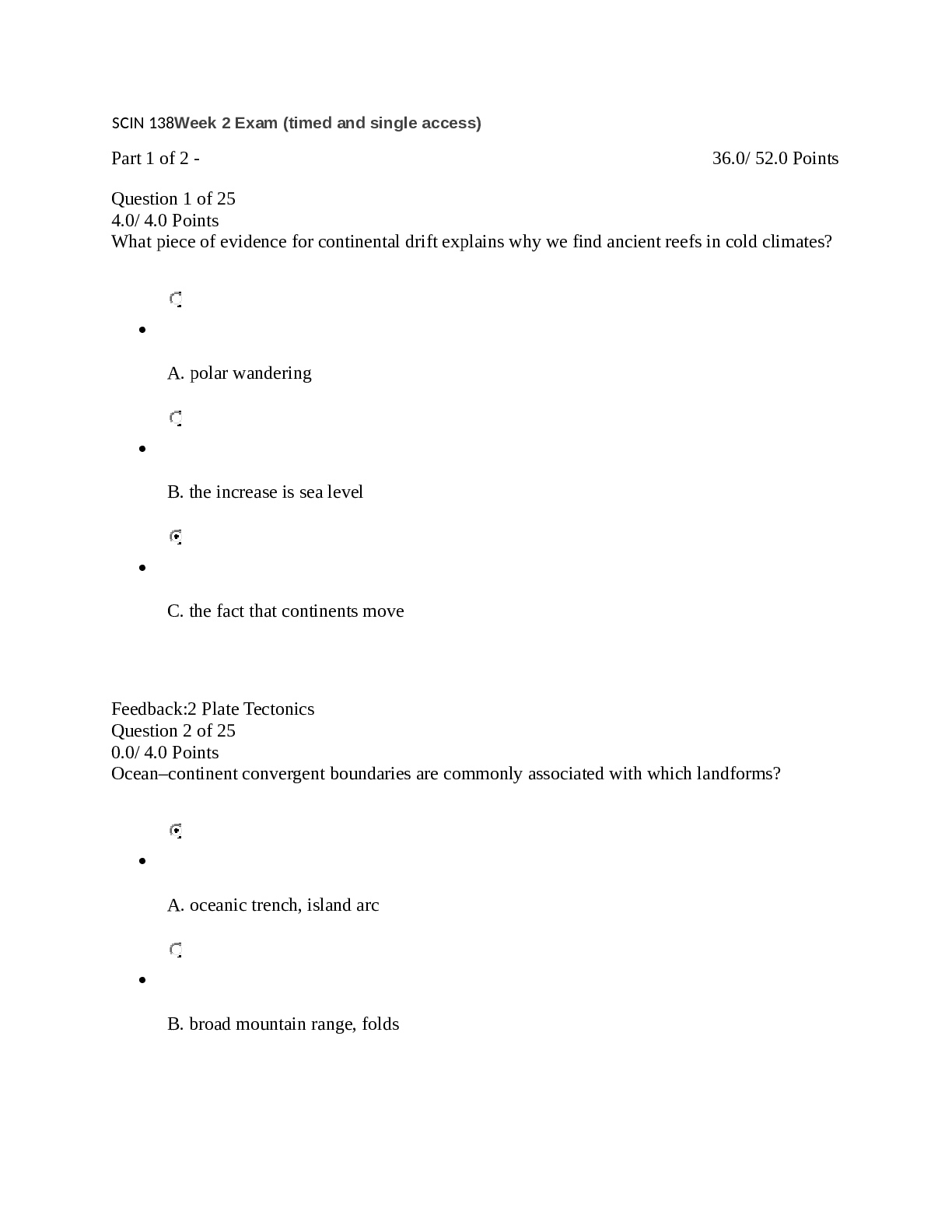
SCIN 138Week 2 Exam (timed and single access) Part 1 of 2 - 36.0/ 52.0 Points Question 1 of 25 4.0/ 4.0 Points What piece of evidence for continental drift explains why we find ancient reefs in co ld ... climates?  A. polar wandering  B. the increase is sea level  C. the fact that continents move Feedback:2 Plate Tectonics Question 2 of 25 0.0/ 4.0 Points Ocean–continent convergent boundaries are commonly associated with which landforms?  A. oceanic trench, island arc  B. broad mountain range, folds  C. volcanic arc, forearc basin Feedback:2 Plate Tectonics Question 3 of 25 0.0/ 4.0 Points Which characteristics describe convergent boundaries?  A. crust being neither created nor destroyed and shearing motion  B. deep sea trenches, the destruction of seafloor crust, and subduction  C. plates moving apart, the creation of new seafloor, and the Mid Ocean Ridge Feedback:2 Plate Tectonics Question 4 of 25 4.0/ 4.0 Points Which of the following statements is true?  A. Plate tectonics built on or expanded on continental drift.  B. Both theories have been proven false.  C. Continental drift built on or expanded on plate tectonics. Feedback:2 Plate Tectonics Question 5 of 25 4.0/ 4.0 Points The Wilson cycle shows all but which of the following?  A. how rocks cycle from one type to another  B. how water cycles on the Earth  C. how oceans open and close throughout geologic time Feedback:2 Plate Tectonics Question 6 of 25 4.0/ 4.0 Points Oceanic plates are composed of what rock type?  A. granite  B. quartz  C. basalt  D. diorite Feedback:2 Plate Tectonics Question 7 of 25 4.0/ 4.0 Points Which type of boundaries involve crust being neither created nor destroyed and shearing motion?  A. transform boundaries  B. divergent boundaries  C. convergent boundaries Feedback:2 Plate Tectonics Question 8 of 25 4.0/ 4.0 Points Ocean-to-continent convergent boundaries can produce all but which of the following?  A. volcanoes  B. mountains  C. new sea-floor Feedback:2 Plate Tectonics Question 9 of 25 4.0/ 4.0 Points Which of the following is the most accurate statement of how the Himalayas were formed?  A. They are actually the original elevation of the continent. As the erosion weathered away to give the current surface, it left the mountains behind.  B. During the last great flood, sediments were deposited that accumulated and were eventually eroded into mountains.  C. As the Indian plate moved into the Eurasian plate, the continents collided and buckled up to form mountains. Feedback:2 Plate Tectonics Question 10 of 25 0.0/ 4.0 Points Which piece of evidence renewed the scientific community's interest in continental drift?  A. how the continents fit together  B. the presence of similar fossils on opposite sides of the oceans  C. paleomagnetism  D. glacial evidence in warm climates Feedback:2.1.3 Development of Plate Tectonic Theory Question 11 of 25 4.0/ 4.0 Points Which of the following would not support Continental Drift?  A. You notice that the same fossil in Australia and Antarctica.  B. You notice that both North America and Africa have the same type of earthquakes and volcanoes.  C. You notice that a similar rock formation is found on both the west coast of Africa and the east coast of South America. Feedback:2 Plate Tectonics Question 12 of 25 4.0/ 4.0 Points Which characteristics describe transform boundaries?  A. plates moving apart, the creation of new seafloor, and the Mid Ocean Ridge  B. deep sea trenches, the destruction of seafloor crust, and subduction  C. crust being neither created nor destroyed and shearing motion Feedback:2 Plate Tectonics Question 13 of 25 0.0/ 4.0 Points The vast majority of Earth’s earthquakes and active volcanoes are located at  A. Mid Ocean Ridge  B. transform boundaries  C. convergent boundaries  D. divergent boundaries Feedback:2 Plate Tectonics Part 2 of 2 - Geologic Time 28.0/ 48.0 Points Question 14 of 25 4.0/ 4.0 Points In a series of undisturbed sedimentary rock layers, the oldest layers are  A. On the bottom  B. On the top  C. variable depending on location Feedback:Chapter 7 Geologic Time Question 15 of 25 4.0/ 4.0 Points Which stratigraphic principle states the fact that sedimentary rocks are deposited in layers perpendicular to the direction of gravity?  A. Original horizontality  B. Superposition  C. Cross-cutting relations  D. Faunal succession  E. Lateral continuity Feedback:Original horizontality states that layered rocks start out in horizontal layers perpendicular to gravity. Question 16 of 25 4.0/ 4.0 Points Which of the following is NOT a way of correlating rocks? [Show More]

Last updated: 3 years ago

Preview 1 out of 17 pages

Buy Now

Instant download

We Accept:

Payment methods accepted on Scholarfriends (We Accept)
Preview image of SCIN 138 Week 2 Exam- Questions and Answers Complete Solution Rated A100% document

Buy this document to get the full access instantly

Instant Download Access after purchase

Buy Now

Instant download

We Accept:

Payment methods accepted on Scholarfriends (We Accept)

Reviews( 0 )

$14.50

Buy Now

We Accept:

Payment methods accepted on Scholarfriends (We Accept)

Instant download

Can't find what you want? Try our AI powered Search

72
0

Document information


Connected school, study & course


About the document


Uploaded On

Mar 05, 2022

Number of pages

17

Written in

All

Seller


Profile illustration for browseAgrades
browseAgrades

Member since 4 years

26 Documents Sold

Reviews Received
2
1
1
0
2
Additional information

This document has been written for:

Uploaded

Mar 05, 2022

Downloads

 0

Views

 72

Document Keyword Tags

Recommended For You

Get more on EXAM »
$14.50
What is Scholarfriends

Scholarfriends.com Online Platform by Browsegrades Inc. 651N South Broad St, Middletown DE. United States.

We are here to help

We're available through e-mail, Twitter, Facebook, and live chat.
 FAQ
 Questions? Leave a message!

Follow us on
 Twitter

Copyright © Scholarfriends · High quality services·