*NURSING  >  NCLEX-PN  >  NCLEX-PN FINAL (All)

NCLEX-PN FINAL

Document Content and Description Below

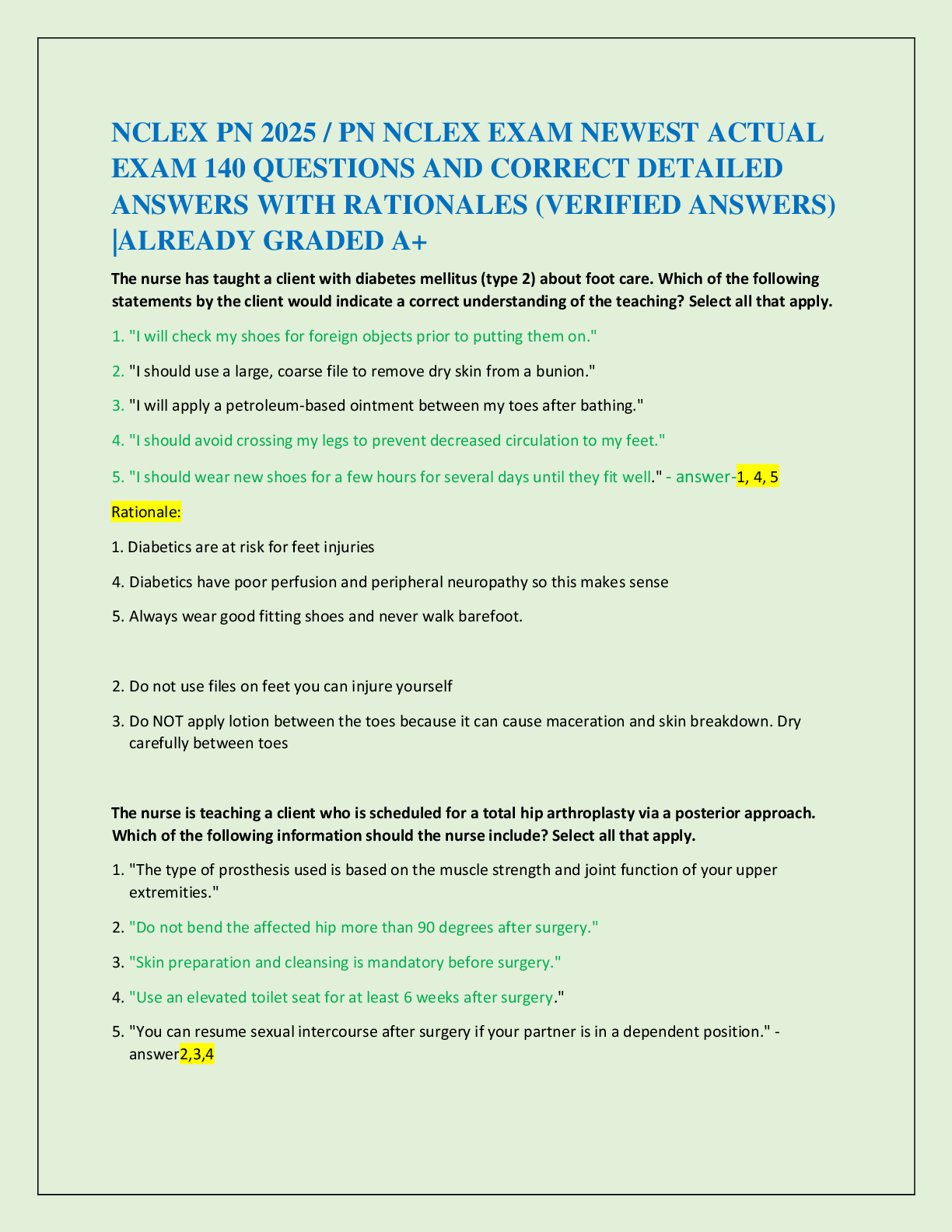
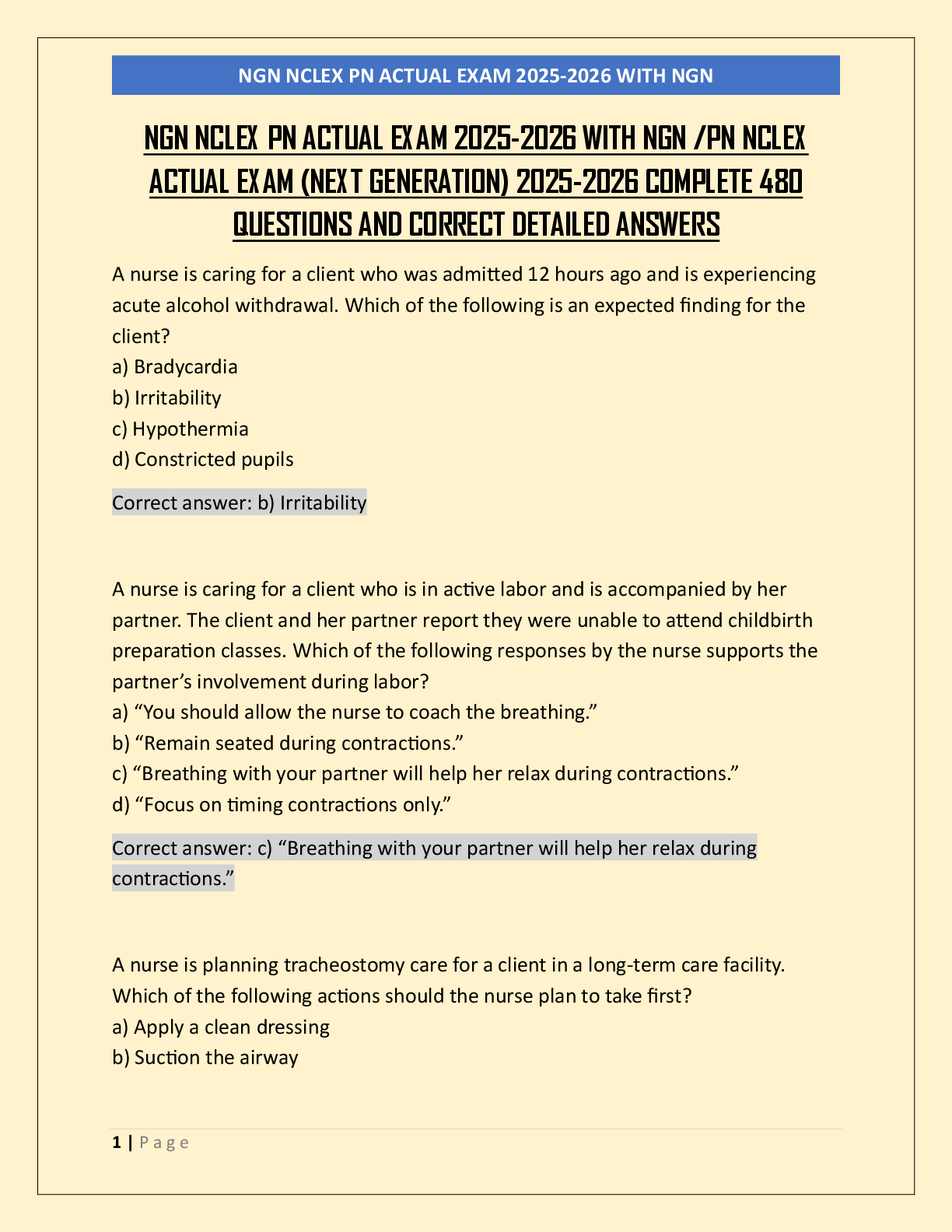
1. A 24-year-old female client is scheduled for surgery in the morning. Which of the following is the primary responsibility of the nurse? A. Taking the vital signs B. Obtaining the permit C. E ... xplaining the procedure D. Checking the lab work 2. The nurse is working in the emergency room when a client arrives with severe burns of the left arm, hands, face, and neck. Which action should receive priority? A. Starting an IV B. Applying oxygen C. Obtaining blood gases D. Medicating the client for pain 3. The nurse is visiting a home health client with osteoporosis. The client has a new prescription for alendronate (Fosamax). Which instruction should be given to the client? A. Rest in bed after taking the medication for at least 30 minutes B. Avoid rapid movements after taking the medication C. Take the medication with water only D. Allow at least 1 hour between taking the medicine and taking other medications 4. The nurse is making initial rounds on a client with a C5 fracture and crutchfield tongs. Which equipment should be kept at the bedside? A. A pair of forceps B. A torque wrench C. A pair of wire cutters D. A screwdriver 5. An infant weighs 7 pounds at birth. The expected weight by 1 year should be: A. 10 pounds B. 12 pounds C. 18 pounds D. 21 pounds 6. A client is admitted with a Ewing’s sarcoma. Which symptoms would be expected due to this tumor’s location? A. Hemiplegia B. Aphasia C. Nausea D. Bone pain 7. The nurse is caring for a client with epilepsy who is being treated with carbamazepine (Tegretol). Which laboratory value might indicate a serious side effect of this drug? A. Uric acid of 5mg/dL B. Hematocrit of 33% C. WBC 2,000 per cubic millimeter D. Platelets 150,000 per cubic millimeter 8. A 6-month-old client is admitted with possible intussuception. Which question during the nursing history is least helpful in obtaining information regarding this diagnosis? A. “Tell me about his pain.” B. “What does his vomit look like?” C. “Describe his usual diet.” D. “Have you noticed changes in his abdominal size?” 9. The nurse is assisting a client with diverticulosis to select appropriate foods. Which food should be avoided? A. Bran B. Fresh peaches C. Cucumber salad D. Yeast rolls 10. A client has rectal cancer and is scheduled for an abdominal perineal resection. What should be the priority nursing care during the post-op period? A. Teaching how to irrigate the illeostomy B. Stopping electrolyte loss in the incisional area C. Encouraging a high-fiber diet D. Facilitating perineal wound drainage 11. The nurse is performing discharge teaching on a client with diverticulitis who has been placed on a low-roughage diet. Which food would have to be eliminated from this client’s diet? A. Roasted chicken B. Noodles C. Cooked broccoli D. Custard 12. A client arrives in the emergency room with a possible fractured femur. The nurse should anticipate an order for: A. Trendelenburg position B. Ice to the entire extremity C. Buck’s traction D. An abduction pillow 13. A client with cancer is to undergo an intravenous pyelogram. The nurse should: A. Force fluids 24 hours before the procedure B. Ask the client to void immediately before the study C. Hold medication that affects the central nervous system for 12 hours pre- and post-test D. Cover the client’s reproductive organs with an x-ray shield 14. The nurse is caring for a client with a malignancy. The classification of the primary tumor is Tis. The nurse should plan care for a tumor: A. That cannot be assessed B. That is in situ C. With increasing lymph node involvement D. With distant metastasis 15. A client is 2 days post-operative colon resection. After a coughing episode, the client’s wound eviscerates. Which nursing action is most appropriate? A. Reinsert the protruding organ and cover with 4×4s B. Cover the wound with a sterile 4×4 and ABD dressing C. Cover the wound with a sterile saline-soaked dressing D. Apply an abdominal binder and manual pressure to the wound 16. The nurse is preparing a client for surgery. Which item is most important to remove before sending the client to surgery? A. Hearing aid B. Contact lenses C. Wedding ring D. Artificial eye 17. The nurse on the 3–11 shift is assessing the chart of a client with an abdominal aneurysm scheduled for surgery in the morning and finds that the consent form has been signed, but the client is unclear about the surgery and possible complications. Which is the most appropriate action? A. Call the surgeon and ask him or her to see the client to clarify the information B. Explain the procedure and complications to the client C. Check in the physician’s progress notes to see if understanding has been documented D. Check with the client’s family to see if they understand the procedure fully 18. The client with diabetes is preparing for discharge. During discharge teaching, the nurse assesses the client’s ability to care for himself. Which statement made by the client would indicate a need for follow-up after discharge? A. “I live by myself.” B. “I have trouble seeing.” C. “I have a cat in the house with me.” D. “I usually drive myself to the doctor.” 19. The client is receiving total parenteral nutrition (TPN). Which lab test should be evaluated while the client is receiving TPN? A. Hemoglobin B. Creatinine C. Blood glucose D. White blood cell count 20. The client with a myocardial infarction comes to the nurse’s station stating that he is ready to go home because there is nothing wrong with him. Which defense mechanism is the client using? A. Rationalization B. Denial C. Projection D. Conversion reaction 21. Which laboratory test would be the least effective in making the diagnosis of a myocardial infarction? A. AST B. Troponin C. CK-MB D. Myoglobin 22. The licensed practical nurse assigned to the post-partal unit is preparing to administer Rhogam to a postpartum client. Which woman is not a candidate for RhoGam? A. A gravida IV para 3 that is Rh negative with an Rh-positive baby B. A gravida I para 1 that is Rh negative with an Rh-positive baby C. A gravida II para 0 that is Rh negative admitted after a stillbirth delivery D. A gravida IV para 2 that is Rh negative with an Rh-negative baby 23. The first exercise that should be performed by the client who had a mastectomy is: A. Walking the hand up the wall B. Sweeping the floor C. Combing her hair D. Squeezing a ball 24. The client is scheduled for a Tensilon test to check for Myasthenia Gravis. Which medication should be kept available during the test? A. Atropine sulfate B. Furosemide C. Prostigmin D. Promethazine 25. The client is scheduled for a pericentesis. Which instruction should be given to the client before the exam? A. “You will need to lay flat during the exam.” B. “You need to empty your bladder before the procedure.” C. “You will be asleep during the procedure.” D. “The doctor will inject a medication to treat your illness during the procedure.” 26. To ensure safety while administering a nitroglycerine patch, the nurse should: A. Wear gloves B. Shave the area where the patch will be applied C. Wash the area thoroughly with soap and rinse with hot water D. Apply the patch to the buttocks 27. The physician has prescribed tranylcypromine sulfate (Parnate) 10mg bid. The nurse should teach the client to refrain from eating foods containing tyramine because it may cause: A. Hypertension B. Hyperthermia C. Melanoma D. Urinary retention 28. The child with seizure disorder is being treated with Dilantin (phenytoin). Which of the following statements by the patient’s mother indicates to the nurse that the patient is experiencing a side effect of Dilantin therapy? A. “She is very irritable lately.” B. “She sleeps quite a bit of the time.” C. “Her gums look too big for her teeth.” D. “She has gained about 10 pounds in the last 6 months.” 29. A 5-year-old is admitted to the unit following a tonsillectomy. Which of the following would indicate a complication of the surgery? A. Decreased appetite B. A low-grade fever C. Chest congestion D. Constant swallowing 30. A 6-year-old with cerebral palsy functions at the level of an 18-month- old. Which finding would support that assessment? A. She dresses herself. B. She pulls a toy behind her. C. She can build a tower of eight blocks. D. She can copy a horizontal or vertical line. 31. Which information obtained from the mother of a child with cerebral palsy most likely correlates to the diagnosis? A. She was born at 42 weeks gestation. B. She had meningitis when she was 6 months old. C. She had physiologic jaundice after delivery. D. She has frequent sore throats. 32. A 10-year-old is being treated for asthma. Before administering Theodur, the nurse should check the: A. Urinary output B. Blood pressure C. Pulse D. Temperature 33. An elderly client is diagnosed with ovarian cancer. She has surgery followed by chemotherapy with a fluorouracil (Adrucil) IV. What should the nurse do if she notices crystals and cloudiness in the IV medication? A. Discard the solution and order a new bag B. Warm the solution C. Continue the infusion and document the finding D. Discontinue the medication 34. The client is diagnosed with multiple myoloma. The doctor has ordered cyclophosphamide (Cytoxan). Which instruction should be given to the client? A. “Walk about a mile a day to prevent calcium loss.” B. “Increase the fiber in your diet.” C. “Report nausea to the doctor immediately.” D. “Drink at least eight large glasses of water a day.” 35. The client is taking rifampin 600mg po daily to treat his tuberculosis. Which action by the nurse indicates understanding of the medication? A. Telling the client that the medication will need to be taken with juice B. Telling the client that the medication will change the color of the urine C. Telling the client to take the medication before going to bed at night D. Telling the client to take the medication if night sweats occur 36. The client is taking prednisone 7.5mg po each morning to treat his systemic lupus errythymatosis. Which statement best explains the reason for taking the prednisone in the morning? A. There is less chance of forgetting the medication if taken in the morning. B. There will be less fluid retention if taken in the morning. C. Prednisone is absorbed best with the breakfast meal. D. Morning administration mimics the body’s natural secretion of corticosteroid. 37. A 20-year-old female has a prescription for tetracycline. While teaching the client how to take her medicine, the nurse learns that the client is also taking Ortho-Novum oral contraceptive pills. Which instructions should be included in the teaching plan? A. The oral contrace ...................................................CONTINUED [Show More]

Last updated: 3 years ago

Preview 1 out of 62 pages

Buy Now

Instant download

We Accept:

Payment methods accepted on Scholarfriends (We Accept)
Preview image of NCLEX-PN FINAL document

Buy this document to get the full access instantly

Instant Download Access after purchase

Buy Now

Instant download

We Accept:

Payment methods accepted on Scholarfriends (We Accept)

Reviews( 0 )

$22.00

Buy Now

We Accept:

Payment methods accepted on Scholarfriends (We Accept)

Instant download

Can't find what you want? Try our AI powered Search

124
0

Document information


Connected school, study & course


About the document


Uploaded On

Mar 06, 2022

Number of pages

62

Written in

All

Seller


Profile illustration for N-PRACTITIONER-MSN
N-PRACTITIONER-MSN

Member since 4 years

14 Documents Sold

Reviews Received
0
0
0
0
1
Additional information

This document has been written for:

Uploaded

Mar 06, 2022

Downloads

 0

Views

 124

Document Keyword Tags

More From N-PRACTITIONER-MSN

View all N-PRACTITIONER-MSN's documents »

Recommended For You

Get more on NCLEX-PN »

$22.00
What is Scholarfriends

Scholarfriends.com Online Platform by Browsegrades Inc. 651N South Broad St, Middletown DE. United States.

We are here to help

We're available through e-mail, Twitter, and live chat.
 FAQ
 Questions? Leave a message!


Copyright © Scholarfriends · High quality services·