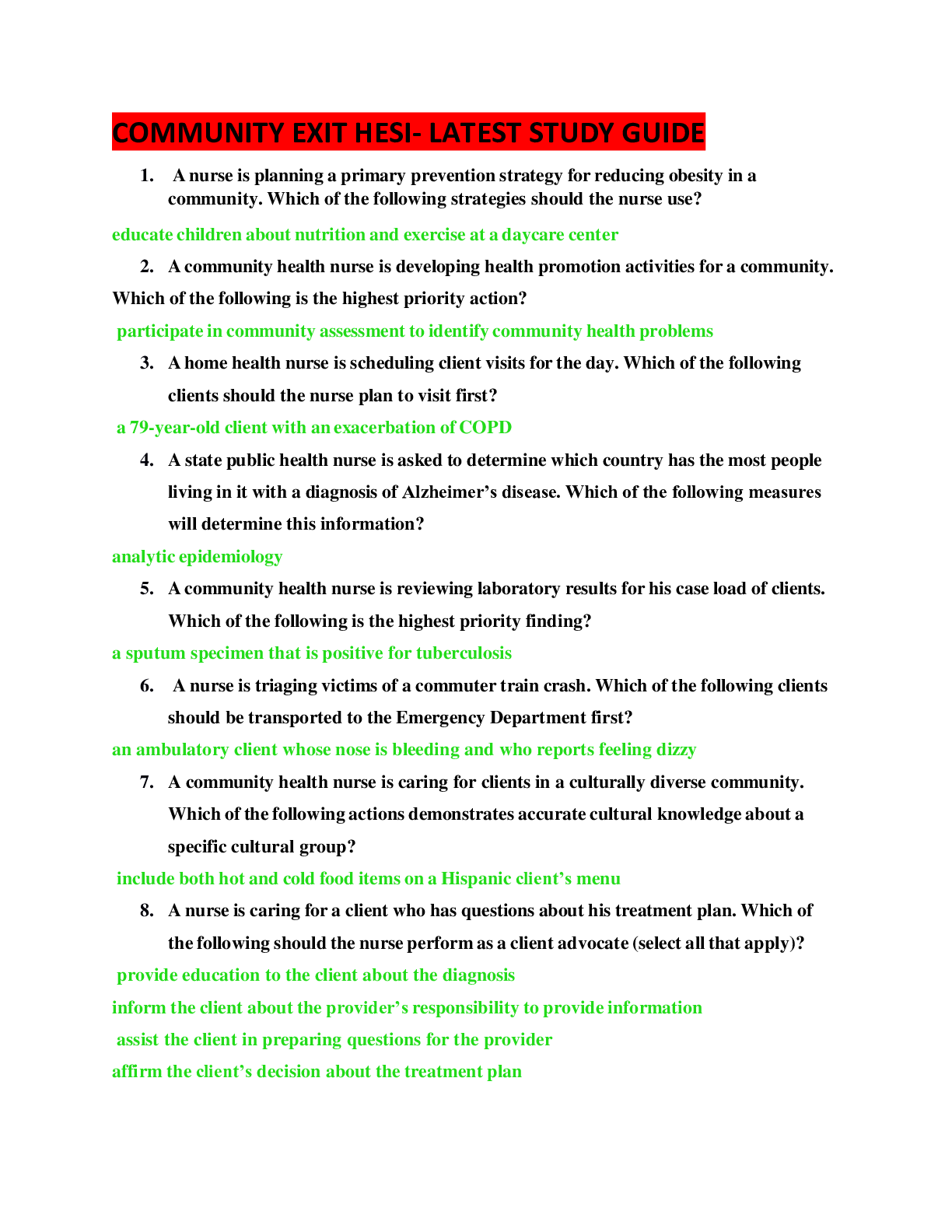
NUR 660 –PHARMACOLOGY MIDTERM UPDATED PRACTICE GUIDE
A child is diagnosed with hypothyroidism. The nurse anticipates an order for the drug of choice when treating children, which is what?
A) Liothyronine (Cytomel)
B)
...
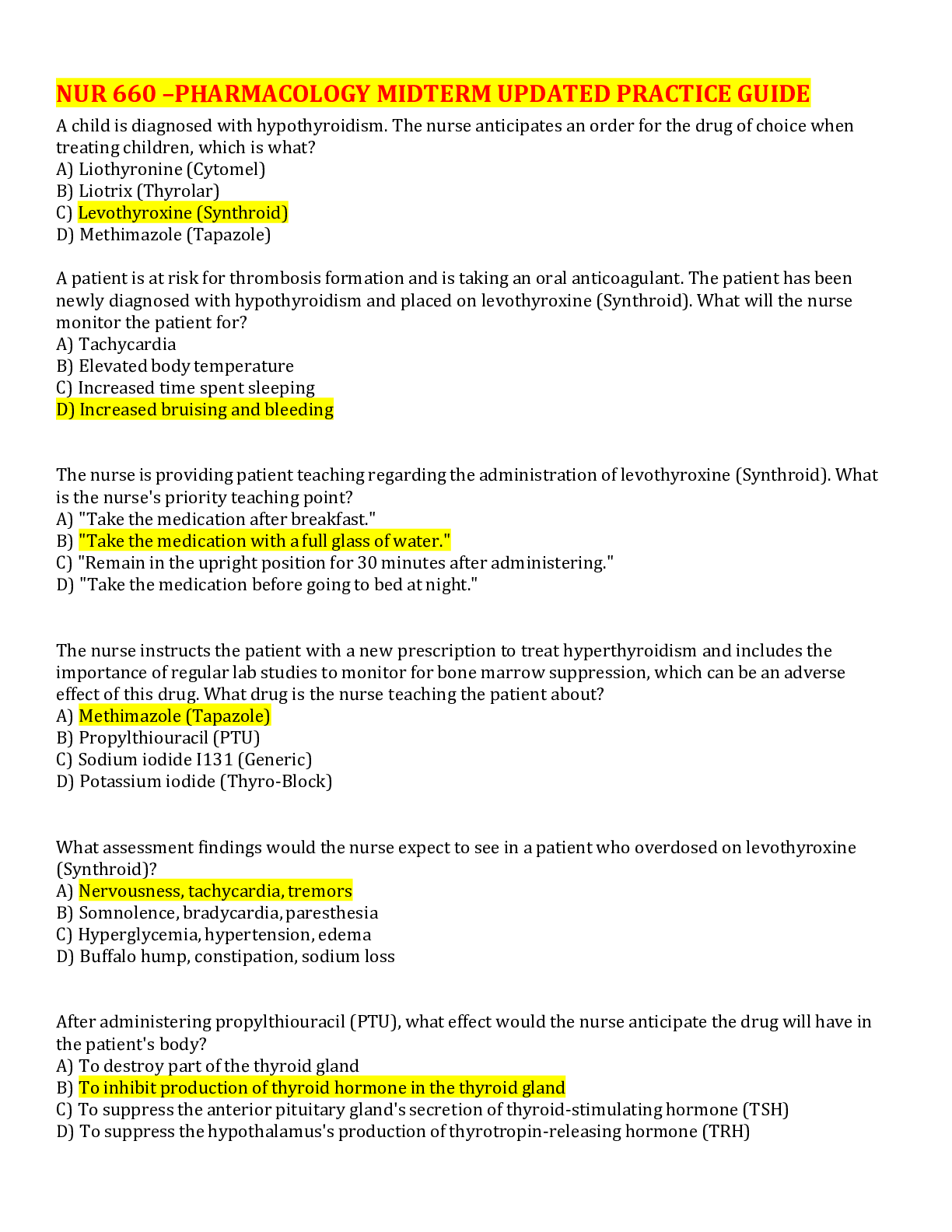
NUR 660 –PHARMACOLOGY MIDTERM UPDATED PRACTICE GUIDE
A child is diagnosed with hypothyroidism. The nurse anticipates an order for the drug of choice when treating children, which is what?
A) Liothyronine (Cytomel)
B) Liotrix (Thyrolar)
C) Levothyroxine (Synthroid)
D) Methimazole (Tapazole)
A patient is at risk for thrombosis formation and is taking an oral anticoagulant. The patient has been newly diagnosed with hypothyroidism and placed on levothyroxine (Synthroid). What will the nurse monitor the patient for?
A) Tachycardia
B) Elevated body temperature
C) Increased time spent sleeping D) Increased bruising and bleeding
The nurse is providing patient teaching regarding the administration of levothyroxine (Synthroid). What is the nurse's priority teaching point?
A) "Take the medication after breakfast."
B) "Take the medication with a full glass of water."
C) "Remain in the upright position for 30 minutes after administering."
D) "Take the medication before going to bed at night."
The nurse instructs the patient with a new prescription to treat hyperthyroidism and includes the importance of regular lab studies to monitor for bone marrow suppression, which can be an adverse effect of this drug. What drug is the nurse teaching the patient about?
A) Methimazole (Tapazole)
B) Propylthiouracil (PTU)
C) Sodium iodide I131 (Generic)
D) Potassium iodide (Thyro-Block)
What assessment findings would the nurse expect to see in a patient who overdosed on levothyroxine (Synthroid)?
A) Nervousness, tachycardia, tremors
B) Somnolence, bradycardia, paresthesia
C) Hyperglycemia, hypertension, edema
D) Buffalo hump, constipation, sodium loss
After administering propylthiouracil (PTU), what effect would the nurse anticipate the drug will have in the patient's body?
A) To destroy part of the thyroid gland
B) To inhibit production of thyroid hormone in the thyroid gland
C) To suppress the anterior pituitary gland's secretion of thyroid-stimulating hormone (TSH)
D) To suppress the hypothalamus's production of thyrotropin-releasing hormone (TRH)
The nurse provides teaching regarding levothyroxine to a 55-year-old patient diagnosed with Hashimoto's disease. What statement made by the patient does the nurse interpret to mean that the drug teaching had been understood?
A) "I can take this medication at any time of day."
B) "I should take this medication on an empty stomach in the morning."
C) "I may take this with a sip of water in the morning."
D) "If I feel nauseated, I may take this drug with an antacid."
The patient with hypothyroidism takes levothyroxine daily and has triiodothyronine (T3), thyroxine (T4), and thyroid-stimulating hormone (TSH) levels drawn in the laboratory to check appropriateness of prescribed dosage. What results would the nurse analyze as indicating the need for a higher dosage of medication?
A) Elevated TSH, elevated T3, and reduced T4 levels
B) Reduced TSH, elevated T3 and T4 levels C) Elevated TSH, reduced T3 and T4 levels
D) Reduced TSH, T3, and T4 levels
A patient presents at the clinic with complaints of weight loss despite an increased appetite. The nurse assesses this patient for what?
A) Chronic thyroiditis
B) Hypercalcemia
C) Hypothyroidism D) Hyperthyroidism
What patient will the nurse assess most closely for secondary hyperparathyroidism?
A) The 12-year-old patient with hypothyroidism
B) The 68-year-old patient with chronic renal failure
C) The 35-year-old patient with diabetes mellitus
D) The 48-year-old patient with hyperthyroidism
What drug would the nurse appropriately administer to the patient to treat hypothyroidism?
A) Teriparatide
B) Methimazole
C) Propylthiouracil D) Levothyroxine
The patient is 8 weeks pregnant and requires an antithyroid medication. The nurse identifies what drug as the drug of choice for this patient?
A) Propylthiouracil
B) Radioactive iodine
C) Alendronate
D) Methimazole
The nurse is discharging a patient with a new prescription for levothyroxine. What would the nurse teach the patient to report to her health care provider? (Select all that apply.)
A) Nervousness B) Insomnia
C) Chest pain
D) Loss of hair
E) Nausea
The nurse is teaching the patient how to take his newly prescribed alendronate and includes what teaching points? (Select all that apply.)
A) "Take the drug in the morning."
B) "Wait 60 minutes before eating breakfast." C) "Take the drug with a full glass of water."
D) "Remain upright for 30 minutes after taking the medication."
E) "Eat a breakfast high in calcium after taking the medication."
The nurse is discussing the endocrine system with a class of nursing students. What substance would the nurse label as a hormone?
A) Acetylcholine B) Norepinephrine
C) Nucleic acid
D) Serotonin
What factors contribute to determining the drug of choice for a patient with epilepsy? (Select all that apply.)
A) Age
B) Type of epilepsy
C) Patient characteristics
D) Preferred adverse effect
E) Gender
The nurse anticipates a reduced dosage due to cultural differences when caring for patients from what cultural groups? (Select all that apply.)
A) Arab Americans B) Asian Americans
C) African Americans
D) White American
E) Native American
1. A child is diagnosed with hypothyroidism. The nurse anticipates an order for the drug of choice when treating children, which is what?
A) Liothyronine (Cytomel)
B) Liotrix (Thyrolar)
C) Levothyroxine (Synthroid)
D) Methimazole (Tapazole)
2. A patient is at risk for thrombosis formation and is taking an oral anticoagulant. The patient has been newly diagnosed with hypothyroidism and placed on levothyroxine (Synthroid). What will the nurse monitor the patient for?
A) Tachycardia
B) Elevated body temperature
C) Increased time spent sleeping D) Increased bruising and bleeding
3. The nurse is providing patient teaching regarding the administration of levothyroxine (Synthroid). What is the nurse's priority teaching point?
A) "Take the medication after breakfast."
B) "Take the medication with a full glass of water."
C) "Remain in the upright position for 30 minutes after administering."
D) "Take the medication before going to bed at night."
4. The nurse instructs the patient with a new prescription to treat hyperthyroidism and includes the importance of regular lab studies to monitor for bone marrow suppression, which can be an adverse effect of this drug. What drug is the nurse teaching the patient about?
A) Methimazole (Tapazole)
B) Propylthiouracil (PTU)
C) Sodium iodide I131 (Generic)
D) Potassium iodide (Thyro-Block)
5. What assessment findings would the nurse expect to see in a patient who overdosed on levothyroxine (Synthroid)?
A) Nervousness, tachycardia, tremors
B) Somnolence, bradycardia, paresthesia
C) Hyperglycemia, hypertension, edema
D) Buffalo hump, constipation, sodium loss
6. After administering propylthiouracil (PTU), what effect would the nurse anticipate the drug will have in the patient's body?
A) To destroy part of the thyroid gland
B) To inhibit production of thyroid hormone in the thyroid gland
C) To suppress the anterior pituitary gland's secretion of thyroid-stimulating hormone (TSH)
D) To suppress the hypothalamus's production of thyrotropin-releasing hormone (TRH)
7. The nurse provides teaching regarding levothyroxine to a 55-year-old patient diagnosed with Hashimoto's disease. What statement made by the patient does the nurse interpret to mean that the drug teaching had been understood?
A) "I can take this medication at any time of day."
B) "I should take this medication on an empty stomach in the morning."
C) "I may take this with a sip of water in the morning."
D) "If I feel nauseated, I may take this drug with an antacid."
8. The patient with hypothyroidism takes levothyroxine daily and has triiodothyronine (T3), thyroxine (T4), and thyroid-stimulating hormone (TSH) levels drawn in the laboratory to check appropriateness of prescribed dosage. What results would the nurse analyze as indicating the need for a higher dosage of medication?
A) Elevated TSH, elevated T3, and reduced T4 levels
B) Reduced TSH, elevated T3 and T4 levels
C) Elevated TSH, reduced T3 and T4 levels
D) Reduced TSH, T3, and T4 levels
9. A patient presents at the clinic with complaints of weight loss despite an increased appetite. The nurse assesses this patient for what?
A) Chronic thyroiditis
B) Hypercalcemia
C) Hypothyroidism
D) Hyperthyroidism
10. What patient will the nurse assess most closely for secondary hyperparathyroidism?
A) The 12-year-old patient with hypothyroidism
B) The 68-year-old patient with chronic renal failure
C) The 35-year-old patient with diabetes mellitus
D) The 48-year-old patient with hyperthyroidism
11. What drug would the nurse appropriately administer to the patient to treat hypothyroidism?
A) Teriparatide
B) Methimazole
C) Propylthiouracil
D) Levothyroxine
12. The patient is 8 weeks pregnant and requires an antithyroid medication. The nurse identifies what drug as the drug of choice for this patient?
A) Propylthiouracil
B) Radioactive iodine
C) Alendronate
D) Methimazole
13. The nurse is discharging a patient with a new prescription for levothyroxine. What would the nurse teach the patient to report to her health care provider? (Select all that apply.)
A) Nervousness
B) Insomnia
C) Chest pain
D) Loss of hair
E) Nausea
14. The nurse is teaching the patient how to take his newly prescribed alendronate and includes what teaching points? (Select all that apply.)
A) "Take the drug in the morning."
B) "Wait 60 minutes before eating breakfast."
C) "Take the drug with a full glass of water."
D) "Remain upright for 30 minutes after taking the medication."
E) "Eat a breakfast high in calcium after taking the medication."
15. The nurse is discussing the endocrine system with a class of nursing students. What substance would the nurse label as a hormone?
A) Acetylcholine
B) Norepinephrine
C) Nucleic acid
D) Serotonin
16. What organ should the nurse recognize as the coordinating center for the nervous and endocrine responses to internal and external stimuli?
A) Hypothalamus
B) Pituitary gland
C) Thyroid gland
D) Parathyroid gland
17. What criteria can the nurse use to describe all hormones?
A) They are produced in very large amounts.
B) They circulate until they are used by receptor cells.
C) They are secreted directly into the tissue where they react.
D) They travel in the blood to specific receptor sites.
18. The nurse explains the end result of the hypothalamus in regulating the central nervous system (CNS), autonomic nervous system (ANS), and endocrine system is what?
A) Regulation of the negative feedback system
B) Creation of a diurnal rhythm
C) Maintenance of homeostasis
D) Production of prolactin-inhibiting factor (PIF)
19. The nurse administers an exogenous hormone to the patient. How does the nurse's action impact the endocrine system? (Select all that apply.)
A) May decrease exogenous hormone levels
B) May increase hormone levels in the body
C) May stop production of releasing and stimulating hormones
D) May lead to a decrease in the normal production of the hormone
E) May increase the endogenous hormone levels
20. A student asks the pharmacology instructor to explain the action of anticholinergic agents. What would be the instructor's best response?
A) They block nicotinic receptors.
B) They compete with serotonin for muscarinic acetylcholine receptor sites.
C) They act to block the effects of the parasympathetic nervous system.
D) They increase norepinephrine at the neuromuscular junction.
21. A 73-year-old male with Parkinson's disease comes to the clinic for routine care. The man has a comorbidity of benign prostatic hyperplasia (BPH). An anticholinergic drug is prescribed for the patient. What is the priority teaching point the nurse must give to the patient in regard to his medication?
A) "Avoid excessively hot environments."
B) "Avoid driving his car while taking the drug."
C) "Call his doctor if he cannot urinate."
D) "Take the drug with food to avoid gastrointestinal (GI) upset."
22. A patient has been given atropine to cause mydriasis and cycloplegia. What is the expected outcome for this patient?
A) Constricted pupils and blurred vision
B) Dilated pupils and improved vision
C) Dilated pupils and blurred vision
D) Dry eyes and constricted pupils
23. Because the effects of atropine are dose related, at what dose of atropine would the nurse expect to see a patient having difficulty speaking?
A) 0.5 mg
B) 1.0 mg
C) 2.0 mg
D) 5.0 mg
24. Because of the systemic effects of anticholinergic drugs, the nurse understands that older adults using these drugs are susceptible to what?
A) Heat stroke
B) Diarrhea
C) Urinary frequency
D) Hypotension
25. Anticholinergics have varied effects on the body. What is one of those effects?
A) Preventing vagal stimulation
B) Stimulating the release of acetylcholine
C) Increasing respiratory tract secretions
D) Increasing secretion of sweat glands
26. Anticholinergic drugs are used in ophthalmology because they produce what effect?
A) Sedation
B) Pupil dilation
C) Pupil constriction
D) Decreased lacrimal secretions
27. The nurse administers atropine preoperatively for what purpose?
A) Providing sedation
B) Dilating the pupils
C) Relaxing bladder muscles
D) Decreasing secretions
28. When the nurse administers an anticholinergic drug to a child, the nurse would carefully assess for what effect that is more likely to occur in children than in adults?
A) Rashes
B) Pupil dilation
C) Heat intolerance
D) Tachycardia
29. A 72-year-old female patient is being discharged home from the hospital on newly prescribed anticholinergic drugs. A referral to the home health nurse has been made. What priority teaching point will the home health nurse emphasize when discussing the patient's drugs?
A) "Do not drive or use machinery.
B) "Take lots of hot baths or showers."
C) "Keep the house warm to avoid a chill."
D) "Limit intake of fluids."
30. The patient, who takes an anticholinergic medication, tells the nurse how much he or she enjoys experimenting with different herbal teas. What herbs will the nurse caution the patient to avoid? (Select all that apply.)
A) Burdock
B) Thyme
C) Rosemary
D) Parsley
E) Tumeric
31. What does parasympathetic nervous system blockade cause? (Select all that apply.)
A) Decrease in heart rate
B) Decrease in urinary bladder tone
C) Increase in heart rate
D) Pupil constriction
E) Decrease in gastrointestinal (GI) activity
32. The patient was involved in a motor vehicle accident and experienced a severe closed head injury resulting in increased intracranial pressure. While intubating the patient, his or her heart rate dropped and did not return to acceptable levels after the tube was in place so the nurse received an order to administer atropine. The physician is performing an exam to determine whether brain death has occurred. What assessment for brain death will be postponed until all atropine is excreted and no longer exerting an effect.
A) Pupil response
B) Electroencephalogram
C) Brainstem reflexes
D) Computed tomographic scan of the brain
33. A student asks the pharmacology instructor to describe the function of a cholinergic agonist. What would the instructor reply?
A) Cholinergic agonists increase the activity of dopamine receptor sites throughout the brain and spinal cord.
B) Cholinergic agonists decrease the activity of gamma-aminobutyric acid (GABA) receptor sites throughout the body.
C) Cholinergic agonists increase the activity of acetylcholine receptor sites throughout the body.
D) Cholinergic agonists decrease the activity of norepinephrine receptor sites throughout the brain and spinal cord.
34. An Alzheimer's patient taking donepezil (Aricept) has a complete blood count that indicates he or she is anemic. What drug taken in combination with donepezil could be the cause of the anemia?
A) Cimetidine (Tagamet)
B) Ibuprofen (Advil)
C) Diltiazem (Cardizem)
D) Furosemide (Lasix)
35. When the nurse administers a cholinergic agonist to the patient, the nurse's expectation is that what system will be stimulated?
A) Sympathetic nervous system
B) Parasympathetic nervous system
C) Central nervous system
D) Voluntary nervous system
36. The nurse is caring for a patient who has indirect-acting cholinergic agonists prescribed to treat myasthenia gravis. When administering this classification of drug, the nurse should assess the patient for toxic effects of the drugs including what?
A) Paralytic ileus
B) Abdominal distension
C) Hypertension
D) Muscle weakness
37. A 77-year-old man is brought to the emergency department with a cholinergic overdose. The nurse knows that older adults are likely to have a greater number of adverse drug effects for what reason?
A) They are more likely to take the medications inconsistently.
B) All older adults have some type of chronic health problem.
C) Older adults have a number of different physiological changes.
D) Older adults have a poor memory and are more likely to overdose.
38. A patient has been newly diagnosed with myasthenia gravis. What important teaching will the nurse provide the family?
A) If one dose of medication is missed double the next dose B) The warning signs of drug overdose
C) How to encourage activity when the patient is tired
D) Importance of monitoring level of consciousness
39. A new patient has come to the clinic. The patient tells the nurse he or she takes donepezil (Aricept). What is the priority nursing assessment related to the medication? (Select all that apply.)
A) Nutritional status B) Blood pressure
C) History of incontinence
D) Breath sounds
E) Muscle strength
40. What family of drugs is used in the treatment of myasthenia gravis?
A) Direct-acting cholinergic agonists
B) Muscarinic inhibitors
C) Indirect-acting cholinergic agonists
D) Nicotinic agonists
41. The nurse administers bethanechol to the patient on an empty stomach for what purpose?
A) To promote rapid absorption
B) To prevent destruction of the drug
C) To reduce irritation of stomach lining D) To decrease nausea and vomiting
42. The nurse administers an adrenergic blocking agent in order to prevent release of what neurotransmitter?
A) Epinephrine
B) Norepinephrine
C) Serotonin
D) Gamma-aminobutyric acid (GABA)
43. What medication, if ordered for an 8-year-old patient, should the nurse question? (Select all that apply.)
A) Amiodarone (Cordarone) 400 mg orally per 24 hours B) Labetalol (Normodyne) 100 mg orally b.i.d.
C) Phentolamine (Regitine) 1 mg intramuscularly 1 to 2 hours before surgery
D) Prazosin (Minipress) 3 mg orally t.i.d. E) Carvedilol (Coreg) 6.25 mg orally b.i.d.
44. A nurse is working with a patient who is taking an adrenergic blocking agent. While assessing the patient's medication history, the nurse discovers that the patient takes several alternative therapies. What herb is the nurse concerned may interact with the adrenergic blocking agent and affect the patient's blood glucose level?
A) Ginseng
B) Nightshade C) Di huang
D) Saw Palmetto
45. A priority nursing assessment for a patient who is to receive an alpha- or beta-adrenergic blocking agent would be what?
A) Monitoring respiratory rate
B) Checking blood glucose level
C) Measuring urine output D) Assessing heart rate
46. What would be the teaching priority for a diabetic patient being treated with a nonselective beta- blocker?
A) To take his own pulse
B) To weigh himself once a week at the same time of day
C) To avoid smoke-filled rooms
D) To understand signs and symptoms of hypo- or hyperglycemic reaction
47.
The nurse is caring for a patient who is receiving an adrenergic blocking agent. While writing the care plan for this patient what nursing diagnoses would be most appropriate concerning comfort?
A) Acute pain related to cardiovascular and systemic effects
B) Decreased cardiac output related to cardiovascular effects
C) Ineffective airway clearance related to lack of bronchodilating effects
D) Deficient knowledge regarding drug therapy
48. A nurse is providing discharge instructions to a patient who is taking atenolol (Tenormin) to treat hypertension. What would the nurse teach the patient regarding a possible drug-drug interaction?
A) Antibiotics
B) Oral contraceptives
C) Nonsteroidal anti-inflammatory drugs (NSAIDs)
D) Antifungal agents
49. A busy patient with many responsibilities is to have a medication ordered to treat her hypertension. To increase compliance with drug therapy, what drug would be a good choice for this patient?
A) Acebutolol (Sectral)
B) Atenolol (Tenormin)
C) Bisoprolol (Zebeta)
D) Metoprolol (Lopressor)
50. The nurse provides patient teaching for a patient who has a new order for nadolol (Corgard) to treat hypertension. What statement by the patient concerning nadolol (Corgard) would indicate that the teaching has been effective?
A) "I should cover my head at all times while I am outdoors."
B) "Since I am taking this drug, I no longer need to worry about diet and exercise."
C) "I will not stop taking this drug abruptly and will talk to my doctor before discontinuing."
D) "I may have a very dry mouth while taking this drug."
51. A patient with benign prostatic hypertrophy (BPH) has been prescribed prazosin (Minipress) and asks the nurse what this is going to do for him. The nurse's response will include what action to explain the purpose of taking this medication?
A) Decreasing vascular tone and vasodilation
B) Reducing the size of the prostate to reduce pressure on the urethra C) Relaxing the bladder and prostate and improving urine flow
D) Lowering blood pressure
52. The nurse is caring for a 55-year-old patient receiving metoprolol (Lopressor). What statement by the patient would lead the nurse to believe that he needs additional instruction?
A) "If I have side effects from the medication, I will contact my physician before I stop taking it." B) "I can take over-the-counter (OTC) cold medication while on metoprolol."
C) "I will take the medication on an empty stomach."
D) "I will report a weight gain of 2 pounds or more in 1 week."
53. Before administering a nonselective adrenergic blocker, what should the nurse assess? A) Pulse and blood pressure
B) Bowel sounds and appetite
C) Serum albumin level
D) Serum sodium and potassium levels
54. What assessment finding indicates to the nurse that timolol (Timoptic) has been effective?
A) The patient's blood pressure increases.
B) The patient's intraocular pressure is reduced.
C) The patient's pulse is reduced.
D) The patient's angina is reduced.
55. The student nurse is studying for a pharmacology exam and notices that many of the adrenergic blocking antagonists drugs studied in class have what suffix?
A) -aine B) -lol
C) -azole
D) -triptan
56. The nurse assesses the patient receiving phentolamine (Regitine) and suspects what finding is an adverse effect of the medication?
A) Hypertension
B) Wheezing C) Tachycardia
D) Depressed respirations
57. The home care nurse is caring for a patient newly prescribed a nonselective beta-blocking agent. What would the nurse include in the teaching plan related to this drug? (Select all that apply.)
A) Take with meals.
B) Change position slowly.
C) Avoid driving or operating hazardous machinery.
D) Warn of possible increase in libido.
E) Increase activity levels as much as possible.
58. The nurse is discharging a 35-year-old patient with diabetes who has been prescribed an adrenergic blocking agent. What is the priority teaching point for the nurse to discuss with this patient?
A) "Monitor blood glucose levels closely and report any instability"
B) "Document signs and symptoms of hyperglycemia and hypoglycemia"
C) "Reduce carbohydrate intake more than usual while taking the new drug"
D) "Increase insulin dosage to compensate for the drug's effect in increasing blood sugar"
59. The home care nurse is providing teaching for a 59-year-old patient taking a nonselective beta- blocker. The nurse teaches the patient the importance of notifying the prescribing physician when what occurs related to this medication?
A) If the patient's pulse stays above 100 bpm for 3 or more days B) If the patient has a sudden onset of a cough
C) If the patient falls
D) If the patient's pulse falls below 60 bpm for 3 or more days
60. The labor and delivery nurse assists with the delivery of a newborn to a woman taking an adrenergic blocker for a congenital heart defect. What organ systems may be affected in the newborn by these drugs? (Select all that apply.)
A) Cardiovascular B) Respiratory
C) Central nervous system (CNS)
D) Gastrointestinal (GI)
E) Genitourinary (GU)
61. The specificity of the adrenergic blocking agents allows the clinician to select a drug to do what? A) Have the desired effect
B) Multiply undesired effects
C) Increase specificity with higher serum blood levels
D) Improving concentration in the body
62. What agents are used primarily to treat cardiac-related conditions? (Select all that apply.) A) Nonselective adrenergic blocking agents
B) Nonselective alpha-adrenergic blocking agents
C) Alpha1-selective adrenergic blocking agents D) Nonselective beta-adrenergic blocking agents E) Beta1-selective adrenergic blocking agents
63. The 64-year-old patient has smoked
CONTINUED............DOWNLOAD FOR MORE REVISION GUIDE AND BEST SCORES
[Show More]


.png)












 BMAL 590- QUANTITATIVE RESEARCH TECHNIQUES AND STATISTICS TEST WITH SUMMARIZED STUDY GUIDE.png)