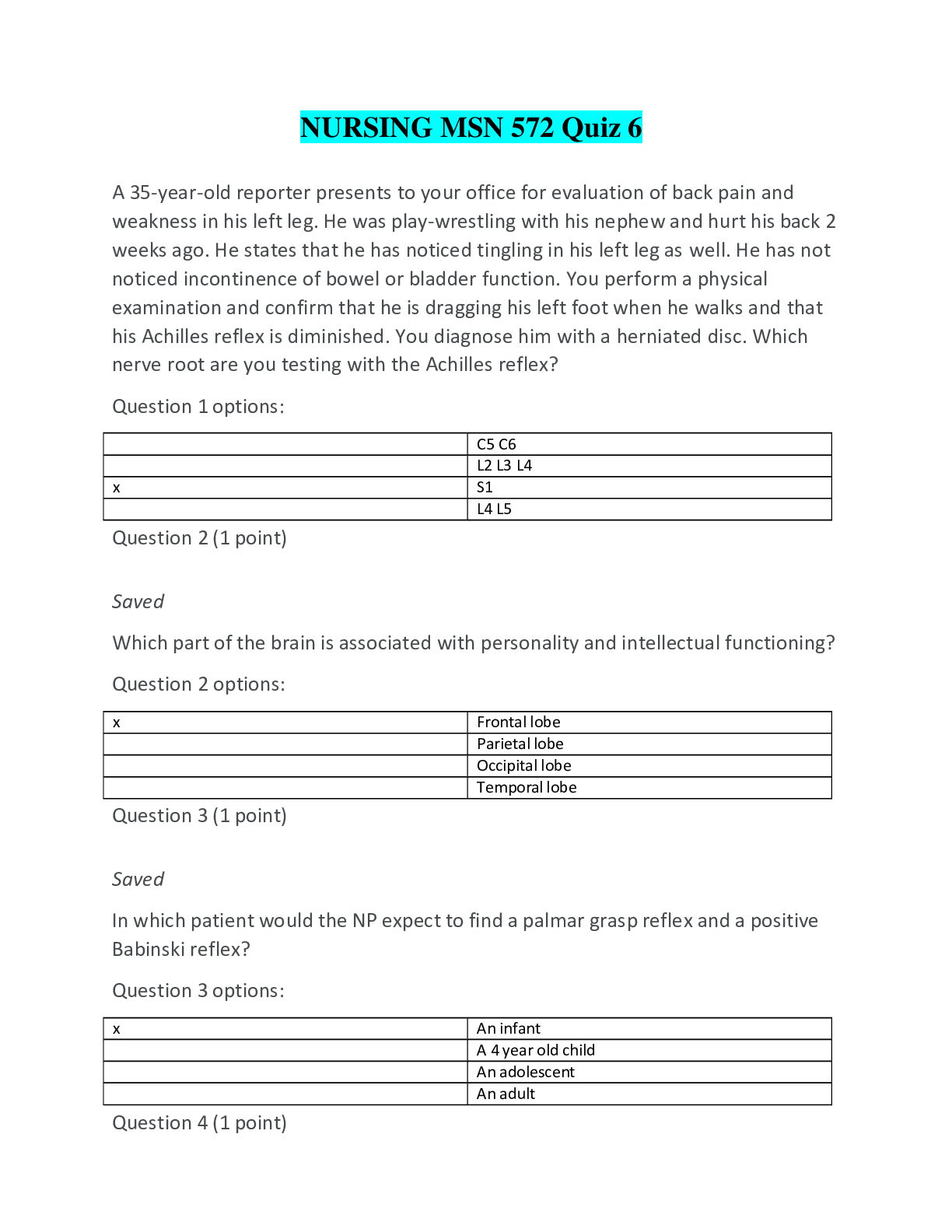
MSN 572 Quiz 6. A 35-year-old reporter presents to your office for evaluation of back pain and weakness in his left leg. He was play-wrestling with his nephew and hurt his back 2 weeks ago. He states that he has noticed
...
MSN 572 Quiz 6. A 35-year-old reporter presents to your office for evaluation of back pain and weakness in his left leg. He was play-wrestling with his nephew and hurt his back 2 weeks ago. He states that he has noticed tingling in his left leg as well. He has not noticed incontinence of bowel or bladder function. You perform a physical examination and confirm that he is dragging his left foot when he walks and that his Achilles reflex is diminished. You diagnose him with a herniated disc. Which nerve root are you testing with the Achilles reflex? Question 1 options: C5 C6 L2 L3 L4 S1 L4 L5 Question 2 (1 point) Saved Which part of the brain is associated with personality and intellectual functioning? Question 2 options: Frontal lobe Parietal lobe Occipital lobe Temporal lobe Question 3 (1 point) Saved In which patient would the NP expect to find a palmar grasp reflex and a positive Babinski reflex? Question 3 options: An infant A 4 year old child An adolescent An adult Question 4 (1 point) Saved In long-standing and poorly controlled hypertension, white matter tracts in the brain are subjected to arteriosclerotic affects. Which one of the following is most vulnerable to this process? Question 4 options: Thalamus Basal ganglia Reticular activating system Diencephalon Internal capsule Question 5 (1 point) Saved A new mom brings in her six month old baby for not being able to keep his eyes together when looking to the left. On exam both of his eyes appear in alignment with conjugate gaze, upon looking to the right. However when looking to the left, the baby’s left eye stays in the forward gays position while the right continues on with full adduction to the left. The eyes appear out of alignment. Which cranial nerve is responsible for the dysfunction in looking left? Question 5 options: The left abducens nerve. The right oculomotor nerve The right abducens nerve The left oculomotor nerve The right Trochlear nerve The left Trochlear nerve Question 6 (1 point) Saved Which cranial nerve injury may cause anosmia in the patient? Question 6 options: Cranial nerve I (olfactory nerve) Cranial nerve II (optic nerve) Cranial nerve III (oculomotor nerve) Cranial nerve IV (trochlear nerve) Question 7 (1 point) Saved A 70-year-old retired musician is brought to your clinic for a hospital follow-up visit after sustaining a stroke. He is able to articulate words but they sound slurred or indistinct. As the astute NP student you would document his speech as: Question 7 options: Dysarthria Dysphonia Dysphagia Aphasia Question 8 (1 point) Saved A 22-year-old daycare worker comes to the clinic for evaluation of fever as high as 103.5°F headache and neck pain. She has photophobia and neck stiffness. During the physical examination you flex the patient's leg at both the hip and the knee and then straighten her knee to elicit meningeal irritation. The patient experiences severe pain. The name of this sign is: Question 8 options: Kernig's sign Brudzinski's sign Babinski's sign Lachman's sign Question 9 (1 point) Saved A 25-year-old housewife presents to the clinic for evaluation of paralysis in her face. She has a history of an upper respiratory infection 2 weeks before the onset of these symptoms. She states that her face is drooping and that she is unable to close her eye. On physical examination you note that her forehead is smooth on the right side her palpebral fissure appears widened and her nasolabial fold appears flattened and she is drooling. Based on this information what is the most likely diagnosis? Question 9 options: Cortical stroke Bell's palsy Horner's syndrome Stress reaction Question 10 (1 point) Saved You are evaluating a 55-year-old teacher for altered mental status. You are trying to distinguish between delirium and dementia. All of the following statements are true about delirium EXCEPT: Question 10 options: Delirium has an acute onset. In delirium there is always a disturbed level of consciousness. Orientation is fairly well maintained but becomes impaired in the later stages of illness. Attention fluctuates Question 11 (1 point) Saved Which nerve roots are tested when the patellar reflex is checked? Question 11 options: C3 C4 L2 L3 L4 T10 T11 T12 C5 C6 Question 12 (1 point) Saved Which of the following is a disease-specific risk factor for stroke? Question 12 options: Obstructive Sleep Apnea Epilepsy Smoking Alcohol use Question 13 (1 point) Saved What is the maximum score given to a patient in the Mini-Mental State Examination (MMSE)? Question 13 options: 5 20 25 30 Question 14 (1 point) Saved Which of the following cranial nerves is responsible for lateral deviation of the eye: Question 14 options: CN II CN III CN IV CN VI Question 15 (1 point) Saved What are the components of a reflex arc? Question 15 options: Nucleus Sensory nerve & motor nerve Motor nerve Cranial nerve Sensory nerve Sensory nerve Neuromuscular junction motor nerve Motor nerve and sensory nerve Question 16 (1 point) Saved While assessing a patient the provider finds that the patient is an at-risk drinker. Which statement by the patient led the provider to conclude this? Question 16 options: I drink 5 alcoholic drinks per week. I drink 6 alcoholic drinks per week. I drink 1 alcoholic drink per occasion. I drink 4 alcoholic drinks per occasion. Question 17 (1 point) Saved
[Show More]