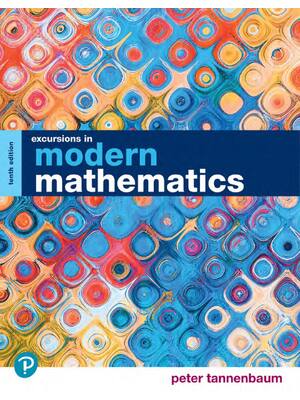
[eBook] [PDF] Excursions in Modern Mathematics, 9th Edition By Peter Tannenbaum Excursions in Modern Mathematics
Excursions in Modern Mathematics
Contents
Preface
From the Author
Outline
A Final Word to the Reader
...
[eBook] [PDF] Excursions in Modern Mathematics, 9th Edition By Peter Tannenbaum Excursions in Modern Mathematics
Excursions in Modern Mathematics
Contents
Preface
From the Author
Outline
A Final Word to the Reader
New in This Edition
Resources for Success MyMathLab® Online Course for Excursions in Modern Mathematics, 9th Edition by Peter Tannenbaum (access code required)
Resources for Success
Instructor Resources
Student Resources
Part 1 Social Choice
1 The Mathematics of Elections The Paradoxes of Democracy
1.1 The Basic Elements of an Election
Preference Ballots and Preference Schedules
Ties
1.2 The Plurality Method
1.3 The Borda Count Method
1.4 The Plurality-with-Elimination Method
1.5 The Method of Pairwise Comparisons
1.6 Fairness Criteria and Arrow's Impossibility Theorem
Conclusion
Key Concepts
1.1 The Basic Elements of an Election
1.2 The Plurality Method
1.3 The Borda Count Method
1.4 The Plurality-with-Elimination Method
1.5 The Method of Pairwise Comparisons
1.6 Fairness Criteria and Arrow's Impossibility Theorem
Exercises
Walking
1.1 Ballots and Preference Schedules
1.2 Plurality Method
1.3 Borda Count
1.4 Plurality-with-Elimination
1.5 Pairwise Comparisons
1.6 Fairness Criteria
Jogging
Running
Applet Bytes
2 The Mathematics of Power Weighted Voting
2.1 An Introduction to Weighted Voting
Notation and Examples
2.2 Banzhaf Power
Shortcuts for Computing Banzhaf Power Distributions
2.3 Shapley-Shubik Power
2.4 Subsets and Permutations
Subsets and Coalitions
Permutations and Sequential Coalitions
Conclusion
Key Concepts
2.1 An Introduction to Weighted Voting
2.2 Banzhaf Power
2.3 Shapley-Shubik Power
2.4 Subsets and Permutations
Exercises
Walking
2.1 Weighted Voting
2.2 Banzhaf Power
2.3 Shapley-Shubik Power
2.4 Subsets and Permutations
Jogging
Running
Applet Bytes
3 The Mathematics of Sharing Fair-Division Games
3.1 Fair-Division Games
Basic Elements of a Fair-Division Game
Fair Shares and Fair Divisions
Fair-Division Methods
3.2 The Divider-Chooser Method
3.3 The Lone-Divider Method
The Lone-Divider Method for Three Players
The Lone-Divider Method for More Than Three Players
3.4 The Lone-Chooser Method
The Lone-Chooser Method for Three Players
The Lone-Chooser Method for N Players
3.5 The Method of Sealed Bids
Auctions, Reverse Auctions, and Negative Bidding
Fine-Grained, Discrete Fair Division
3.6 The Method of Markers
Conclusion
Key Concepts
3.1 Fair-Division Games
3.2 The Divider-Chooser Method
3.3 The Lone-Divider Method
3.4 The Lone-Chooser Method
3.5 The Method of Sealed Bids
3.6 The Method of Markers
Exercises
Walking
3.1 Fair-Division Games
3.2 The Divider-Chooser Method
3.3 The Lone-Divider Method
3.4 The Lone-Chooser Method
3.5 The Method of Sealed Bids
3.6 The Method of Markers
Jogging
Running
4 The Mathematics of Apportionment Making the Rounds
4.1 Apportionment Problems and Apportionment Methods
Apportionment: Basic Concepts and Terminology
4.2 Hamilton's Method
4.3 Jefferson's Method
4.4 Adams's and Webster's Methods
Adams's Method
Webster's Method
4.5 The Huntington-Hill Method
The Geometric Mean and The Huntington-Hill Rounding Rule
The Huntington-Hill Method
4.6 The Quota Rule and Apportionment Paradoxes
Apportionment Paradoxes
Conclusion
A Brief History of Apportionment in the United States
Key Concepts
4.1 Apportionment Problems and Apportionment Methods
4.2 Hamilton's Method
4.3 Jefferson's Method
4.4 Adams's and Webster's Methods
4.5 The Huntington-Hill Method
4.6 The Quota Rule and Apportionment Paradoxes
Exercises
Walking
4.1 Apportionment Problems and Apportionment Methods
4.2 Hamilton's Method
4.3 Jefferson's Method
4.4 Adams's and Webster's Methods
4.5 The Huntington-Hill Method
4.6 The Quota Rule and Apportionment Paradoxes
Jogging
Running
Applet Bytes
Part 2 Management Science
5 The Mathematics of Getting Around Euler Paths and Circuits
5.1 Street-Routing Problems
5.2 An Introduction to Graphs
Graphs as Models
5.3 Euler's Theorems and Fleury's Algorithm
Fleury's Algorithm
5.4 Eulerizing and Semi-Eulerizing Graphs
Eulerizations
Semi-Eulerizations
Conclusion
Key Concepts
5.1 Street-Routing Problems
5.2 An Introduction to Graphs
5.3 Euler's Theorems and Fleury's Algorithm
5.4 Eulerizing and Semi-Eulerizing Graphs
Exercises
Walking
5.1 Street-Routing Problems
5.2 An Introduction to Graphs
5.3 Euler's Theorems and Fleury's Algorithm
5.4 Eulerizing and Semi-Eulerizating Graphs
Jogging
Running
Applet Bytes
6 The Mathematics of Touring Traveling Salesman Problems
6.1 What Is a Traveling Salesman Problem?
6.2 Hamilton Paths and Circuits
Complete Graphs
6.3 The Brute-Force Algorithm
6.4 The Nearest-Neighbor and Repetitive Nearest-Neighbor Algorithms
The Repetitive Nearest-Neighbor Algorithm
6.5 The Cheapest-Link Algorithm
Conclusion
Key Concepts
6.1 What Is a Traveling Salesman Problem?
6.2 Hamilton Paths and Circuits
6.3 The Brute-Force Algorithm
6.4 The Nearest-Neighbor and Repetitive Nearest-Neighbor Algorithms
6.5 The Cheapest-Link Algorithm
Exercises
Walking
6.1 What Is a Traveling Salesman Problem?
6.2 Hamilton Paths and Circuits
6.3 The Brute-Force Algorithm
6.4 The Nearest-Neighbor and Repetitive Nearest-Neighbor Algorithms
6.5 Cheapest-Link Algorithm
Jogging
Running
Applet Bytes
7 The Mathematics of Networks The Cost of Being Connected
7.1 Networks and Trees
Networks
Trees
7.2 Spanning Trees, MSTs, and MaxSTs
Spanning Trees
7.3 Kruskal's Algorithm
Conclusion
Key Concepts
7.1 Networks and Trees
7.2 Spanning Trees, MSTs, and MaxSTs
7.3 Kruskal's Algorithm
Exercises
Walking
7.1 Networks and Trees
7.2 Spanning Trees, MSTs, and MaxSTs
7.3 Kruskal's Algorithm
Jogging
Running
Applet Bytes
8 The Mathematics of Scheduling Chasing the Critical Path
8.1 An Introduction to Scheduling
8.2 Directed Graphs
8.3 Priority-List Scheduling
The Priority-List Model
8.4 The Decreasing-Time Algorithm
8.5 Critical Paths and the Critical-Path Algorithm
The Critical-Path Algorithm
Conclusion
Key Concepts
8.1 An Introduction to Scheduling
8.2 Directed Graphs
8.3 Priority-List Scheduling
8.4 The Decreasing-Time Algorithm
8.5 Critical Paths and the Critical-Path Algorithm
Exercises
Walking
8.1 An Introduction to Scheduling
8.2 Directed Graphs
8.3 Priority-List Scheduling
8.4 The Decreasing-Time Algorithm
8.5 Critical Paths and the Critical-Path Algorithm
Jogging
Running
Applet Bytes
Part 3 Growth
9 Population Growth Models There is Strength in Numbers
9.1 Sequences and Population Sequences
Sequences
Population Sequences
9.2 The Linear Growth Model
Arithmetic Sums and the Arithmetic Sum Formula
9.3 The Exponential Growth Model
The Geometric Sum Formula
9.4 The Logistic Growth Model
Conclusion
Key Concepts
9.1 Sequences and Population Sequences
9.2 The Linear Growth Model
9.3 The Exponential Growth Model
9.4 The Logistic Growth Model
Exercises
Walking
9.1 Sequences and Population Sequences
9.2 The Linear Growth Model
9.3 The Exponential Growth Model
9.4 The Logistic Growth Model
Jogging
Running
Solution to the “Mystery” Sequence in Example 9.1:
10 Financial Mathematics Money Matters
10.1 Percentages
Percentage Traps
10.2 Simple Interest
Interest
The Simple Interest Formula
Bonds
Payday Loans
10.3 Compound Interest
Annual Compounding
Certificates of Deposit
General Compounding
Continuous Compounding
Savings Accounts
Annual Percentage Yield
10.4 Retirement Savings
10.5 Consumer Debt
Credit Card Debt
Installment Loans
Conclusion
Key Concepts
10.1 Percentages
10.2 Simple Interest
10.3 Compound Interest
10.4 Retirement Savings
10.5 Consumer Debt
Exercises
Walking
10.1 Percentages
10.2 Simple Interest
10.3 Compound Interest
10.4 Retirement Savings
10.5 Consumer Debt
Jogging
Part 4 Shape and Form
11 The Mathematics of Symmetry Beyond Reflection
11.1 Rigid Motions
Rigid Motions
11.2 Reflections
11.3 Rotations
11.4 Translations
11.5 Glide Reflections
11.6 Symmetries and Symmetry Types
11.7 Patterns
Border Patterns
Wallpaper Patterns
Conclusion
Key Concepts
11.1 Rigid Motions
11.2 Reflections
11.3 Rotations
11.4 Translations
11.5 Glide Reflections
11.6 Symmetries and Symmetry Types
11.7 Patterns
Exercises
Walking
11.1 Rigid Motions
11.2 Reflections
11.3 Rotations
11.4 Translations
11.5 Glide Reflections
11.6 Symmetries and Symmetry Types
11.7 Patterns
Jogging
Running
12 Fractal Geometry The Kinky Nature of Nature
12.1 The Koch Snowflake and Self-Similarity
Self-Similarity
12.2 The Sierpinski Gasket and the Chaos Game
The Chaos Game
12.3 The Twisted Sierpinski Gasket
12.4 The Mandelbrot Set
Complex Numbers and Mandelbrot Sequences
The Mandelbrot Set
Conclusion
Key Concepts
12.1 The Koch Snowflake and Self-Similarity
12.2 The Sierpinski Gasket and the Chaos Game
12.3 The Twisted Sierpinski Gasket
12.4 The Mandelbrot Set
Exercises
Walking
12.1 The Koch Snowflake and Self-Similarity
12.2 The Sierpinski Gasket and the Chaos Game
12.3 The Twisted Sierpinski Gasket
12.4 The Mandelbrot Set
Jogging
Running
APPLET BYTES
13 Fibonacci Numbers and the Golden Ratio Tales of Rabbits and Gnomons
13.1 Fibonacci Numbers
Fibonacci Numbers in Nature
13.2 The Golden Ratio
Fibonacci Numbers and the Golden Ratio
13.3 Gnomons
Similarity
Gnomons
Golden and Fibonacci Rectangles
13.4 Spiral Growth in Nature
Gnomonic Growth
Conclusion
Key Concepts
13.1 Fibonacci Numbers
13.2 The Golden Ratio
13.3 Gnomons
13.4 Spiral Growth in Nature
Exercises
Walking
13.1 Fibonacci Numbers
13.2 The Golden Ratio
13.3 Gnomons
13.4 Spiral Growth in Nature
Jogging
Running
Part 5 Statistics
14 Censuses, Surveys, Polls, and Studies The Joys of Collecting Data
14.1 Enumeration
Censuses for Enumeration
Surveys for Enumeration
14.2 Measurement
Sampling
Selection Bias
Convenience Sampling
Quota Sampling
Random Sampling
14.3 Cause and Effect
Clinical Studies
Conclusion
Key Concepts
14.1 Enumeration
14.2 Measurement
14.3 Cause and Effect
Exercises
Walking
14.1 Enumeration
14.2 Measurement
14.3 Cause and Effect
Jogging
Running
15 Graphs, Charts, and Numbers The Data Show and Tell
15.1 Graphs and Charts
Bar Graphs, Pictograms, and Line Graphs
Categorical Variables and Pie Charts
Continuous Variables and Histograms
15.2 Means, Medians, and Percentiles
The Average
Percentiles
The Median and the Quartiles
A note of warning:
The Five-Number Summary
Box Plots
15.3 Ranges and Standard Deviations
The Standard Deviation
Conclusion
Key Concepts
15.1 Graphs and Charts
15.2 Means, Medians, and Percentiles
15.3 Ranges and Standard Deviations
Exercises
Walking
15.1 Graphs and Charts
15.2 Means, Medians, and Percentiles
15.3 Ranges and Standard Deviations
Jogging
Running
16 Probabilities, Odds, and Expectations Measuring Uncertainty and Risk
16.1 Sample Spaces and Events
Events
16.2 The Multiplication Rule, Permutations, and Combinations
Permutations and Combinations
16.3 Probabilities and Odds
Probability Assignments
Equiprobable Spaces
Odds
16.4 Expectations
Weighted Averages
16.5 Measuring Risk
Conclusion
Key Concepts
16.1 Sample Spaces and Events
16.2 The Multiplication Rule, Permutations, and Combinations
16.3 Probabilities and Odds
16.4 Expectations
16.5 Measuring Risk
Exercises
Walking
16.1 Sample Spaces and Events
16.2 The Multiplication Rule, Permutations, and Combinations
16.3 Probabilities and Odds
16.4 Expectations
16.5 Measuring Risk
Jogging
17 The Mathematics of Normality The Call of the Bell
17.1 Approximately Normal Data Sets
17.2 Normal Curves and Normal Distributions
Standardizing Normal Data
17.3 Modeling Approximately Normal Distributions
17.4 Normality in Random Events
Conclusion
Key Concepts
17.1 Approximately Normal Data Sets
17.2 Normal Curves and Normal Distributions
17.3 Modeling Approximately Normal Distributions
17.4 Normality in Random Events
Exercises
Walking
17.1 Approximately Normal Data Sets
17.2 Normal Curves and Normal Distributions
17.3 Modeling Approximately Normal Distributions
17.4 Normality in Random Events
Jogging
Running
Answers to Selected Exercises
Chapter 1 The Mathematics of Elections
Walking
1.1 Ballots and Preference Schedules
1.2 Plurality Method
1.3 Borda Count
1.4 Plurality with Elimination
1.5 Pairwise Comparisons
1.6 Fairness Criteria
Jogging
Chapter 2 The Mathematics of Power
Walking
2.1 Weighted Voting
2.2 Banzhaf Power
2.3 Shapley-Shubik Power
2.4 Subsets and Permutations
Jogging
Chapter 3 The Mathematics of Sharing
Walking
3.1 Fair-Division Games
3.2 The Divider-Chooser Method
3.3 The Lone-Divider Method
3.4 The Lone-Chooser Method
3.5 The Method of Sealed Bids
3.6 The Method of Markers
Jogging
Chapter 4 The Mathematics of Apportionment
Walking
4.1 Apportionment Problems and Apportionment Methods
4.2 Hamilton's Method
4.3 Jefferson's Method
4.4 Adams's and Webster's Methods
4.5 The Huntington-Hill Method
4.6 The Quota Rule and Apportionment Paradoxes
Jogging
Chapter 5 The Mathematics of Getting Around
Walking
5.2 An Introduction to Graphs
5.3 Euler's Theorems and Fleury's Algorithm
5.4 Eulerizing and Semi-Eulerizing Graphs
Jogging
Chapter 6 The Mathematics of Touring
Walking
6.2 Hamilton Paths and Circuits
6.3 The Brute-Force Algorithm
6.4 The Nearest-Neighbor and Repetitive Nearest-Neighbor Algorithms
6.5 The Cheapest-Link Algorithm
Jogging
Chapter 7 The Mathematics of Networks
Walking
7.1 Networks and Trees
7.2 Spanning Trees, MSTs, and MaxSTs
7.3 Kruskal's Algorithm
Jogging
Chapter 8 The Mathematics of Scheduling
Walking
8.2 Directed Graphs
8.3 Priority-List Scheduling
8.4 The Decreasing-Time Algorithm
8.5 Critical Paths and the Critical-Path Algorithm
Jogging
Chapter 9 Population Growth Models
Walking
9.1 Sequences and Population Sequences
9.2 The Linear Growth Model
9.3 The Exponential Growth Model
9.4 The Logistic Growth Model
Jogging
Chapter 10 Financial Mathematics
Walking
10.1 Percentages
10.2 Simple Interest
10.3 Compound Interest
10.4 Retirement Savings
10.5 Consumer Debt
Jogging
Chapter 11 The Mathematics of Symmetry
Walking
11.2 Reflections
11.3 Rotations
11.4 Translations
11.5 Glide Reflections
11.6 Symmetries and Symmetry Types
11.7 Patterns
Jogging
Chapter 12 Fractal Geometry
Walking
12.1 The Koch Snowflake and Self-Similarity
12.2 The Sierpinski Gasket and the Chaos Game
12.4 The Mandelbrot Set
Jogging
Chapter 13 Fibonacci Numbers and the Golden Ratio
Walking
13.1 Fibonacci Numbers
13.2 The Golden Ratio
13.3 Gnomons
Jogging
Chapter 14 Censuses, Surveys, Polls, and Studies
Walking
14.1 Enumeration
14.2 Measurement
14.3 Cause and Effect
Jogging
Chapter 15 Graphs, Charts, and Numbers
Walking
15.1 Graphs and Charts
15.2 Means, Medians, and Percentiles
15.3 Ranges and Standard Deviations
Jogging
Chapter 16 Probabilities, Odds, and Expectations
Walking
16.1 Sample Spaces and Events
16.2 The Multiplication Rule, Permutations, and Combinations
16.3 Probabilities and Odds
16.4 Expectations
16.5 Measuring Risk
Jogging
Chapter 17 The Mathematics of Normality
Walking
17.2 Normal Curves and Normal Distribution
17.3 Modeling Approximately Normal Distributions
17.4 Normality in Random Events
Jogging
Index
[Show More]