NURS6630 fall exam 2020 questions and answers solution test
• Question 1
1 out of 1 points
The PMHNP is caring for a patient with chronic insomnia who is worried about pharmacological treatment because the patien
...
NURS6630 fall exam 2020 questions and answers solution test
• Question 1
1 out of 1 points
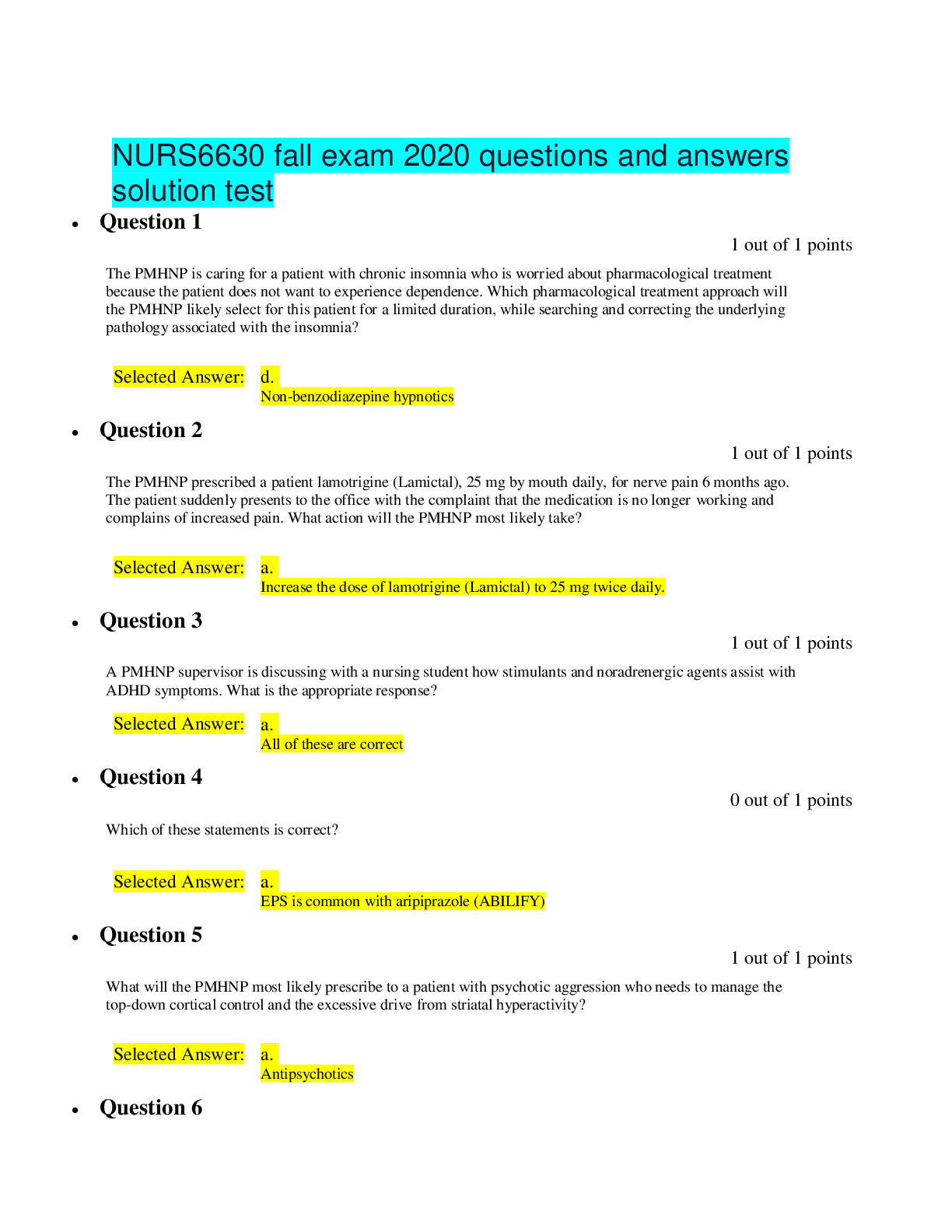
The PMHNP is caring for a patient with chronic insomnia who is worried about pharmacological treatment because the patient does not want to experience dependence. Which pharmacological treatment approach will the PMHNP likely select for this patient for a limited duration, while searching and correcting the underlying pathology associated with the insomnia?
• Question 2
1 out of 1 points
The PMHNP prescribed a patient lamotrigine (Lamictal), 25 mg by mouth daily, for nerve pain 6 months ago. The patient suddenly presents to the office with the complaint that the medication is no longer working and complains of increased pain. What action will the PMHNP most likely take?
• Question 3
1 out of 1 points
A PMHNP supervisor is discussing with a nursing student how stimulants and noradrenergic agents assist with ADHD symptoms. What is the appropriate response?
• Question 4
0 out of 1 points
Which of these statements is correct?
• Question 5
1 out of 1 points
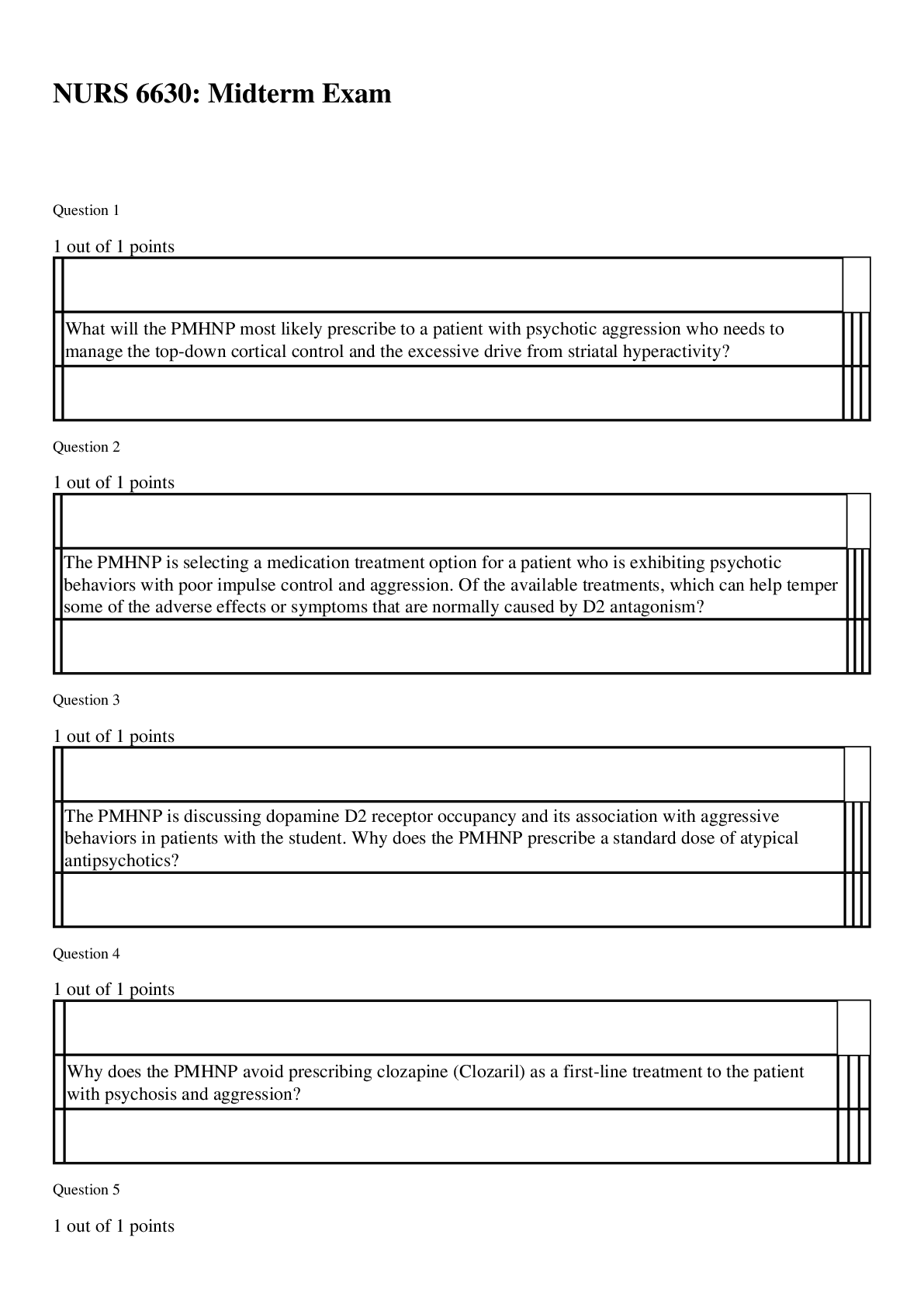
What will the PMHNP most likely prescribe to a patient with psychotic aggression who needs to manage the top-down cortical control and the excessive drive from striatal hyperactivity?
• Question 6
1 out of 1 points
The PMHNP prescribes an obese patient phentermine (Adipex-p)/topiramate ER (Topamax) (Qsymia), Why is topiramate (Topamax) often prescribed with phentermine (Adipex-P)?
• Question 7
0 out of 1 points
A patient with a new diagnosis of diabetic peripheral neuropathy is switched from sertraline (ZOLOFT) to duloxetine (CYMBALTA). The patient asks why they are switching treatment. What is the best response?
• Question 8
1 out of 1 points
All drugs that lead to addiction increase __________________in the ventral striatum, which is also called the _______________.
• Question 9
1 out of 1 points
The PMHNP is performing a quality assurance peer review of the chart of another PMHNP. Upon review, the PMHNP reviews the chart of an older adult patient in long-term care facility who has chronic insomnia. The chart indicates that the patient has been receiving hypnotics on a nightly basis. What does the PMHNP find problematic about this documentation?
• Question 10
0 out of 1 points
The novel neurotransmitter adenosine is responsible for the sleep-wake cycle by increasing throughout the day and diminishing during night. Which of the follow is an antagonist of adenosine?
• Question 11
1 out of 1 points
You decide to start a patient on lurasidone (LATUDA). Which of these counseling points is correct?
• Question 12
1 out of 1 points
A young patient is prescribed Vyvanse. During the follow-up appointment, which comment made by the patient makes the PMHNP think that the dosing is being done incorrectly?
• Question 13
1 out of 1 points
Why does the PMHNP avoid prescribing clozapine (Clozaril) as a first-line treatment to the patient with psychosis and aggression?
• Question 14
1 out of 1 points
The PMHNP is assessing a female patient who has been taking lamotrigine (Lamictal) for migraine prophylaxis. After discovering that the patient has reached the maximum dose of this medication, the PMHNP decides to change the patient’s medication to zonisamide (Zonegran). In addition to evaluating this patient’s day-to-day activities, what should the PMHNP ensure that this patient understands?
• Question 15
0 out of 1 points
The PMHNP evaluates a patient presenting with symptoms of dementia. Before the PMHNP considers treatment options, the patient must be assessed for other possible causes of dementia. Which of the following answers addresses both possible other causes of dementia and a rational treatment option for Dementia?
• Question 16
1 out of 1 points
An adult patient presents with a history of alcohol addiction and attention deficit hyperactivity disorder (ADHD). Given these comorbidities, the PMHNP determines which of the following medications may be the best treatment option?
• Question 17
1 out of 1 points
Mr. Peterson is meeting with the PMHNP to discuss healthier dietary habits. With a BMI of 33, Mr. Peterson is obese and needs to modify his food intake. “Sometimes I think I’m addicted to food the way some people are addicted to drugs,” he says. Which statement best describes the neurobiological parallels between food and drug addiction?
• Question 18
1 out of 1 points
The PMHNP is consulted to evaluate a patient in a long-term care facility that is having difficulties participating in group therapy each morning after breakfast. What is the likely cause of excessive daytime sleepiness?
• Question 19
1 out of 1 points
Which of the following is a true statement regarding the use of stimulants to treat attention deficit hyperactivity disorder (ADHD)?
• Question 20
1 out of 1 points
A patient with irritable bowel syndrome reports chronic stomach pain. The PMHNP wants to prescribe the patient an agent that will cause irrelevant nociceptive inputs from the pain to be ignored and no longer perceived as painful. Which drug will the PMHNP prescribe?
• Question 21
1 out of 1 points
A patient addicted to heroin is receiving treatment for detoxification. He begins to experience tachycardia, tremors, and diaphoresis. What medication will the PMHNP prescribe for this patient?
• Question 22
1 out of 1 points
The PMHNP is caring for a patient with fibromyalgia. Which second-line treatment does the PMHNP select that may be effective for managing this patient’s pain?
• Question 23
0 out of 1 points
Which of the following substances has the highest probability of becoming dependent after a single use?
• Question 24
1 out of 1 points
A 75-year-old male patient diagnosed with Alzheimer’s disease presents with agitation and aggressive behavior. The PMHNP determines which of the following to be the best treatment option?
• Question 25
1 out of 1 points
The PMHNP is caring for a patient on risperidone (Risperdal). Which action made by the PMHNP exhibits proper care for this patient?
• Question 26
1 out of 1 points
A patient you have been evaluating was admitted to the hospital with some abnormal lab work. Hematology/oncology was consulted and diagnoses the patient with aplastic anemia and agranulocytosis. Which medication was likely the culprit?
• Question 27
0 out of 1 points
Heather is admitted for opioid withdrawals and detoxification. The PMHNP decides to prescribe an alpha-2 adrenergic agonist to reduce the symptoms of autonomic hyperactivity during withdrawal and aid in the detoxification process. Which medication did the PMHNP prescribe?
• Question 28
1 out of 1 points
A patient on chronic opioids is currently on oxycodone ER (OxyContin). The PMHNP is consulted to treat underlying depression. Under which circumstance should the PMHNP order naloxone (NARCAN)?
• Question 29
1 out of 1 points
Which medication is an irreversible inhibitor of aldehyde dehydrogenase that creates a negative and aversive response following ingestion of alcohol?
• Question 30
1 out of 1 points
A 72-year-old male patient is in the early stages of Alzheimer’s disease. The PMHNP determines that improving memory is a key consideration in selecting a medication. Which of the following would be an appropriate choice?
• Question 31
1 out of 1 points
The PMHNP is assessing a patient who will be receiving phentermine (Adipex-P)/topiramate (Topamax) (Qsymia). Which of the following conditions/diseases will require further evaluation before this medication can be prescribed?
• Question 33
0 out of 1 points
Methylphenidate, amphetamine, and cocaine are alike because all three _____________________.
• Question 34
1 out of 1 points
Antihistamines may cause side effects such as blurred vision, constipation, memory problems, and dry mouth. This is due to the _______________ effects of antihistamines.
• Question 35
1 out of 1 points
A patient is being prescribed bupropion and is concerned about the side effects. What will the PMHNP tell the patient regarding bupropion?
• Question 36
1 out of 1 points
An 18-year-old female with a history of frequent headaches and a mood disorder is prescribed topiramate (Topamax), 25 mg by mouth daily. The PMHNP understands that this medication is effective in treating which condition(s) in this patient?
• Question 37
1 out of 1 points
The PMHNP is attempting to treat a patient’s chronic pain by having the agent bind the open channel conformation of VSCCs to block those channels with a “use-dependent” form of inhibition. Which agent will the PMHNP most likely select?
• Question 38
0 out of 1 points
The PMHNP is caring for a patient with chronic insomnia. The PMHNP wishes to prescribe a drug with an ultra-short half-life. Which drug will the PMHNP prescribe?
• Question 39
1 out of 1 points
Daniel is a 33 year old patient with ADHD and multiple comorbidities: mood disorder, alcohol abuse, ADHD, and nicotine dependence. Which comorbidity should be treated first?
• Question 40
1 out of 1 points
The PMHNP is attempting to treat a patient’s chronic insomnia and wishes to start with an initial prescription that has a half-life of approximately 1–2 hours. What is the most appropriate prescription for the PMHNP to make?
• Question 41
0 out of 1 points
A 63-year-old patient presents with the following symptoms. The PMHNP determines which set of symptoms warrant prescribing a medication? Select the answer that is matched with an appropriate treatment.
• Question 42
0 out of 1 points
The PMHNP is assessing a patient who presents with elevated levels of brain amyloid as noted by positron emission tomography (PET). What other factors will the PMHNP consider before prescribing medication for this patient, and what medication would the PMHNP want to avoid given these other factors?
• Question 43
0 out of 1 points
A 71-year-old male patient comes to an appointment with his 65-year-old wife. They are both having concerns related to her memory and ability to recognize faces. The PMNHP is considering prescribing memantine (Namenda) based on the following symptoms:
• Question 44
0 out of 1 points
Jerry presents to the clinic for his four-week follow-up after starting trazodone for insomnia. How does trazodone help with insomnia?
• Question 45
1 out of 1 points
Jacob is a 7-year-old pediatric patient who has significant oppositional symptoms associated with his ADHD diagnosis. What is the best treatment for this patient?
• Question 46
1 out of 1 points
Mike wants to quit smoking. He has tried nicotine replacement and varenicline without success. He has asked for another medication to help him kick his habit. The PMHNP decides to try a medication that increases dopamine by prescribing a medications that can increase both norepinephrine and dopamine. Which medication did the PMHNP prescribe?
• Question 47
0 out of 1 points
The PMHNP is evaluating a 30-year-old female patient who states that she notices pain and a drastic change in mood before the start of her menstrual cycle. The patient states that she has tried diet and lifestyle changes but nothing has worked. What will the PMHNP most likely do?
• Question 48
1 out of 1 points
You have been consulted to evaluate a patient who presents with symptoms of dementia. The patient is experiencing memory deficit, aphasia, apraxia, and agnosia. Which treatment option is best for this patient?
• Question 49
0 out of 1 points
The PMHNP is evaluating a 7 year old pediatric patient for the treatment of ADHD. The PMHNP decides to prescribe a medication that is selective for alpha-2A receptors that has a lower incidence of sedation and hypotension. Which agent did the PMHNP prescribe?
• Question 50
0 out of 1 points
Which of the following is considered as a disruptive/impulse control behavior?
• Question 51
0 out of 1 points
Insomnia is caused by excessive nighttime arousal. The PMHNP is likely to prescribe which of the following to treat insomnia?
• Question 52
0 out of 1 points
The PMHNP understands that varenicline (CHANTIX) is an effective way to assist patients with smoking cessation. Why is this medication effective for these patients?
• Question 53
1 out of 1 points
Which of the following anticonvulsants increases serotonergic neurotransmission and GABAergic transmission, while decreasing glutamatergic neurotransmission?
• Question 54
1 out of 1 points
The PMHNP prescribes pregabalin (LYRICA) for a patient with chronic pain. How does pregabalin work to reduce pain?
• Question 55
1 out of 1 points
The parents of a 7-year-old patient with ADHD are concerned about the effects of stimulants on their child. The parents prefer to start pharmacological treatment with a non-stimulant. Which medication will the PMHNP will most likely prescribe?
• Question 56
0 out of 1 points
Sandra complains of constipation after being on quetiapine (SEROQUEL) for several weeks. Constipation is likely caused by the binding of quetiapine (SEROQUEL) to which receptor?
• Question 57
0 out of 1 points
The PMHNP is working with the student to care for a patient with diabetic peripheral neuropathic pain. The student asks the PMHNP why SSRIs are not consistently useful in treating this particular patient’s pain. What is the best response by the PMHNP?
• Question 58
1 out of 1 points
A patient recovering from shingles presents with tenderness and sensitivity to the upper back. He states it is bothersome to put a shirt on most days. This patient has end stage renal disease (ESRD) and is scheduled to have hemodialysis tomorrow but states that he does not know how he can lie in a recliner for 3 hours feeling this uncomfortable. What will be the PMHNP’s priority?
• Question 59
0 out of 1 points
Molly is a 52-year-old female that has a diagnosis of fibromyalgia. She complains of fatigue and cognitive difficulties. Which medication is the PMHNP most likely to prescribe?
• Question 60
0 out of 1 points
A patient diagnosed with obsessive compulsive disorder has been taking a high-dose SSRI and is participating in therapy twice a week. He reports an inability to carry out responsibilities due to consistent interferences of his obsessions and compulsions. The PMHNP knows that the next step would be which of the following?
• Question 61
1 out of 1 points
The PMHNP is assessing a patient she has been treating with the diagnosis of chronic pain. During the assessment, the patient states that he has recently been having trouble getting to sleep and staying asleep. Based on this information, what action is the PMHNP most likely to take?
• Question 62
0 out of 1 points
A patient calls the clinic to ask about an over-the-counter sleep aid. What is the best response?
• Question 63
1 out of 1 points
The PMHNP is caring for a patient who experiences too much overstimulation and anxiety during daytime hours. The patient agrees to a pharmacological treatment but states, “I don’t want to feel sedated or drowsy from the medicine.” Which decision made by the PMHNP demonstrates proper knowledge of this patient’s symptoms and appropriate treatment options?
• Question 64
1 out of 1 points
Antipsychotics are doses at a level that blocks ________% of D2 receptors.
• Question 65
1 out of 1 points
The PMHNP is teaching a patient with a sleep disorder about taking diphenhydramine (Benadryl). The patient is concerned about the side effects of the drug. What can the PMHNP teach the patient about this treatment approach?
• Question 66
1 out of 1 points
Which patient will receive a lower dose of guanfacine?
• Question 67
1 out of 1 points
The PMHNP wants to prescribe Mr. Barber a mood stabilizer that will target aggressive and impulsive symptoms by decreasing dopaminergic neurotransmission. Which mood stabilizer will the PMHNP select?
• Question 68
1 out of 1 points
The PMHNP understands that slow-dose extended release stimulants are most appropriate for which patient with ADHD?
• Question 69
0 out of 1 points
Which statement best describes a pharmacological approach to treating patients for impulsive aggression?
• Question 70
1 out of 1 points
A patient is prescribed D-methylphenidate, 10-mg extended-release capsules. What should the PMHNP include when discussing the side effects with the patient?
• Question 71
1 out of 1 points
An elderly woman with a history of Alzheimer’s disease, coronary artery disease, and myocardial infarction had a fall at home 3 months ago that resulted in her receiving an open reduction internal fixation. While assessing this patient, the PMHNP is made aware that the patient continues to experience mild to moderate pain. What is the PMHNP most likely to do?
• Question 72
0 out of 1 points
Naltrexone (Revia), an opioid antagonist, is a medication that is used for which of the following conditions?
• Question 73
0 out of 1 points
The parents of a 10 year old girl diagnosed with ADHD ask if the PMHNP can prescribe something to help their daughter’s ADHD that is not a stimulant. Which of the following responses is correct?
• Question 74
0 out of 1 points
A patient with hypersexual disorder is being assessed for possible pharmacologic treatment. Why does the PMHNP prescribe an antiandrogen for this patient?
• Question 75
1 out of 1 points
Karen completes the Epworth sleepiness scale and scores abnormally high. She is diagnosed with narcolepsy. The PMHNP prescribes a wake-promoting agent that is a weak dopamine transporter antagonist. Which medication did the PMHNP prescribe?
• Question 76
0 out of 1 points
The PMHNP is teaching parents about their child’s new prescription for Ritalin. What will the PMHNP include in the teaching?
[Show More]






.png)
.png)




 answers.png)


